
Shipping Software Ranked 2026: AfterShip vs The Rest


Choosing Shipping Software in 2026: It's More Than Just a Label
Your team is spending more time copying and pasting tracking numbers than talking to customers. You know you need shipping software, but they all look the same. Here's the truth: they aren't. Choosing the right one starts with a question most brands fail to ask: Are you just trying to print labels faster, or are you trying to build a better business?
Most operators evaluate these tools like a commodity. They line up the carrier discounts, the monthly fee, and the label speed, then pick whatever scores best on a spreadsheet. The label is the cheapest part of the decision. What happens after you print it is where the cost piles up or the growth comes from.
Think about where the hours actually go. It isn't the printing. It's the tab-switching between Shopify and carrier sites, the manual copy-paste of tracking numbers, and the WISMO tickets ("where is my order?") that flood your inbox the moment a package ships. If the mechanics are still new to your team, our guide on how to create shipping labels online covers the basics.
A faster label printer fixes the first ten minutes of that problem. It does nothing for the rest.
And you're not just picking a tool for today. You're making a call you'll defend to your manager and live with for at least a year. The real fear isn't choosing something that doesn't work. It's choosing something you outgrow the moment your order volume climbs.
That is the lens for this entire guide: are you buying a tool, or a platform? Hold that question while we break the market into the categories that actually matter.
The Key Framework: Are You Buying a Shipping Tool or a Post-Purchase Platform?
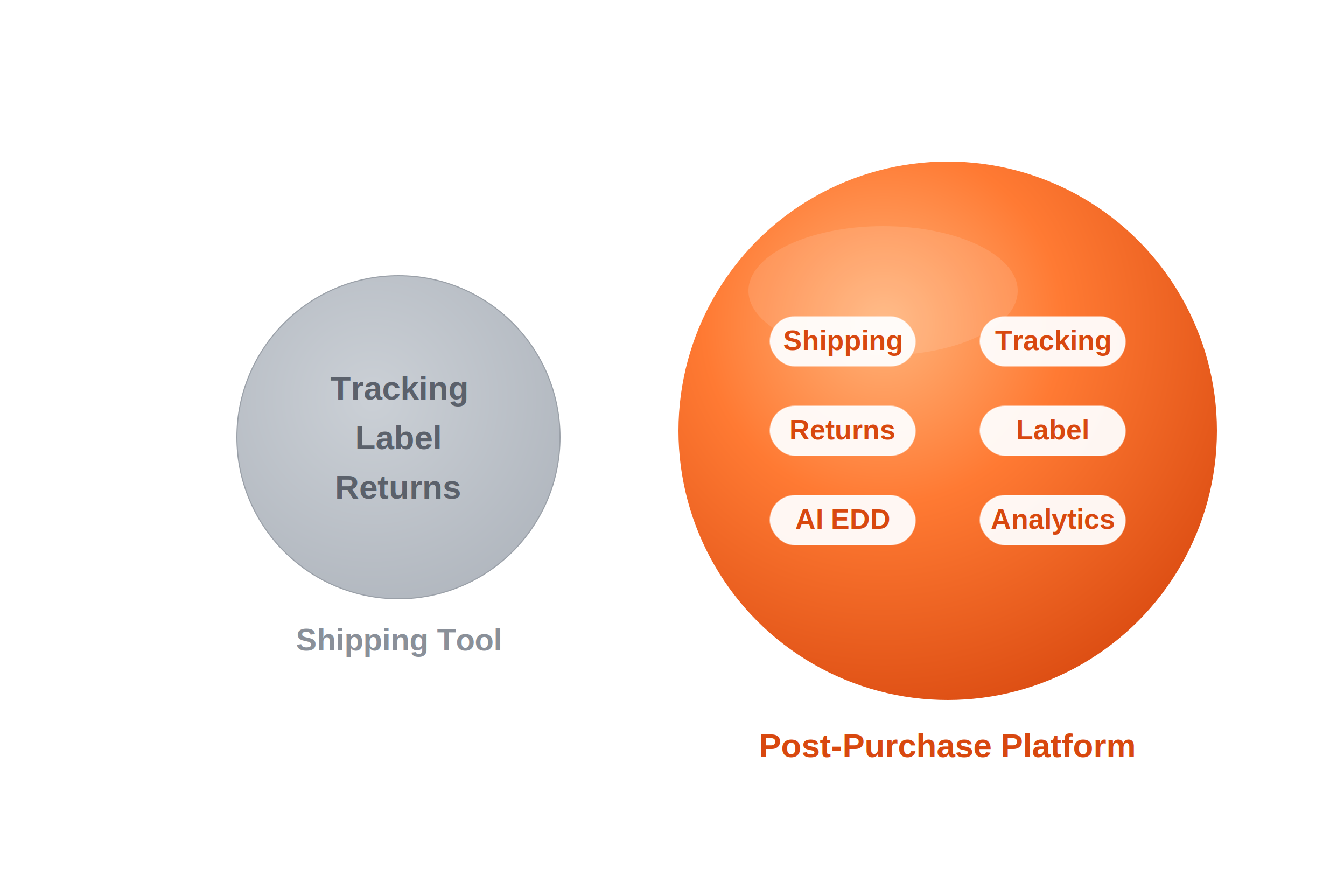
The five names you keep seeing aren't really five competitors. They fall into three groups. There are the pure-play label printers built to generate labels at volume (ShipStation, Shippo, and Starshipit), the cross-border specialist built for international duties and landed cost (Easyship), and the integrated post-purchase platform that treats the label as one step in a longer journey (AfterShip).
Here's the part most comparison articles get wrong. All five give you some branded tracking and some kind of returns portal. The honest difference isn't presence, it's depth. The question is whether post-purchase is a bolt-on or the foundation.
A shipping tool starts with a label engine and attaches post-purchase features around the edges. Tracking and returns exist, but they're add-ons stitched to a printing workflow. Each one is a separate surface, often a separate login, sometimes a separate vendor. That arrangement holds up until something breaks. The day a tracking gap and a return collide, you learn fast that the two systems were never really talking to each other.
AfterShip runs the other direction. It's a post-purchase platform that happens to include a shipping engine, so the label is generated inside the same system that already runs your tracking and returns.
That depth shows up in concrete capabilities. AfterShip Returns handles exchanges, store credit, fraud controls, and 3PL RMA creation rather than just printing a return label. AfterShip's AI EDD predicts delivery dates, getting its first prediction right roughly 90% of the time and covering more than 80% of typical shipments. Add Warranty, native connections to Klaviyo (16 flow triggers on Premium, 18 on Enterprise), Gorgias, and Attentive, plus cross-product analytics. All of it sits on one data layer, behind one login, with a 25% first-year discount when you run two or more products together.
One data layer is the quiet advantage. A delivery delay, a return, and a repeat order all read from the same customer record, so your team stops maintaining integrations between four point tools that each know only part of the story.
Picture one customer at 3,000 orders a month. Her package runs two days late, she requests a return, then reorders a different size. On a stitched-together stack, three tools treat that as three unrelated events. On one platform, it reads as a single customer story your team can act on without exporting a CSV.
So the real question isn't which shipping software prints labels fastest. It's whether you're buying a faster printer or the system that turns one purchase into the next.
The Best Shipping Software of 2026, Ranked and Reviewed
Five tools dominate the shortlist for growing DTC brands: AfterShip Shipping, ShipStation, Shippo, Easyship, and Starshipit. They don't compete on the same axis, which is exactly why a flat feature list misleads. We ranked them against the five criteria that actually move the needle for an operations team scaling past manual fulfillment:
- Pricing and scalability: how cost behaves as your order volume climbs.
- Carrier network and discounts: label-generation coverage and the negotiated rates that run below carrier retail pricing.
- Automation: rate shopping, batch printing, and the rules that cut manual steps.
- Post-purchase experience: how deep tracking, returns, and retention go beyond the label.
- Ease of use: how fast your team actually gets running.
One tool leads on each criterion. Only one is built to win across all five at once. Here's how they stack up.
1. AfterShip Shipping: Best for Integrated Post-Purchase Experience
AfterShip Shipping earns the top spot not by winning the standalone label race, but by refusing to treat the label as the finish line. The moment you generate a label, that shipment already lives inside the same system that runs your branded tracking, your returns, and your delivery estimates. Nothing has to sync between vendors.
Inside AfterShip's multi-carrier shipping software, you compare live rates across carriers on one screen and print in batches. That part is table stakes, and every tool on this list does it. The difference is what AfterShip does with the shipment after it exists.
On post-purchase depth, the gap is real. AfterShip Returns handles exchanges, store credit, fraud controls, automation rules, and 3PL RMA creation, drawing on a 68-carrier returns pool, 9,000 Happy Returns Return Bars across the US, and more than 310,000 global drop-off points. AfterShip's AI EDD predicts delivery dates, landing its first prediction right roughly 90% of the time and covering more than 80% of typical shipments. It connects natively to Shopify, Shopify Plus, BigCommerce, Wix, WooCommerce, Magento, and Salesforce Commerce Cloud.
It's also the only tool of the five with no per-shipment fee for bringing your own carrier account on published tiers.
Now the honest part. As a standalone shipping app, AfterShip Shipping rates 3.9/5 across 83 Shopify App Store reviews. That's parity with ShipStation's 3.9/5 from roughly 560 Shopify reviews, not a runaway lead. If a label printer is all you want, the score says you have several equally good options.
The platform is where the rating story changes. AfterShip Tracking holds 4.5/5 across 1,200+ Shopify reviews and AfterShip Returns 4.7/5 across 1,260+, both carrying Built for Shopify status. You aren't buying the label app in isolation. You're buying the stack it plugs into.
Aetrex offers a useful benchmark for the platform a Shipping customer plugs into. Running AfterShip Tracking and Returns together (not Shipping), the orthopedic-footwear brand consolidated its post-purchase stack and reported an 86% reduction in return processing time, a 50% reduction in operational cost, a 74% reduction in WISMO tickets, a 141-point NPS increase, and 120,000+ packages handled a year. It's a platform-consolidation outcome, not a standalone-Shipping result.
Aetrex
“We've been happy with AfterShip Tracking; there's no downtime or issues. When evaluating a returns management solution, going with AfterShip Returns made sense. We can simplify our tech stack and leverage the data together.”
Rui Kojima, Senior Director of eCommerce
Read their story →Pros
- Native Tracking, Returns, and AI EDD on one data layer, which cuts WISMO tickets and supports repeat purchase
- Returns depth competitors treat as an add-on: exchanges, store credit, fraud controls, 3PL RMA, and a 68-carrier returns pool
- 130+ carriers for label generation (87 internationally connected), with no per-shipment BYO carrier fee on published tiers
- Bundle economics: a 25% first-year discount across two or more products, plus shared seats
Cons
- The standalone Shipping app (3.9/5) does not lead the pure label-printing category
- Not the cheapest option below roughly 100 orders a month, where a pay-as-you-go printer wins on price
- Value compounds at scale; the cost-competitive sweet spot starts around 2,000 orders a month (see AfterShip Shipping's pricing plans for current tiers)
Best for: Growth-focused DTC brands on Shopify or BigCommerce, roughly 500 to 10,000 orders a month, that see shipping as one piece of a larger post-purchase problem and would rather run one platform than maintain four.
2. ShipStation: Best for High-Volume, Marketplace-Heavy Sellers
ShipStation is the long-established name in pure-play label printing, and its strongest card is channel coverage. If you sell across Amazon, eBay, Etsy, Walmart, Wayfair, and dozens of smaller marketplaces, ShipStation likely connects to all of them out of the box. For a seller whose complexity lives in the number of storefronts, that connector library is a genuine advantage, and we'll give it full credit.
Reviewers back the workflow. ShipStation holds 4.6/5 across 957 Capterra reviews, alongside 3.9/5 from roughly 560 Shopify reviews. It is a dependable, batch-oriented label engine refined over many years.
Where it thins out is everything after the label. Tracking and returns exist, but as a shallow bolt-on rather than a retention system, so many ShipStation users add a separate tool like AfterShip Tracking to close the post-purchase loop. That isn't a missing feature. It's a depth gap.
Pros
- Widest set of marketplace and channel integrations of the five (Amazon, eBay, Etsy, Walmart, Wayfair, and more)
- Refined, high-volume batch label workflow
- Strong third-party validation: 4.6/5 across 957 Capterra reviews
Cons
- Post-purchase tracking and returns are a shallow bolt-on, often requiring a second tool
- Standalone shipping experience rates 3.9/5 on Shopify, on par with AfterShip Shipping
- Less suited to brands whose growth problem is retention rather than channel count
Best for: High-volume sellers on Amazon and other marketplaces who need dependable label printing across many channels and handle post-purchase elsewhere.
3. Shippo: Best for Pay-As-You-Go Flexibility
Shippo is the agile, API-first answer to ShipStation. There's a free tier plus pay-as-you-go pricing at $0.05 per label when you bring your own carrier account, with access to 40+ carriers. For a pre-launch brand or one shipping under roughly 100 orders a month, that low commitment is hard to beat.
Honest verdict: at low volume, Shippo is genuinely cheaper than a platform, and we won't pretend otherwise. The trade-offs surface as you scale. Advanced automation and support depth lag the heavier tools, and post-purchase is a basic tracking-and-returns bolt-on rather than a retention layer. On Capterra, Shippo holds 4.8/5 across 800+ reviews.
Pros
- Lowest barrier to entry: free tier plus $0.05/label pay-as-you-go
- API-first and flexible for developer-led teams
- 40+ carriers for label generation
Cons
- Advanced automation and support thin out as volume grows
- Post-purchase is a shallow bolt-on, not a retention system
- Less suited to brands that have already outgrown manual fulfillment
Best for: Pre-launch brands and stores shipping under roughly 100 orders a month that want flexibility with no subscription.
4. Easyship: Best for International & DDP Shipping
Easyship is the cross-border specialist, and its strength is real. With 550+ carriers, it has the deepest international network of the five, paired with duties and landed-cost (DDP) calculation that genuinely simplifies cross-border selling. A free tier covers your first 50 shipments a month.
A note on our relationship here: AfterShip integrates Easyship as a shipping partner behind AfterShip Shipping for international labels, so this isn't a rivalry. When cross-border rate optimization and accurate landed cost are the primary problem you're solving, Easyship is the right answer, and we'll say so plainly.
Its domestic feature set is less of a differentiator than its international depth, and like the other shipping tools, its post-purchase experience is a bolt-on rather than a platform. On Capterra, Easyship holds 4.3/5 across 240+ reviews.
Pros
- 550+ carriers, the strongest international coverage of the five
- Duties and landed-cost (DDP) calculation built for cross-border
- Free tier covering the first 50 shipments a month
Cons
- Domestic shipping is less differentiated than its international depth
- Post-purchase tracking and returns remain a bolt-on
- International strength is wasted on a primarily domestic brand
Best for: Brands whose core problem is international and DDP shipping, where carrier choice and landed-cost accuracy outweigh post-purchase depth.
*See also: for a deeper comparison of AfterShip Tracking vs Easyship's tracking layer, read our deeper dive into how it compares to Easyship.*
5. Starshipit: Best for ANZ & UK Retailers with Complex Rules
Starshipit's calling card is its automation engine, the deepest of the five at the rules-engine layer. If your fulfillment runs on intricate conditional logic (carrier by weight, by destination, by product type, with a dozen exceptions), Starshipit handles it well. Its focus is the ANZ and UK markets, with AUD-priced plans that reflect that home base.
The trade-offs are scope. Its carrier network is less broad globally than Easyship's or AfterShip's, and its interface can feel less intuitive on day one. Post-purchase exists as a bolt-on rather than an integrated platform. On Capterra, Starshipit earns 4.5/5, though on a small base of about 32 reviews.
Pros
- Deepest shipping-automation rules engine of the five
- Strong fit for ANZ and UK retailers, with AUD-priced plans
- Handles complex conditional fulfillment logic well
Cons
- Narrower global carrier network than Easyship or AfterShip
- Interface carries a steeper initial learning curve
- Post-purchase remains a bolt-on, not a platform
Best for: ANZ and UK retailers with complex, rule-heavy shipping workflows that value automation depth over global carrier reach.
Step back and the pattern is clear: four of these five solve one slice of the problem well. Only AfterShip is built to carry the entire post-purchase journey on a single platform. The full side-by-side comparison is next.
Head-to-Head Feature Comparison Matrix: 2026
Here's how the five tools compare across the five criteria that matter most to a scaling operations team. The carrier counts are scope-matched to label generation, so you're comparing like with like instead of one tool's marketing number against another's.
| Criteria | AfterShip | ShipStation | Shippo | Easyship | Starshipit |
|---|---|---|---|---|---|
| Pricing & scalability | Free + volume-based tiers (annual billing); cost-competitive ~2,000+ orders/mo; lowest total cost bundled (25% off 2+ products). Not cheapest at low volume. | Free + volume-based pricing per 50 shipments/mo (three paid tiers) | Free + $0.05/label pay-as-you-go; cheapest at low volume | Free up to 50 shipments/mo | AUD-priced volume tiers (100-10,000 shipments/mo); no per-label fee |
| Multi-carrier rate shopping | Yes. Only tool with no per-shipment BYO carrier fee (published tiers) | Yes | Yes | Yes | Yes |
| Carrier network (label generation) | 130+ (87 internationally connected) | Broad major-carrier set | 40+ | 550+ (strongest international) | All major carriers |
| USPS / carrier discounts | Markets "up to 91%" (USPS commercial rates) | Broadly comparable (USPS commercial rates) | Broadly comparable | Broadly comparable | Not a USPS-centric tool (ANZ/UK focus) |
| Integrated post-purchase / returns depth | Deep: exchanges, store credit, fraud, 3PL RMA, 68-carrier returns pool, 9,000 Happy Returns Bars (US), 310,000+ global drop-off | Branded tracking + basic returns (shallow bolt-on) | Branded tracking + basic returns (shallow bolt-on) | Branded tracking + basic returns (shallow bolt-on) | Branded tracking + basic returns (shallow bolt-on) |
The table makes the split visible. Each shipping tool peaks on a single row, while AfterShip is the only column that holds up on post-purchase depth as well as on the label itself.
Read each row as a buying question. The carrier row answers whether a tool can reach your customers; the post-purchase row answers what happens after the box ships. Only one column gives a strong answer to both without adding a second subscription.
Final Verdict: Which Shipping Software Should You Choose?
Start with the honest recommendations, because the best tool depends entirely on the problem you are solving.
Choose Shippo for your first hundred shipments a month, when pay-as-you-go pricing and no subscription matter more than depth. Choose ShipStation if you sell across many marketplaces and need dependable label printing more than a retention layer. Choose Easyship when international and DDP shipping is the core problem and landed-cost accuracy outweighs everything else. Choose Starshipit if you are an ANZ or UK retailer whose fulfillment runs on complex automation rules.
Choose AfterShip when shipping is one part of a larger post-purchase challenge. The winning profile is specific: a growth-focused DTC brand on Shopify or BigCommerce, doing 500 to 10,000 orders a month, that would rather run one platform than maintain integrations between four point tools. AfterShip wins when consolidation matters more than per-label price.
That is the Tool versus Platform decision from the start of this guide, now with a price tag attached. A cheaper label is real savings you can measure this month. A connected post-purchase experience is repeat revenue you measure next quarter. Consolidation is more than a smaller software bill, too. It is the engineering hours your team doesn't spend wiring four tools together, and the customer data that stops scattering across four separate dashboards. The stakes are not small.
An estimated $849.9 billion in merchandise will be returned across US retail in 2025, and 76% of consumers won't buy again after a poor returns experience.
*Sources: NRF + Happy Returns 2025 Retail Returns Landscape; Narvar 2025 State of Post-Purchase.*
If your shipping problem is really a growth problem, AfterShip belongs on the shortlist.
Simplify shipping and order fulfillment across Shopify, TikTok Shop, and your carrier network.
Book a demoFrequently Asked Questions
A few specific questions come up again and again when brands weigh these tools side by side.
What's the real difference between AfterShip and ShipStation?
ShipStation is a label printer with the widest set of marketplace connections, built to generate labels at volume across many channels. AfterShip is a post-purchase platform where the label is one step alongside branded tracking, returns, and delivery estimates on one data layer. Pick ShipStation when your complexity is channel count. Pick AfterShip when it's post-purchase depth and consolidation.
Can I use AfterShip Tracking with ShipStation?
Yes. AfterShip Tracking works independently of where you print your labels, so you can keep ShipStation for fulfillment and layer AfterShip Tracking on top for branded tracking pages and proactive notifications. Many merchants run exactly this setup to close the post-purchase gap that a pure label printer leaves open.
Which shipping software offers the best discounted USPS rates?
In practice, the discounts are broadly comparable. AfterShip markets savings of up to 91%, and Shippo, ShipStation, and Easyship sit in a similar range because they all rest on the same USPS commercial agreements. The USPS rate itself is rarely the deciding factor, so choose on the platform around the label, not the label discount alone.
How many orders a month make AfterShip worth it over a cheaper label printer?
On label cost alone, AfterShip becomes cost-competitive around 2,000 orders a month and up. Below that, a pay-as-you-go printer is cheaper on the label itself. The platform case can justify AfterShip earlier for brands where fewer WISMO tickets and higher repeat-purchase rates outweigh the per-label price.