
Easyship vs Shippo: Here's How Shopify Merchants Should Decide


Easyship vs. Shippo: The 30-Second Verdict for Shopify Merchants
You've narrowed your choice to Easyship and Shippo, two of the biggest names in the Shopify shipping game. They both print labels and get you discounts. So, which one is right? The answer depends on whether you're solving today's shipping problem or building tomorrow's customer experience.
Both apps clear the core job: syncing Shopify orders, buying discounted labels, and moving parcels out the door faster than native Shopify Shipping ever will. The real difference isn't the label. It's where your orders go and how far you intend to grow.
If you're reading this, you've likely already hit the ceiling of native Shopify Shipping: manual label creation, rates that aren't quite competitive, and international orders that turn into a customs guessing game. Both apps fix that. The question is which one fixes it in a way you won't outgrow in six months.
So here is the honest, skimmable verdict for the easyship vs shippo decision:
- Choose Shippo if you're a US-domestic, lower-volume store that wants the simplest possible way to buy and print USPS or UPS labels. It's the cleanest on-ramp out of native Shopify Shipping.
- Choose Easyship if international orders are your real headache. Its specialty is calculating duties and taxes at checkout, backed by a broad courier network built for cross-border shipping.
- Choose neither, on its own, if your goal is to own the entire customer journey. A shipping-only app goes quiet the moment the label prints, and that silence is where WISMO tickets ("where is my order?"), anxious customers, and missed repeat purchases pile up.
That third option is the one most comparison articles ignore, and it reframes the whole question. You're not just picking a label printer. You're deciding how much of the post-purchase experience you want to control.
For a store scaling past a few hundred orders a month, that control isn't a nice-to-have. It's the difference between a support queue that grows with every sale and one that stays flat while revenue climbs.
Head-to-Head: How Easyship & Shippo Stack Up for Shopify
Feature checklists are easy to pad, so this comparison sticks to the four decisions a Shopify merchant doing 50 to 1,000 orders a month actually has to make. How native does the app feel inside Shopify? What does it truly cost once per-label fees and plan tiers are counted? How well does it handle international duties and taxes? And what does your customer experience after they hit "buy"?
The table lays those out side by side, with AfterShip Shipping added as a third reference point so you can see where a platform approach diverges from a single-function shipping app. If Easyship is the option you are weighing most seriously, a more detailed breakdown of its features is worth a look.
| Criteria | Shippo | Easyship | AfterShip Shipping |
|---|---|---|---|
| Shopify integration & ease of use | Simple Shopify app, order sync | Shopify app (more setup, steeper) | "Built for Shopify"; order sync + auto-fill + tracking write-back |
| Pricing & true cost | Free to 30 labels/mo (5¢/label own-carrier); Pro from $17/mo ($19 App Store) | Free $0 (50) / Plus $29 / Premier $69 / Scale $99 | Free 10 labels → Essentials $9/mo ($11 App Store) → Pro $69/mo |
| International / DDP | Global carriers, no native checkout DDP | 550+ couriers; all-in-one duty & tax at checkout (Premier+) | 130+ carriers; international labels |
| Carriers | 40+ | 550+ | 130+ |
| Post-purchase | Branded tracking + AI EDD Pro-gated; return labels, no portal | Basic; tracking redirects to carrier | Branded Tracking (65% fewer WISMO tickets) + self-service Returns portal + AI EDD (80%+ coverage, 90% first-prediction) |
| USPS discount | "Best USPS, UPS, FedEx, DHL Express discounts" | up to 91% off retail | "Best USPS discount"; up to 90% with USPS, no minimum volume |
| Ratings | Shopify 4.2/298, G2 4.2/77 | Shopify 4.0/365, G2 4.4/178 | Tracking 4.5/1,199, Returns 4.7/1,269, G2 4.7/311 (Shipping app 3.9/82) |
Read it one way and each app wins its lane: Shippo on domestic simplicity, Easyship on cross-border logistics. Read it another way and a pattern surfaces. Both tools stop contributing the instant a label is generated, leaving tracking and returns to the carrier and to your support inbox. That gap, not the discount rate, is what should anchor your easyship vs shippo decision.
When to Choose Shippo: The Case for Simplicity
Shippo earns its reputation on one thing: getting you from a Shopify order to a printed label with as little friction as possible. If you run a US-domestic, lower-volume store and mostly want labels bought and printed without a learning curve, this is the app that respects your time. The ideal Shippo user is the founder still packing boxes personally, shipping domestically, and counting the minutes each order takes.
The free plan covers up to 30 labels per month, which is enough to carry a young store through its first real season. Bring your own carrier accounts and Shippo adds 5 cents per label on top; step up to Pro and pricing starts from $17 per month (listed at $19 on the Shopify App Store). Across its 40+ carriers you tap negotiated USPS, UPS, FedEx, and DHL Express discounts, so you are not trading away rates for a clean interface.
Here is where the word "simple" gets unfair to Shippo. It is not a bare carrier link. Shippo does offer branded tracking and AI-based delivery estimates. They simply sit behind the Pro tier rather than the free one. For a store still testing whether shipping software is worth paying for, that gate reads as a fair deal, not a missing feature.
"one of the easiest and most dependable parts of running my business"
Plant Traps, Shopify App Store, June 2 2026 (★★★★★). Read the full review
The honest limits show up at the edges of the journey. There is no native duty and tax (DDP) calculation at checkout, so cross-border orders still lean on manual workarounds. Return labels come with every plan, but there is no self-service returns portal where customers manage their own exchanges or refunds. Shippo is a strong first step out of native Shopify Shipping. It is built to print labels well, not to own everything that happens after the box leaves.
When to Choose Easyship: The International Specialist
If your shipping headache has a passport, Easyship is built for you. Its entire identity centers on cross-border complexity, and it handles the part that trips up most Shopify merchants: landed cost. The ideal Easyship user ships internationally often enough that customs, not carrier choice, is the daily friction.
The standout feature is all-in-one duty and tax calculation at checkout, available from the Premier tier and up. International shoppers see and prepay duties before they buy, which cuts the surprise-customs-fee refusals that quietly kill overseas conversion. Behind it sits a 550+ courier network, far wider than a domestic-first tool needs, giving you real routing options into most markets. If a meaningful share of your revenue crosses a border, that single capability can justify the platform on its own.
Pricing scales with ambition rather than punishing it. Easyship starts free, then moves to Plus at $29, Premier at $69, and Scale at $99 per month, so you can layer on duty-and-tax handling and volume as your international orders grow.
"being able to compare courier options, understand international shipping costs"
FULL FEAST LTD, Shopify App Store, June 12 2026 (★★★★★). Read the full review
The trade-off is everything that happens after dispatch. Easyship's post-purchase experience is a basic add-on rather than a core strength: tracking largely redirects customers to the carrier's own site. The branded moment you built at checkout dissolves the second the parcel ships. For a merchant whose core problem is duties and couriers, that may be an acceptable gap today. For one who wants to own the delivery experience end to end, it is the ceiling you will eventually reach.
The Real Problem: Shipping Apps Don't Solve The Customer Experience Gap
Here is the uncomfortable truth about both Shippo and Easyship: their job is essentially finished the moment a label prints. The parcel becomes the carrier's problem, and every question about it becomes yours.
That handoff is where the real cost of a shipping-only stack shows up. Your customer, who just gave you money, now refreshes a bare carrier tracking page that carries none of your branding. When the parcel stalls, they don't email the carrier. They email you, and that WISMO ("where is my order?") ticket lands in the same inbox you use to run the business.
Returns follow the same pattern. A shipping app can generate a return label, but it does not hand your customer a self-service portal to start an exchange or choose store credit. So refunds turn into manual back-and-forth, and a moment that could win loyalty instead burns hours.
The stakes are not abstract: Narvar's 2025 research found 73% of shoppers say estimated delivery dates influence their purchase decisions, and 40% won't buy without one. When the post-purchase experience is an afterthought, you are gambling with the exact expectations that drive the sale.
None of this is a knock on printing labels well. It is a reminder that the label is the first mile of a much longer journey, and the part your customer actually remembers happens after it.

The Shopify-Native Platform Approach: Unify Shipping, Tracking, and Returns
The fix is not a better label printer. It is connecting the shipping data you already generate to the two experiences that follow it: tracking and returns.
This is the difference between a point solution and a platform. AfterShip treats the problem as one continuous post-purchase journey rather than three disconnected tools. Shipping generates the movement, AfterShip Tracking turns that movement into a branded tracking page (following parcels across over 1,200 carriers), and AfterShip Returns hands customers an automated self-service portal for exchanges and store credit. Because all three share deep integration with Shopify, your order data flows through the whole journey without extra plumbing.
The payoff is measurable, not vague. Merchants using AfterShip's branded tracking and proactive notifications see up to a 65% reduction in WISMO tickets, because customers get answers on your page before they ever open a support email. AI-powered estimated delivery dates build on that, with coverage on 80%+ of shipments and a 90% first-prediction rate, so the dates a shopper sees are ones you can stand behind.
One clarification matters here. AfterShip Shipping, AfterShip Tracking, and AfterShip Returns are separate products, each with its own plan. The platform value comes from how tightly they connect, not from a single bundle that quietly covers all three.
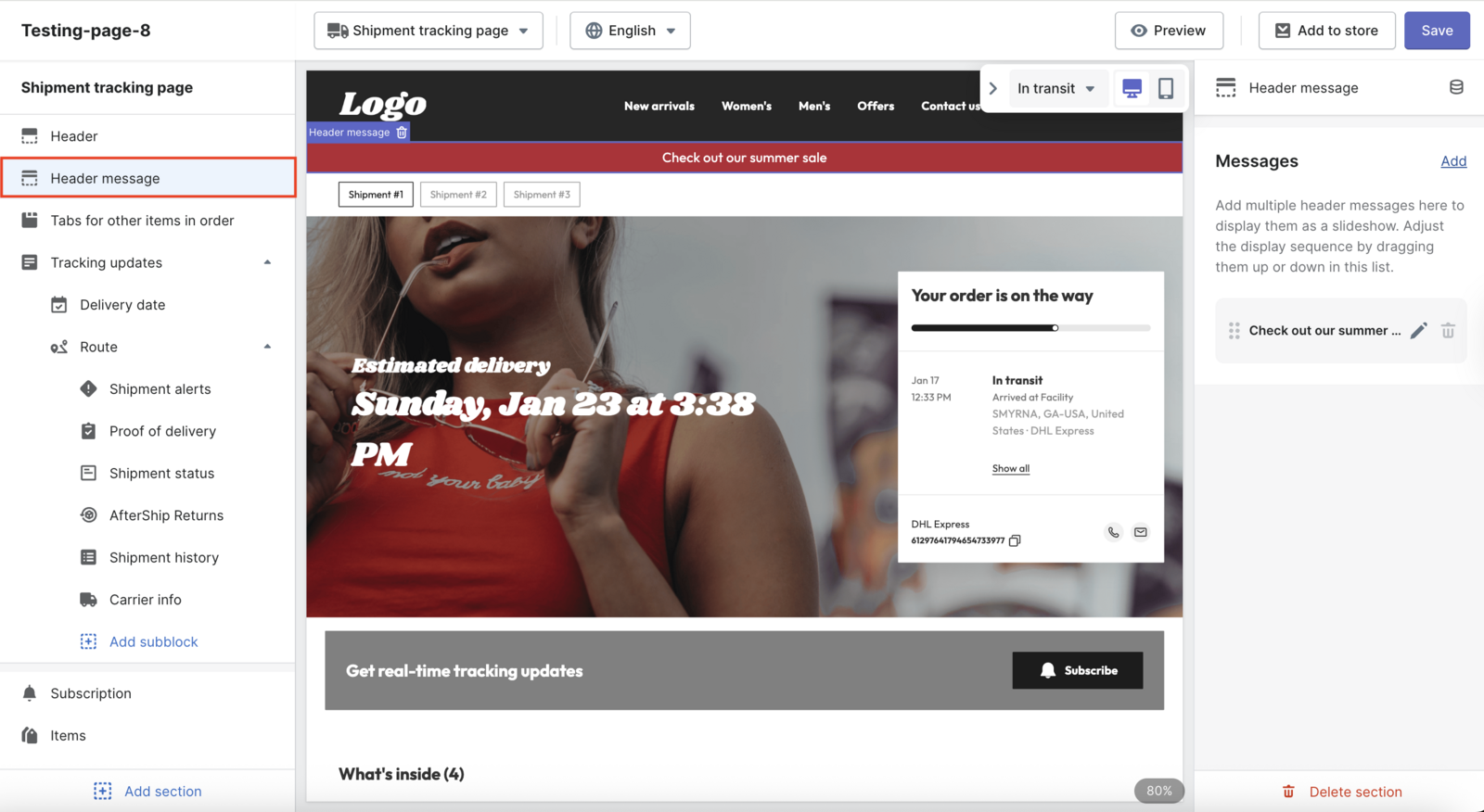
How AfterShip Shipping Delivers More Than Just Labels
Zoom in on the shipping product itself and the "more than labels" claim gets concrete. AfterShip Shipping, a multi-carrier shipping software, is built to strip out the manual work that eats into a growing store's day.
Three differentiators do most of that work:
- A unified multi-carrier bill. Instead of reconciling separate invoices from every carrier you use, you get one consolidated bill across 130+ carriers, which alone saves hours at month-end. It also surfaces the best USPS discount, up to 90% off with no minimum volume.
- IF/THEN automation rules. Set the logic once and let it run: if SKU is X and the destination is Y, use carrier Z. Rules can auto-select the cheapest qualifying option on every order, so cost control stops depending on whoever is packing that day.
- Native integration with AfterShip Tracking. Because Shipping and Tracking share one platform, shipment data flows straight into branded tracking pages and proactive notifications with no extra setup. The branded post-purchase experience is on by default, not a separate project.
That last point is the whole thesis in miniature. With a standalone app, the branded experience is something you bolt on later, if at all. Here it is a byproduct of shipping the order.

The Final Recommendation for 2026
So where does that leave your decision in 2026?
Shippo is for starting. If you ship domestically, at low volume, and want the simplest way off native Shopify Shipping, it does that job cleanly.
And to be honest, AfterShip is not the cheapest on day one: for a store shipping 50 domestic packages a month, Shippo's free plan wins upfront, and we won't pretend otherwise. But you'll outgrow a labels-only app, and AfterShip is built for the next step.
Easyship is for a specific international job. If duties, taxes, and cross-border couriers are your daily friction, its checkout duty-and-tax handling and wide courier network are purpose-built for it.
AfterShip is for scaling. When your real goal is a customer experience that earns repeat purchases, the winning move is not a better label. It is a platform that connects shipping to tracking and returns so the journey stays yours from checkout to doorstep and back again.
The label is the easy part. The experience around it is what customers remember, and what compounds into growth. If that is the direction you are building toward, explore AfterShip Shipping's Shopify integration or book a demo to see the unified stack run against your own order volume.
Frequently Asked Questions
Is Shippo or Easyship better for a Shopify store?
It depends on where you ship. Shippo fits US-domestic, lower-volume stores (free up to 30 labels a month, Pro from $17/mo or $19 on the App Store), while Easyship suits international sellers with duty and tax at checkout (Premier tier up) across 550+ couriers.
How much does Shippo cost on Shopify?
Shippo is free for up to 30 labels a month, plus a 5-cent per-label fee on your own carrier accounts. Its Pro plan starts from $17/mo, listed at $19 on the Shopify App Store.
Does Easyship calculate duties and taxes at checkout?
Yes. Easyship calculates all-in-one duty and tax at checkout from the Premier tier up, letting international shoppers prepay duties before buying, across a 550+ courier network.
What is the best multi-carrier shipping app for Shopify?
There is no single winner: Shippo suits US labels, Easyship international duty and tax. AfterShip Shipping unifies shipping with AfterShip Tracking (65% fewer WISMO tickets) and Returns across a 130+ carrier network.
Can Shippo or Easyship handle returns for a Shopify store?
Both generate return labels, but neither offers a customer self-service returns portal. That portal, with exchanges and store credit, is part of the AfterShip platform through AfterShip Returns.