
Margins Too Tight? Easyship vs Budget Shipping Tools 2026

You've squeezed your ad spend and renegotiated with suppliers, but your profit margins are still shrinking. The culprit is likely shipping. You're searching for the "cheapest" shipping software, but what if that's the wrong question? Let's talk about the most profitable way to ship.
We get it. When you are running fulfillment yourself and watching every dollar, the instinct is to sort the options by monthly fee and pick the lowest one. That is exactly how most founders approach Easyship vs budget shipping tools, and it is exactly where the money quietly leaks out.

Here is how to think about it like a pro. Before you choose a tool, get the math right. A handful of proven strategies for reducing shipping costs will do more for your margins than switching to whatever software charges a few dollars less per month.
Beyond the Monthly Fee: The Real Cost of Shipping for Your Store
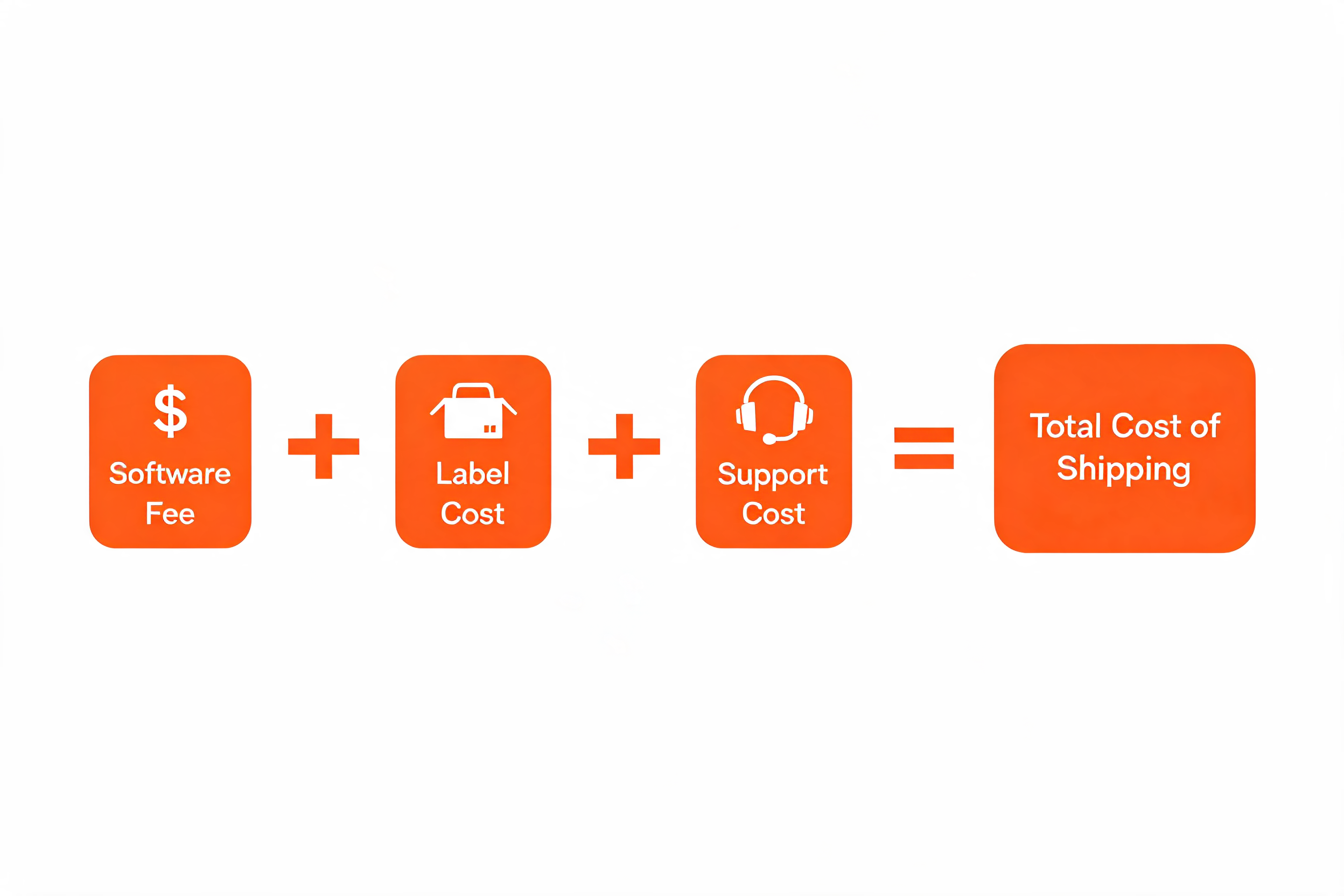
Your shipping bill is not one number. It is three. The monthly software fee is the only one most comparison pages talk about, and for a growing store it is usually the smallest of the three.
Here is what actually makes up your total cost of shipping:
- Software fee: the monthly subscription you pay the platform. It is fixed, predictable, and the figure every pricing page leads with.
- Label cost: what you pay the carrier for each parcel. At 300 orders a month, a small per-label difference compounds into real money fast.
- Support cost: the time and money you spend answering "where is my order?" (WISMO) tickets when your tracking experience is poor.
Put them together and you get the equation that should drive your decision: Total Cost of Shipping = Software Fee + Label Cost + Support Cost. Chasing the lowest software fee while ignoring the other two is the rookie mistake that keeps margins thin.
To make label cost concrete: on a small, heavy parcel, the gap between two carrier rates can run $0.45 to $1.00 per label (illustrative). Multiply that by 300 shipments and the subscription line starts to look like background noise.
The cheapest software is rarely the most profitable way to ship.
So the right question is not "which shipping aggregator for small business has the lowest subscription?" It is "which tool lowers all three numbers at once?" Hold that lens as we compare the popular budget options below.
2026 Head-to-Head: Easyship vs. "Free" Tools (Pirate Ship & Shippo)
Here is how the most common budget options compare for a store shipping around 300 orders a month, on the criteria that actually move your bottom line. Each cell is scoped to that tool's own plan and rating, so you can read easyship vs pirate ship vs shippo on equal footing.
| Criteria | AfterShip Shipping | Easyship | Pirate Ship | Shippo (Free) |
|---|---|---|---|---|
| Monthly software fee (~300 labels/mo) | Essentials $9/mo annual ($11 App Store); Free = 10 labels | Plus $29/mo (free tier to 50/mo) | $0 — no monthly fee | Free to 30 labels/mo, then Pro $17/mo ($19 App Store) |
| Access to discounted rates | 130+ carriers ('100+' on pricing page); 'Best USPS discount' / 'Save up to 90% with USPS, no minimum volume' | 550+ couriers, up to 91% off retail | up to 87% off USPS & UPS; Priority Mail Cubic | 40+ carriers, multi-carrier discounts; USPS Cubic available |
| Ease of finding cheapest label | Rate shopping surfaces cheapest live rate across 100+ carriers; IF/THEN rules | Rate shopping + batch printing | USPS/UPS only (limited scope) | Rate shopping across 40+ (simple UI) |
| Cost to reduce WISMO | Branded Tracking + notifications = 65% WISMO reduction (AfterShip Tracking, billed separately) | Basic; typically redirects to carrier tracking | None/minimal (carrier-direct) | Branded tracking on Pro/Premier only |
| Time to manage | Low (automation rules) | Moderate (steeper learning curve) | Low but limited | Low (simple) |
| Hidden costs | Shipping/Tracking/Returns billed separately | Own-carrier account = Plus+ ($29); DDP at checkout = Premier+ ($69) | None (genuinely free) | 5c/label on own-carrier accounts; 30-label free cap |
| Shopify rating | 3.9/82 | 4.0/364 | 4.9/138 | 4.2/298 |
A quick read of the table: Pirate Ship wins outright on the software fee, because it has none. Easyship and Shippo sit in the middle, and a deeper detailed comparison of EasyShip's features is worth a look if you ship internationally.
But notice what the software-fee column does not tell you. It says nothing about your label cost or your support cost, the two numbers that scale with every order you ship. That is the gap the rest of this guide closes, and it is why the lowest subscription is not the same as the lowest bill.
The Hidden Costs: Where "Free" and "Cheap" Get Expensive
On paper, the budget tools look like an easy win. The catch is that the software fee is the one cost that does not grow with your order volume. The other two costs do, and they are exactly where "free" and "cheap" get expensive. Worse, unlike the subscription, you cannot cap them by staying on a cheaper plan.
Three costs hide behind a low subscription:
- The Support Cost: Poor tracking generates more "where is my order?" (WISMO) tickets. Every ticket is staff time, and when you are the staff, it is your time pulled away from selling.
- The Time Cost: Manually checking rates across carriers, or wrestling with clunky software, burns hours that never appear on an invoice but always appear in your week.
- The Brand Cost: A generic, unbranded tracking experience hands your customer off to the carrier's website at the most anxious moment of the order. You lose the relationship, and often the next sale, right when attention is highest.
Merchants feel this gap, and the ratings reflect it. AfterShip Tracking holds a 4.5 across 1,200 Shopify reviews and a 4.7 across 311 reviews on G2, largely on the strength of fewer WISMO tickets and a tracking page customers actually trust.
TAVCO
“Keeping our customers updated on shipping status has greatly reduced the amount of calls that we receive and help drive up our return customer rate.”
TAVCO
Here is the clearest case of a "cheap" headline hiding a real cost. Easyship gates own-carrier (bring-your-own) accounts behind its Plus+ tier at $29/mo, so the moment you want to plug in your own negotiated carrier rates, the free plan is already behind you. AfterShip Shipping allows bring-your-own-carrier on its entry tier, so the same move does not force an upgrade.
The lowest sticker price is not the lowest bill. Read the plan, not the headline.
How to Actually Lower Your Shipping Costs (Hint: It's Not Just the Software)
If total cost of shipping is three numbers, then the way to reduce e-commerce shipping costs is to pull on more than one of them at once. AfterShip is built to lower two of the three: your label cost and your support cost.
Start with label cost. AfterShip Shipping surfaces the cheapest live rate across 100+ carriers in real time, then lets you set IF/THEN rules so the right rate is applied on every order without you checking by hand. It does not quietly auto-pick a single carrier program for you. It shows you the live options, and the cheapest one wins. Across 300 orders a month, consistently catching the lower rate is where the per-label gap from earlier stops being theoretical and starts compounding in your favor.
You can see the full feature set on the AfterShip Shipping product page.
Now the support cost. AfterShip Tracking turns the post-purchase window into a branded experience: branded tracking pages plus proactive shipment notifications that keep customers updated before they think to ask. With real-time tracking, that reduces WISMO tickets by 65%, which is the support-cost lever working directly against the very ticket load that budget tools quietly create. Fewer tickets is not a vanity metric here. It is the support-cost line in your total falling, order after order.
One thing to be clear about: AfterShip Shipping and AfterShip Tracking are two separate subscriptions. That matters for the math, because the savings come from two products, and so does the cost. We will add up both sides in the next section.
Pull both levers and you lower the total cost of shipping, not just the line item on your software bill.
Let's Do the Math: How AfterShip Pays for Itself
Numbers settle arguments, so let's run them for a store shipping 300 orders a month.
Start with the cost, and be honest about it: this is two subscriptions, not one. On AfterShip's annual pricing, Shipping Essentials runs $9/mo and Tracking Essentials runs $29/mo. Add them up and your real software line is $38/mo. Those are the aftership.com annual figures; the Shopify App Store monthly prices differ, so check the channel you actually buy on.
Now the savings, starting with label cost. Say sharper rate shopping trims an average of $0.50 off each label (illustrative, not a published AfterShip rate). Across 300 shipments, that is roughly $150 a month back in your pocket.
Then support cost, and here we will be conservative on purpose. Assume branded tracking and proactive notifications prevent just 10 "where is my order?" tickets a month. At about $5 to resolve a ticket (Claimlane, 2026), that is another $50 a month. The published headline is higher: AfterShip Tracking reduces WISMO tickets by 65% with real-time tracking, so 10 prevented tickets is a deliberately modest floor, not the ceiling.
Add the two savings and you land near $200 a month against a $38 software line.
The software pays for itself several times over. Over a year, that gap is roughly $2,400 in savings against about $456 in software (illustrative), and that is before counting the hours you stop spending on manual rate checks. Halve every assumption here and the math still clears the $38 line with room to spare.
The Verdict: The Best Budget Shipping Software for 2026
No hedging. The right tool depends on your order volume and where your margins actually leak.
- Under ~50 orders a month, domestic USPS only: Pirate Ship. It is genuinely free, and at that volume your total cost of shipping is dominated by the software line you simply do not pay.
- 100+ orders a month, focused on profitability: AfterShip Shipping. This is where lowering label cost and support cost outweighs a cheap subscription, and where the total-cost math turns decisively in your favor.
- Easyship and Shippo: a more complex middle ground. They can rate-shop, but you take on more setup and gated tiers without the combined total-cost optimization of AfterShip Shipping plus Tracking. Shippo's free plan also caps at 30 labels a month, so any real volume pushes you onto a paid tier.
Let's be direct about the trade-off. If your only goal is to print a free USPS label at low volume, AfterShip is not the cheapest tool on the software fee. Pirate Ship is free, and we will not pretend otherwise. AfterShip is built for the next step: the point where saving on every label (illustrative) and cutting your support ticket load is plainly more profitable than saving a few dollars on a subscription.
When you are ready to compare tiers, AfterShip Shipping's pricing plans lay out exactly what each level includes.
If you are weighing easyship vs budget shipping tools and shipping real volume, the most profitable choice is the one that lowers all three numbers, not just the smallest one.
Frequently Asked Questions
Is Easyship cheaper than Pirate Ship?
On the monthly software fee, Pirate Ship is cheaper: it charges $0 with no subscription, while Easyship's paid plans start at $29/mo (Plus) and its free tier gates own-carrier accounts behind that same Plus tier. Pirate Ship covers USPS and UPS only, whereas Easyship offers 550+ couriers, so which is "cheaper" depends partly on whether you need that breadth. Keep in mind the software fee is only one part of your total cost of shipping; label cost and support cost matter just as much.
How can I reduce my shipping costs?
Think in terms of total cost of shipping: software fee plus label cost plus support cost. You lower label cost by rate shopping across carriers, AfterShip Shipping surfaces the cheapest live rate across 100+ carriers, and even an illustrative $0.50 saved per label adds up across a few hundred orders. You lower support cost by cutting WISMO ("where is my order?") tickets: AfterShip Tracking reduces them by 65% with real-time tracking, and at roughly $5 to resolve a ticket (Claimlane, 2026) that adds up too. Trimming the smallest line, the software fee, rarely moves your bill as much as cutting label and support cost.
Is AfterShip good for small businesses?
For very low volume, under about 50 orders a month printing only domestic USPS labels, AfterShip is not the cheapest option on the software fee; Pirate Ship is free, and that is the honest answer. AfterShip Shipping fits the next step: it starts at $9/mo (Essentials), surfaces the cheapest live rate across 100+ carriers, and lets you connect your own carrier accounts on every tier including the entry tier. Paired with AfterShip Tracking, a separate subscription that cuts WISMO tickets by 65% with real-time tracking, it is built to lower your total cost of shipping once you ship real volume. On the Shopify App Store, AfterShip Shipping is rated 3.9/82 and AfterShip Tracking 4.5/1,200.