
Easyship vs The Field: How the Smartest Small Brands Choose Their Shipping Software in 2026


You've outgrown printing labels on your home office printer. You've heard Easyship is the answer. For many brands, it is. But is it the right answer for where your brand is going? Choosing your first shipping software is about more than just rates; it's one of your first big bets on what kind of business you want to build.
If you're running 50 to 500 orders a month on Shopify or WooCommerce, you've hit the wall where packing slips and manual labels stop scaling. So you start researching, and almost every "easyship vs" search points you at the same shortlist of names. This guide won't just hand you another list of easyship alternatives. It gives you a way to think about the whole category, so the tool you pick still fits the brand you're building two years from now.
Why Easyship Sets the Benchmark for Small Business Shipping
There's a reason Easyship shows up first. Scroll any Shopify Community thread on shipping and the first question is almost always the same: which one is cheapest? For a small brand trying to escape retail shipping rates, it nails the core job: access to a lot of carriers, at prices you could never negotiate alone, with no monthly commitment to get started. If you're still new to the broader category of multi-carrier parcel management solutions, Easyship is a sensible place to anchor your research.
Its value props are easy to like for this stage:
- Access to 550+ courier services, so you can rate-shop almost any route from one dashboard.
- Pre-negotiated discounts of up to 91% off retail rates.
- Taxes and duties calculated at checkout (on the Premier tier and up), which removes a real headache for cross-border orders.
- A genuine free tier covering up to 50 shipments a month, so you can test it before committing a dollar.
Add a 4.0 rating across 364 Shopify reviews, and it's clear why Easyship earns its spot on the shortlist. So it answers one question well: how do I print cheaper labels across more carriers? The smarter question is whether that's the only question you should be asking.
Don't Just Shop for a Tool, Shop for a Category
Here's the reframe that saves brands from buyer's remorse: shipping tools aren't one market. They're three. Each solves a different job, and the trap is buying from the wrong category for where your brand is headed.
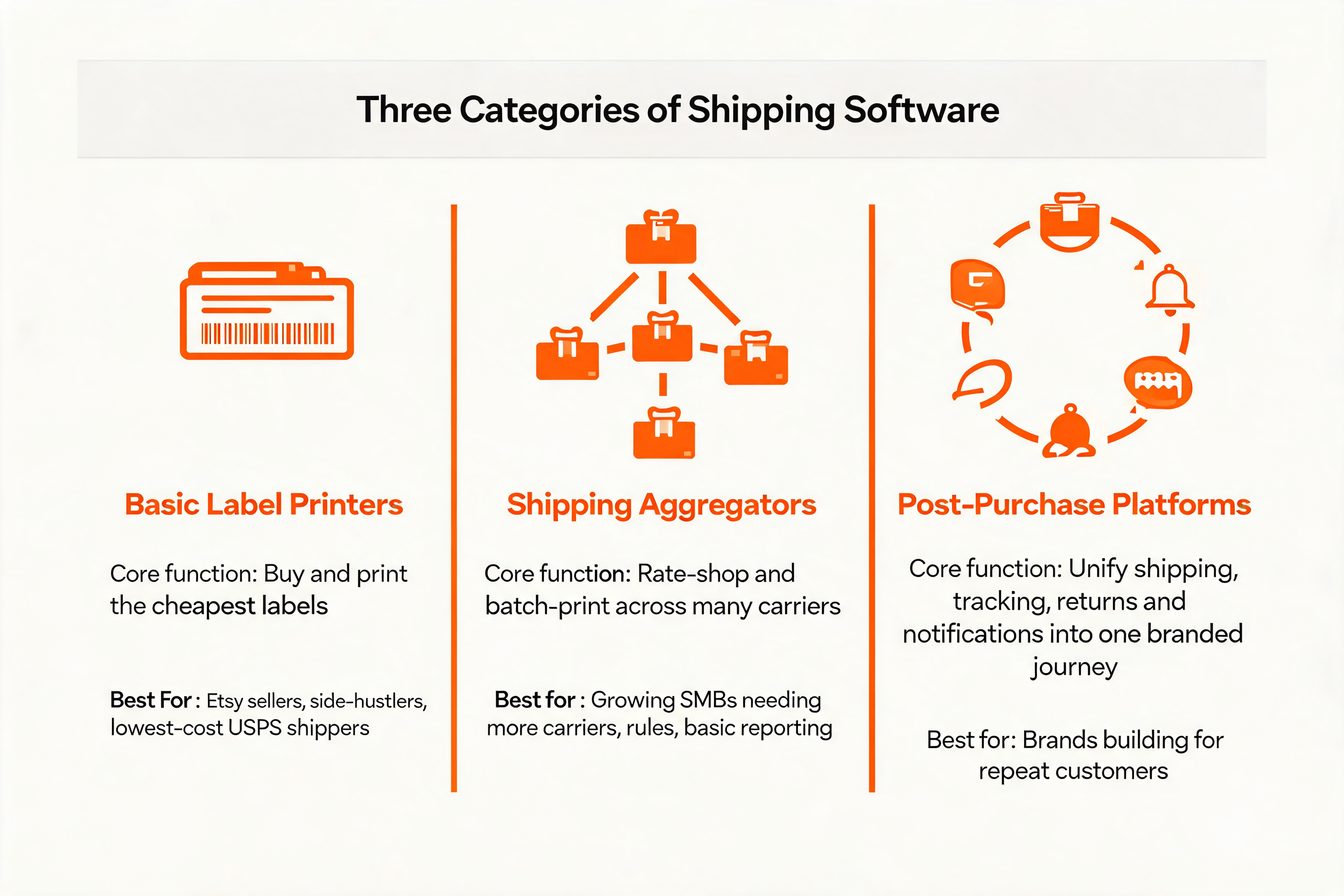
The real first step in how to choose shipping software isn't comparing features. It's figuring out which of three categories you're actually shopping in: basic label printers, shipping aggregators, and post-purchase platforms. The first two are about getting the parcel out the door. The third is about what happens after, which is the part of the journey your customer actually sees.
Place yourself first. Then the feature sheets start to mean something.
Category 1: Basic Label Printers (Example: Pirate Ship)
Who it's for: Etsy sellers, side-hustlers, and brands whose single priority is the lowest possible cost per label. Core function: buy and print cheap labels, nothing more. Pirate Ship is the clearest example. It charges no monthly fees, passes through discounts of up to 87% off USPS and UPS, and supports cost-saving rate classes like Priority Mail Cubic.
The tradeoff is scope. Pirate Ship covers USPS and UPS only, adds no branding, and hands your customer a bare carrier tracking link at best. That's a fair deal for a hobby store, and its 4.9 rating across 138 Shopify reviews shows it does its narrow job well. But there's no path from here to a premium customer experience, because that was never the point.
Category 2: Shipping Aggregators (Examples: Easyship, ShipStation)
This is where most growing brands land, and where Easyship lives. Who it's for: SMBs that have outgrown a single carrier and need rate-shopping, automation rules, and basic reporting. Core function: compare rates across many carriers and batch-print at volume. These are the shipping aggregators for shopify stores that most founders mean when they say they need "real" shipping software.
ShipStation is the other heavyweight here, and it's a capable one. It connects to 200+ carriers, includes unlimited automation rules even on its Standard plan, and offers a Branded Tracking Page on its legacy setup. Easyship counters with its 550+ courier reach and duty calculation at checkout. Neither is a lightweight.
The honest limitation isn't capability. It's where the experience stops. For most aggregators, the job ends the moment the label prints. Branded tracking, where it exists, is often basic or reserved for higher tiers, and the shopper usually gets bounced to the carrier's own page to find out where their order is. That's fine until the day you realize the post-purchase window is your best shot at a second sale.
Category 3: Post-Purchase Platforms (Example: AfterShip)
Who it's for: ambitious DTC brands that have internalized one fact, that keeping a customer costs less than finding a new one. Core function: unify shipping, tracking, returns, and notifications into a single, branded journey instead of four disconnected tools. This is the category AfterShip Shipping sits in.
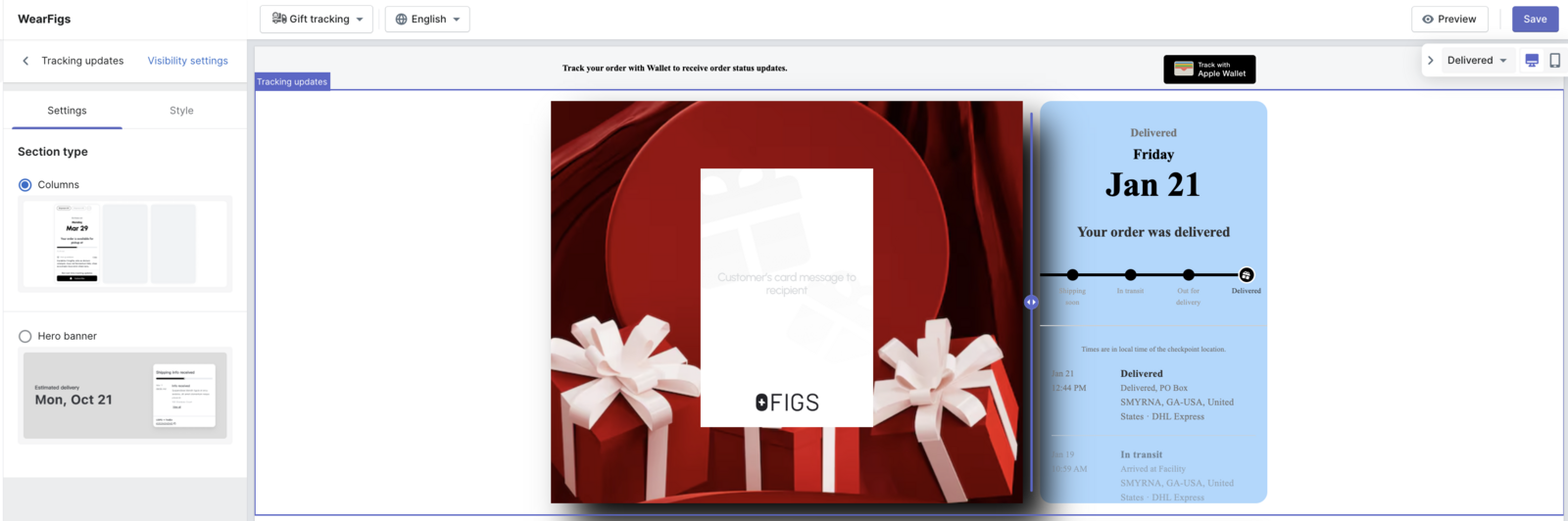
The shift is in what you treat shipping as. An aggregator treats it as a cost to minimize. A post-purchase platform treats it as a marketing channel you already own. With AfterShip, the same shipment that prints a label also powers a branded tracking page, product recommendations on that page, proactive delivery notifications, and a self-serve returns flow, all under your brand instead of the carrier's.
None of this means a 12-order-a-month store needs a platform. It means that if your plan is to build a brand people come back to, the category you shop in matters more than any single line on a feature sheet. We'll put AfterShip Shipping and Easyship side by side shortly, but only after you've placed yourself.
Which Category Fits Your Brand? Answer These 3 Questions.
You've seen the three categories. Now place yourself in one. Three questions do the sorting, and your honest answers point you toward a single category, not all three.
1. What matters more right now: saving 50 cents on a label, or earning a repeat customer? If every decision still comes down to cost per label, a basic label printer or an aggregator is doing exactly the job you need. If you'd trade a few cents to make tracking and delivery feel like your brand, you're shopping for a platform.
2. Is your growth plan domestic, or are you going international? Staying USPS-and-domestic keeps your needs simple, and a label printer or a single aggregator covers it cleanly. Selling across borders adds carriers, duties, and tax math, which is where an aggregator like Easyship (550+ couriers, plus tax and duty display at checkout on Premier and up) earns its place, and where a platform keeps that complexity from leaking onto the customer.
3. Are you solving a shipping problem or a customer-retention problem? A shipping problem ends when the parcel ships. A retention problem starts there. If your real goal is the second purchase, a tool that only prints labels will always leave that money on the table.
Most growing brands answer "experience," "expanding," or "retention" to at least one of these. That's the signal you've outgrown the aggregator category, even if you're still perfectly happy inside it today. None of these questions has a wrong answer. They just tell you which shelf to shop from.
Head-to-Head: AfterShip Shipping vs. Easyship for the Growth-Minded Brand
So you've placed yourself in the platform category. Now the easyship vs AfterShip Shipping comparison is worth having, because you've earned the right to it. The table below lines them up on the criteria that matter to a brand building for repeat business, not just the cheapest label.
Put simply: Easyship helps you ship your first 1,000 orders. AfterShip helps you get your 1,000th customer to buy again.
| Criteria | Easyship | AfterShip Shipping |
|---|---|---|
| Core Job | Save money on labels - rate-shop 550+ couriers, up to 91% off retail | Drive repeat business - labels across 130+ carriers; 'Best USPS discount' / 'Save up to 90% with USPS, no minimum volume' |
| Branded Customer Experience | Basic - typically redirects the shopper to the carrier's tracking page | Branded tracking pages, product recommendations, on-page AI EDD, Apple Wallet, multilingual (via AfterShip Tracking) |
| Automation & Rules | Rate shopping + batch printing + automation rules | IF/THEN rules (carrier/service/weight/destination/SKU), auto-select cheapest; 80% of fulfillment operations automated |
| Ecosystem & Scalability | Shipping-centric; duties & taxes at checkout (Premier+) | Unified platform - connects to Tracking (65% WISMO reduction), Returns, and AI EDD (80%+ coverage, ~3x the <40% baseline; 90% first-prediction accuracy) |
| Analytics | Basic shipping reports | Full post-purchase journey insights |
| Free tier / entry pricing | Free $0 (up to 50 shipments) / Plus $29 / Premier $69 / Scale $99 | Free (10 labels) -> Essentials $9/mo annual ($11/mo App Store) -> Pro $69/mo annual ($89/mo App Store) |
| Shopify App Store rating | 4.0 / 364 | Shipping app 3.9 / 82 (suite: Tracking 4.5 / 1,199, G2 4.7 / 311) |
The pattern is consistent down the column. Easyship sharpens the label. AfterShip Shipping rate-shops across 130+ carriers too, then connects that same label to branded tracking, returns, and notifications, so the order keeps working for you after it leaves the warehouse. One tool ends at the dispatch desk; the other treats dispatch as the start of the relationship.
On automation, neither is a lightweight. Easyship runs shipping automation rules out of the box. AfterShip Shipping adds IF/THEN logic by carrier, service, weight, destination, or SKU, and can auto-select the cheapest valid rate for every order, which is how it reports roughly 80% of fulfillment operations running automated. For a lean team shipping hundreds of orders a week, that difference is hours back, not a line on a feature sheet.
If you want to drill past this summary, a direct, feature-by-feature comparison goes deeper into the specifics than a single table can.
The Verdict: A Great Start vs. The Platform to Grow With
Here's the call, stated plainly. Easyship is one of the best starting points for small businesses looking to save money on multi-carrier shipping. It's a fantastic aggregator. AfterShip is the platform you graduate to when you realize shipping isn't a cost center, but your single biggest opportunity to build brand loyalty and drive repeat purchases. If your goal is to build a brand, not just sell a product, AfterShip is the strategic choice.
That said, the honest answer depends on where you are today. If you ship fewer than 100 orders a month and your number one, non-negotiable goal is the absolute lowest cost per label, then the free tiers of Easyship or even a simpler tool like Pirate Ship are likely a better financial fit for you right now. AfterShip is built for the moment you decide your customer's experience with your brand is worth investing in.
The decision, then, isn't really Easyship versus AfterShip. It's which problem you're solving this year.
Beyond the Label: How AfterShip Drives Growth Post-Purchase
Here's what a pure-play shipper structurally can't do: connect the label to everything that happens after it. That's the entire point of the platform. With AfterShip, the same shipment that generated the label also feeds a branded tracking page, real-time delivery updates, and a self-serve returns flow, all running on the infrastructure your shipping already uses.
Two levers do most of the work. The first is the branded tracking page. By giving customers real-time tracking on a page that's yours rather than the carrier's, AfterShip's world-class branded Tracking pages cut WISMO tickets, the "where is my order" messages, by 65%. The second is the delivery date itself. AfterShip's AI EDD covers 80%+ of deliveries at 90% first-prediction accuracy, and its pre-purchase engine, on the AfterShip Tracking Premium tier, shows shoppers a credible delivery date before they check out. That edge is bigger than it sounds: Baymard finds that 41% of sites still don't show a delivery date at checkout, so a clear pre-purchase estimate is a real differentiator.
The payoff shows up in repeat revenue, not just fewer support tickets.
Vivino, which ships more than 2,000,000 orders a month, credits its branded tracking pages with a 30% hike in repeat sales. Miss to Mrs attributes 25% of its online-store sales to its AfterShip tracking pages.
*Sources: Vivino customer story; AfterShip branded tracking best practices.*
Those are larger brands, and the scale is theirs, not yours yet. But the lever isn't reserved for enterprise. The same branded tracking page, the same proactive notifications, and the same pre-purchase delivery date are available to a brand shipping its first hundred orders, from day one.
Making Your Decision
Step back, and the choice was never really about labels. Your shipping software is a statement of strategy. Choose a label printer or an aggregator if the job this year is to ship cheaply. Choose a platform if the job is to turn every shipment into a reason to come back.
If that second job is where you're headed, explore what AfterShip Shipping can do as the front end of a post-purchase platform, or talk to an expert about the path from where you are today. Either way, pick the tool that fits the brand you're building, not just the orders you're shipping this week.
Frequently Asked Questions
What is the difference between Easyship and AfterShip?
Easyship is a shipping aggregator: it rate-shops labels across 550+ couriers at up to 91% off retail, and its job largely ends when the label prints. AfterShip Shipping is a post-purchase platform: it rate-shops across 130+ carriers too, then connects that same label to branded tracking pages, AI delivery estimates, proactive notifications, and self-serve returns, so the order keeps working after dispatch. Easyship optimizes the cheapest label; AfterShip optimizes the repeat customer.
What are the main types of shipping software for small businesses?
There are three categories. Basic label printers (for example, Pirate Ship) buy and print cheap labels with no branding. Shipping aggregators (for example, Easyship and ShipStation) rate-shop across many carriers and batch-print at volume. Post-purchase platforms (for example, AfterShip) unify shipping, tracking, returns, and notifications into one branded journey. Choosing the right category for where your brand is headed matters more than any single feature.
Is Easyship good for small businesses?
Yes, for the right job. Easyship is one of the best starting points for small businesses that want to save money on multi-carrier shipping: 550+ couriers, up to 91% off retail, taxes and duties calculated at checkout on higher tiers, and a free tier covering up to 50 shipments a month (rated 4.0 across 364 Shopify reviews). If you ship fewer than 100 orders a month and your top priority is the lowest cost per label, Easyship is a strong fit. Brands focused on repeat purchases and a branded post-purchase experience tend to graduate to a platform.