
AfterShip vs Narvar vs Loop: The Honest Verdict for Enterprise Returns in 2026


The 30-Second Verdict: Who Wins for Enterprise Returns in 2026?
Your returns are costing you more than just the refund. They're costing you in siloed data, developer time spent on integrations, and a disjointed customer experience. You've shortlisted AfterShip, Narvar, and Loop to fix your returns process, but you might be asking the wrong question. The best choice for 2026 isn't the best returns tool; it's the platform that eliminates the hidden costs of a fragmented post-purchase stack.
For an enterprise team weighing AfterShip vs Narvar vs Loop, the short answer is AfterShip.
It is the only one of the three with robust data and a mature product experience across the entire post-purchase journey, inclusive of returns, tracking, shipping, AI-based estimated delivery dates, and warranty, all from a single account. That said, each platform earns its shortlist spot, and the difference comes down to scope. Here is the skim-level read for the executive who wants the answer before the analysis.
| Platform | Best For | Platform Scope | Price-to-Value |
|---|---|---|---|
| AfterShip | Enterprise brands that want one post-purchase platform and the best total cost of ownership | Returns, Tracking, Shipping, AI EDD and Warranty in one account; broadest multi-platform reach | Highest value through consolidation |
| Narvar | Fortune 500 brands prioritizing a premium branded tracking experience, and any HIPAA-required vertical | Tracking-heavy enterprise CX suite with returns as a secondary product | Premium, quote-based, enterprise-only |
| Loop | Shopify-only, less operationally complex DTC brands | Shopify and Shopify Plus only; returns-first solution | Strong value for Shopify, returns and tracking sold as two separate subscriptions |
Narvar still owns the premium enterprise tracking experience, and it is the only one of the three that offers HIPAA. Loop remains a solid choice for smaller, less operationally complex Shopify brands. AfterShip wins on post-purchase platform consolidation combined with robust capabilities to serve brands at scale, and the market signal backs it up: its Returns product alone holds a 4.7-star rating across more than 1,200 Shopify App Store reviews and is Built for Shopify certified.
Why Comparing 'Returns Features' Is the Wrong Approach for Enterprise
At enterprise scale, the platform you buy matters more than the feature checklist you compare.
Most RMS evaluations start as a feature bake-off: who has instant exchanges, who has store credit, who has the cleaner portal. Judged that way, all three look close, and you end up deciding on price or polish. The real cost driver isn't a missing feature. It's the operational overhead of running returns, tracking, shipping, and notifications across separate vendors.
Picture the brand you actually run: 10,000 to 50,000 orders a month, a VP who wants a recommendation this quarter, and a current setup that already leaks support tickets and labor hours. Bolting a best-of-breed returns tool onto that stack doesn't stop the leak. It adds one more vendor to manage, one more integration to maintain, and one more dataset that never reconciles with the others.
Total cost of ownership, the full cost of running a tool beyond its sticker price, is where point solutions quietly get expensive. A returns tool solves one step. A post-purchase platform connects the whole journey. The gap between those two shows up not on the invoice, but in the engineering and CX hours your team spends holding the seams together.
That distinction is the entire decision. AfterShip consolidates tracking, shipping, AI estimated delivery dates, returns, and warranty into one account and one contract, all connected by over a decade of shipment data across the broadest range of carriers. Loop runs returns and tracking as two separate subscriptions with two renewals to manage. Narvar splits the same capabilities across discrete products, each carrying its own line item.
The hidden taxes of that fragmentation land on the teams you can least afford to slow down:
- Developer hours spent building and maintaining integrations between each vendor.
- Vendor management overhead: multiple contracts, renewals, and security reviews to run in parallel.
- Fragmented data, where returns, tracking, and shipping never resolve into a single view.
- Inefficient cross-sells, because the exchange flow and the tracking page never share context.
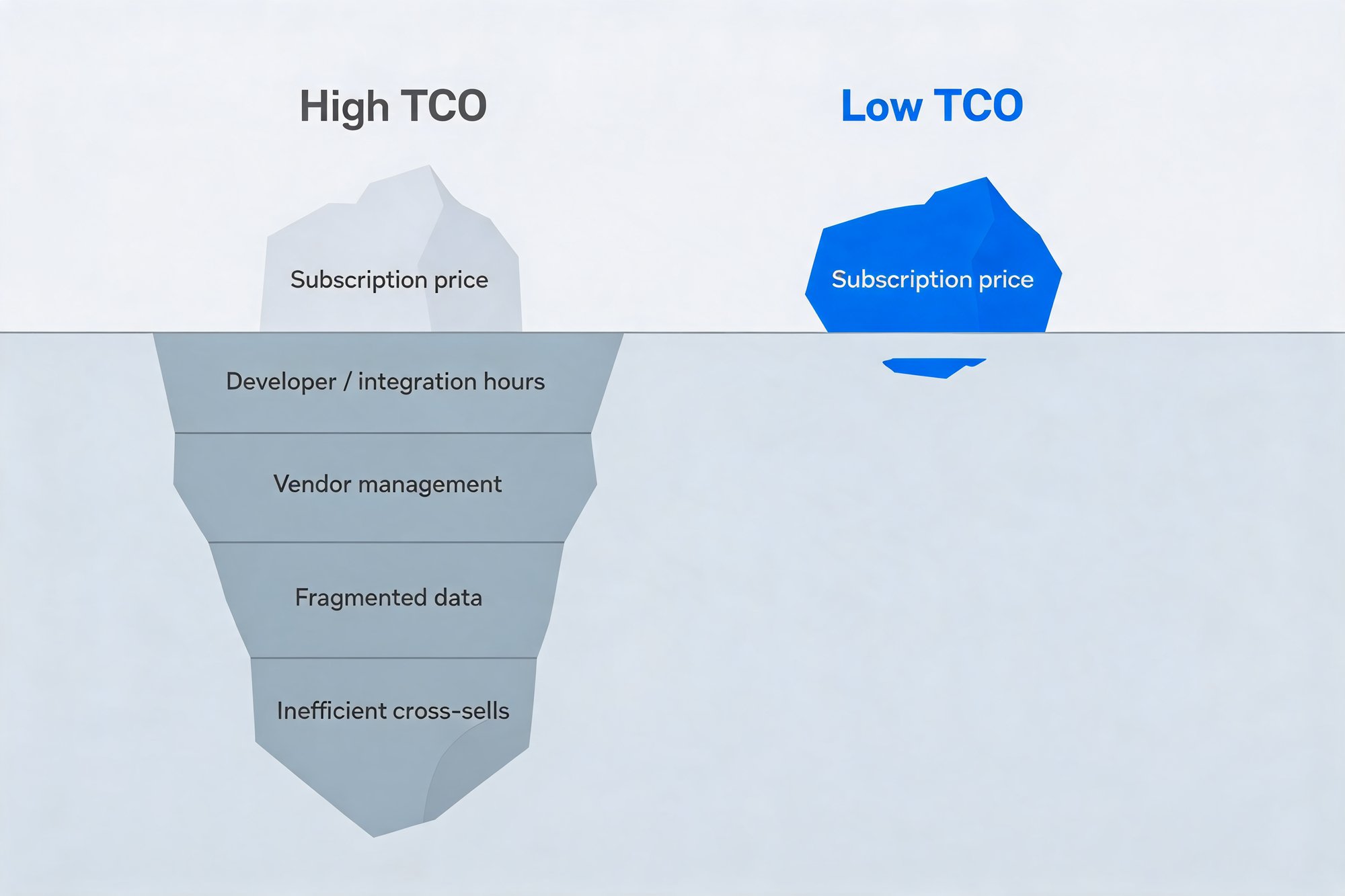
So before you score features, score architecture. For enterprise returns management in 2026, the platform that removes vendors from your stack will almost always beat the one that adds another. That is the lens the rest of this comparison applies.
Head-to-Head: AfterShip vs. Narvar vs. Loop on Core Capabilities
Judged one criterion at a time, the three platforms separate quickly: AfterShip works best when platform scope and automation are a priority, Narvar is built for premium tracking, and Loop is most mature in returns management for less complex brands.
The matrix below rates all three on the five criteria that actually move an enterprise returns decision.
| Criteria | AfterShip | Narvar | Loop Returns |
|---|---|---|---|
| Platform Scope | Returns, Tracking, Shipping, AI EDD, and warranty in one account. Native installs across Shopify, BigCommerce, Wix, WooCommerce, Magento, Salesforce, Amazon, and 30+ commerce platforms. | Tracking-led enterprise CX suite; returns is a separate product (Shield). | Shopify and Shopify Plus only; most mature in returns for less complex brands. |
| Returns Automation & Logistics Control | Native multi-warehouse routing, multi-label logic, bundle returns, and gift-with-purchase; rules branchable by product tag or customer value. | Branded returns portal; OOTB exchanges/Shop Now, Bonus Credit, bundle returns, and GWP not offered; fraud and instant exchanges are extra-fee add-ons (Assist). | Branded returns portal; Bonus Credit is its signature feature. Bundle returns constrained; multi-warehouse limited. |
| Carrier Network & Cost Optimization (returns reverse-logistics only) | Auto-label support across 23 carriers; 3 / 5 / unlimited connected carriers per tier (Essentials to Enterprise); pre-negotiated rates on every tier. | Bring-your-own-carrier: connect your own carrier accounts; no platform pre-negotiated rates. | Named list of 16 carriers with pre-negotiated rates via Ship by Loop. |
| Enterprise Readiness | SOC 2 Type II, ISO 27001, GDPR; 99.9% uptime SLA with service credits. Open API at 10 requests/sec per org (Enterprise ceiling custom-quoted). SOC 2 is company-level; Returns-scoped report on request. | SOC 2, GDPR; uniquely offers HIPAA on a separate tier. API documentation gated behind an enterprise contract. | SOC 2, GDPR, CCPA; open API at 5 requests/sec. ISO 27001, HIPAA, and a published uptime SLA are not listed on Loop's security page. |
| Total Cost of Ownership | One platform, one contract; consolidation lowers TCO. Enterprise is custom-quoted. Optional free Return Care tier funded by shopper-paid return fees. | Discrete products with core capabilities (EDD, fraud, shipping protection) sold as paid add-ons; quote-based. Fragmentation raises total cost. | Returns and tracking sold as two separate subscriptions, with two renewals to manage. |
Three patterns hold across every row: AfterShip covers more of the journey, Narvar prices more of it as separate products, and Loop does less of it but does the Shopify slice exceptionally well.
Criterion 1: Returns Management & Automation
On core returns automation, the three are closer than the marketing implies, and the real separation shows up in reach and rule depth, not the portal itself.
All three give you a branded portal, automated labels, refunds, exchanges, and routing rules, including Loop's returns portal.
AfterShip's separation is in rule granularity and logistics control. It handles native multi-warehouse routing, multi-label logic, bundle returns, and gift-with-purchase scenarios, with automation rules you can branch by product tag or customer value. For an ops team writing policies that differ by SKU, region, and customer tier, that depth is the difference between a rule engine and a workaround.
The bigger enterprise differentiator is platform reach. AfterShip Returns installs natively across 30+ major commerce platforms including: Shopify, BigCommerce, Wix, WooCommerce, Magento, Salesforce, and Amazon. Loop runs on Shopify and Shopify Plus only, which is ideal if you are Shopify-native and limiting if you are not. Narvar's returns product is built for enterprise.
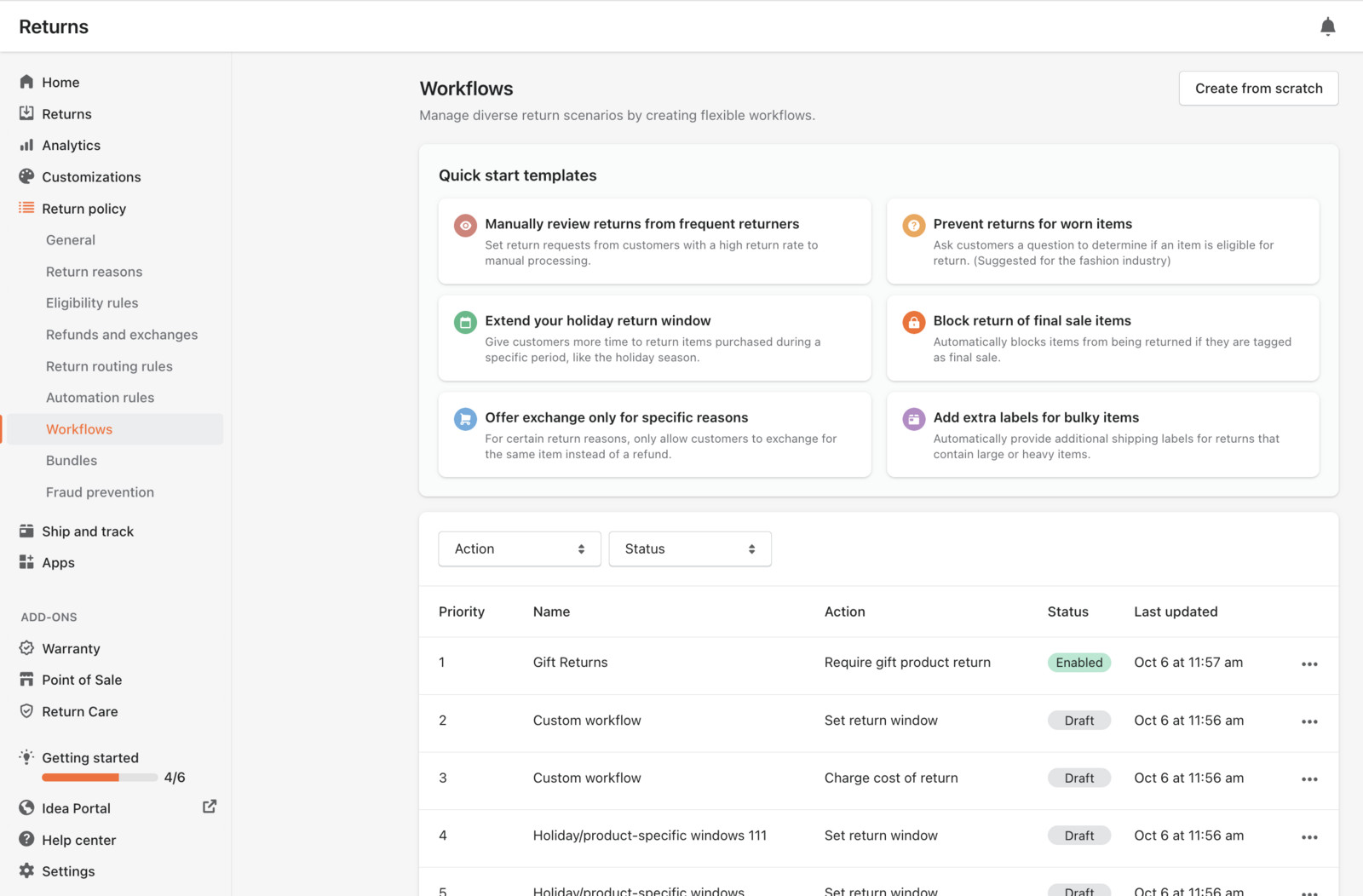
If your operation spans multiple warehouses, bundled SKUs, or non-Shopify channels, this is exactly where a single-purpose returns tool starts charging you in manual workarounds. Those costs rarely show up at evaluation time; they surface in month three, when a new policy needs an exception the tool cannot model.
Criterion 2: Carrier Network & Reverse Logistics Control
On reverse logistics, the right question is rate control, not raw carrier count.
A long carrier list means little if you still negotiate every rate yourself. At enterprise volume, what moves cost is whether your return labels draw on pre-negotiated rates and whether the drop-off network actually reaches your customers. Two platforms with identical carrier lists can have very different per-return economics. The line item that grows with volume is the label cost, not the length of the carrier roster.
AfterShip generates return labels from a pool of 23 carriers with auto-label support, with pre-negotiated rates available on every plan tier, so the savings do not depend on your own carrier contracts. Connected-carrier access grows by tier: 3 on Essentials, 5 on Premium, and unlimited on Enterprise.
Loop publishes a transparent list of 16 named carriers, with pre-negotiated rates available through Ship by Loop.
Narvar takes a bring-your-own-carrier approach: you connect your own carrier accounts rather than drawing on platform-negotiated rates, because Narvar does not provide pre-negotiated platform rates.
Before you compare any numbers, pressure-test the model with three questions:
- Are return-label rates pre-negotiated by the platform, or do you bring your own carrier contracts?
- How many carriers can you connect on your plan tier, and what does adding one cost mid-contract?
- Does the drop-off network cover where your customers actually live?
The structural point stands: pre-negotiated, tier-based carrier access lowers reverse-logistics cost without turning carrier setup into a procurement project.
Criterion 3: The End-to-End Customer Experience (Tracking & Notifications)
This is the criterion where Narvar earns its reputation, and where AfterShip's single-platform design pays off.
Narvar built its name on a premium, heavily branded tracking experience. For enterprise brands that treat the tracking page as a marketing surface, that polish is real and worth acknowledging. Loop entered tracking more recently, adding it by acquiring Wonderment in 2024, so its tracking layer is newer and still maturing alongside its returns core.
AfterShip's advantage is connection, not just a cleaner page. Because returns, tracking, and notifications run on one platform, a single exchange flows from return initiation, to the outbound tracking of the replacement item, to the proactive update that tells the shopper it shipped, with no three-tool handoff in the middle. That continuity is hard to replicate by wiring point solutions together.
On the tracking side specifically, AfterShip's notification engine runs more than 33 workflow triggers, and its tracking layer spans more than 1,300 carriers, so delivery updates stay accurate across regions. The result is fewer "where is my order" tickets feeding back into your support queue.
This shows up in public reviews, too. On Capterra, one returns lead who moved off Loop pointed to pricing as the deciding factor, while another buyer chose AfterShip for greater platform flexibility and stronger support than Loop.
For brands that see post-purchase as one continuous experience rather than a set of separate tools, that unified design is the differentiator that survives contact with peak season.
Criterion 4: Platform Extensibility & Integrations (API & ERPs)
At the integration layer, the gap comes down to access: what is open, what is gated, and what is included by default.
AfterShip publishes its API openly, with a documented limit of 10 requests per second per organization. Loop documents a limit of 5 requests per second. Narvar gates its API documentation behind an enterprise contract, so you often cannot evaluate the integration surface until you are already in a sales cycle. On AfterShip, returns webhooks are available from the Premium tier and the full Returns API at Enterprise, where the rate-limit ceiling is custom-quoted rather than published. For a team that wants to prototype against the API before signing anything, open documentation is itself a buying signal.
Enterprise readiness is where a hard requirement can settle the decision on its own. AfterShip holds SOC 2 Type II, ISO 27001, and GDPR, and publishes a 99.9% uptime SLA with service credits. That SOC 2 Type II certification is company-level; a Returns-scoped report is available on request rather than assumed. Narvar publishes SOC 2 and GDPR and, uniquely among the three, offers HIPAA on a separate tier for regulated verticals. Loop publishes SOC 2, GDPR, and CCPA; ISO 27001, HIPAA, and a published uptime SLA are not listed on Loop's security page.
If your roadmap leans on open APIs, ERP connections, or a compliance line item, this is where the platform-versus-point-solution gap turns into a procurement reality. And if a vertical you serve touches protected health information, the HIPAA question alone can decide the vendor before any other criterion is scored.
The TCO Breakdown: Uncovering the Hidden Costs in 2026
The sticker price is the smallest number in a returns decision; the cost that compounds is the return volume you cannot see at signup.
Start with the industry baseline. In 2025, 19.3% of online sales were returned, and that rate is the multiplier that turns your order volume into a returns bill.
Apply that rate to the brand in this brief and the exposure becomes concrete:
- A brand at 10,000 orders per month generates roughly 23,000 returns a year.
- A brand at 50,000 orders per month generates roughly 116,000 returns a year.
- AfterShip Returns Premium runs $99 per month and includes 1,200 returns a year, with each additional return billed at $1.
- At 23,000 to 116,000 returns, you are tens of thousands of returns past the Premium cap, which is why Enterprise becomes the operative tier at this scale.
That overage line is the one that surprises teams. A plan that looks affordable at the cap quietly changes shape once real return volume runs through it, and the per-return charge is what your finance team feels at renewal.
Enterprise pricing is custom-quoted, so the honest move is to size it with AfterShip Sales rather than anchor on a number that will not match your volume. For brands with the right catalog economics, AfterShip also offers a free Return Care tier funded by shopper-paid return fees, which can offset return costs without becoming a line item of its own.
Those are still the visible costs. The fees that never reach an invoice are the engineering hours spent maintaining connectors between separate vendors, the parallel contracts and renewals, and the reporting that never reconciles across tools. Consolidate the stack onto one platform and those lines collapse toward zero.
Totaled honestly, the cheapest subscription rarely wins. The lowest total cost of ownership does.
The Final Verdict: Your Recommendation for Q3
For a Q3 recommendation, the decision narrows to one question: how much of the post-purchase journey do you want to run from a single contract?
Choose AfterShip if you want one platform to operate returns, tracking, shipping, and delivery estimates from a single account, the widest reach across Shopify and non-Shopify storefronts, and the lowest total cost of ownership once real return volume is in the model. For most teams running this evaluation, that consolidation is the recommendation, and the operational efficiency compounds as you scale.
Returns automation that enhances the returns and exchanges experience, reduces costs, and retains more revenue.
Book a demoChoose Narvar if you are a Fortune 500 brand where a premium, white-glove branded tracking experience is the priority and budget is secondary, or if you operate in a vertical that requires HIPAA.
Choose Loop if you are a Shopify or Shopify Plus brand with less complex needs (bundled returns, multi-warehouse workflows, custom-coded discounts).
For an enterprise team weighing AfterShip vs Narvar vs Loop, the platform that unifies returns, tracking, shipping, and delivery estimates into one account remains the most defensible enterprise returns management recommendation you can put in front of your VP this quarter.
Frequently Asked Questions
Which is best for enterprise returns: AfterShip, Narvar, or Loop?
AfterShip is the best fit for brands that want one platform for returns, tracking, shipping, and AI delivery estimates with the lowest total cost of ownership. Narvar suits Fortune 500 brands prioritizing a premium branded tracking experience, and any vertical that requires HIPAA. Loop suits smaller, less operationally complex Shopify and Shopify Plus brands.
How many carriers does AfterShip Returns support for return labels?
AfterShip Returns offers auto-label support across 23 carriers, with pre-negotiated rates on every plan tier. Connected-carrier access scales by tier: 3 on Essentials, 5 on Premium, and unlimited on Enterprise.
Does AfterShip provide an uptime SLA?
Yes. AfterShip publishes a 99.9% uptime SLA with service credits, alongside SOC 2 Type II, ISO 27001, and GDPR.
When does AfterShip Returns move from Premium to Enterprise pricing?
AfterShip Returns Premium runs $99 per month and includes 1,200 returns a year, with each additional return billed at $1. A brand doing 10,000 to 50,000 orders a month generates roughly 23,000 to 116,000 returns a year, so Enterprise becomes the operative tier at that scale.