
AfterShip vs Narvar: The Honest Verdict for Enterprise Retailers in 2026


Choosing a post-purchase partner at enterprise scale comes down to what actually moves the numbers: accurate delivery dates, deep carrier coverage, and a complete post-purchase suite that scales with you. Let's compare AfterShip and Narvar on the criteria that define success at scale.
If you have already shortlisted both vendors, you are past the marketing pages and into the questions procurement actually asks in an AfterShip vs Narvar enterprise evaluation: delivery accuracy, carrier coverage, returns depth, data ownership, and SLA terms. This guide answers those directly, and where AfterShip fits a complex global operation, our dedicated Enterprise solutions are built for exactly this profile.
Executive Summary: AfterShip vs. Narvar for the Enterprise in 2026
The short version: AfterShip is the stronger fit for enterprise retailers who want a complete post-purchase suite on one platform, AI delivery estimates included in core tracking, and market-leading carrier coverage. Narvar can suit a largely legacy operation that prefers an established incumbent.
Three differences carry most of the decision:
- AI EDD included, not an add-on. AfterShip builds AI-powered estimated delivery dates into core Tracking. Narvar sells its equivalent, Promise, as a separate paid add-on.
- One complete post-purchase suite. Tracking, Returns, Shipping, Email, and Warranty run on one stack, versus a set of separately packaged products.
- Market-leading carrier coverage. AfterShip tracks 1,300+ carriers with AI auto-detection and web-crawl onboarding, so your team does not have to supply its own carrier accounts.
AfterShip AI EDD is trained on 11B+ shipments (4.4B+ tracking data points), and Enterprise plans carry a contractual 99.9% uptime SLA. That 99.9% figure is the commitment with service credits behind it. A higher realized-uptime number you may see quoted on a marketing page is not the same as the percentage you sign in the contract.
Beyond the Feature Grid: 4 Architectural Differences That Matter at Scale
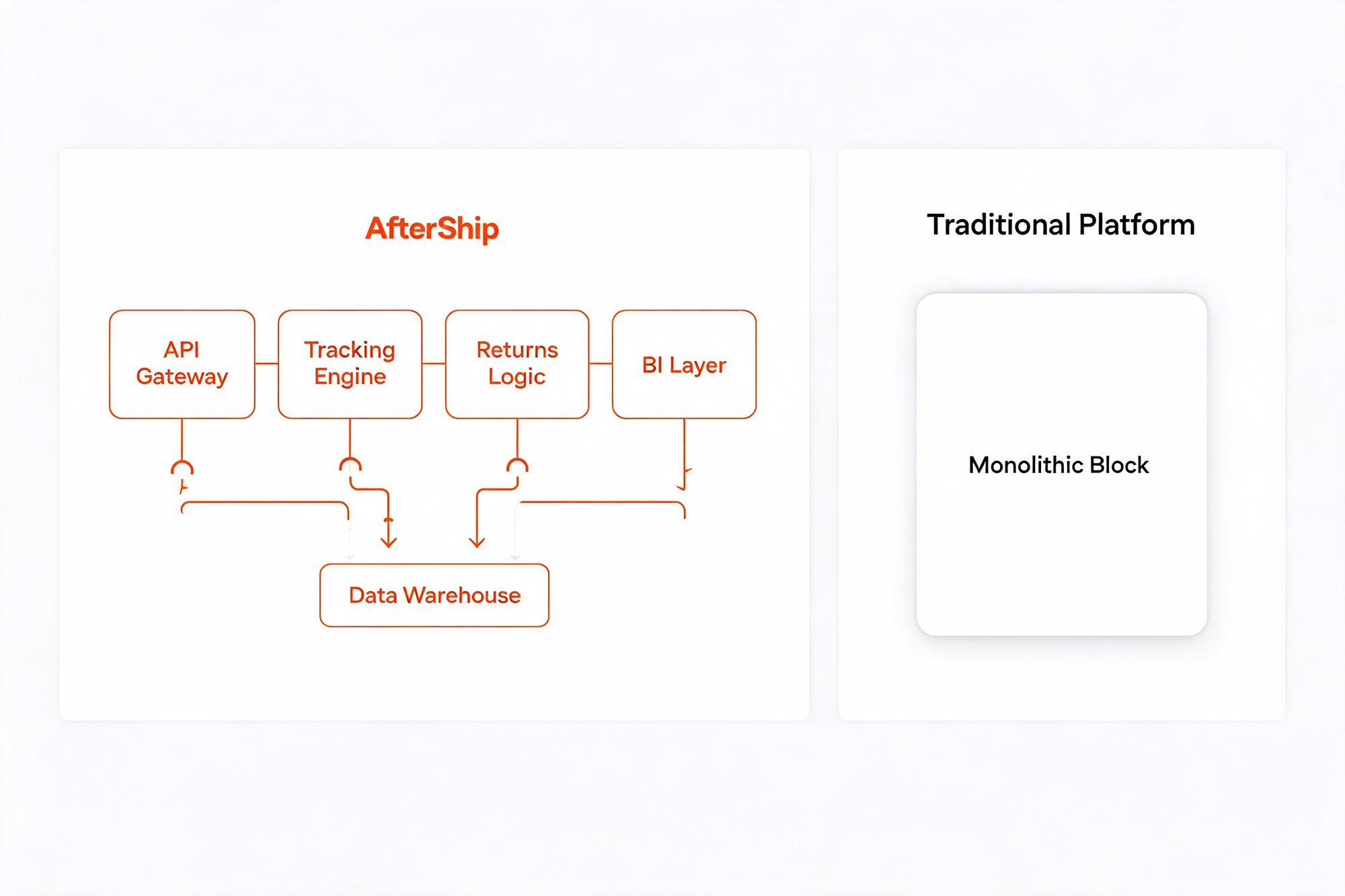
A feature checklist tells you what a platform does today. It does not tell you whether the platform will bend to your stack or force your stack to bend to it. The four differences below are where AfterShip's API-first architecture separates from a more monolithic, established platform, and each maps directly to a job your operations team has to deliver. That modular, composable direction is the broader industry trend championed by the MACH Alliance, the group behind the push toward API-first commerce.
1. Data Model & Accessibility
Architecture decides who owns the data. AfterShip treats every tracking event as an exportable record: you can pull data out through webhooks for sub-second reactions, scheduled API calls for real-time syncs, and scheduled CSV exports that cover a three-year retention window, with custom export formatting available on Premium and Enterprise.
There is no native data-warehouse connector, so the path into a warehouse runs through partner ETL tools such as Skyvia, which load AfterShip data into Snowflake, BigQuery, or Redshift. That is a setup step worth scoping early in an integration plan, but it keeps the raw events in a form your own pipelines can consume.
For an enterprise building its own analytics layer, that openness matters more than any prebuilt dashboard. It lets your team join shipment data with order, marketing, and support data to produce deep post-purchase insights that live in your own BI stack, not behind someone else's login.
2. Multi-Brand Management at Scale
Global brands rarely operate as a single store. A parent company often runs several brands, regions, or business units, each generating its own tracking pages, returns flows, and reporting. AfterShip's Enterprise plan manages multiple stores under one organization, with consolidated analytics across every brand and market from a single view, so you report on the whole portfolio in one place instead of exporting from separate accounts.
Narvar's model leans on separate accounts per brand, which adds context-switching for teams that operate across markets. That single-organization structure is the difference between reporting on your post-purchase operation as one business and reporting on it one silo at a time.
3. Speed of Innovation & Feature Deployment
Innovation at enterprise scale is less about one flagship feature and more about how openly a platform exposes its intelligence. The consumer-side gap is stark: in Stord's 2025 mystery-shopping study, 58% of consumers said they want estimated delivery dates while only 1% of brands provided them. AfterShip ships AI EDD (estimated delivery dates) with about 80% shipment coverage, compared with under 40% for native carrier EDDs, and reaches roughly 95% average accuracy, included in core Tracking where Narvar sells its equivalent, Promise, as a separate paid add-on. AfterShip Intelligence layers Catalog, Discovery, and Logistics AI on top of 11B+ shipments (4.4B+ tracking data points).
Be precise about how you consume that intelligence. Enterprises read AI EDD predictions as a field on the shipment record but cannot tune the underlying models, while every raw event remains exportable through webhook and API for teams that want to build their own predictive layer on top.
4. Ecosystem & Integration Philosophy
The last difference is philosophy. AfterShip is API-first, with webhook fan-out to up to 10 webhook URLs per account, a dated webhook version header so integrations don't break on silent changes, and native integrations across tools such as Klaviyo, Gorgias, and major 3PLs.
For a custom enterprise stack, that posture is the whole point: the platform is designed to be wired into the systems you already run, not to become another silo. Architecture, not the feature grid, is what will still be serving you three peak seasons from now.
Deep Dive: Which Platform Excels at Core Enterprise Jobs-to-be-Done?
Architecture only matters if it shows up in the daily work. Three enterprise jobs separate the two platforms in practice: running branded tracking across a global carrier mix, routing complex returns, and wiring the platform into a custom ERP, WMS, and OMS stack. Here is how AfterShip and Narvar handle each.
1. Branded Global Tracking at Scale
Carrier coverage sets the ceiling on what you can actually track. AfterShip tracks more than 1,300 carriers, market-leading coverage, with AI auto-detection and web-crawl onboarding that brings new carriers online without your team supplying its own carrier accounts. For a brand shipping across several regions and a mix of last-mile providers, that gap shows up as fewer "carrier not supported" dead ends in the long tail of your shipping data.
White-labeling is the other half of branded tracking. AfterShip supports true CNAME masking with SSL on both Tracking and Returns, available on Premium (one custom domain) and Enterprise (up to five custom domains), so the tracking experience runs on your own domain. Narvar offers branded, customizable tracking pages, but does not publicly document own-domain CNAME masking.
At enterprise volume, both halves compound. Deeper carrier coverage means fewer manual look-ups when a shipment falls outside a supported network, and an on-domain tracking page keeps the highest-traffic moment of the post-purchase journey, the delivery wait, pointing at your brand instead of a vendor URL.
If keeping shoppers on your domain all the way through delivery is part of the brief, that is one concrete line to confirm in any vendor demo rather than assume.
2. Optimizing Complex Returns & Reverse Logistics
This is the comparison most often misread. Both platforms route multi-warehouse returns. Narvar performs return-to-vendor and nearest-distribution-center routing, with ERP-triggered warehouse approval. The differentiator is not whether returns get routed; it is how openly you can configure and extend that routing. At 50,000-plus orders a month, routing is not a one-time setup: rules shift with seasons, SKUs, and warehouse capacity, so the ability to change them without filing a support ticket becomes a real operational lever.
AfterShip exposes a priority-based, if-then routing rule builder. You can branch on conditions such as customer tag, resolution, return reason, return value, SKU, product tag or type, and order tag, then send each case to distribution centers, public warehouses, repair centers, or third-party vendors. Amazon MCF and Shopify Collective are supported as destinations.
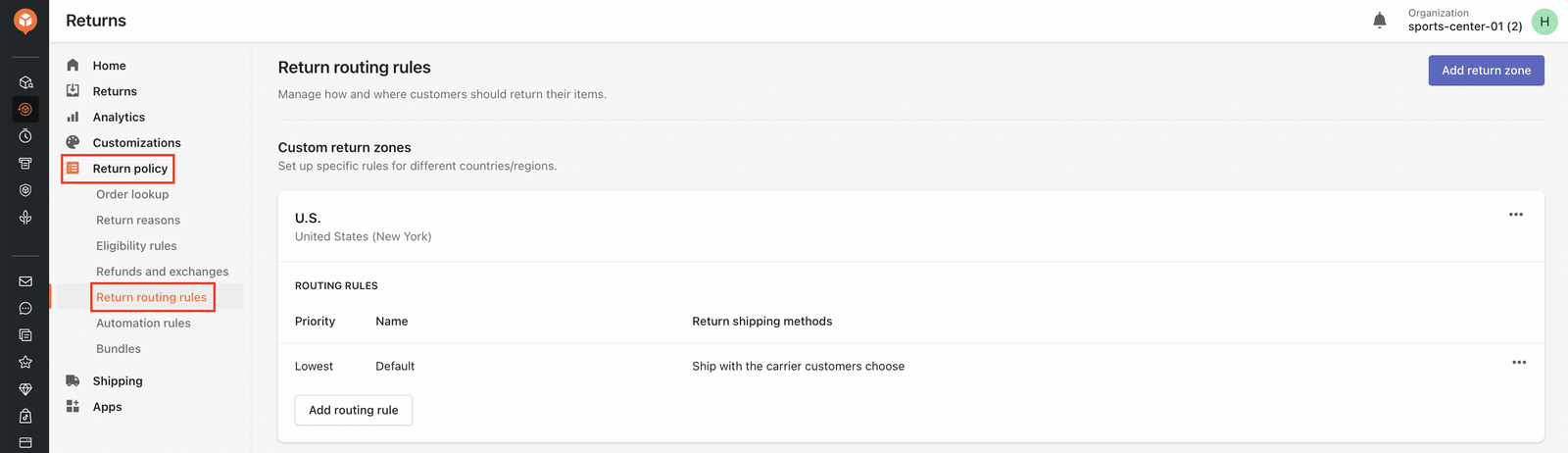
For enterprises that need their warehouse systems in the loop, AfterShip also exposes a Returns Public API (Enterprise-gated) for warehouse integration, supporting receive-by-RMA, A/B/C/D grading, and disposition tagging, with warranty management available on Enterprise. That is the kind of advanced multi-warehouse return routing an ops team can wire into its existing WMS instead of operating as a black box.
The practical test: ask whether you can change a routing rule yourself, and whether your warehouse can act on it through an API. On AfterShip, both answers are yes.
3. Integrating with a Custom Tech Stack (ERP, WMS, OMS)
The third job is the one that quietly sinks projects: getting the platform to talk to the systems you already run. AfterShip publishes its API documentation and SDKs openly, so your engineers can scope an ERP, WMS, or OMS integration before a contract is signed, not after the ink dries.
Delivery durability is where webhooks earn their keep. AfterShip retries each webhook up to 14 times with exponential backoff that stretches out to roughly 34 hours, and every event carries an event_id (a UUID v4) so your systems can deduplicate and stay idempotent if the same delivery arrives twice. That retry-and-idempotency design keeps integrations stable through both outages and platform upgrades.
For a procurement team, that openness lowers a specific risk: you can validate the integration against your real ERP and WMS during evaluation, instead of discovering the gaps in month two of implementation.
When the integration is genuinely complex, a dedicated Solutions Architect is part of the Enterprise engagement, not a separate line item. Open documentation plus hands-on architecture support is what lets a custom stack absorb a new platform without a half-year freeze on every other roadmap item.
AfterShip vs. Narvar: Head-to-Head Capability Matrix
Pull the threads together and the pattern holds. The table below compares AfterShip and Narvar on the seven criteria that carry the most weight in an enterprise evaluation, using verified per-vendor values your team can lift straight into an internal scorecard. Each row is sourced to a checked value rather than a marketing claim, so the comparison holds up to scrutiny from a procurement reviewer.
| Criteria | AfterShip (Enterprise) | Narvar (Enterprise Suite) |
|---|---|---|
| AI Estimated Delivery Dates | Included in core Tracking; ~95% average accuracy, 80%+ shipment coverage (~3x carrier-typical) | Available as a separate paid add-on (Promise) |
| Built for Shopify | Built for Shopify certified (Feb 2026), Shopify Plus partner | Not Built for Shopify certified |
| Notification Triggers | 33+ triggers with native Flow Editor (conditional split, A/B test) | Roughly 3 to 5 standard triggers |
| Carrier Network Depth (International) | 1,300+ carriers with AI auto-detect and web-crawl onboarding | Requires merchant-supplied carrier accounts; total coverage not publicly documented |
| API Flexibility | Open REST API with public docs + SDKs; custom Enterprise rate ceilings | API access gated behind enterprise contracts; no public static cap |
| White-Label Customization (true CNAME) | True CNAME + SSL; Premium 1 domain, Enterprise up to 5 | Branded, customizable tracking pages; no documented own-domain CNAME |
| Multi-Warehouse Logic | If-then routing rule builder + Enterprise Returns Public API (receive-by-RMA, A/B/C/D grading, disposition) | Return-to-vendor + nearest-DC routing, ERP-triggered warehouse approval (both route; AfterShip more openly configurable) |
| BI & Data Accessibility | Webhooks, real-time API pulls, CSV (3-year window, custom format on Premium/Enterprise), partner ETL (e.g. Skyvia) to Snowflake/BigQuery/Redshift; no native warehouse connector | Order API + integration-based access; no public raw-export-to-warehouse path documented |
| SLA & Support Model | Contractual 99.9% Enterprise SLA with tiered service credits; public status page; Gold support tier | No publicly published SLA terms; public status page without a contractual percentage |
| Security & Compliance | SOC 2 Type II (EY-audited), ISO 27001, GDPR, CCPA, AES-256, TLS 1.2, US-hosted, no PCI | SOC 2, GDPR, AWS-hosted, no PCI |
The line through every row is the same. Narvar covers the jobs; AfterShip leaves them open for you to configure, extend, and own. For an enterprise weighing AfterShip vs Narvar, that openness is the difference that compounds across a multi-year contract.
The Verdict for 2026: Who Wins for Your Specific Use Case?
Enough comparison. Here is the call, segmented by the situation you are actually in.
Choose AfterShip if
Choose AfterShip if you run a modern, composable tech stack and want the platform to fit your systems rather than force your systems to fit it. It is the stronger choice when you operate across multiple global markets, need granular data access and API flexibility, and treat post-purchase as a revenue driver rather than a cost center.
If your team plans to build on top of shipment and returns data, the openness covered earlier in this comparison is the deciding factor, not any single feature. See how Mejuri consolidated its post-purchase stack onto AfterShip, replacing a custom-built setup with one platform across tracking, returns, EDD, and warranty.
Consider Narvar if
Consider Narvar if your tech stack is largely legacy and you have no near-term plans to change that. It can be the pragmatic pick when your operations are primarily domestic, and you value incumbent vendor stability.
There is nothing wrong with choosing the incumbent when the incumbent matches your operating model. For an enterprise on the modern, multi-market end of that spectrum, though, the verdict points clearly to AfterShip.
If that profile fits, the next step is a hands-on look at the platform against your own stack and volume.
The API-first post-purchase platform for global enterprises, with open data access, a contractual 99.9% uptime SLA, and full ownership of your shipment and returns data.
Book an Enterprise DemoA Note on Partnership & Support: SLAs, Onboarding, and CSMs
A platform decision is also a support decision, and this is where the two contracts read most differently.
AfterShip publishes a contractual 99.9% monthly uptime SLA carried on its Silver and Gold support tiers, backed by a tiered service-credit schedule.
One distinction worth keeping straight for procurement: the higher realized-uptime figure you may see quoted on the Tracking API page is a marketing number, not the contractual commitment. The percentage you can actually hold a vendor to is 99.9%.
Support beyond uptime is tiered separately. AfterShip's Gold support tier (priced at 30% of subscription, with a $400/month per-product minimum) adds response-time commitments, a 2-minute live-chat target, 15-minute email, and 30-minute updates on critical issues, plus an implementation consultant, BFCM peak-event management, and quarterly account reviews. Narvar runs a public status page but does not publicly publish SLA terms or a contractual percentage, so on paper the contrast is a documented commitment versus an undocumented one.
The takeaway for a procurement file is straightforward: with AfterShip, the reliability promise and the credits that back it are written into the contract.
Frequently Asked Questions
How does AfterShip handle data security and compliance (GDPR, SOC 2)?
AfterShip is SOC 2 Type II and ISO 27001 certified, GDPR-compliant with Standard Contractual Clauses and a named EU representative (Brussels) and DPO, and CCPA-compliant. It encrypts data in transit (TLS 1.2) and at rest (AES-256) and hosts production on Google Cloud Platform and Amazon Web Services in the United States. Production data is US-hosted, and AfterShip does not publicly document EU, UK, or APAC regional residency, so for an EU or UK enterprise the lawful basis for US processing is the SCCs plus the EU-US Data Privacy Framework. HIPAA and PCI DSS are out of scope: no PHI is handled, and no cardholder data is stored, processed, or transmitted. Enterprise customers can request the SOC 2 Type II report and ISO 27001 certificate under NDA.
What does the migration process from Narvar to AfterShip look like?
A realistic enterprise migration at 50,000+ orders per month runs about 6 to 10 weeks end-to-end, led by a dedicated CSM and Solutions Engineer assigned at contract signing: discovery and field-mapping, a staging build, UAT and a parallel run, production cutover, then decommissioning the prior platform. You can import up to 3 years of historical shipment data (matching AfterShip's retention window) plus full RMA history via REST API or CSV; there is no one-click bulk-import tool. Post-purchase migrations move in both directions across the market, so weigh the switch on fit rather than momentum. Several enterprise brands have publicly moved from Narvar to AfterShip, and named references are available on request.
Can AfterShip's tracking page be fully white-labeled on our own domain?
Yes. AfterShip supports true CNAME masking with SSL on Premium (1 custom domain) and Enterprise (up to 5 custom domains), with no published one-time setup fee. For procurement, Enterprise contracts term-lock the feature set, so a contracted capability such as custom domains, white-label, or SSL cannot be re-tiered mid-contract; list-price tier changes apply only at renewal.
Is the 99.9% uptime SLA included or an add-on?
The 99.9% uptime SLA is included on AfterShip's Silver and Gold support tiers, so it is not a Gold-only add-on. Gold support adds response-time and white-glove commitments, not the uptime SLA itself.