
AfterShip vs Convey (project44): The Verdict for Enterprise Retail


Your visibility platform contract is up for renewal. Sticking with a legacy name like Convey (now project44) feels like the 'safe' choice. But in 2026, is a tool that only solves for visibility a strategic investment, or a costly silo? This analysis breaks down the Total Cost of Ownership (TCO) difference between a point solution and a true post-purchase platform.
Executive Summary: AfterShip vs. Convey at a Glance
For the logistics leader who needs the verdict before the analysis, here is the strategic read on AfterShip vs Convey. It compares the two on the points that actually shape a renewal decision: what each platform is built to do, who it serves, and where returns fit.
| Criteria | AfterShip | Convey (project44) |
|---|---|---|
| Platform Scope | Integrated post-purchase platform: Tracking, Returns, Shipping, AI EDD, and Intelligence on one account | Specialized last-mile delivery visibility tool |
| Primary Use Case | Retail and D2C final-mile delivery experience | Multimodal B2B freight visibility |
| Returns | Full returns management: branded portal, automation, exchanges, store credit, and labels | Returns visibility only, a reverse-logistics tracking layer launched February 2026 |
| Ideal Customer Profile | Enterprise retailers and 3PLs that want to own the post-purchase journey | Shippers tracking multimodal freight into a custom-built logistics backend |
The pattern is hard to miss. project44 is built to see freight move; AfterShip is built to run the final-mile experience your customer actually touches.
The Real Question: Is Last-Mile Visibility Enough in 2026?
Most renewal conversations start with the wrong question. They ask which tool tracks packages better, when the real question is whether tracking alone still earns its place in your stack.
A visibility provider tells you what is happening: the package is late, the truck is delayed, the exception just fired. A post-purchase platform lets you act on it: notify the customer, trigger a return, generate a discounted label, and feed the outcome back into your carrier decisions. One reports. The other runs the operation.
Here is the competitor in plain terms. Convey, acquired by project44 in September 2021 for $255 million, is now sold as Last Mile Resolution, and we refer to it as project44 from here. Convey is now project44's Last Mile Resolution, a last-mile visibility data provider.
That distinction matters because the cost is no longer in failing to know. It is in everything you still have to do once you know. AfterShip is an integrated platform for the entire post-purchase experience, which means the action and the data sit in the same system. For an enterprise retailer measured on WISMO (the "where is my order" tickets that flood support), NPS, and return rate, a tool that only reports leaves the expensive work on your team and the data scattered across vendors.
So the 2026 question is not "can we see the shipment." It is "what does it cost us to do something about it." That answer favors the platform that already holds tracking, returns, shipping, and analytics in one place.
Where Convey Shines (And Its Strategic Limitations)
Give project44 its due. It earned its enterprise reputation in the hardest part of logistics: complex, multimodal freight.
project44, by virtue of its multimodal visibility platform spanning ocean, over-the-road, air, rail, parcel, and last-mile, offers depth in complex B2B supply-chain tracking that AfterShip is not built to match. For a retailer whose primary challenge is tracking container ships from Shanghai to Long Beach, project44 is the market leader. AfterShip's strength is the customer-experience layer at the final mile.
That strength is real and independently recognized. project44 was named a Leader in the 2025 Gartner Magic Quadrant for Real-Time Transportation Visibility, and in February 2026 it added Returns Visibility to its lineup.
The limitation is not capability. It is scope. For a modern D2C or retail program, a last-mile visibility tool leaves four gaps:
- It is a data feed, not an action platform. It surfaces the exception; your team still builds the response.
- Its returns capability is visibility, not management. project44's Returns Visibility tracks a return shipment. It does not run a branded portal, automation rules, exchanges, store credit, or label generation.
- It does not generate shipping labels or run rate shopping. Carrier rate shopping and discounted labels live in a separate tool.
- It requires costly integrations to complete the experience. A full post-purchase program means stitching project44 to a returns tool, a shipping tool, and an analytics layer, each with its own contract.
None of this makes project44 a weak product. It makes it a narrow one for this buyer. project44 owns the inbound freight visibility story; the outbound customer-experience story is a different platform decision. That is the comparison the rest of this analysis runs, starting with how AfterShip turns those four gaps into a single operating advantage.
AfterShip's Platform Advantage: Unifying CX and Operations
Here is where the integrated model stops being a slogan and starts being math. AfterShip runs tracking, returns, shipping, and analytics as one connected system, so each product makes the next one cheaper to run.
Start with tracking. Proactive delivery notifications cut WISMO tickets, which pulls cost straight out of your support queue. The branded tracking page that carries those updates also drives engagement, so the same touchpoint that lowers cost lifts customer experience.
That tracking page links directly into the returns portal. The portal runs on a full suite of returns automation rules and pulls discounted carrier labels from AfterShip Shipping, so a return clears without a rep touching it and without a premium label rate. Each step feeds the next: notifications reduce tickets, the tracking page routes returns, automation closes returns, and shipping holds down the unit cost. A last-mile visibility tool cannot close that loop, because it only owns the first step.
At your volume, that loop is not a rounding error. A retailer shipping 50,000 orders a month feels every point of WISMO reduction as thousands of fewer tickets, and every return that auto-clears as labor that never gets spent. Stitch those same four jobs across four vendors and the math inverts: you pay for the integration work, the duplicate data syncs, and the parallel renewals that one platform absorbs. The siloed stack does not just cost more to license. It costs more to operate, every single day.
This is a unified platform that connects tracking, returns, and shipping, and the payoff compounds at enterprise volume.
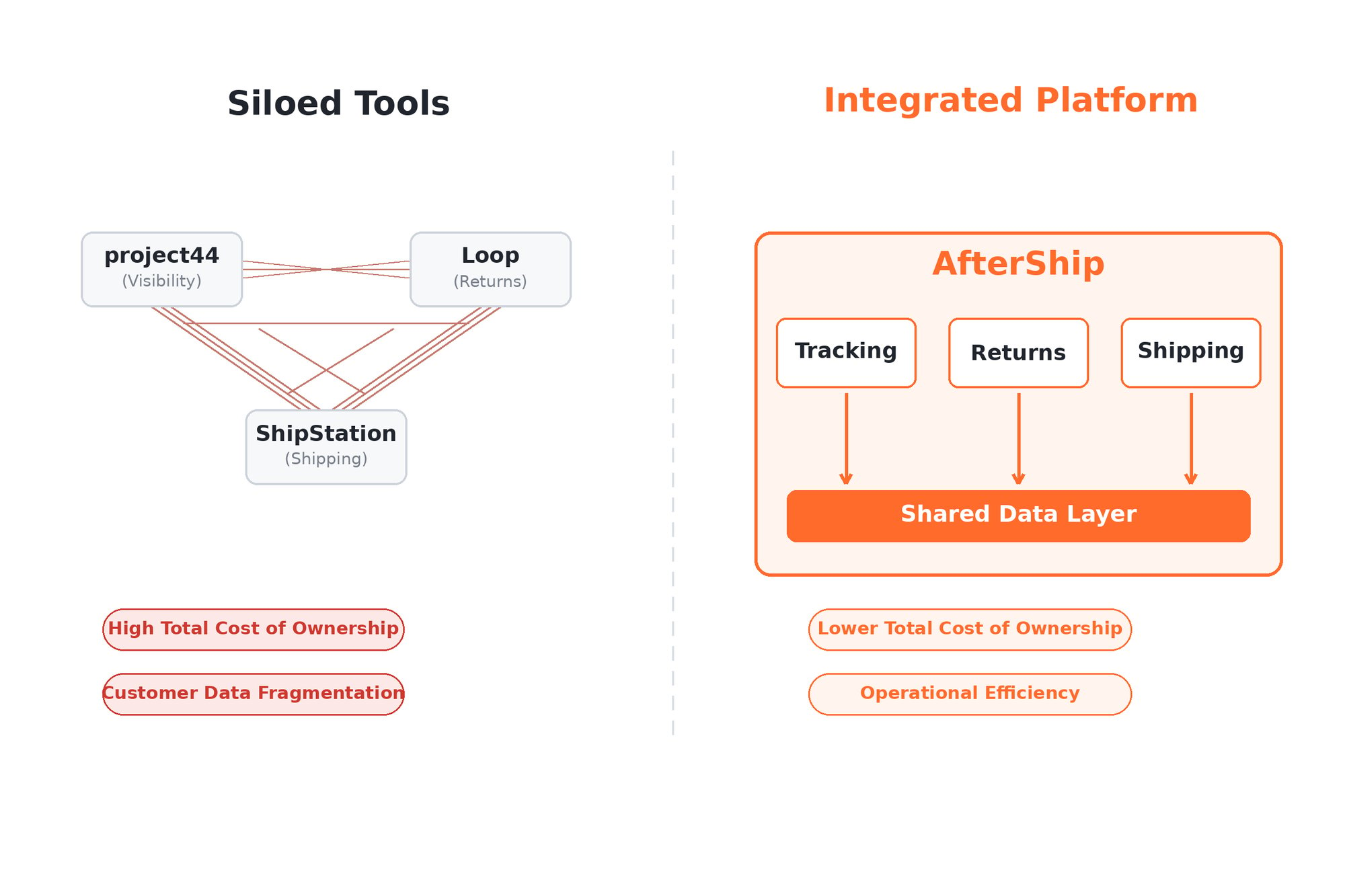
The data layer is where the gap gets concrete. project44 surfaces visibility data; AfterShip Intelligence connects that data to the decision. Its headline cross-product report, Returns Reason by Delivery Performance, cross-references each return's stated reason against how that shipment actually performed in transit.
The result is a number a visibility feed cannot produce on its own: what share of your returns trace back to a delivery problem (late, damaged, or an exception in transit) versus a product or fit problem. One is a carrier conversation. The other is a merchandising conversation. Knowing the split is how you cut return rate instead of just reporting it. With the split in hand, your team routes the delivery-driven returns to a carrier fix and the fit-driven returns to sizing or product detail, so the same dashboard that explains last quarter's return rate tells you which lever moves next quarter's.
That is the platform advantage in one line: every product lowers the cost or raises the value of the one beside it, on a single data layer no point solution can replicate.
Head-to-Head: AfterShip vs. Convey on Enterprise-Critical Features
Strategy aside, your technical evaluator wants the matrix. The criteria below are the ones that decide an enterprise post-purchase program, and they line up with a direct comparison of features and pricing rather than a generic checklist.
| Criteria | AfterShip | Convey (project44) |
|---|---|---|
| Platform Scope | Integrated post-purchase platform: Tracking, Returns, Shipping, AI EDD, and Intelligence on one account | Specialized last-mile visibility tool |
| Carrier Network (parcel scope) | 1,000+ parcel and last-mile carriers, 3PLs, and LTL | 259,000+ multimodal carriers (ocean, OTR, air, rail) |
| Native Returns Management | Full returns management: branded portal, automation rules, exchanges, store credit, 68-carrier return-label generation, fraud detection | Returns Visibility only, a reverse-logistics tracking layer launched February 2026 |
| Multi-Carrier Shipping | 130+ shipping carriers with label generation and rate shopping | Not available |
| API & Uptime | Open API with public docs, 100ms response; 99.99%+ API uptime (marketing) backed by a 99.9% contractual SLA (reasonable endeavours) | Visibility-focused tracking data; no open API documentation found on its site per AfterShip's comparison page |
| Time-to-Value | Under 2 weeks for the Tracking API; 4-8 weeks for the full suite with a parallel run | Multimodal re-platforming, typically longer given inbound-freight EDI integrations |
| Enterprise Controls & Compliance | Dedicated CSM and onboarding, Enterprise SLAs and SSO, Solutions Architect integrations, multi-org management (Company console, unlimited orgs, centralized billing, Member management API on Enterprise), SOC 2 Type II, ISO 27001 (2024), GDPR; white-label branded tracking page on a custom domain (Premium and Enterprise) plus a branded returns portal (Premium and above) | Established enterprise visibility platform; 2025 Gartner Magic Quadrant Leader |
| Total Cost of Ownership | Single-platform cost: one vendor, one set of webhooks, native cross-product reporting | Visibility tool plus separate returns, shipping, and analytics, plus the integration engineering to connect them |
Carrier counts reflect different scopes. AfterShip's 1,000+ are parcel and last-mile carriers relevant to retail delivery; project44's 259,000+ span multimodal freight assets (ocean, OTR, air, rail) that a retail parcel program does not typically touch. For the persona's use case, AfterShip's parcel-focused integration depth and structured delivery-event data per carrier are the more useful evaluation criterion than headline count.
Read the carrier row with the footnote, not without it. The 259,000+ figure counts multimodal freight assets; the 1,000+ figure counts the parcel and last-mile carriers your customers actually receive packages from. They answer different questions, and only one of those questions is yours.
On the criteria that govern a retail post-purchase program, the split is consistent: AfterShip consolidates into one contract what project44 leaves you to assemble from several. That is the difference between buying a feature and buying an operating model. For a team under pressure to cut cost and lift NPS in the same quarter, that is the distinction that survives the budget review.
Proactive shipment tracking that delights your customers, reduces WISMO tickets, and improves your delivery performance.
Book a demoCalculating the True ROI: A TCO Comparison
License fees are the smallest number in this decision. The real cost of a point solution is the integration work it forces onto the teams you can least afford to slow down.
The data backs the instinct. MuleSoft's 2026 Connectivity Benchmark, an 11th-annual survey of 1,050 IT leaders, found the average enterprise runs 957 applications and integrates only 27% of them. Every vendor you add lands in that un-integrated majority, and the engineering to connect it is a cost that compounds.
An integrated post-purchase platform lowers total cost of ownership versus point tools. One platform replaces a visibility tool, a returns tool, a shipping tool, and an analytics layer, removing the integration debt of stitching them together. For the business case you take to your CFO, that is two savings, the licenses you stop paying and the engineering hours you stop burning, and only one ever showed up on the invoice.
Pricing follows the same logic. AfterShip does not publish an enterprise price, because enterprise is scoped to your annual shipment and return volume rather than a per-seat list. Individual products start around $11 a month and scale by volume, and a 25% first-year discount applies when you run two or more products together, on top of roughly 18% for annual billing. The consolidation that lowers your operating cost also lowers your license cost. For an enterprise quote, the path is Contact Sales, not a checkout page.
The proof is in the outcomes. Aetrex, a retail footwear brand running AfterShip Tracking and Returns, reported a 141-point NPS increase, an 86% reduction in return processing time, a 74% drop in WISMO tickets, and 50% operational cost savings after consolidating on AfterShip.
“We've been happy with AfterShip Tracking, there's no downtime or issues. Going with AfterShip Returns made sense. We can simplify our tech stack and leverage the data together.”
Rui Kojima, Senior Director of eCommerce, Aetrex
Read their story →The pattern holds across personas. Wineshipping, a 3PL, cut WISMO tickets 80% and reported a 10x return on its AfterShip investment. And as this case study shows, even a supply-chain visibility provider running AfterShip's API behind its own product removed roughly 10% of shipment exceptions and saved about five hours of work a week. Different businesses, same lever: consolidation.
The Verdict: When to Choose AfterShip vs. Convey
The honest version names the use case, not a winner in the abstract.
Choose project44 when your core problem is upstream. If you need a raw, high-fidelity visibility feed for complex multimodal freight and LTL to plug into a custom-built logistics backend, and you run returns and customer communications in separate systems by design, project44 leads. For tracking container ships and global freight, nothing here changes that.
Choose AfterShip when you own the outbound customer journey. For enterprise retailers and 3PLs who want to cut operational complexity, reduce cost, and grow revenue from one integrated platform, AfterShip is the clearer decision, and the comparison stops being close.
Time-to-value seals it. AfterShip's Tracking API goes live in under 2 weeks, and a full platform cutover (Tracking, Returns, Shipping, and AI EDD) runs 4 to 8 weeks, with a parallel run alongside your incumbent in weeks 4 to 6. That is materially shorter than re-platforming a multimodal visibility tool, which means your renewal deadline is a starting line, not a constraint.
Frequently Asked Questions
Is Convey now part of project44?
Yes. project44 acquired Convey in September 2021, and Convey's last-mile delivery experience product is now sold as Last Mile Resolution under the project44 brand. The Convey name has been fully retired on project44's website.
Does AfterShip handle freight and LTL?
AfterShip's Tracking API covers parcel, last-mile couriers, 3PLs, and LTL carriers, the carrier set most relevant to retail and D2C delivery. AfterShip is not built for tracking ocean container shipments, air cargo, rail freight, or multimodal B2B supply chains; that is project44's domain. The two scopes overlap on LTL but diverge sharply on ocean, air, and rail.
How does AfterShip's pricing work for enterprise?
Enterprise pricing is custom-quoted and scoped to annual shipment and return volume rather than per-product license fees. Individual products start around $11 a month to anchor scale, and a multi-product bundle discount applies, but enterprise scoping runs through Contact Sales.
How hard is it to switch from Convey or project44?
A Solutions Architect leads the migration: under 2 weeks for the Tracking API, 4 to 8 weeks for the full platform with a parallel run in weeks 4 to 6, RMA history migration for the last 12 months, and a staged cutover.