
Comparing Tracking in Logistics Solutions for US Retailers

You are about to sign a multi-year contract for a new WMS. The demo showed a tracking dashboard, and the sales rep checked the box for 'shipment tracking.' But what does that checkbox actually cost you in customer loyalty and operational efficiency down the line?
It is the right question to ask before the ink dries, because the answer rarely shows up in a feature matrix.
The Hidden Compromise of "Included" Shipment Tracking
Your instinct is correct. The tracking module bundled into an OMS, WMS, or ERP almost always looks thin next to the rest of the platform, and there is a structural reason for that. These systems are engineered to run the operation: managing inventory, orchestrating warehouses, routing orders, and reconciling fulfillment across locations. At that job they are excellent, and nothing here suggests otherwise.
Tracking, though, tends to arrive as a line item on a request for proposal rather than a product anyone set out to perfect. It exists so a box can be checked during procurement, not so your customer feels cared for the moment their order ships. To be fair to the platforms, the built-in module is genuinely good at what it was built for: internal operational visibility tied to inventory, warehousing, and routing. Your operations team can see where shipments sit and act on exceptions, and that has real value inside the four walls of the business.
The limit is one of purpose, not competence. A back-office module surfaces tracking in the carrier's own raw status language, for your team. It was never designed to be the customer-facing post-purchase experience: a branded page, normalized statuses, and proactive messaging that carry your brand from checkout to doorstep. That is the gap, and it is exactly the gap your Head of CX feels every time a "Where is my order?" ticket lands in the queue. The platform is doing its job well. It is simply not doing the customer's job at all.
Defining the Modern Tracking Experience Your Customers Expect in 2026
So what does "good enough" actually need to clear in 2026? The bar has moved. Buyers now judge the wait between purchase and delivery as part of the product itself, and they expect the brand, not the carrier, to own it. A modern post-purchase experience is part of a unified, lifecycle approach to order tracking, and for a retailer or 3PL that takes customer experience seriously, it is non-negotiable on these points:
- A branded tracking page hosted on your own domain, not a redirect off to a carrier site
- Proactive SMS and email updates that reach the customer before they think to ask
- Accurate, AI-driven delivery estimates that customers can actually plan their day around
- A mobile-first design, since the overwhelming majority of tracking checks happen on a phone
- Marketing and upsell placements on the tracking page, turning a routine status check into a return visit
The delivery-estimate line deserves a closer look, because it is where built-in tracking quietly falls short. Most carrier-provided estimated delivery dates cover under 40 percent of deliveries, which leaves the majority of orders with no reliable promised date at all. A dedicated solution closes that gap, covering at least 80 percent of deliveries with an estimate the customer can trust. The difference is not cosmetic. It is the difference between a customer who waits calmly and one who opens a ticket, and at scale that distinction drives your WISMO volume and your CSAT score in opposite directions.
58 percent of consumers want to see estimated delivery dates, yet only about 1 percent of brands provide them (Stord, 2025). That distance between what buyers expect and what most brands actually deliver is the opening a dedicated tracking solution is built to close, and it is the standard the rest of this comparison measures against.
Built-in OMS/WMS Tracking vs. a Dedicated Solution: A Head-to-Head Comparison
It is worth scoping the conversation before the comparison. If you have seen the Gartner Magic Quadrant for Real-Time Transportation Visibility Platforms, where the Leaders are project44, FourKites, and Shippeo, that category covers freight and multimodal visibility across the supply chain. AfterShip is not evaluated in it, and that is by design: AfterShip is a parcel post-purchase layer that sits beside freight visibility, not a competitor within it. The comparison that matters for this decision is narrower and far more practical, the parcel tracking your customer sees after they check out.
Measured against the standard set above, the pattern is consistent across all six criteria that matter to this persona: a built-in module holds its own on internal operations, while a dedicated solution wins decisively on every customer-facing and data-quality dimension. The gap is widest, and least disputable, on the three rows your customers actually touch, the branded tracking page, status normalization, and proactive notifications, so read the table with those rows leading.
| Criteria | Typical built-in OMS/WMS/ERP tracking module | AfterShip Tracking |
|---|---|---|
| Carrier network breadth & depth | Tracks the handful of carriers the platform was wired to support; new carriers and regional/LTL carriers require a custom data feed | 1,100-plus carriers in one integration (confirm the live number at publish), read-only, including regional and international carriers |
| Data normalization & accuracy | Surfaces the carrier's own raw event language, which differs carrier to carrier; carrier-provided delivery estimates cover under 40 percent of deliveries | Normalizes raw carrier events into 9 standardized delivery statuses (Information Received, In Transit, Out for Delivery, Failed Attempt, Delivered, Available for Pickup, Exception, Expired, Pending) plus more granular sub-statuses; AI delivery dates cover at least 80 percent of deliveries, about 91 percent accurate for a single predicted date and about 96 percent for a two-day range |
| Branded customer experience | Internal operational view, or a link out to the carrier's site | Customizable, hosted tracking page on your own domain, with marketing/upsell assets (about 3.2x views per order) |
| Proactive notification engine | Status visible inside the back-office system; little or no proactive customer messaging | Rule-based proactive notifications, including delay alerts, via email and SMS, with native integrations to Klaviyo, Attentive, and Omnisend |
| Analytics & performance insight | Order/inventory reporting; rarely surfaces carrier-performance analytics | AfterShip Tracking analytics: total shipments over time, total shipments by status, and carrier transit time analytics |
| API-first extensibility | Tracking is a closed module inside the platform | Documented Tracking API plus webhooks to move order data in and the 9 normalized tracking events out across the stack |
The verdict is not subtle. For basic internal visibility a built-in module can suffice, and it is genuinely good at that job. For any retailer or 3PL that competes on customer experience, a dedicated solution is the only serious answer. Which raises the objection every CFO is about to make.
"But I Don't Want Another Vendor": Deconstructing the Total Cost of Ownership
The instinct to consolidate is reasonable. Fewer vendors means fewer contracts, fewer integrations, and one fewer line in the budget, and the tracking that ships inside your platform looks free. The problem is that "free" describes only the license fee, not the total cost of ownership, and the hidden costs land on three different teams.
The first cost is support. When tracking is passive and unbranded, customers route their anxiety straight into your support queue, and every WISMO ticket carries a real cost to serve. Wineshipping, a 3PL serving wineries, cut winery WISMO by 80 percent after moving its clients onto a dedicated tracking experience, with a reported 10x ROI. That is the scale of the line item a built-in module quietly leaves on the table.
The second cost is engineering. The handful of carriers your platform was wired to support rarely covers the regional and LTL carriers your network actually uses, so onboarding each one becomes custom development, a standing item on a roadmap that should be building revenue features instead. The third cost is marketing. Every order that resolves on a carrier's page instead of yours is a branded impression you paid to earn and then handed to someone else, along with the upsell that impression could have carried.
Seen that way, a dedicated solution is not a new cost. It is an ROI-positive investment that converts three cost centers into one managed surface. The contrast is easy to picture.

How AfterShip Complements, Not Replaces, Your Core Logistics Stack
This is the part that should put the single-vendor worry to rest: choosing a dedicated solution does not mean ripping anything out. Your OMS, WMS, or ERP keeps doing what it does best, running the operation, while AfterShip owns the layer it was built for, the customer-facing post-purchase experience. The two connect through a documented Tracking API plus webhooks, a standardized integration rather than a custom build, and not a packaged one-click NetSuite, Manhattan, or SAP connector. In practice your platform, or your existing iPaaS or middleware, pushes order and tracking data in through the create-tracking endpoint, and AfterShip pushes the normalized tracking events back out through webhooks.
On the way through, AfterShip normalizes raw carrier events into 9 standardized delivery statuses, so Out for Delivery means the same thing whether the parcel moved on a national carrier or a regional one. Those status callbacks then feed three destinations at once: the branded tracking page, the proactive notification engine, with native integrations to Klaviyo, Attentive, and Omnisend for rule-based delay alerts, and your helpdesk. The same pipeline produces the AI-driven delivery estimates and the broad carrier coverage detailed in the comparison above. And because every event is captured, you get carrier transit time and delivery-status analytics through AfterShip Tracking analytics, not just the order and inventory reporting your platform already provides.
The architecture is easier to see than to describe.
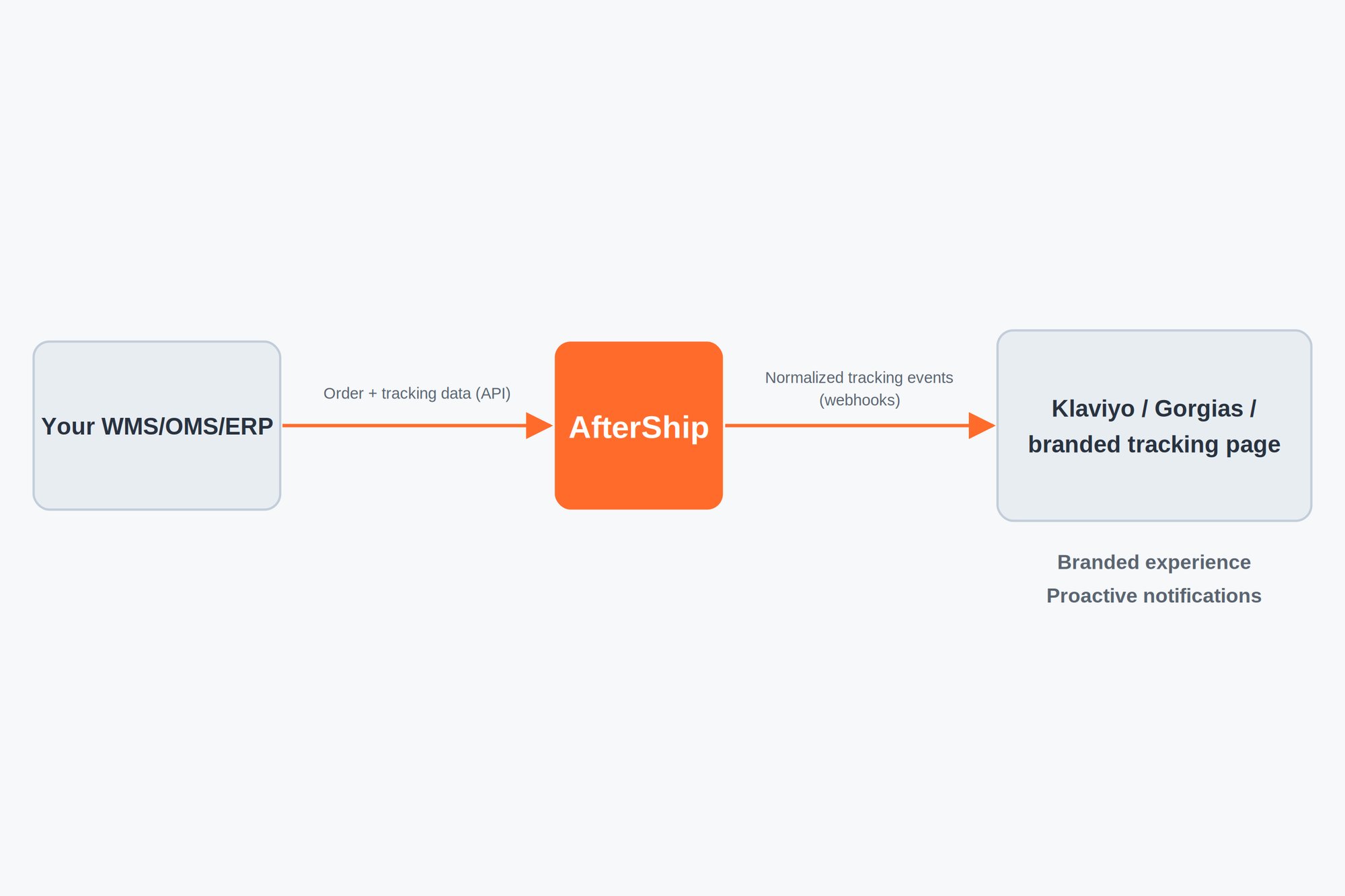
This is not theory, and it is the exact pattern a 3PL relies on to protect its clients' brand experience. A solution trusted by logistics providers like Wineshipping runs precisely this best-of-breed model, keeping its own operational platform for fulfillment while letting a dedicated layer own the moment the order reaches the customer's door.
Wineshipping
“AfterShip has allowed us to become more attractive in the market. We want to tell the market that we are not just Wineshipping, we are wine delivering.”
Pawel Smolarkiewicz, CXO
Building the Business Case for a Dedicated Tracking Platform
By this point the strategic case is clear. Winning the budget meeting is a separate task, and it comes down to translating one decision into the language each stakeholder in the room already speaks. The good news is that every talking point below rests on a verified customer outcome, not a projection. Here is the argument, broken out by who you need to convince.
- For the CFO, lead with cost to serve. A dedicated tracking experience deflects WISMO tickets before they reach a human, and the deflection is measurable: Wineshipping cut winery WISMO by 80 percent. Fewer tickets at the same headcount is margin handed back to the operation.
- For the CMO, reframe the tracking page as media you already own. A branded tracking page draws about 3.2x views per order, so a brand shipping 1,000,000 orders a year generates roughly 3,200,000 branded page views a year, a high-intent surface for upsell and retention that costs nothing extra to reach.
- For the CCO or Head of CX, the metric is trust. Proactive, branded communication and accurate delivery dates replace anxiety with confidence, and that shows up directly in CSAT and in repeat-purchase behavior.
None of this is hypothetical at scale. eBay, running its post-purchase tracking on a dedicated layer, expanded from under 100 to more than 650 integrated carriers, with about 400 active each week, and now auto-corrects 200,000-plus packages each month. That program drove $1,000,000-plus in operational savings, about a 10 percent improvement in EDD accuracy in 2024, and about a 20 percent improvement in valid tracking rate. Those are the numbers a finance team recognizes on sight: more coverage, cleaner data, and lower cost, all at once.
Smaller brands see the same shape of return. Vivino attributes about 30 percent repeat sales to its branded tracking page and about a 50 percent reduction in WISMO tickets, which is the clearest evidence that the marketing surface and the support savings are two sides of the same investment rather than competing line items.
The Right Tool for the Most Important Job: Keeping Your Customer's Trust
Strip away the architecture diagrams and the ROI math, and one fact remains. The final mile is the most intimate stretch of the customer relationship, the days when a buyer checks their phone, waits at the door, and quietly decides whether your brand is one they trust. That moment is too important to inherit from a back-office feature that was built to manage inventory.
A dedicated solution does not ask you to compromise anywhere else. Your OMS, WMS, or ERP keeps running the operation with the same strength it always has, while a purpose-built layer owns the experience your customer actually sees. That is the logic behind how leading 3PLs deliver a better post-purchase experience, and it is the reason the best-of-breed stack keeps winning: each system does the one job it was designed to do best.
Settling for built-in tracking is not a small convenience. It is a quiet decision to let your most important customer moment run on a feature no one built for it. The retailers and 3PLs that take the post-purchase experience seriously make the opposite choice, and they make it on purpose. If you want to see what that looks like on your own orders, this is the place to start.
Proactive shipment tracking that delights your customers, reduces WISMO tickets, and optimizes your delivery performance.
Book a demoFrequently Asked Questions
Is the tracking in my WMS/OMS good enough?
It is good for internal operational visibility tied to inventory and routing. It usually surfaces the carrier's own raw status language and has no customizable, customer-facing branded page or proactive notification engine, which is where WISMO and CSAT pressure live.
What are the benefits of a dedicated tracking solution?
AfterShip tracks 1,100-plus carriers in one integration, normalizes events into 9 standardized statuses, hosts a branded tracking page on your domain (about 3.2x views per order), sends rule-based proactive notifications via Klaviyo, Attentive, and Omnisend, and surfaces carrier transit time analytics. Named outcome: Wineshipping cut winery WISMO by 80 percent with 10x ROI.
How does a tracking solution integrate with an OMS?
Through a documented Tracking API and webhooks. You push order and tracking data in (create-tracking endpoint), AfterShip pushes the 9 normalized statuses back out via webhooks, and those events feed the branded page, the notification engine, and your helpdesk. It is a standardized API integration, not a one-click native connector.