
ShippingEasy vs Easyship: The Verdict for Growing DTC Brands

You've Outgrown Your Starter Shipping: Now What?
You've hit a wall. The shipping process that got you to 1,000 orders a month is now the biggest bottleneck to hitting 10,000. You're comparing ShippingEasy and Easyship to solve it. This article will give you a verdict, but it will also argue that you might be asking the wrong question.
The pain is real and specific. Your team still creates labels by hand, one order at a time, because the starter plan never automated the boring 80%. WISMO tickets ("where is my order?") climb every week as volume grows, and each one quietly eats time and attention your team doesn't have. And when finance asks what shipping actually costs per order, nobody can answer, because the data lives in three systems and reconciles in none.
That pain is what sends most growing brands to a tool like ShippingEasy or Easyship. It's the logical next step: trade the manual grind for real automation and discounted carrier rates. For a lot of brands, it's also the right step.
But before you sign, ask what problem you're actually solving. A faster label fixes today. The bottleneck you'll hit at 10,000 orders a month isn't just labels. It's a post-purchase operation that has to run without you watching it. Hold that thought.
ShippingEasy vs. Easyship vs. AfterShip Shipping: At a Glance
Here's the quick read most evaluators come for: a side-by-side on the criteria that matter when you're scaling, not a generic feature dump.
| Feature | ShippingEasy | Easyship | AfterShip Shipping |
|---|---|---|---|
| Best For | US-focused automation, price-sensitive | International DDP from day one | Building a unified post-purchase platform |
| Core Function | USPS + UPS label automation (Auctane / ex-Stamps.com) | 550+ courier rate-shop + duties at checkout | Multi-carrier labels + engine for Tracking/Returns/AI EDD |
| Automation Depth | Real automation, 'no IT support required' | Rules, international-focused | IF/THEN rules, rate/delivery comparison, multi-location |
| Pricing Model | Free (25/mo) -> Growth $19.99 -> Basic $29.99 -> Plus $49.99 -> Select/Premium -> Enterprise (to 10k) | Free $0 (50) / Plus $29 / Premier $69 / Scale $99 | Free 10 labels -> Essentials $9/mo ($11 App Store) -> Pro $69/mo ($89; API tier) |
| Unified Platform | No, point solution | No, point solution | Yes: Tracking ($11/$70) + Returns ($11/$59/$239) + AI EDD |
A few things stand out. ShippingEasy and Easyship are strong shipping tools that do one job well. AfterShip Shipping does that same job, then connects it to tracking, returns, and analytics on one platform.
That last column is the whole argument of this piece, so keep an eye on it. If you want a more granular breakdown of its features, AfterShip publishes a deeper side-by-side too.
Deep Dive: Which Platform Scales Best?
The table tells you where each tool sits. This is where you decide which one survives contact with 10,000 orders a month. Four criteria separate a starter tool from a platform that scales: automation, batch throughput, carrier costs, and support.
Automation Rules
ShippingEasy earns real credit here. Its rule engine runs with no IT support required, so an ops lead can set conditions once and walk away. That matters when your team is five people, not fifty. ShippingEasy is ideal for simple, US-focused shipping automation.
Easyship's automation leans international. If most of your complexity is customs and duties, its rules are built for that world.
AfterShip Shipping runs its own rule-based shipping automation, with IF/THEN conditions on carrier, service, weight, destination, SKU or product type, and delivery timing. Picture a rule that prints a specific packing slip whenever a SKU contains "FRAGILE." (That's an illustration of the logic, not a screenshot of a single feature.)
The difference that matters at scale is structural. Because AfterShip keeps shipping, tracking, and returns on one platform, the data those rules run on doesn't stay trapped in a shipping silo. Over time, that shared context is what lets your operation make smarter calls, not just faster labels.
Batch Processing & Workflow
At 200 orders before lunch, throughput is the whole game. The question is blunt: how many clicks stand between a stack of orders and a stack of printed labels?
All three platforms support batch label creation, so the real differences live in the workflow around it. Scan-to-print speeds up the pack bench by tying a barcode scan straight to the right label. User roles let you give warehouse staff exactly the access they need and nothing more. Batch validation catches the bad address before it ships, not after it becomes a return.
Map your actual pack process before you commit. The tool that wins is the one that removes the steps your team repeats hundreds of times a day.
Carrier Costs & Management
Rates are where the spreadsheet math gets real. ShippingEasy advertises discounted USPS and UPS rates, up to 82% off UPS Daily Rates, with a workflow built around those two carriers. Easyship casts a wider net: up to 91% off retail across 550+ couriers, which is its core strength for cross-border parcels. Easyship specializes in international shipping with automated duties and taxes.
AfterShip Shipping plays the rate game from both sides, and that's the part most evaluators miss. You can connect your own negotiated carrier accounts, so the rates you fought for stay yours. You can also tap AfterShip's own USPS discount, advertised as up to 90% off with no minimum volume. AfterShip compares rates and delivery times across carriers and applies your routing rules to each order, so cost and speed both stay in view.
The takeaway is simple. If you already have negotiated rates, you shouldn't have to surrender them to gain automation. The best setup keeps both.
Support for When Things Break
Every shipping tool looks identical until a carrier integration breaks at 4 p.m. on a Friday. Support is the criterion nobody weighs until they need it, and then it's the only one that matters.
The honest read is that support quality varies by plan across all three platforms, and the experience on an entry tier is rarely the experience higher up. What you're really buying at scale is a faster path to a human who can fix the thing.
AfterShip offers dedicated support on its higher tiers, which is the level an ops manager who can't absorb downtime should be evaluating. Whichever tool you pick, ask exactly what support looks like on the plan you'll actually be on, not the one in the headline.
Run all four tests and a pattern emerges. On the ShippingEasy vs. Easyship question alone, both are genuinely good at what they do. But every one of these criteria quietly points at the same larger question: what happens to all this data once the label is printed? That's what the next section is really about.
The Hidden Costs of a Disconnected Post-Purchase Stack
So you pick a shipping tool. The ShippingEasy vs. Easyship decision feels like the big call you have to get right. It isn't. The more expensive problem isn't the tool you choose, it's everything that tool can't see.
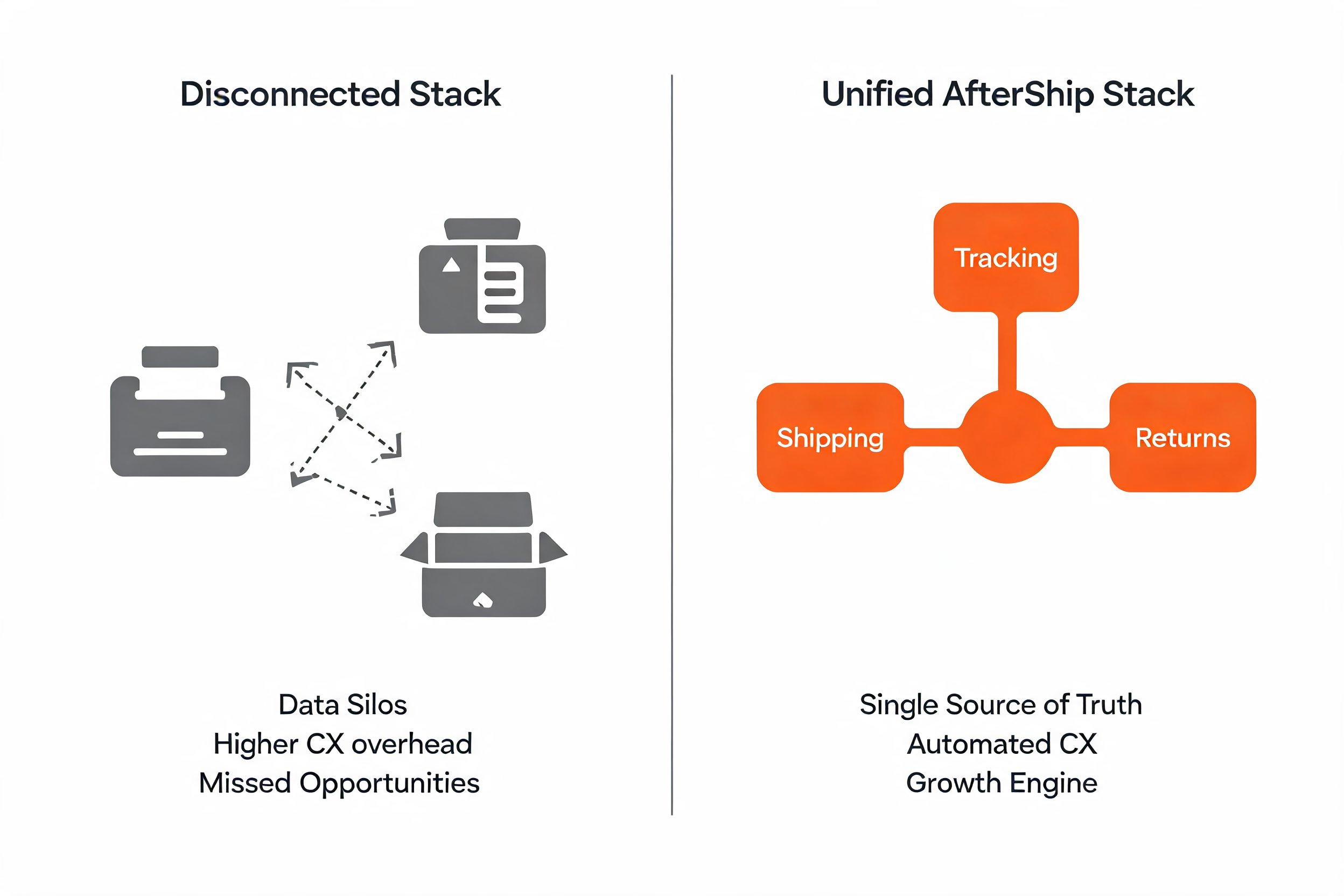
Here's what a disconnected stack actually costs you. You buy a shipping tool for labels, bolt on a separate app for tracking, then add a third tool for returns. Each one works on its own. None of them talk to each other. The result is a set of data silos that quietly tax every team downstream:
- Your marketing team can't see delivery status inside Klaviyo, so the "your order shipped" flow fires blind and a prime post-purchase email moment slips away.
- Your CX team in Gorgias doesn't know whether a return has shipped back yet, so agents answer "where's my refund?" by digging through a second system.
- You can't show an accurate delivery date on your product page, because your shipping tool and your storefront were never introduced.
None of these are edge cases. They are the daily friction of running three tools that were each built to do one thing. Every silo is a place where a customer falls through a crack you can't even see from your shipping dashboard.
The cost compounds in two directions at once. Operationally, every disconnect adds a manual reconciliation step that someone has to own. Strategically, the data you'd use to improve, like which carriers run late or which SKUs drive the most returns, sits scattered across tools that were never designed to compare notes. You end up paying for three subscriptions and still flying half-blind.
The Unified Platform Advantage: How AfterShip Solves for Scale
AfterShip unifies shipping, tracking, and returns on one platform. This is the case for a platform instead of a pile of tools. AfterShip Shipping is the engine that prints the label, but its real value shows up when all three share one system of record.
Start with what each piece does. AfterShip Tracking gives customers real-time, branded order tracking and cuts WISMO tickets by 65%. AfterShip Returns runs a self-service portal with smart routing, so most returns resolve without a support agent in the loop. AI EDD puts an accurate delivery date on the page before checkout, with 80%+ order coverage and 90% first-prediction accuracy.
Now connect them. When all three run on one platform, your analytics stop being three exports you stitch together in a spreadsheet on Friday afternoon.
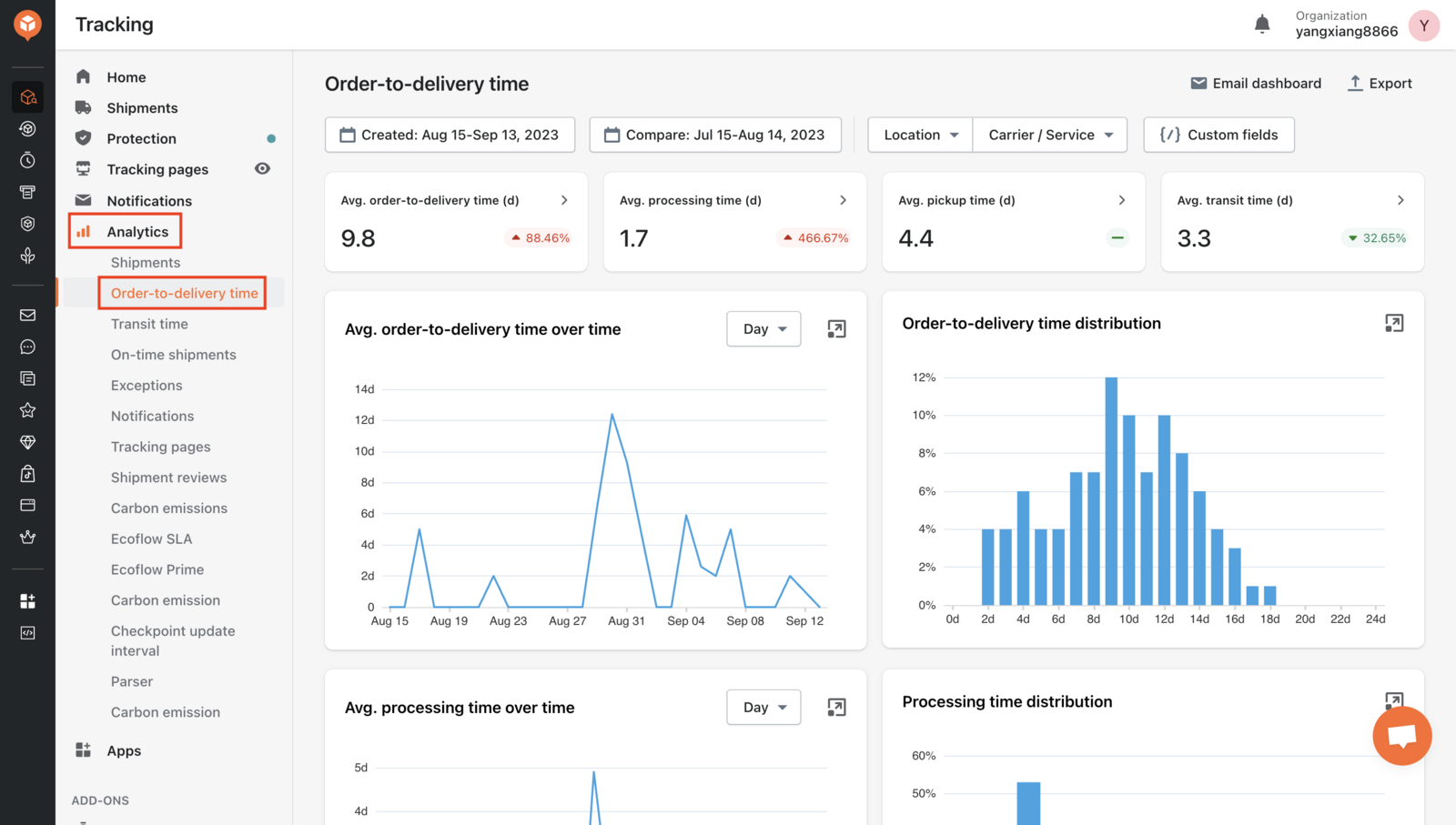
The one-platform point is bigger than any single screen. When shipping, tracking, and returns run on the same system, the silos from the last section disappear. The same data that was trapped in three tools starts doing three jobs at once: it powers better CX through proactive notifications, lowers cost by routing returns intelligently, and lifts conversion by showing a believable delivery date before the customer buys. Third-party data backs this up: 73% of shoppers say delivery-date estimates influence their purchase decisions, and 40% won't buy without one, according to a 2025 Narvar report.
Here's the loop in practice. A delay surfaced in tracking can trigger a proactive notification before the customer opens a ticket. A return started in the portal can route to the right location and resolve into an exchange or store credit without a support agent. None of that requires a fourth tool. It's the byproduct of the data living in one place.
You don't have to take our word for the payoff.
On G2, AfterShip scores 4.7/5, ahead of ShippingEasy (4.6) and Easyship (4.4).
The pattern in reviews like that one is consistent. The win isn't a single feature, it's the operation getting simpler as it gets bigger. For a growing brand, that is the rarest and most valuable thing a tool can do.
The Verdict: Which Shipping Software Should You Choose in 2026?
After all the comparison, the decision is simpler than the spreadsheet makes it look. The three tools are not really competing for the same job, so the right answer depends on what job you are actually hiring for. Here's the call for 2026.
Choose Easyship if international shipping with complex duties and taxes is more than 30% of your business. Its strengths are a wide carrier network of 550+ couriers and DDP at checkout, built for cross-border from day one.
Choose AfterShip if you are building a brand for the long term and want one platform for shipping, tracking, returns, and analytics. That is the strategic choice, not just a tool upgrade.
Two honest concessions before you decide. For a small, US-only brand watching every dollar, ShippingEasy will likely be cheaper to start with. For a brand whose entire complexity is DDP international shipping, Easyship's singular focus may fit better than a broader platform. And if you want to survey the broader category first, roundups of multi-carrier parcel management solutions map the wider field of options. Neither point changes the larger pattern. A shipping tool solves shipping. The moment you decide that tracking, returns, and the data tying them together are part of your customer experience, you have outgrown the point-solution question entirely. That is the journey AfterShip is built for, and it is why the ShippingEasy vs. Easyship debate is the wrong place to stop.
Frequently Asked Questions
Does ShippingEasy or Easyship have better Shopify integration?
Both connect to Shopify and pull orders automatically, so for everyday label printing either works. On the Shopify App Store, ShippingEasy rates slightly higher than Easyship (4.3 vs. 4.0) and has the longer track record, so on the narrow question of the shipping integration itself, ShippingEasy has a small edge. The more useful point for a scaling brand is that AfterShip's advantage is not a single better connector, it is running labels, tracking, and returns against the same Shopify order inside one platform. Note that the Built for Shopify designation attaches to AfterShip Tracking and Returns, not to the AfterShip Shipping app.
Can I use my own negotiated carrier rates with these platforms?
Yes, with an important difference. AfterShip lets you connect your own negotiated carrier accounts and also use its own USPS discount, advertised as up to 90% off with no minimum volume, so you can keep the rates you fought for and still benefit from platform pricing. ShippingEasy and Easyship lean primarily on their own platform-negotiated discounts (ShippingEasy up to 82% off UPS Daily Rates with a USPS and UPS focus; Easyship up to 91% off retail across 550+ couriers). If preserving your existing carrier contracts is a priority, confirm each platform supports your specific accounts before you commit.
What are the typical costs for a brand doing 5,000 orders per month?
There is no single sticker price, because the honest comparison is a three-product sum rather than one line item. A representative AfterShip stack is roughly Shipping Pro at $69, Tracking Premium at $59, and Returns Essentials at $11, which lands near $139 per month at direct pricing, versus about $99 per month for Easyship's Scale plan, which covers labels only. AfterShip is not the cheapest per label, and we will not pretend it is; you are paying for one platform across shipping, tracking, and returns. A 25% first-year multi-product discount exists, but it is a sales-led incentive, not a published rate. At genuinely high volume, both sides move to custom Enterprise pricing.