
Beyond Basic Tracking: The Post-Purchase Software Comparison for Mid-Market Brands in 2026


The Real Cost of "Good Enough" Post-Purchase CX
Your team spends 40% of its time on "Where Is My Order?" tickets. That's not a customer service problem; it's a systems problem. Your basic tracking solution is failing, and it's costing you more than just support hours.
Put a number on it before you start any post-purchase software comparison. Take a brand shipping 5,000 orders a month. If 6% of those orders trigger a WISMO contact (the customer asking where an order is), that is 300 tickets every month. At a fully loaded cost of roughly $5 per ticket, you are spending about $18,000 a year answering a question your tracking experience should have answered on its own.
The dollar figure is the easy part. The harder cost is the 40% of your support capacity those tickets consume, capacity you could be spending on revenue-generating conversations instead.
Then there is the dead end. When a shopper clicks "track my order" and lands on a raw carrier page or a broken link, the most valuable moment of attention in the entire post-purchase window goes to the carrier, not to you, and you lose control of the post-purchase experience. That is a missed re-engagement, a missed cross-sell, and a quiet dent in the lifetime value of a customer you already paid to acquire. Repeat buyers are where margin lives, and the tracking moment is one of the few touchpoints a customer opens by choice.
The reduction is provable, and it is large. StackCommerce cut WISMO tickets by 71% year over year, against an internal goal of 25%, after replacing reactive lookups with proactive, branded delivery updates. Other brands land in the same range, reporting roughly 74% to 75% fewer WISMO contacts once customers get delivery updates before they have to ask.
So the consideration-stage question is not whether to fix this. It is what kind of system fixes it permanently.
Stop Comparing Tracking Apps. Compare Post-Purchase Platforms.
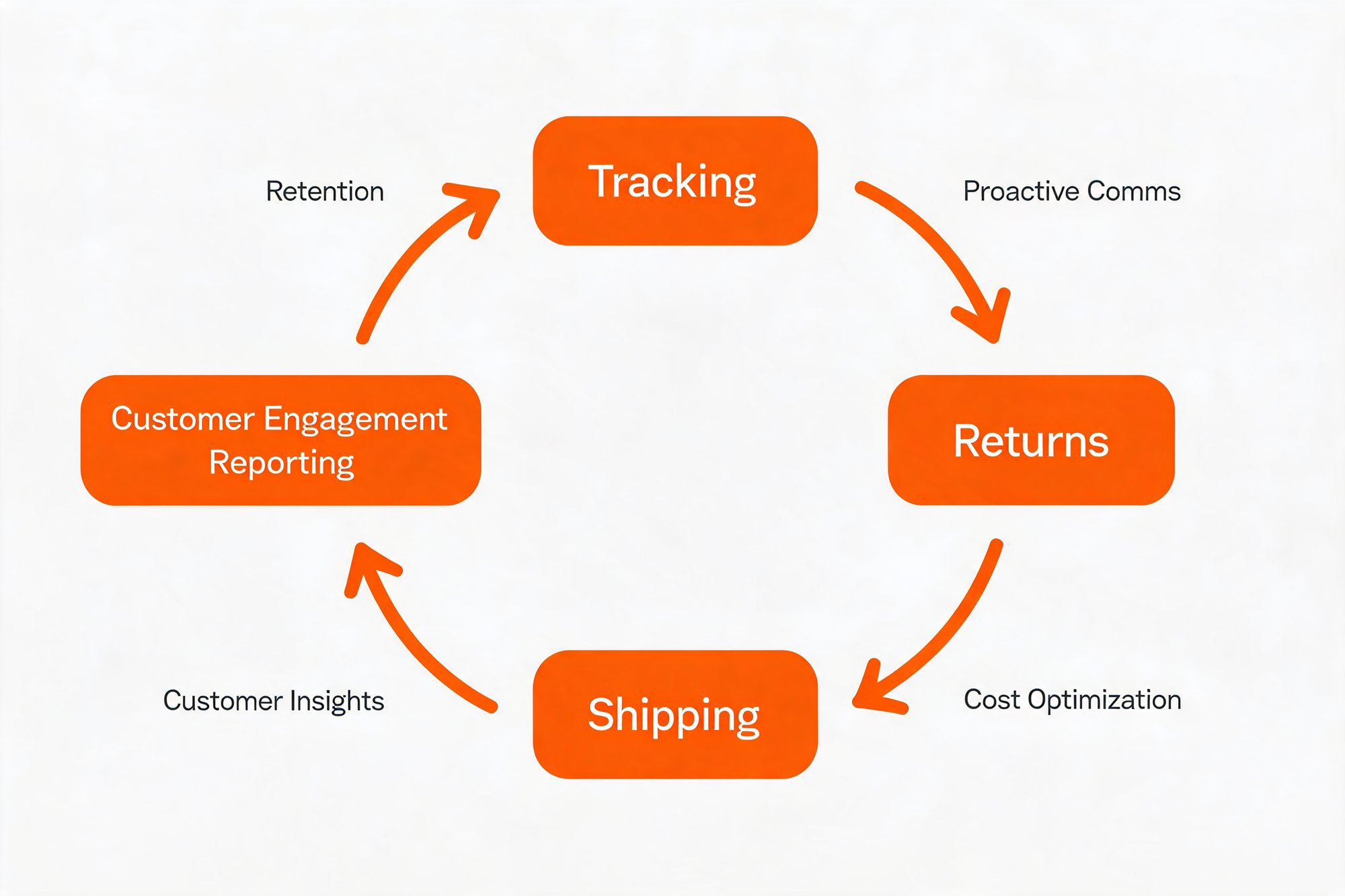
A standalone tracking page treats the symptom; a post-purchase platform fixes the system by stitching tracking, returns, and engagement into a unified customer experience. That distinction is the heart of any honest post-purchase software comparison.
A real platform connects four capabilities on a single data layer:
- Order tracking that standardizes every carrier event into one timeline
- Returns and exchanges that run on that same delivery data
- Proactive communication triggered by real shipment status
- Customer-engagement reporting that shows what each touchpoint earns back
Each piece feeds the next, which is why the value compounds instead of just adding up. Tracking data exposes which lanes and carriers run late. That signal sharpens your returns rules and shipping choices. Those choices generate engagement data, which in turn tightens your notifications and retention plays. Run the loop for a quarter and the system gets smarter on its own.
Here is what that looks like in practice. Tracking flags a 3PL lane that is consistently two days late. The platform suppresses the optimistic delivery estimate for that lane, heads off the WISMO tickets the delay would have caused, and routes affected returns toward a faster resolution, all without a developer touching the code.
A point-solution stack cannot do this. Bolt a separate returns tool onto a separate tracking widget and the two never share data, so every insight stays trapped in its own silo and your team becomes the integration layer.
This is why the brands posting 70%-plus WISMO reductions are not running a nicer tracking page. They are running an integrated operating model. For a mid-market post-purchase platform decision, that is the real lens: not "which tracking page looks best," but "which system gives my team the levers to control the entire journey."
Evaluate platforms, not pages. The criteria in the next section score exactly that.
Post-Purchase Platform Comparison 2026: AfterShip vs. Narvar vs. parcelLab
For a mid-market brand, the winner is the platform that hands non-technical teams the most control across the widest span of the journey. On that test AfterShip leads, Narvar trails on self-serve operability, and parcelLab is strong but narrower.
This post-purchase software comparison scores the three on the five criteria that actually move a mid-market operation: brand-experience control, automation depth, integrated platform scope, analytics, and speed to value. The framing matters. Every gap below is about depth and who has to touch the code, not about whether a vendor can tick a feature box. Speed to value is the most underrated of the five: a mid-market team rarely has a spare developer, so a tool that needs vendor services hours to change anything is slower in practice than its feature list suggests.
| Criteria | AfterShip | Narvar | parcelLab |
|---|---|---|---|
| Brand-experience control (non-dev customization) | Yes, via a self-serve drag-and-drop visual editor; marketing and product-recommendation blocks; custom domain with managed SSL on Premium and up. | Yes, but tracking-page edits are account-manager mediated; pages carry a "Powered by Narvar" mark and often render on narvar.com rather than your own domain. | Communications-led platform (Convert, Engage, Retain, Insights); brand-experience control is not its lead focus. |
| CX-automation depth (proactive rules) | Deep: 7 key statuses plus ~40 sub-statuses mapped to tailored messages; AI EDD at 80%+ coverage (~3x the under-40% baseline), ~90% first-prediction accuracy, 100+ carriers; native email and SMS plus Klaviyo flows (16 Premium / 18 Enterprise). | Yes, but on a narrower trigger set; its estimated-delivery capability (Promise) is sold as a separate paid package rather than included. | Strong: proactive, branded messaging (its Engage pillar) is the platform's core strength. |
| Integrated platform scope (native returns vs bolt-on) | Native: Returns runs on the same back end as Tracking, sharing delivery data and one customer record; 68 auto-label carriers and a 300,000+ drop-off network; return-reason analytics under Returns. | Returns via a separate product (Shield); instant exchanges and returns fraud are packaged as separate paid add-ons (a depth-and-packaging difference, not a missing feature). | Returns handled through its Retain module, narrower in scope than a native returns module. |
| Analytics | Customer Engagement Reporting / Tracking analytics (tracking-page visits, click-through, shipping reviews); return-reason analytics under Returns. | Configurable dashboards and category benchmarks across its brand network. | Analytics via its Insights pillar. |
| Speed to value / implementation | Self-serve: transparent published tiers and a free trial let you evaluate and right-size without a sales engagement. | Sales-led, quote-based rollout; no public pricing or self-serve trial; a managed, services-led implementation. | Quote-based; no public pricing, so evaluation requires a sales engagement. |
Read the matrix as a depth chart for the AfterShip vs. Narvar vs. parcelLab decision, not a feature checklist. The three rounds below unpack the rows that decide it. If you are weighing the broader field, see our roundup of the Top parcelLab Alternatives.
Round 1 — Branded Experience & Customer Engagement
On branded experience, the deciding factor is who can change the page: your team, or your vendor's.
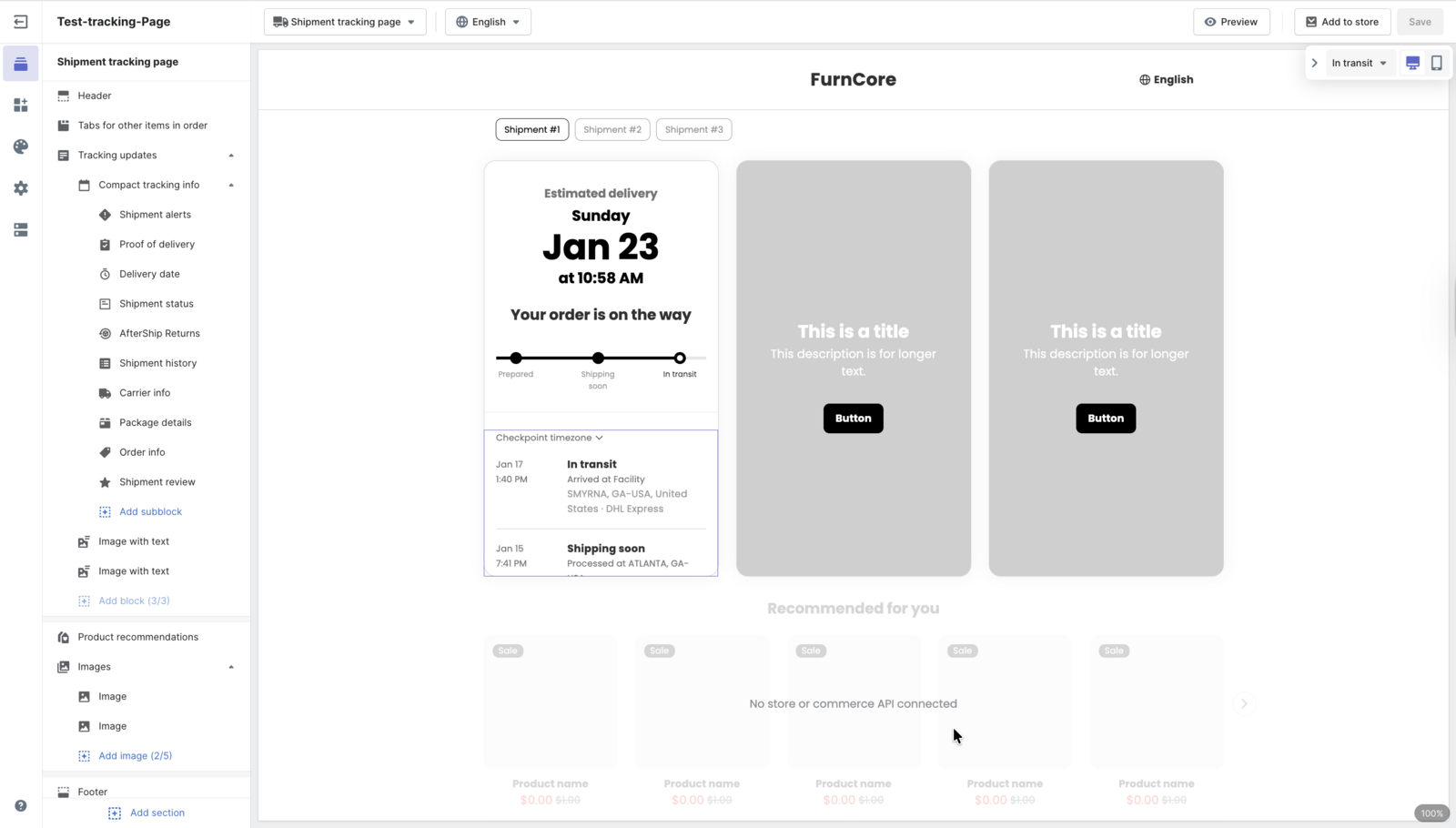
AfterShip puts the branded tracking page in a drag-and-drop editor that operations and marketing can update without a developer or an account manager. You can drop in marketing blocks and product-recommendation modules that turn the tracking page from a status screen into a revenue surface, which is where the "customer engagement" half of this round is won. Those same modules can surface order-status-triggered recommendations, so the highest-attention page in the post-purchase window does merchandising work too. The one genuinely technical step, pointing a custom domain with managed SSL at the page, is a one-time setup gated to the Premium tier, which starts at $59 a month on direct billing.
Narvar runs a different operating model on the same surface. Updating the Narvar branded tracking page generally goes through an account manager rather than a self-serve editor, and the page carries a "Powered by Narvar" mark, often rendering on a narvar.com address rather than your own domain. For a lean team that wants to ship a copy change the same afternoon, that vendor dependency is a recurring cost that lands hardest during peak season, exactly when changes are most urgent. Multiply one mediated change request by every campaign, holiday banner, and policy update across a quarter, and the self-serve gap turns into a line on the operating budget, not just an inconvenience.
parcelLab approaches this round from a different center of gravity. Its platform is communications-led, organized around Convert, Engage, Retain, and Insights rather than centered on a self-serve branded-page builder, so brand-experience control is not the criterion it is built to lead. On this particular test, it is not the front-runner.
If your team needs to own the page and move fast, self-serve control is the differentiator, and it is the first place the platform-versus-tool gap shows up.
Round 2 — Proactive Communications & CX Automation
Proactive communication either prevents WISMO tickets or just narrates them, and the depth of your triggers is the dividing line.
AfterShip's notification engine maps to 7 key shipment statuses and roughly 40 sub-statuses, so you can fire a distinct message for a customs hold, a failed delivery attempt, or a parcel stalled in transit instead of one generic "your order shipped." That granularity is what lets you intercept the specific exceptions that generate tickets, before the customer ever opens one. A "stalled in transit" status, for instance, can trigger a proactive apology with a refreshed delivery estimate, turning a would-be WISMO ticket into a reassurance message. The estimated delivery dates behind those messages come from AfterShip's AI EDD, which reaches 80%-plus shipment coverage, roughly three times the under-40% baseline of raw carrier estimates, at around 90% first-prediction accuracy across 100-plus carriers.
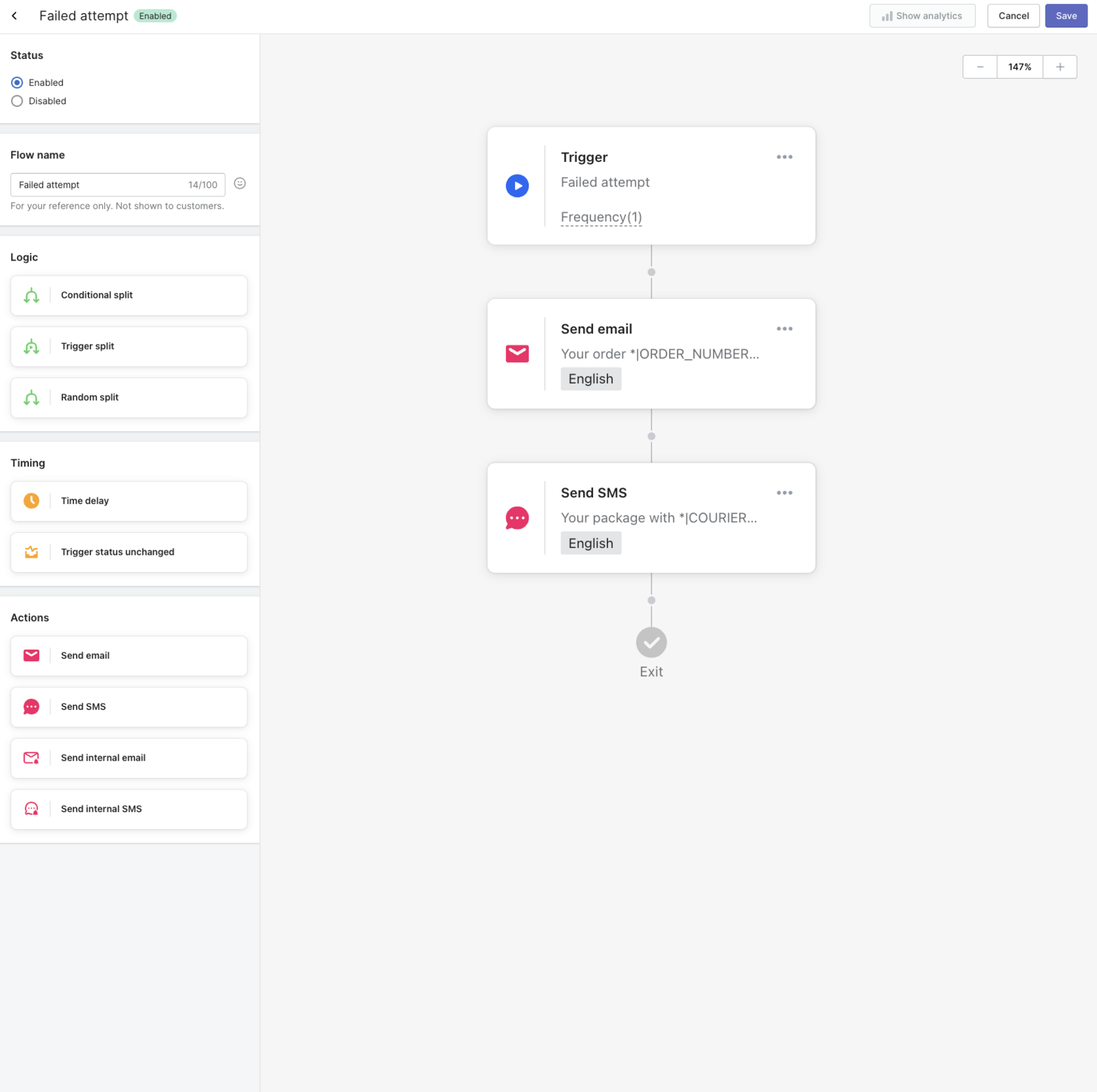
Channels matter as much as triggers. AfterShip sends natively over email and SMS and connects to marketing tools like Klaviyo, with 16 prebuilt flows on Premium and 18 on Enterprise. One honest caveat: SMS is native but commonly metered and region-dependent, so plan for it as a cost line, not a free channel everywhere.
Narvar's Notify handles proactive messaging as well, but across a narrower set of triggers, which means fewer distinct failure modes you can match to a tailored message. Its estimated-delivery capability, Promise, is sold as a separate paid package rather than bundled into the base Track product, so the EDD that powers proactive messaging is an added line item rather than an included one.
parcelLab is the strongest of the three on pure communications. Its platform is built around proactive, branded messaging through its Engage pillar, and for a brand whose single highest priority is communication depth, parcelLab earns a genuine look. Where it gives ground is reach: that communications strength does not extend into the integrated returns and analytics layers the way an all-in-one platform does.
For a mid-market team, the goal is fewer tickets, not prettier ones, and trigger depth plus an included EDD is what gets you there.
Round 3 — Integrated Returns Management
Returns is where "integrated" stops being a slogan: a native returns module reads the same delivery data as tracking, while a bolt-on tool starts from a blank slate.
AfterShip Returns runs on the same back end as Tracking, so a return can be triggered, validated, and refunded against the actual scan data the tracking side already sees. It automates return labels across 68 carriers and offers a drop-off network of 300,000-plus locations, and because returns and tracking share one customer record, return-reason analytics sit right next to delivery performance. The pricing is transparent and self-serve: Returns Premium is $119 a month billed monthly, about $99 a month on annual billing, with Essentials at $19 a month monthly, about $16 on annual; mid-market brands typically land on Premium or Enterprise. Because both products share one customer record, your team runs tracking and returns from a single system instead of reconciling two, the kind of self-serve, services-light setup a lean mid-market team can actually operate.
That shared-data design is the difference a bolt-on cannot copy. When returns and tracking are two separate tools, the returns flow cannot see that a parcel was actually delivered late, so refunds, exchanges, and fraud checks all run on partial information and someone on your team becomes the integration layer.
Narvar offers returns through its Shield product, but capabilities like instant exchanges and returns fraud prevention are packaged as separate paid add-ons rather than included, which is a depth-and-packaging difference rather than a missing-feature one. parcelLab handles returns through its Retain module, which is narrower in scope than AfterShip's native returns module. Both Narvar and parcelLab also run a sales-led, quote-based buying motion with no public pricing, so even evaluating them takes a sales cycle that a self-serve trial sidesteps.
The third-party signal backs the integrated story. AfterShip holds a 4.7 out of 5 rating across roughly 311 G2 reviews, and the reviews that count most for this decision are the ones describing tracking and returns running as a single system.
If returns and tracking do not share data, you do not have a platform. You have two tools and a spreadsheet to reconcile them, which is the exact operating burden a mid-market post-purchase platform is supposed to remove.
How to Build the Business Case for a Post-Purchase Platform
The business case writes itself once you put four numbers in one place: what WISMO costs you today, what you recover, what you gain back in repeat revenue, and what the software costs. It is the same benefits-versus-costs logic behind Forrester's Total Economic Impact methodology.
Use the same brand from earlier: 5,000 orders a month, about 6% of them generating a WISMO contact, at roughly $5 per ticket. Here is the copy-paste version.
- Current WISMO cost. 300 tickets a month at $5 each is $1,500 a month, or about $18,000 a year, before you count the 40% of support capacity those tickets tie up.
- Support-cost reduction. Proactive, branded delivery updates are the lever. StackCommerce cut WISMO tickets 71% year over year, so applying that rate to your $18,000 recovers roughly $12,800 a year.
- LTV uplift. The branded tracking page is re-engagement real estate, so plug in your own numbers. Even a 1-point lift in repeat-purchase rate on 5,000 monthly orders at a $60 average order value is about 50 extra orders a month, near $36,000 a year (illustrative, adjust to your AOV and repeat rate).
- Minus software cost. A mid-market AfterShip stack of Tracking Premium plus Returns Premium runs roughly $1,900 to $2,150 a year, depending on annual versus monthly billing.
Net it out and a conservative first year clears well past $45,000 in combined savings and recovered revenue against about $2,000 in software. That is the ratio that gets a budget approved.
For platform-neutral evidence, see real-world proof from brands like Aetrex. Running on Salesforce Commerce Cloud, not Shopify Plus, and shipping around 10,000 packages a month, Aetrex reported an 86% drop in return-processing time, 74% fewer WISMO contacts, 50% lower operating expense, and a 141-point NPS gain after consolidating tracking and returns on one platform.
The Verdict
For an integrated-platform mid-market brand, AfterShip is the right call, full stop.
It gives a lean team self-serve control of the entire journey, includes AI EDD in core Tracking where Narvar sells its equivalent as a separate paid package, and runs the combined Tracking plus Returns stack for under about $200 a month. Narvar is the better fit for enterprise or services-heavy retailers with developer teams and a large implementation budget, where a managed, white-glove rollout is a feature rather than a tax. parcelLab is a strong choice when proactive communication is the single most important capability, though its integrated reach across returns and analytics is narrower.
Here is the honest limitation. For a pure-play enterprise with massive, complex, multi-system requirements and the budget to staff them, Narvar's services-led model can fit better than a product-led platform. The counter is simple: for an agile mid-market brand, AfterShip's product-led approach delivers more value, faster, and that is exactly the brand this post-purchase software comparison is written for. Once the platform is in place, these amazing post-purchase ideas are a practical next step for turning delivery moments into repeat revenue.
Proactive shipment tracking that delights your customers, reduces WISMO tickets, and optimizes your delivery performance.
Book a demoFrequently Asked Questions
Is AfterShip better than Narvar for Shopify Plus?
For a Shopify Plus brand, the answer comes down to operating model. AfterShip is built to run natively on Shopify and suits brands that want an integrated platform their own team can operate without a services engagement. Narvar suits enterprise retailers with developer resources for a managed rollout. A Shopify Plus brand prioritizing speed and self-serve control will usually find AfterShip the better fit.
What is the pricing model for post-purchase software?
The models split cleanly. AfterShip publishes transparent, self-serve tiers with a free trial, so you can right-size before talking to sales. Narvar and parcelLab are quote-gated with no public pricing, so evaluating them takes a sales cycle just to get a number.
How much does AfterShip cost for a mid-market brand?
AfterShip Tracking starts free on the Shopify App Store for up to 50 orders a month, with paid Tracking tiers there running about $11 to $70 a month, or $29 (Essentials) to $59 (Premium) a month on direct billing. Returns Premium is $119 a month billed monthly, about $99 a month on annual billing. Most mid-market brands land on Premium or Enterprise.
Can a post-purchase platform reduce WISMO tickets?
Yes, and the effect is large once notifications go proactive. Instead of waiting for shoppers to ask, the platform pushes delivery updates and flags exceptions early. StackCommerce cut WISMO tickets 71% year over year after making that switch.
What is the difference between AfterShip, Narvar, and parcelLab?
AfterShip is an integrated, self-serve platform spanning tracking, returns, proactive communication, and engagement reporting on one data layer. Narvar is an enterprise, services-led suite that packages estimated delivery and fraud as separate paid add-ons. parcelLab is communications-led, strongest on proactive messaging, with narrower integrated returns and analytics.