
Parcel Perform vs AfterShip: The Verdict for High-Growth Brands


Is Your Tracking Tool Solving Yesterday's Problem?
Your tracking solution handled 1 million shipments last year. But did it help you reduce your returns rate? Or lower your cost per shipment? If not, you are not evaluating a tracking solution, you are evaluating a data silo. Let us compare what true scalability looks like for a high-growth brand in 2026: a point solution vs. a strategic platform.
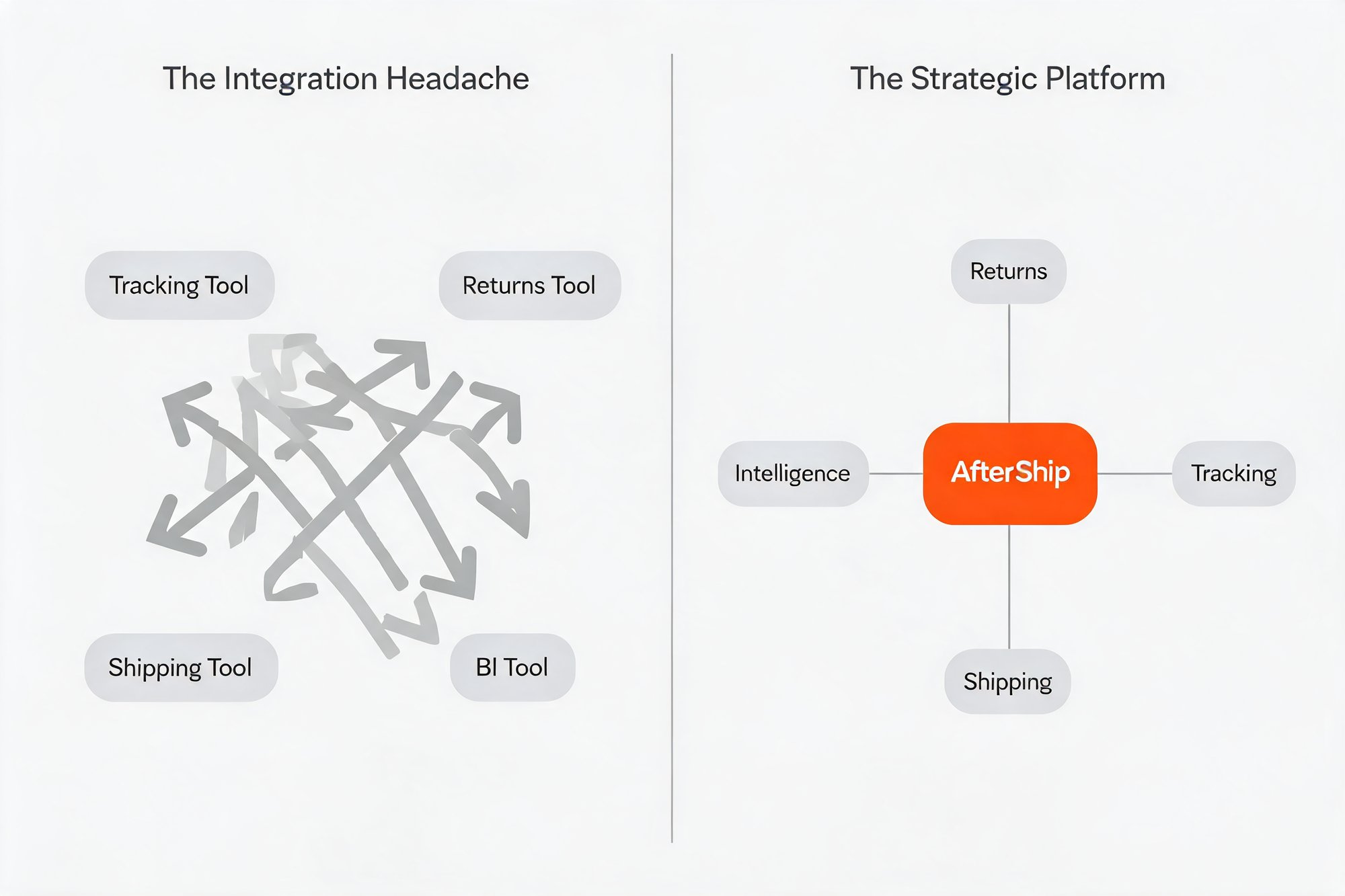
That reframe matters, because the Parcel Perform vs AfterShip decision is usually run as a tracking bake-off, and tracking is the wrong unit of analysis. At 25,000-plus orders a month, you do not have a tracking problem. You have a disconnected post-purchase data problem: tracking, returns, shipping, and analytics living in separate systems that were never designed to talk to each other.
The hidden cost of a stitched-together stack rarely shows up on any single invoice. It shows up as engineering build time spread across multiple vendor APIs; as ongoing maintenance every time any one of those vendors changes its API; as recurring data-ops work to join tracking, returns, and shipping into the single BI view your CFO will actually trust; and as an inconsistent customer experience, where the tracking page, the returns flow, and the delivery promise each look and behave like they came from a different company, because they did.
A unified post-purchase platform answers this at the architecture level, not the feature level. When tracking and returns share one data model, shipment data syncs once and returns automation can react to delivery status instead of waiting on a nightly export and a brittle join. That is the real scalability question, and it is not the same question as "who covers more carriers."
So let us start where you started: core tracking.
Head-to-Head: AfterShip vs. Parcel Perform on Core Tracking
On the capability most buyers shortlist first, the two are genuinely close, and Parcel Perform is a serious tool here. The table below compares them on the dimensions that matter to an operations leader running at scale.
| Feature / Capability | AfterShip | Parcel Perform |
|---|---|---|
| Tracking carrier network (read-only) | 1,300+ (live page reads 1,321) | 1,100+ |
| Branded tracking page | Revenue channel: 3.2x views per order, 65% WISMO reduction, product recommendations (AfterShip Personalization or Nosto) and promo banners | Delivery-experience page |
| AI estimated delivery date | Covers 80%+ of deliveries (most carriers under 40%), trained on 4.4B+ shipments; 'up to 95%' ceiling, about 91% single-date, about 96% on a 2-day range | Markets delivery prediction |
| Native returns | Native on the same data model: SKU/reason analytics, delivery-status-driven automation, return labels across 68 carriers | Returns Experience product (AI routing across 500+ services, 700,000+ drop-off points), sold alongside delivery modules |
| Native shipping / labels | AfterShip Shipping generates labels across 130+ carriers (BYO accounts, negotiated rates) | No equivalent forward-shipping label product published |
| Unified analytics | AfterShip Intelligence: one dashboard across tracking and returns on one data model | Strong delivery/logistics data, suited to feeding an existing BI stack |
| Enterprise SLA | 99.9% monthly uptime, contractual, with a published service-credit schedule (10% to 100%) and P1 response (2h first reply / 6h resolution); 99.99+% tracking-API uptime as a product figure | 99.9% stated as a marketing figure; no published credit schedule or incident tiers found |
| Support model | Dedicated CSM and dedicated onboarding on Enterprise; one platform means one onboarding relationship for a multi-product rollout | Enterprise support |
A few rows deserve a verdict rather than a glance. On carrier coverage (the one apples-to-apples row), AfterShip Tracking reads 1,300+ (the live page shows 1,321) against Parcel Perform's 1,100+; both are deep enough that raw coverage rarely decides it for a DTC brand. The branded tracking page is the clearer differentiator: AfterShip positions it as a revenue channel, with reported figures of 3.2x views per order and a 65% reduction in WISMO tickets, against a delivery-experience page focused on status.
The estimated-delivery-date gap is the one worth pressing on. AfterShip's AI EDD covers 80%+ of deliveries, against under 40% for most carriers, and is trained on 4.4B+ shipments, with accuracy stated as up to 95% at the ceiling, about 91% on a single date, and about 96% across a two-day range. Those accuracy figures apply to a subset of major carriers rather than the full tracking network, and the payoff is conversion through a credible delivery promise (slow or unclear delivery is a documented driver of cart abandonment), not a guaranteed lift you can bank in a spreadsheet.
On the SLA, do not be misled by the headline. Both vendors state 99.9% uptime, so there is no win on the number itself. The difference is what stands behind it: AfterShip publishes a contractual service-credit schedule and incident-severity tiers, while Parcel Perform's 99.9% is stated as a marketing figure with no published credit schedule or tiers. For a brand that just lost a peak season to a tracking outage, that distinction is the whole point.
Tracking, then, is a near-draw that AfterShip narrowly edges. But winning the tracking row is not the same as winning the decision, and that gap is exactly where a high-growth brand's evaluation should really begin.
Beyond Tracking: The Platform Advantage Parcel Perform Cannot Match
Here is the part most comparison guides skip. Core tracking is only about a quarter of the post-purchase job; the "where is my order" question is roughly 25% of the story, and the other 75% is everything around it: returns, shipping decisions, and the analytics that tie them together. Judge two vendors on tracking alone and you are optimizing the smallest quarter of the problem.
This is where the platform argument stops being a slogan and becomes architecture. AfterShip Tracking, Returns, Shipping, Protection and Warranty, and Intelligence all run on one data model, one login, and one API. A shipment, a return, and a delivery prediction are not three records in three systems that you reconcile later; they are one customer and one order, described once.
To be fair, Parcel Perform now sells a full Returns Experience product, so this is not a question of who has a returns feature and who does not. The real question for a brand at your scale is narrower and harder: whose tracking, returns, shipping, and analytics actually share one data model, one login, and one API, versus whose are separate products you integrate and maintain yourself.
The difference shows up the moment you try to do something useful with that data, which is what the next three jobs make concrete.
Turn Tracking Insights into Lower Returns
Returns are where a shared data model pays for itself first. Because Tracking and Returns sit on the same platform and the same dashboard, your team can read return reasons (color, quality, and size, broken out by SKU and variant) alongside delivery and transit performance, instead of exporting from one vendor, exporting from another, and stitching the two together in a spreadsheet every week. If you want to test whether a size-driven return rate tracks with your slower lanes, that is a correlation your team runs across the shared data, not a prebuilt report or a single ready-made view that hands you the answer. The benefit is narrower and real: the inputs already sit on one platform, so the analysis starts from one source instead of a weekly reconciliation job.
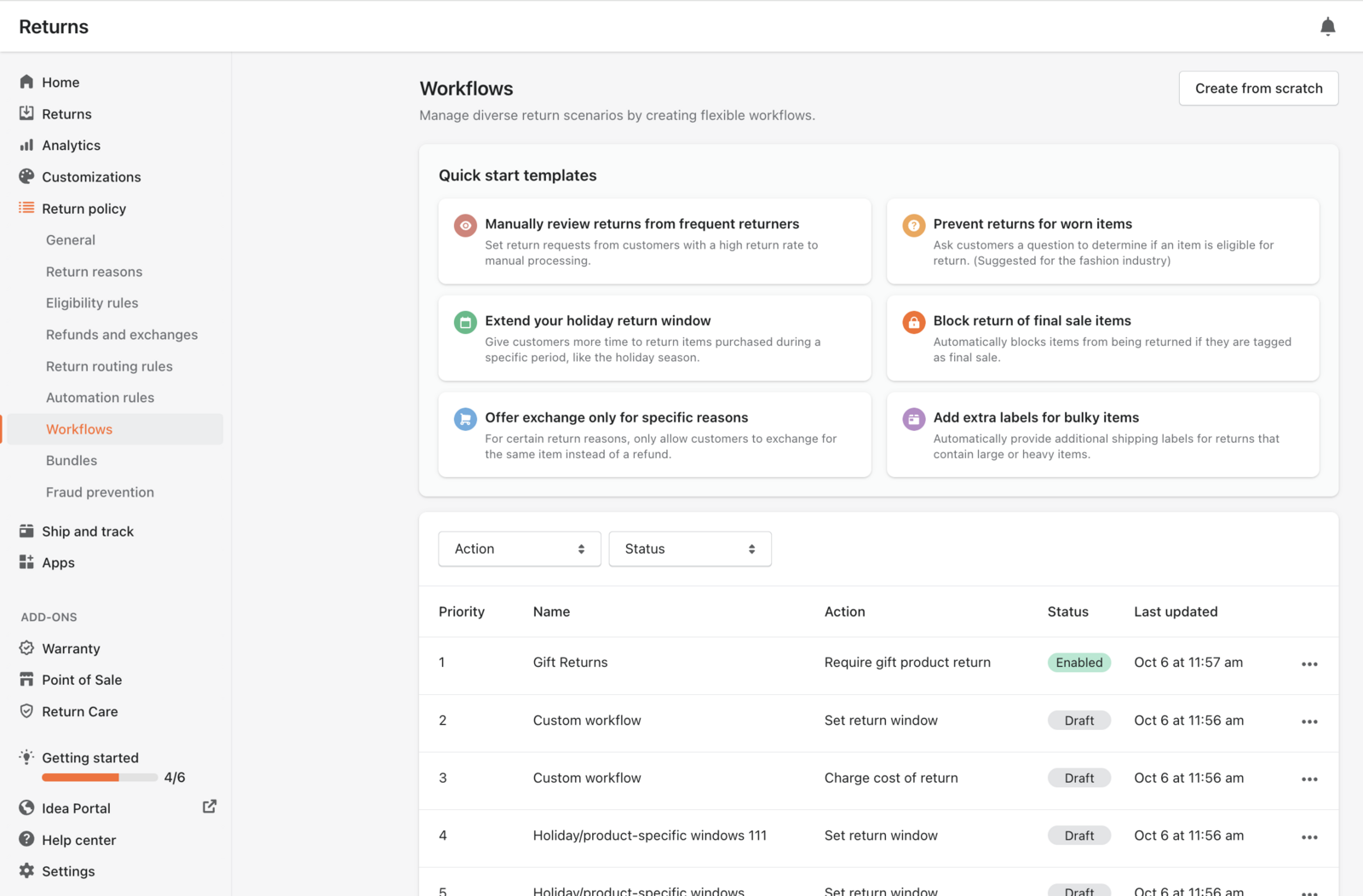
It also drives action, not just analysis. AfterShip Returns can auto-create exchange orders based on delivery statuses, so an exchange can move the moment the original parcel is confirmed delivered, keeping the customer in product rather than in a refund queue. One precision point worth stating plainly: the "Delivery date" value that a return-window rule keys off comes from your eCommerce platform's order record, not from AfterShip Tracking's own carrier scan. The automation reacts to delivery status; it does not read a tracking scan to open the window, and there is no carrier-fault or "delivered but returned" report sitting behind it. Return labels span 68 carriers.
Use Delivery Data to Optimize Shipping Costs
Tracking data is only valuable if you have somewhere to act on it, and a standalone tracking tool hands you the read-out with no controls attached. On one platform, that delivery data helps you optimize your multi-carrier shipping strategy.
There are three concrete mechanisms. First, carrier performance analytics by lane: compare on-time rates, EDD coverage, and shipment volumes across your carriers and service levels, so a carrier that quietly degrades on a key lane becomes visible before it costs you a peak season. Second, rule-based carrier selection in AfterShip Shipping: auto-select options, pre-filled fields, and side-by-side rate and delivery-time comparisons, so the cheapest acceptable service wins by rule rather than by habit. Third, an AI shipping rule that uses the last 30 days of your Shopify tracking data to automatically configure shipping rules for you.
Be precise about that last one, because it is easy to oversell. The AI shipping rule is scoped to the Shopify EDD widget and is available on Premium and Enterprise; it tunes carrier and ship-from choices from your own recent history. It is not a universal one-click cheapest-carrier-by-route optimizer across every sales channel, and you should not buy it expecting that. Shipping spans 130+ carriers using your own accounts and negotiated rates.
Unify Your Data with AfterShip Intelligence
The payoff of everything above is one place to look. Comprehensive analytics from AfterShip Intelligence bring tracking performance and returns analysis into a single dashboard, so on-time rate and returns-by-reason live in the same view instead of arriving as three separate exports from a tracking vendor, a returns vendor, and a BI tool that someone has to reconcile before anyone can act. At 25,000 orders a month, the cost of that reconciliation is not abstract: it is analyst hours every week and a reporting lag that pushes decisions a cycle late.
Be accurate about how the AI works across products, because the honest version is strong enough on its own. The documented cross-product join is prediction-side: Logistics AI uses Catalog AI product tags to sharpen delivery-date predictions, so what the catalog knows about a product improves what the model promises about its arrival. That is a real, specific connection between two products on one data model. It is not a returns-to-carrier correlation report that automatically names the carrier causing your damaged returns; that report does not exist, and a credible business case should not lean on it.
For a high-growth brand, this is the whole thesis in miniature. A point solution can be excellent at its one job and still leave you holding the integration work, the maintenance, and the reconciliation that turn four good tools into one fragile stack. One data model, one login, and one API is not an IT preference; it is what lets returns, shipping, and analytics compound on each other instead of staying four products you pay four times over to keep in sync.
The Verdict for High-Growth Brands in 2026
Start with a brand running the consolidated setup this whole comparison argues for. Aetrex runs AfterShip Tracking and Returns together and cut operating costs 50%, support tickets 74%, and return-processing time 86%, with NPS up 141, across 120K+ packages a year. That is the kind of consolidated-operations result you do not get from stitching point solutions together, because the savings come from one team working one data model, not from any single feature.
Breadth tells the same story under pressure. Mejuri runs Tracking, Returns, EDD, and Warranty on the platform and deflected 2,500+ WISMO inquiries in a single peak week, the exact scenario, a brutal peak, that pushed you into this evaluation in the first place. A point solution can handle its slice of that week; a platform absorbs the whole of it.
So here is the call, with a clear use case for each tool. If your organization needs a raw, normalized tracking-data feed to pour into an existing, heavily customized BI stack, Parcel Perform is a capable choice, and yes, it now sells a full returns product too. If you are a high-growth DTC brand scaling the entire post-purchase experience, with tracking, returns, shipping, and analytics on one data model, AfterShip is the strategic platform, not just the better tracker.
Credit where it is due. Parcel Perform is genuinely strong in global and cross-border B2B logistics-data depth, the kind of normalized delivery intelligence that feeds a custom data warehouse well. That strength is also the boundary. A brand that needs an actionable customer-experience platform, rather than a clean data feed, will keep running into the work of turning that feed into customer-facing action.
On cost, be honest about what you are actually comparing. At 25,000+ orders a month, both AfterShip and Parcel Perform are custom Enterprise deals, so sticker price is the wrong axis. The real number is total cost of ownership. With AfterShip, one platform means one login, one data model, and one API, not one invoice; each product is still billed separately, with a 25% multi-product discount in the first year and no multi-year price freeze to bank on. Returns are a structural cost rather than a tail risk: industry-wide, roughly 19.3% of online sales are returned (NRF 2025), an industry figure rather than a number for any one brand, which is exactly why consolidating returns onto the same platform as tracking and shipping matters at scale. Against that sits the standing cost of a stitched stack: the engineering, the maintenance, and the data-ops that never appear on a vendor quote, the line items a finance team discovers in year two rather than on the order form. Aetrex's 50% lower operating cost and 86% faster return processing are the shape of that difference, achieved by consolidating rather than by buying the cheapest label.
The decision, then, is not which tracker wins a feature checklist. It is whether you are buying a data feed or a platform, and at your scale the platform is the one that compounds, and we make that case openly, including in how we compare to other leading solutions. For a brand that just lost a peak season to a tool that did its one job in isolation, that is not a close call.
See AfterShip Tracking, Returns, Shipping, and Intelligence run on one data model, sized to your own order volumes.
Book a demoFrequently Asked Questions
Does Parcel Perform offer returns management?
Yes. Parcel Perform sells a Returns Experience product with self-service returns, instant exchanges, store-credit retention, AI fraud deterrence, and AI routing across 500+ returns services and 700,000+ drop-off points. The difference is architecture: AfterShip Returns runs on the same data model, login, and API as Tracking, Shipping, and Intelligence, so a multi-product rollout is one platform rather than modules bought alongside each other.
Can AfterShip recommend the cheapest or most reliable carrier automatically?
AfterShip surfaces on-time and cost performance by carrier and lane, then lets you turn that into automated carrier-selection rules. On Premium and Enterprise, AfterShip's AI can auto-configure shipping rules from your last 30 days of delivery data, currently for the Shopify EDD widget. It is not a universal one-click optimizer across every channel.
How do the APIs compare for developers?
Both offer APIs. AfterShip's edge is one unified API surface for tracking, returns, and shipping data, so a scaling brand maintains one integration instead of stitching several vendors' APIs together (auth, webhooks, retries, error handling per vendor).
Is AfterShip cheaper than Parcel Perform?
Not on sticker price. At 25,000+ orders/month both are custom Enterprise deals. AfterShip's case is total cost of ownership: one platform, one API, one data model, one SLA, and a 25% multi-product discount in the first year, against the build-and-maintain cost of a stitched stack.