
Choosing an Email System: A Guide for Mid-Market Retail

If you are shopping for an email system for mid-market retail, you are probably asking the wrong question.
Most teams ask which tool sends the best post-purchase email: Klaviyo, HubSpot, or something else. But your campaign builder is not the problem. Klaviyo and HubSpot are very good at what they were built for, including promotions, lifecycle flows, segmentation, and revenue attribution before the order ships.
The chaos starts after checkout. Your support queue fills with "Where is my order?" tickets, your "shipped" email fires hours late, and your "delivered" notification lands while the customer is still staring at an empty porch. None of that is a copywriting failure. It is a data failure.
So the real question is not which email tool to buy. It is which underlying data system should control your post-purchase communication. Get that wrong, and the best-written email in the world still goes out with stale information.
Why Your Marketing Cloud Is Failing Your Customers Post-Purchase
Your marketing cloud is only as current as the data feeding it.
For shipping events, that data arrives late and incomplete. Generic email systems often rely on delayed post-purchase data. Your ESP does not talk to carriers directly; it waits for your store platform or order management system (OMS) to relay an update, then triggers a flow. By the time the event reaches the customer, the package has often already moved on.
Klaviyo's own documentation is explicit about the limitation. Shipment events only reach Klaviyo when they are available in Shopify, and Shopify only passes along notifications for certain carriers. HubSpot inherits the same dependency. If your carrier is not one your store platform relays, the event never arrives, and your automated flow stays silent.
This is not a question of whether a marketing cloud can run post-purchase messaging. It can. The issue is the source and the timing of the data it has to work with. A flow built on a feed that is partial and lagging produces notifications customers stop trusting.
Think of it as yesterday's newspaper. The layout is clean, the writing is sharp, and the headline is already wrong. A "your order is on its way" email that arrives after delivery does more damage than no email at all, because it teaches customers to ignore you.

The Real Question: Is Your System Built on Marketing or Logistics Data?
Once you see the problem as a data problem, the buying decision changes shape. You are not choosing an email vendor. You are choosing which database owns the truth about a shipment.
There are two architectures, and they behave very differently.
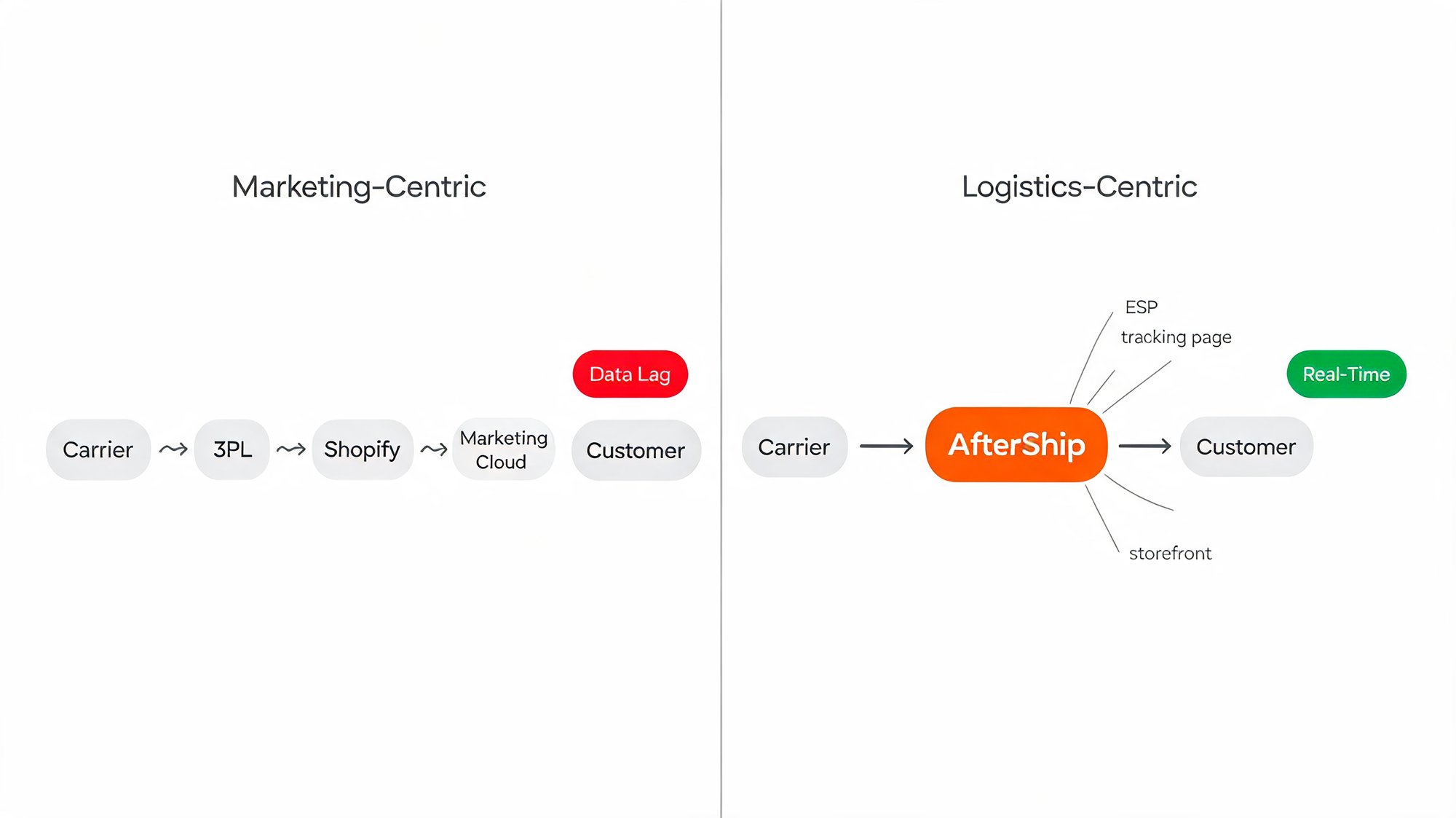
Model 1 is marketing-centric. Carrier and warehouse events flow into your store platform, the store platform relays a subset to your ESP, and the ESP messages the customer. Every hop adds latency and drops detail. The marketing database sits at the end of a long chain, reacting to whatever trickles down. This is the model that produces the data lag you feel today.
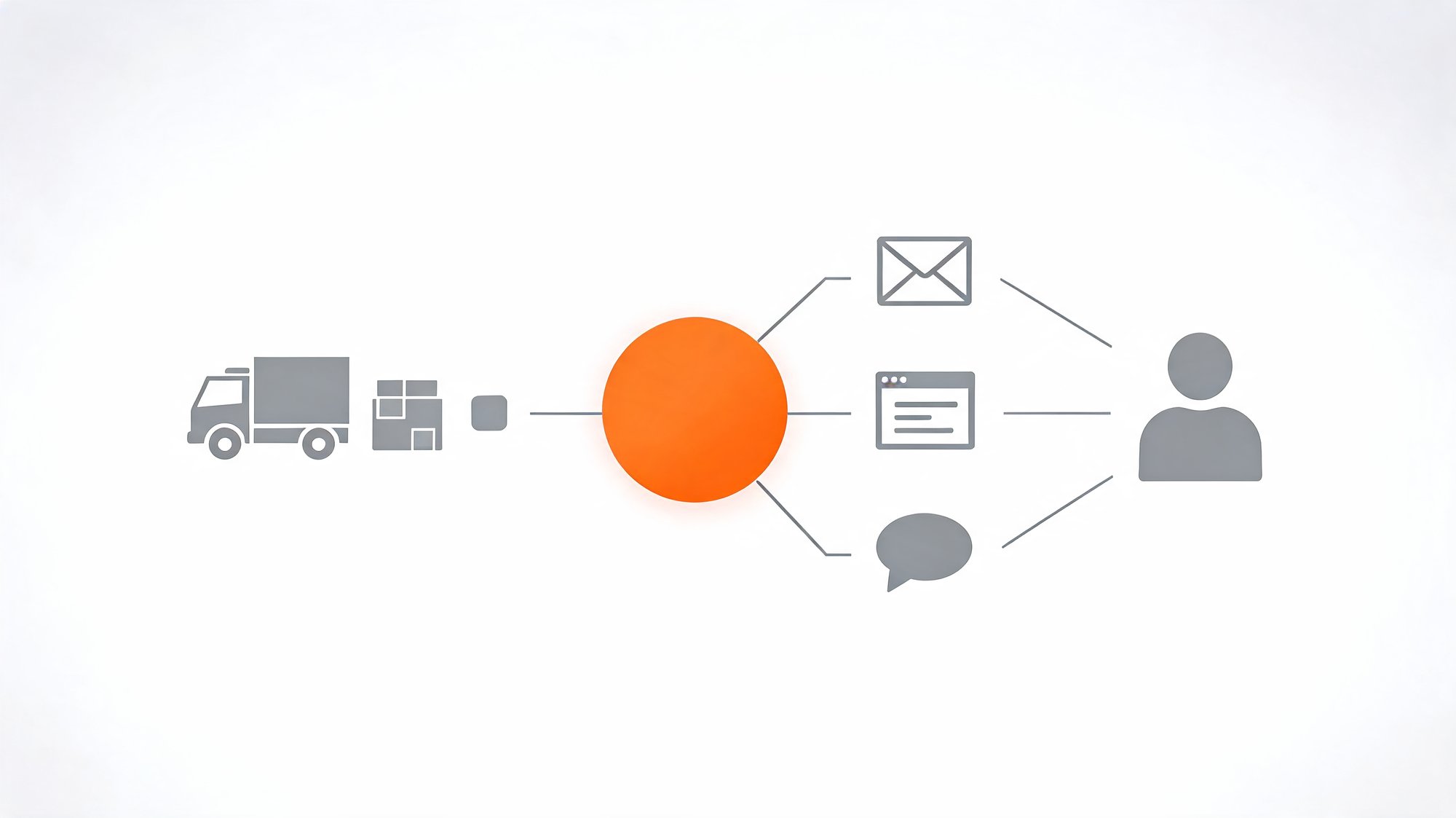
Model 2 is logistics-centric. A dedicated post-purchase platform sits directly between the carriers and everything customer-facing. AfterShip connects directly to the major carriers your volume depends on, normalizes delivery events across 1,300+ carriers into one consistent format, predicts the delivery date, and owns the shipment's status. It then feeds that clean, real-time state outward to your ESP, your help desk, your branded tracking page, and your storefront.
The difference is direction. In Model 1, marketing data flows toward logistics as an afterthought. In Model 2, logistics data is the source of truth, and your email tool becomes one of several channels it powers.
That single source of truth is what lets every downstream channel say the same accurate thing at the same moment. For a mid-market retailer, this is the architectural choice that decides whether post-purchase email is a liability or an asset.
5 Evaluation Criteria for a True Post-Purchase System in 2026
A true post-purchase system is judged on its data architecture, not its template gallery. The five questions below separate a platform that owns shipping data from a marketing tool that merely receives it.
A marketing cloud fails most of these tests for one structural reason: it has no carrier connection. It waits for your store platform to forward whatever it happens to relay. A dedicated platform connects to the source instead.
- Direct data integration. Ask how the system actually gets its shipping events. AfterShip connects directly to the major carriers your volume depends on, such as FedEx, UPS, DHL, and USPS, using carrier APIs and webhooks. It then normalizes events across 1,300+ carriers into one consistent format. Not every one of those connections is a direct API, and any vendor claiming all of them are is overstating it. What matters is that the carriers carrying most of your volume are direct, while a marketing cloud inherits only what your store platform forwards.
- Event-driven automation. Ask whether the system triggers on real shipping events or only on a coarse "fulfilled" flag. AfterShip resolves every shipment into 7 core shipment statuses and fires on the events that actually matter, including an exception or a failed delivery attempt. That is the difference between automating your post-purchase communication flows around what is really happening and guessing from a thin status update.
- Unified data model. Ask whether the outbound delivery and the return live under one record. When returns run through AfterShip Returns, the return is created against and linked to the original order, so the forward shipment and the reverse shipment sit on one platform under a single order. This linkage comes from AfterShip Returns specifically, not from standalone Tracking. For your team, it means one timeline per order instead of two disconnected systems to reconcile. A post-purchase platform centralizes logistics and returns communication data.
- Predictive intelligence. Ask whether the system can tell a customer when a package will arrive, not just where it is. AfterShip's AI estimated delivery date (EDD) is a hybrid model that combines machine learning with rule-based logic. It reaches up to 95% accuracy: roughly 90% of orders arrive on time, climbing to around 95% once proactive updates are layered in, with 91% accuracy on a single predicted date and 96% on a date range. That holds across 80%+ of shipments, against under 40% for carriers' own estimates, on a 150+ carrier prediction network. Read "up to 95%" as a ceiling, not a flat guarantee.
- CX stack extensibility. Ask whether your agents see shipping context without leaving the help desk. AfterShip's native Gorgias and Zendesk integrations push the tracking number, current status, AI EDD, carrier, and order details straight into the ticket. Your agent resolves a "Where is my order?" question on one screen instead of pivoting across four tabs.
Score any vendor against these five. A marketing cloud will pass on messaging and fail on data.
The criteria describe the engine. The messaging layer, including powerful email and SMS notifications, sits on top of that engine and is only ever as accurate as the data feeding it.
"But We Love Klaviyo…": The Integration-First Approach
None of this means you should rip out Klaviyo. You should not.
This is the most common objection we hear, and it rests on a false choice. AfterShip is not a replacement for your ESP. It is the system of record that makes your ESP better. AfterShip captures and normalizes the shipping data, then feeds clean status events one way into Klaviyo and Attentive, where your team already builds flows and segments.
That feed is usable in two ways, not one. In Klaviyo, AfterShip's events drive up to 16 status-based notification triggers and double as segment definitions, so you can trigger a flow on "out for delivery" and also build an audience of customers stuck in an exception. In Attentive, 8 shipment statuses flow into Journeys and Audience Manager the same way. Native support today covers Klaviyo, Attentive, and Omnisend.
So the architecture is additive, not a swap. Klaviyo keeps doing what it is best at, including campaigns, lifecycle flows, and behavioral segmentation. AfterShip supplies the one ingredient your ESP cannot source on its own: real-time, normalized logistics data.
Do not build this in-house. The tempting shortcut is to wire a handful of carrier APIs straight into your ESP and skip the platform. Carrier normalization is where that plan quietly fails. Every carrier formats its statuses differently and changes them without warning. Maintaining that mapping across hundreds of carriers is a permanent engineering tax, not a one-time project, and it is the exact work a dedicated platform absorbs for you.
For a mid-market retail operation, that is the whole win. Run the two together and you keep your marketing stack intact while finally fixing the data feeding it.
Calculating the ROI of a Dedicated Post-Purchase System
The case for a dedicated post-purchase platform is not a feeling. It shows up in three lines on a spreadsheet: cost down, hours saved, and revenue up.
Start with cost. Integrating a logistics platform can significantly reduce WISMO support tickets. WISMO is the most expensive habit in post-purchase support, and accurate, proactive notifications are the cure. When a customer can see a reliable delivery date and live status, the reason to open a ticket simply disappears.
Up to 65%
reduction in "Where Is My Order?" (WISMO) tickets for brands using AfterShip Tracking.
That headline is backed by named results, not estimates. StackCommerce cut WISMO contacts by 71%. Aetrex cut support tickets by 74%. Each ticket you prevent is roughly $4 to $12 of fully loaded support cost you never spend, and at mid-market volume those tickets add up fast.
The second line is labor, and it is where the savings get physical. A dedicated platform automates the manual reconciliation your team does by hand today.
Marc Nolan cut the time spent on returns by 97%, from 35 hours a week down to 1. Aetrex reduced return processing time by 86% and returns operating cost by 50%. Fellow shortened resolution time by 52%. At enterprise scale, eBay auto-corrects more than 200,000 packages a month and saves over $1 million doing it.
The third line is revenue, where post-purchase quietly compounds. Better data does not only save money. It keeps money you would otherwise refund away.
Marc Nolan doubled its exchange-to-refund ratio and retained $125,000 in 90 days by steering returns toward exchanges. A branded tracking page earns 3.2 times more views per order than a generic carrier page, which turns a routine delivery update into a merchandising surface. AfterShip publishes an illustrative ROI projection of around $17,000 a year for a representative brand. Treat that as a directional model for your own math, not a promise.
Add the three lines together and the pattern is clear: the platform pays for the data, and the data pays for itself. None of these numbers come from a tool sending prettier emails. They come from owning the shipping data underneath. If you want to go past these benchmarks, calculating the total ROI against your own order volume is the honest next step.
Proactive shipment tracking that delights your customers, reduces WISMO tickets, and optimizes your delivery performance.
Book a demoFrequently Asked Questions
What is the best email marketing system for mid-market retail?
For post-purchase, the best setup is not a single email tool. Use a marketing cloud like Klaviyo or HubSpot for pre-purchase marketing, and pair it with a dedicated post-purchase platform such as AfterShip that acts as the system of record for your logistics data. AfterShip captures and normalizes shipping events, then feeds that clean data into your email tool so your notifications reflect the real shipping status. The 2026 best practice is to run both together.
Do I have to replace Klaviyo or HubSpot to fix post-purchase communication?
No. AfterShip is not a replacement for Klaviyo or HubSpot. It feeds clean, normalized status events one way into Klaviyo and Attentive, where they work as both flow triggers and segment definitions. Your marketing cloud keeps running campaigns, flows, and segmentation, while AfterShip adds the real-time logistics data your ESP would otherwise wait on Shopify to relay.
Why are my Klaviyo or HubSpot shipping notifications late or inaccurate?
It is a data-source and latency limitation, not a capability gap. Klaviyo and HubSpot receive shipment events only when Shopify has them, and Shopify only relays notifications for certain carriers. If your carrier is not one that gets relayed, the event arrives late or never, so the notification your flow sends ends up stale.
How much can a dedicated post-purchase platform reduce WISMO tickets?
Up to 65% for brands using AfterShip Tracking, because accurate, proactive notifications remove the reason to open a ticket. That headline is backed by named results: StackCommerce cut WISMO contacts by 71%, and Aetrex cut support tickets by 74%. Your own result depends on your order volume and current WISMO rate.
When should a mid-market brand add a dedicated post-purchase platform?
Add one when any of these is true: you ship around 1,000 or more orders a month and climbing; WISMO runs at 10% to 25% of your support contacts at $4 to $12 each; you ship across more than one or two carriers or multiple warehouses and 3PLs; or you carry material returns volume. If even one applies, a dedicated platform usually pays for itself.
Your Next Step: Graduate from an Email Tool to an Experience Platform
Here is the verdict, stated plainly. For pre-purchase marketing, your marketing cloud wins. For post-purchase operations, a dedicated platform wins. The 2026 best practice is to run both, with AfterShip as the system of record for logistics data and your ESP as the channel that delivers it.
Be honest about the line between them. AfterShip is not a replacement for Klaviyo's or HubSpot's campaign builders, their predictive and behavioral segmentation, their lead nurture, or their pre-purchase orchestration. Those remain best-in-class. AfterShip owns the one slice they cannot source on their own, real-time logistics data, and it makes them better by feeding it in.
You are ready for a dedicated platform once the signals stack up: order volume climbing, WISMO eating a real share of your support queue, more than a couple of carriers or warehouses, or meaningful returns volume.
If even one of those describes you, the email-tool question was never the real one. Map your post-purchase data flow first, decide which system should own the truth about a shipment, and let your email system inherit that truth instead of guessing at it.