
Logistics Tracking API: A Developer's Verdict for 2026


Your current tracking API is probably lying to you. Not maliciously, but through omission - stale data, delayed webhooks, and undocumented downtime that creates a cascade of support tickets. In 2026, that's a C-level problem. This verdict will show you how to choose an API based on the only two things that matter for a developer: performance and reliability.
Before anyone names a winner, we have to agree on what "good" means for a logistics tracking API at production scale. So we start with the criteria, then the contenders, then the head-to-head numbers.
Beyond "Does it work?": The Real Evaluation Criteria for a 2026 Logistics API
The question is no longer whether an API returns a tracking status; it is whether it holds that promise under load and in a contract, because a 99.9% contractual SLA caps your exposure at about 43 minutes of downtime a month while an uncontracted "99.99%" on a marketing page caps nothing.
If you are the engineer signing off on this, you will open the SLA, the live status page, and the docs and check every figure before you stake your name on it. That instinct is correct. A single number that does not survive a click-through should sink the whole recommendation, so the criteria below are the ones that hold up when someone actually verifies them.
Most evaluation checklists still grade on feature presence: does it have webhooks, does it list carriers, does it ship an SDK. That bar was set years ago. At enterprise, 3PL, and marketplace volume, presence is assumed, and the differences that actually break production are qualitative.
Four criteria predict whether a logistics tracking API survives in production:
- Reliability and uptime. Look for a credit-backed contractual SLA, not a string on a homepage. A verifiable delivery model matters more than a vanity percentage. Ask what the contract pays out when the number slips, and whether you can watch it move on a live status page.
- Performance at scale. Treat the webhook delivery model, per-endpoint rate limits, and control-plane response time as three separate questions. A fast synchronous read tells you nothing about how quickly an event is pushed after a tracking update.
- Carrier network depth. Count carriers, then interrogate integration quality: normalized statuses, real international coverage, and how fast a new carrier gets added. A hundred shallow integrations lose to a deeply normalized network every time.
- Developer experience. Documentation, SDK coverage, and support set your implementation time and long-term maintenance cost, and that maintenance is most of your real total cost of ownership.
Notice what is missing from that list: raw feature counts. A longer feature page does not lower your on-call burden, and it is the on-call burden, not the spec sheet, that a tracking API lives or dies on at scale.
Hold those four in mind. They are the lens for everything that follows, and they are the rows you will see scored later.
The 2026 Contenders: A Quick Introduction
Three multi-carrier tracking APIs dominate this shortlist, and they sit at very different points on the scale curve: AfterShip tracks 1,000+ carriers worldwide, ShipEngine lists 200+, and EasyPost covers 100+.
AfterShip is the enterprise and global-scale option. Its tracking network spans 1,000+ carriers worldwide on a read-only tracking model, which is the number to use when you are sizing international coverage rather than label generation. That depth is the reason it lands on shortlists for marketplaces and 3PLs with cross-border volume.
EasyPost is the developer-first, US and Western-centric choice, and it is an independent company. It is independent - not part of the Stamps.com or Auctane group. Its tracking sits alongside a shipping API and covers 100+ carriers, which fits teams whose volume is concentrated in North America and who value per-call simplicity above all else.
ShipEngine is part of Auctane, the lineage that also includes Stamps.com and ShipStation, and it is rebranding to "ShipStation API" in 2026. It lists 200+ carriers and is the natural fit for teams already embedded in that ecosystem.
So when you ask how many carriers each API supports, the honest read is 1,000+ for AfterShip (read-only tracking), 200+ for ShipEngine, and 100+ for EasyPost. Keep the comparison apples-to-apples, because a tracking-carrier count is not the same thing as a label-generation carrier count. The gap matters most the moment a shipment leaves your home region: a 100-carrier US footprint and a 1,000+ worldwide network behave very differently once your orders cross a border.
This is a focused technical showdown, not a market survey. Three credible APIs, one production decision.
The Developer's Verdict: A Head-to-Head API Comparison
On the four criteria above, the gaps get obvious once you put the verified numbers side by side. The table below scores each API on the metrics a developer is accountable for in production, not the features a marketing page leads with.
Here is how AfterShip, EasyPost, and ShipEngine compare on uptime and SLA, carrier depth, webhook model, predictive EDD, SDK coverage, rate limits, independent trust signals, and ownership.
| Criteria | AfterShip | EasyPost | ShipEngine |
|---|---|---|---|
| Uptime / SLA | 99.9 percent contractual Service Uptime SLA (credit-backed); advertises 99.99 percent-plus | No SLA percentage on tracking-API page; 90-day status: API ~99.95 percent, Tracking ~99.97 percent | '100.0 percent' 90-day status-page uptime (a status metric, not a contractual SLA) |
| Carrier network | 1,000+ carriers worldwide (read-only tracking) | 'All 100+' carriers, US/Western-centric | '200+ carriers' |
| Webhook model | Push, HMAC-signed, version-pinned payloads, retry-with-backoff; ~100ms control-plane REST response | Real-time webhooks; trackers free with Shipping API | Webhook support via Auctane/ShipStation stack |
| Predictive EDD | AI EDD callable via POST /estimated-delivery-date/predict + /predict-batch; ~91 percent single-date / ~96 percent two-day range; 80 percent coverage vs under 40 percent; 4.4B+ shipments | SmartRate = pre-purchase percentile transit prediction (NOT a post-purchase EDD) | No documented AI-trained post-purchase EDD figure |
| SDKs | Six official: Node.js, .NET, Python, Ruby, PHP, Go | Python, PHP, Ruby, Node.js, Java, and more | Auctane/ShipStation SDK set |
| Rate limits | Per-endpoint model (reads/writes/EDD separate quotas); rate-limit headers; elevated limits for Enterprise/marketplace | Documented per provider page | Documented per provider page |
| G2 (as of June 2026) | 4.7/5 | 4.2/5 | 1.8/5 |
| Ownership | Independent | Independent (NOT Stamps.com/Auctane) | Part of Auctane (Stamps.com/ShipStation lineage), becoming 'ShipStation API' |
Read top to bottom, the pattern holds: AfterShip leads on carrier depth and a credit-backed 99.9% SLA, EasyPost earns its place on US-centric simplicity, and ShipEngine's 100% is a status-page uptime metric, which is not the same as a contractual SLA. The rest of this verdict pressure-tests each row so you can defend your logistics tracking API choice to your VP, not just assert it.
Deep Dive: Documentation, SDKs, and Developer Experience
Developer experience is not a nice-to-have on a logistics tracking API; it is most of your total cost of ownership, and AfterShip keeps that cost low with six official SDKs and a versioned, three-pane documentation portal.
The documentation is a live Stoplight portal pinned to version 2026-01, served from the base URL api.aftership.com/tracking/2026-01. It uses the familiar three-pane layout: the navigation and endpoint index on the left, the endpoint reference in the center, and runnable request and response code samples on the right. You can read the contract for an endpoint and copy a working call from the same view, which is the difference between a thirty-minute integration and a thirty-minute argument with a 404.
On SDKs, the number to write down is six. AfterShip maintains six official SDKs: Node.js, .NET, Python, Ruby, PHP, and Go. There is no AfterShip Java SDK, so if a vendor comparison claims one, it is wrong; Java belongs to EasyPost's SDK set, not AfterShip's. Six covers the runtimes most production logistics stacks actually run, and each is generated against the same versioned spec, so an SDK upgrade tracks the API instead of drifting from it.
Rate limits are enforced per endpoint, not as a single global ceiling. Reads, writes, and EDD predictions carry separate quotas, so a burst of prediction calls does not starve your status reads. Every response returns rate-limit headers (limit, remaining, and reset), which lets a well-behaved client back off cleanly on a 429 rather than hammering a throttled endpoint. Elevated limits are available for Enterprise and marketplace volume on request.
One deliberate choice follows from that: do not hard-code a requests-per-second number into your integration. The canonical, always-current limits live in the API overview, and AfterShip publishes a complete API overview as the single source of truth. Read the limit off the headers at runtime and treat the overview, not a blog post, as the contract. An RPS you pasted into a comment last quarter is a latent incident; a header you read at runtime is not. The same goes for the comprehensive API documentation, which stays version-pinned so your client and the docs never disagree.
Good docs and stable SDKs are what turn a tracking API from a quarter-long integration project into a sprint.
Performance Under Pressure: Webhook Reliability and the Delivery Model
Reliability at scale is a delivery model you can verify, not a percentage on a slide, and AfterShip backs it with a 99.9% monthly Service Uptime SLA (about 43 minutes of allowable monthly downtime, service-credit-backed).
Start with how events reach you. AfterShip pushes tracking updates to your endpoint instead of making you poll, and every payload is HMAC-signed so your receiver can verify it actually came from AfterShip and was not tampered with in transit. Payloads are version-pinned to a dated scheme (for example, 2026-01), so a future schema change cannot silently break a consumer that was built against today's shape. When your endpoint has a transient outage, AfterShip retries with backoff rather than dropping the event on the floor.
This is also where most vendor comparisons get sloppy, so be precise. The frequently quoted ~100ms figure is the control-plane response time: how fast a synchronous REST call returns when you create a shipment or fetch a status. It is not a measure of how quickly an event is pushed after a carrier scan. Treat the two as separate numbers, because conflating them is how teams get surprised in production.
The real failure mode in this category is not a slow webhook; it is a dropped or unverified one. An event that never arrives, or one your system cannot prove is authentic, quietly creates data drift between the carrier's truth and your database. Signed, retried, version-pinned delivery is the antidote, which is why the delivery model matters more than any single latency stat.
That 99.9% SLA is contractual and credit-backed, not a marketing figure; the homepage may advertise 99.99%-plus observed uptime, but the number you can hold AfterShip to in writing is 99.9%. So if you are asking which API has the best-documented SLA, AfterShip is the one that publishes a contractual, service-credit-backed commitment and lets you watch it on a public status page. The second number worth pinning up is 1,000+ carrier integrations, the read-only tracking network behind every one of those events. Do not transcribe a live percentage off the status page into your evaluation; link the live status page and let it report itself.
The Future, Now: Why AI-Powered Predictive ETAs are a Must-Have in 2026
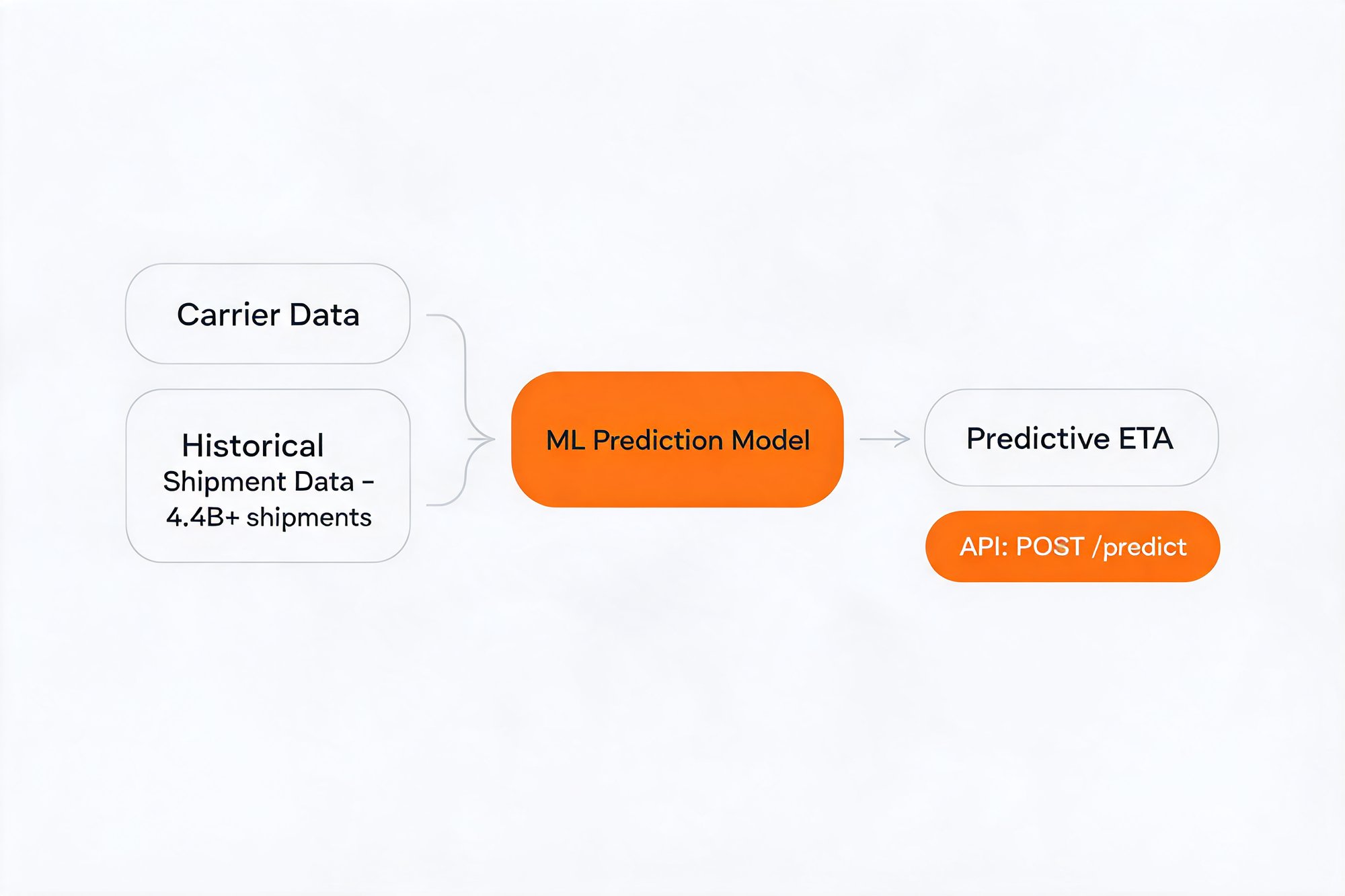
A predictive ETA is only useful if your code can call it, and AfterShip AI EDD is a real endpoint that covers at least 80% of deliveries versus under 40% for most carriers working alone.
The accuracy split is the part an engineer should lead with: about 91% single-date accuracy and about 96% two-day-range accuracy, trained on over 4.4 billion shipments and spanning 150+ major worldwide carriers. The marketing page summarizes this as "up to 95%," but the single-date and range figures are the honest way to set expectations in a status timeline or a checkout promise.
Yes, it is callable from the API, not locked inside a dashboard. You predict a single shipment with POST /estimated-delivery-date/predict and a set of them with /predict-batch. A request and response look roughly like this:
POST /estimated-delivery-date/predict
{
  "origin_address":      { "country": "US", "postal_code": "94105" },
  "destination_address": { "country": "DE", "postal_code": "10115" },
  "slug": "dhl",
  "pickup_time": "2026-06-29T18:00:00Z"
}

200 OK
{
  "estimated_delivery_date": "2026-07-03",
  "confidence_range": { "min": "2026-07-02", "max": "2026-07-04" }
}
Keep this distinct from EasyPost SmartRate. SmartRate is a pre-purchase, percentile transit-time prediction you use before buying a label; AI EDD is a post-purchase delivery-date model you call after the order ships. They answer different questions, and treating them as equivalent is a category error. The batch endpoint earns its keep at scale: one call can score an entire fulfillment run instead of a request per parcel, which keeps you well inside the EDD quota.
The flow from raw inputs to a callable prediction is easiest to see as a diagram.
Put together, the versioned docs, the verifiable delivery model, and a callable AI EDD endpoint are what separate a logistics tracking API you can build a business on from one you merely integrate and hope holds. The next section turns these capabilities into a single verdict.
The Final Verdict: Why AfterShip is the Enterprise-Grade Choice for 2026
For any application with mission-critical logistics and a global footprint, the logistics tracking API verdict points to AfterShip, because it is the only option here that pairs 1,000+ carrier depth with a credit-backed 99.9% SLA.
Strip away the marketing and the case is a stack of verifiable parts: 1,000+ carriers of read-only tracking depth, a contractual, service-credit-backed 99.9% monthly uptime SLA, a webhook model you can actually verify (push, HMAC-signed, version-pinned, retried), six maintained SDKs across Node.js, .NET, Python, Ruby, PHP, and Go, and an AI EDD model you call as an endpoint rather than read off a dashboard. That combination is what enterprise, 3PL, and marketplace applications demand, and no single piece of it rests on a number that fails a click-through.
The payoff shows up in production, not in a feature list. This is work proven by top technology providers building on the same APIs: at one supply-chain-visibility technology provider, an Advanced Analytics / Information Management Lead reports cutting shipment exceptions by about 10% and reclaiming roughly 5 hours a week of manual work after standardizing on the platform. Fewer exceptions and fewer manual hours are the two numbers an operations or engineering leader is actually measured on.
This does not make AfterShip the right answer for every build, and pretending otherwise would insult a technical reader. For a simple, low-volume, or US-only integration, EasyPost's per-call simplicity can genuinely be the better call, and that is a fair choice. But that view prices only the API call. At production scale and global reach, total cost of ownership is dominated by downtime, engineering time, carrier gaps, and stale data, not by the headline price of a single request.
Look at the cost drivers, not a price sheet. A credit-backed 99.9% SLA caps your downtime exposure where an uncontracted status headline does not. A 1,000+ carrier network covers routes a roughly 100-carrier US footprint cannot. Six maintained SDKs and signed, versioned webhooks cut the engineering hours you would otherwise spend nursing brittle integrations, and a callable AI EDD keeps your delivery dates fresh instead of stale. Measured on those drivers rather than a per-call sticker price, AfterShip is the lower-risk, lower-total-cost choice at scale.
So segment the decision honestly. Choose AfterShip when you are an enterprise, 3PL, or global marketplace and reliability, carrier breadth, and scalability are non-negotiable. Choose EasyPost when your volume is US-only or low and simplicity matters more than reach. Choose ShipEngine when your team already lives inside the Auctane and ShipStation ecosystem and staying there is the priority.
If your evaluation comes down to which API documents the most defensible reliability commitment, AfterShip is the one publishing a contractual, service-credit-backed 99.9% SLA, with 99.99%-plus uptime advertised on top. When you are ready, the cleanest next step is to open the AfterShip Tracking API docs and run the numbers against your own SLA, status page, and carrier list, the same way you would vet any dependency you plan to build a business on.
Proactive shipment tracking that delights your customers, reduces WISMO tickets, and optimizes your delivery performance.
Book a demo