
Gorgias vs Narvar: Building the Best CX Stack for DTC Brands


You're searching for Gorgias vs. Narvar, but that's the wrong comparison and it's a sign your CX stack is holding you back. The real question isn't which tool to choose; it's how to build a modern CX engine. Here's the blueprint.
If you run support at a DTC brand doing $10M to $50M in GMV, you already feel the squeeze. WISMO tickets pile up, returns get processed by hand, and you're being asked to present a 2026 stack that scales without adding headcount. So you start comparing the two names you keep hearing: Gorgias and Narvar. The stakes go beyond ticket volume: the post-purchase experience is a major driver of customer retention, which is why the operations layer deserves real strategic weight.
Here's the reframe that changes the whole budget conversation. Gorgias and Narvar are not two options you pick between. They do two different jobs. The strongest stacks pair them, or more precisely, pair a helpdesk with a purpose-built post-purchase platform.
The math is why this matters. WISMO, short for "where is my order," runs about 18 percent of incoming support requests, and by Gorgias's own benchmark a human-handled WISMO ticket costs roughly $12.40 while an automated resolution costs about $0.18 to $0.40. That spread is the entire business case, and it only closes when your communication layer and your operations layer actually talk to each other.
So the real decision is this: keep Gorgias as your communication layer, then choose the operations layer that makes it smarter. For a modern, API-first DTC brand, that operations layer is AfterShip, a stronger fit than Narvar for the reasons we'll lay out next. The rest of this article is the blueprint.
The Two Core Jobs of a Modern CX Stack
A modern CX stack runs on two distinct engines, and treating one as a substitute for the other is what stalls most support teams.
The first engine is the communication layer, and that is Gorgias, a help desk software platform. Its job is the conversation, not the shipment.
- Centralize email, chat, SMS, and social into one agent inbox.
- Manage and route tickets, macros, and SLAs.
- Give agents the context and tooling to resolve issues faster.
The second engine is the operations layer, the post-purchase platform, and that is where Narvar or AfterShip lives. Its job is the order after checkout, not the conversation.
- Track every shipment and surface a real-time status and delivery estimate.
- Send proactive shipping and delivery notifications before customers ask.
- Run returns, exchanges, and warranty claims from request to resolution.
When one engine tries to do the other's job, both get worse. A helpdesk bolted into a tracking role sends generic updates with no carrier intelligence. A post-purchase tool pushed into conversations becomes a second, disconnected outbox. Given that WISMO is roughly 18 percent of your ticket volume, the operations layer is where most of that load gets removed before it ever reaches an agent.
Why the Confusion? Where Gorgias and Narvar Seem to Overlap
The confusion is reasonable, and it comes down to one shared surface: both platforms can message your customer.
Narvar sends tracking and delivery updates as part of its post-purchase role. Gorgias can also send messages, because outbound communication is what a helpdesk does. Stand those two facts side by side and it looks like overlap, so the "Gorgias vs Narvar" framing feels natural. It isn't really overlap. It's two tools touching the same moment from opposite ends.
The danger shows up when you let both message customers without a shared source of truth.
Warning: Running two un-integrated systems as your customer-facing voice is how you ship a broken experience. When your helpdesk and your post-purchase platform each hold their own version of an order, customers get conflicting updates: a "delivered" email from one system and a "still in transit" reply from the other. Agents stop trusting their own tools, tickets reopen, and the WISMO load you were trying to cut climbs back up.
That single failure mode is the argument for an integrated stack, not two parallel ones. Define the two jobs clearly, connect them, and the overlap stops being a conflict and becomes an advantage. Next we'll settle the choice that actually matters: which platform should own that operations layer.
Evaluating Your Post-Purchase Engine: AfterShip vs. Narvar
For a Gorgias-powered DTC brand, AfterShip is the operations layer to choose, and Narvar is the one to measure it against.
This is the most consequential decision you'll make after the helpdesk, because the operations layer is what strips out WISMO load and runs your returns. Once Gorgias owns the conversation, the open question is which post-purchase platform feeds it. That is the real choice behind "what is the best post-purchase platform to pair with Gorgias," and it comes down to the criteria that matter most: Gorgias integration depth, returns automation, carrier coverage, API access, and self-serve setup.
Start with scale, stated honestly, because the figure depends on who is counting. In its own published figures, Narvar reports 1,500+ global brands and integration with 1,000+ carriers. AfterShip's Narvar comparison page characterizes Narvar differently, at 300+ carriers and 1,200+ client brands. Those are two different lenses on the same company, so keep them apart rather than averaging them: Narvar reports more than 1,000 carrier integrations, while AfterShip's Narvar comparison characterizes Narvar at more than 300 versus AfterShip's more than 1,000 native carrier integrations. Read both, and never blend them into one number.
Does Narvar integrate with Gorgias? Yes, and it's worth being precise about how. Narvar connects to Gorgias through a manual HTTP integration that surfaces view-only returns data inside the helpdesk. The contrast with AfterShip is not whether an integration exists, it's how deep it runs. AfterShip ships native, purpose-built Gorgias apps with one-click injection and AI-agent actions, while Narvar's connection is a manual setup an agent can read but not act on. The same nuance applies to the API: Narvar has one, but its integration model is heavier and sales-gated, where AfterShip's is open and self-serve.
Returns automation is the second divider. AfterShip Returns runs condition-based AND/OR workflows that can auto-approve, refund, issue store credit, drive exchanges, and route to the right warehouse or carrier, all from a self-serve, brand-controlled portal. Narvar supports returns too, but its richer configuration tends to be heavier and sales-gated rather than self-serve. On commercials, AfterShip Returns is published from $16/mo with no "Pro" tier, against Narvar's quote-based model.
The full criteria-by-criteria comparison looks like this:
| Criteria | AfterShip | Narvar |
|---|---|---|
| Gorgias Integration Depth | Native Tracking and Returns apps, one-click injection, AI-agent actions | Manual HTTP, view-only returns data |
| Returns Automation | Condition-based AND/OR workflows (auto-approve, refund, store credit, exchange, warehouse/carrier routing), self-serve | Heavier, sales-gated configuration |
| Carrier Network | More than 1,000 native carriers | More than 1,000 by Narvar's own count; AfterShip's comparison page cites more than 300 |
| API and Webhook Access | Open, public API and documentation; webhooks for tracking, delivery-exception, and RMA events | Has an API, with a heavier, sales-gated integration model |
| Self-Serve Setup and Onboarding | Shopify App Store install, published pricing from $16/mo, no Pro tier | Quote-based, sales-led |
For a sophisticated, growth-stage DTC brand already on Gorgias, the verdict is clear: AfterShip is the best post-purchase platform to pair with it. Narvar is a capable enterprise player with genuine brand recognition and real enterprise relationships, but its heavier, sales-gated model suits large retailers on long-term contracts more than the API-first brands building a 2026 stack.
The Power Play: How Gorgias + AfterShip Automates Proactive CX
Paired correctly, Gorgias and AfterShip turn post-purchase support into proactive service that resolves shipping and returns questions before they ever cost you an agent.
How do Gorgias and AfterShip work together? AfterShip's native Gorgias integration runs through two purpose-built apps and three concrete workflows, not a vague promise that it "connects."
The first workflow is unified context inside the Gorgias agent view, and it's important to understand this as the combined effect of two separate apps, never one. Each app does a distinct job:
- The AfterShip Tracking + Gorgias app surfaces real-time shipment status, carrier, estimated delivery date, and order details in the agent's sidebar.
- The AfterShip Returns + Gorgias app can sync returns data directly into Gorgias, surfacing RMA and return-shipment status, up to three recent RMAs, plus refund, return-reason, and warranty data.
Install one app and you get that half of the picture. Install both and your agents stop switching tabs to answer a shipping or returns question.
The second workflow is one-click injection. An agent can inject the current tracking or return status directly into a Gorgias reply or ticket in a single click, so the customer gets an accurate, live answer and the agent never retypes a status by hand.
The third workflow is AI-agent deflection. You can empower the Gorgias AI agent to answer WISMO questions automatically, and when a customer wants to send something back, the AI agent sends a pre-populated return-portal link. The conversation resolves without reaching a human, and the customer never has to hunt for the right page.
That is what "deeper Gorgias integration" means in practice: two native apps, one-click injection, and an AI agent that takes action. It's also why the pairing, not the either-or, is the architecture a modern DTC brand should be budgeting for.
The Anatomy of a Winning 2026 DTC CX Stack
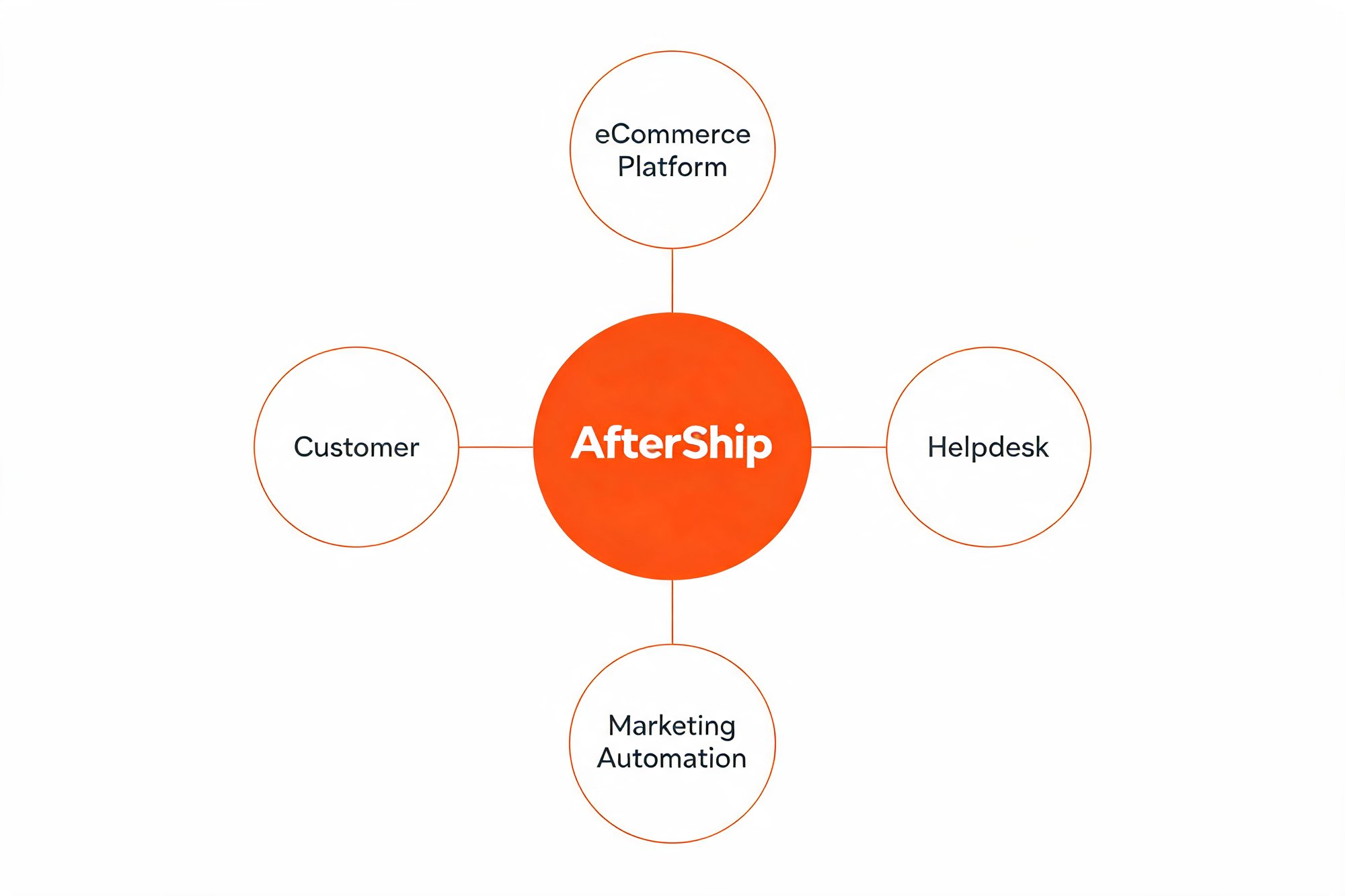
In a 2026 DTC stack that actually scales, AfterShip sits at the center as the post-purchase operations hub, not as one more app bolted to the edge.
Zoom out from the Gorgias integration and look at the whole system. Your store generates orders, your marketing tools talk to customers, your helpdesk fields the questions, and something has to sit in the middle holding the post-purchase truth: where every order is, what has been returned, and what happens next. That hub is AfterShip.
It earns the center by connecting natively to the tools you already run:
- eCommerce platforms: Shopify and BigCommerce.
- Helpdesk: Gorgias.
- Marketing and ESP: Klaviyo, Attentive, and Omnisend.
Those connections move live events, not static data. AfterShip's API and webhooks expose the post-purchase moments your other systems need to act on: shipment and tracking status changes, delivery exceptions, and returns or RMA status changes. When a delivery exception fires, that event can trigger a proactive Klaviyo or Attentive message before the customer even notices, so the stack reacts in real time instead of waiting for a support ticket. Webhooks and API access for Returns sit on the Premium plan and above.
That is the difference between a pile of apps and an actual architecture. AfterShip is the infrastructure the rest of the stack builds on.
The Business Case: ROI of Choosing AfterShip over Narvar
The ROI case for AfterShip over Narvar rests on three numbers a CFO will recognize: fewer WISMO tickets, lower returns cost, and faster time-to-value.
Start with WISMO, because it is the most visible line on the support budget. Proactive notifications and branded tracking pages move customers off your queue and onto self-service. The named results are concrete: Mous cut its WISMO contact rate from 12.9 percent to 5.9 percent, a 54 percent reduction, and StackCommerce reduced WISMO tickets by 71 percent year over year. Those are specific brands with specific numbers, which is exactly what belongs in a budget proposal instead of a headline average.
Second is operational efficiency on returns, where reverse-logistics cost quietly hides. Returns automation does more than refund faster; it removes the manual handling and warranty back-and-forth that eats agent hours. Consider how leading brands like Goodr scale their CX: using AfterShip Returns plus Warranty, Goodr cut support tickets by 60 percent and warranty claims by 75 percent. Keep the scope honest: that is a Returns-and-Warranty result, not a WISMO or tracking figure, and Gorgias is not part of the Goodr story. It still tells your CFO what automated returns are worth.
When you build the case, keep two kinds of proof separate. Capability proof is the integration itself: AfterShip's native Gorgias apps are live and documented, so the workflows above are real, not theoretical. ROI proof is what brands measure once post-purchase is automated, and it stands on its own, independent of any single connector.
“AfterShip allowed us to set up KPI dashboards to see how well everything is going and troubleshoot before it becomes a problem.”
Rosie Jennings, Head of Logistics
Read their story →Brands on AfterShip see results like these because the platform automates the post-purchase work end to end, not because of one integration.
Third is time-to-value, which is really a difference in operating model. AfterShip is self-serve and Shopify-native: you sign up, install, and configure without a sales cycle. Narvar's model is quote-based and sales-led. That is not a knock on Narvar's capability; it is a structural difference in how fast a lean team can get live and start measuring return on investment.
Your Next Move
Your next move isn't booking a demo; it's deciding to architect your stack instead of shopping for tools in isolation.
Stop comparing tools as if one has to win. Keep Gorgias as your communication layer, make AfterShip the operations layer underneath it, and let the two run as one proactive engine. That is the stack that drives WISMO down and CSAT up without adding headcount in 2026.
When you are ready, the step is simple: map your current post-purchase events to the architecture above, and see where AfterShip's Gorgias integration gives your support team the operational backbone it has been missing.
Keep Gorgias as your communication layer and add AfterShip as the post-purchase operations layer: cut WISMO, automate returns, and scale CX without adding headcount.
Book a demoFrequently Asked Questions
How do Gorgias and AfterShip work together?
AfterShip's native Gorgias integration runs through two purpose-built apps and three workflows: unified tracking and returns context inside the Gorgias agent view, one-click injection of live tracking or return status into a reply or ticket, and AI-agent deflection where the Gorgias AI agent answers WISMO automatically and sends a pre-populated return-portal link.
What is the best post-purchase platform to pair with Gorgias?
For a growth-stage DTC brand on Gorgias, AfterShip is the best post-purchase operations layer to pair with it, thanks to deeper Gorgias integration, condition-based returns automation, open API and webhooks, and a self-serve, Shopify-native setup. Narvar is a capable enterprise player, but its heavier, sales-gated model fits large retailers on long-term contracts more than API-first DTC brands.
Does Narvar integrate with Gorgias?
Yes. Narvar connects to Gorgias through a manual HTTP integration that surfaces view-only returns data inside the helpdesk. AfterShip's integration is deeper, with native Tracking and Returns apps, one-click injection, and AI-agent actions.