
The Ultimate E-commerce Tech Stack: 15 Essential Tools for Growth


Your Shopify store is live and sales are climbing. The good news? People love your product. The bad news? You're now drowning in tracking-number lookups, return-request emails, and a chaotic shipping-label process. Your scrappy startup stack is breaking. It's time to build a real one.
That breaking point tends to arrive somewhere between 500 and 5,000 orders a month. The spreadsheets that once felt resourceful turn into liabilities. A customer asks where their order is, and you are three browser tabs deep before you can answer. A return request sits in a shared inbox for two days. Your e-commerce tech stack, the software that runs the business day to day, has quietly become the bottleneck instead of the engine.
The problem is rarely too few tools. It is too many that do not talk to each other. The fix is not one more app. It is a framework. An e-commerce tech stack organizes tools by core business functions, and once you see those functions clearly, the "essential versus nice-to-have" question mostly answers itself.
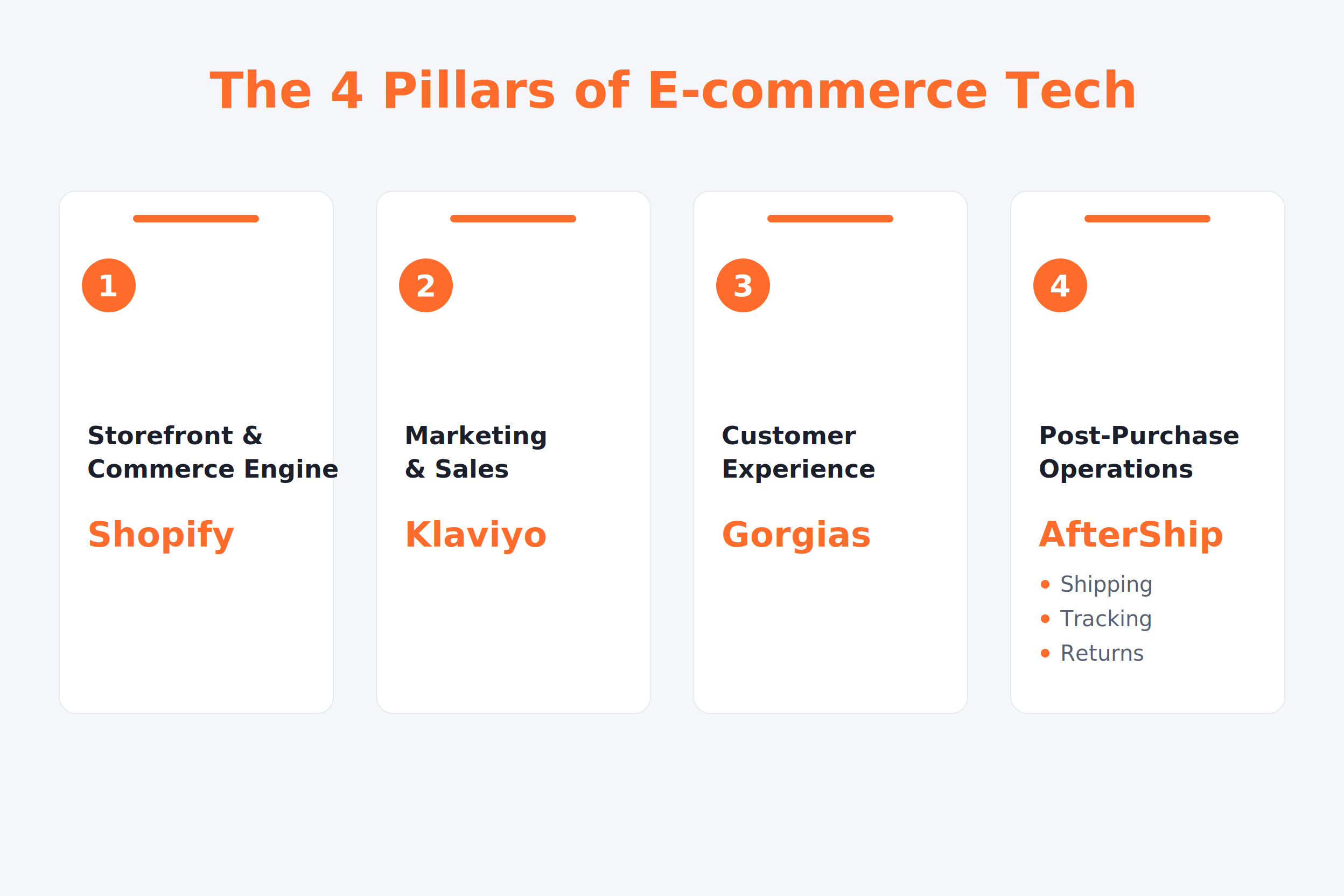
This guide maps 15 tools across four pillars: Storefront and Commerce Engine, Marketing and Sales, Customer Experience, and Post-Purchase Operations. Each tool earns its place by the job it does, not by how long its feature list runs. By the end you will have a way to tell what you actually need from what is just noise.
Your Tech Stack Isn't a List, It's an Integrated System
Most "best tools" roundups hand you a flat list and wish you luck. That is how brands end up running 30 apps that each solve one problem and create two more at the handoffs between them.
A stack is a system, not a shopping list. The value does not live in any single tool. It lives in the data moving between them. When your storefront passes order data to your marketing platform, and your shipping system feeds delivery status back to your support desk, every tool makes the others smarter.
Integrated platforms reduce manual data entry and improve the customer experience. A disconnected stack does the reverse. It forces your team to rekey information between systems, and that is exactly where errors, delays, and 11 p.m. fire drills come from.
So the real question for any tool is not "is this popular?" It is two questions: what job does this own, and how cleanly does it share data with the rest of my stack? Judge the connection before the feature list. A slightly simpler tool that shares data cleanly will beat a feature-heavy one that strands it.
With that test in hand, build the stack pillar by pillar.
Pillar 1 — Storefront & Commerce Engine
Every stack starts with the engine that processes the sale. This is the one decision you cannot easily reverse later, so make it deliberately.
Shopify, and Shopify Plus for higher-volume brands, is the default for a founder shipping 500 to 5,000 orders a month, and for a concrete reason. It owns a single job completely: turn a visitor into a paid, recorded order, then expose that order data to the rest of your stack through a deep integration ecosystem. BigCommerce is a credible alternative, especially for brands with large catalogs or B2B pricing rules.
For this persona, Shopify usually wins on app availability and time to launch rather than on raw configurability. If you are weighing the platform decision, it helps to understand how Shopify works as a platform before you commit, because every other pillar in this guide will plug into it.
Choose your commerce engine for how openly it shares order data, not only for how the checkout looks. That one choice shapes every integration that follows.
Pillar 2 — Marketing & Sales
This pillar owns one job: turn attention into orders, then turn first-time buyers into repeat ones. Four tools cover it, and the best ones all run on real order data.
Klaviyo runs email and SMS. Its strongest move for a post-purchase-minded brand is event-triggered messaging. Through its AfterShip Tracking integration, Klaviyo fires flows on actual shipping events such as shipped, out for delivery, and delivered, instead of guessing at timing. AfterShip Tracking exposes 16 flow triggers to Klaviyo, rising to 18 on the Enterprise plan, available on paid Tracking plans (Essentials, Premium, and Enterprise). A "delivered" trigger that launches a review request the moment the box arrives outperforms a dozen generic sends.
Yotpo and Judge.me handle reviews and user-generated content. The job is collecting social proof, and timing decides the result: a review request tied to the delivery event converts far better than one sent days early while the customer is still refreshing the tracking page.
Ahrefs and Clearscope cover SEO and content, the levers that lower customer acquisition cost over time. Paid channels rent attention; organic search owns it. To see how these pieces fit together, a comprehensive eCommerce marketing strategy ties content, reviews, and lifecycle messaging into one motion instead of four disconnected tactics.
AfterShip Feed closes the pillar by syncing your products, inventory, and orders to high-growth social commerce channels: TikTok Shop as the primary channel, plus SHEIN Marketplace. Rather than managing each channel by hand, Feed keeps catalog and order data consistent across them, so expanding to a new marketplace does not mean rebuilding your operations from scratch.
The throughline across all four tools is the same: a marketing stack earns its keep when it acts on real order and delivery data, not assumptions. That is also the seam where your e-commerce tech stack either holds together or falls apart, which is exactly where the next two pillars, Customer Experience and Post-Purchase Operations, come in.
Pillar 3 — Customer Experience
Customer experience is where your stack either compounds trust or quietly erodes it. Two jobs matter most once you pass a few hundred orders a month: answering support fast, and turning happy buyers into repeat ones.
Gorgias owns support. Its highest-leverage move for a growing brand is surfacing real-time order tracking directly inside the support ticket. When an agent can see "out for delivery, arriving today" without leaving the conversation, the WISMO ticket (where is my order) closes in one reply instead of a back-and-forth. That single capability cuts resolution time on the most common ticket type in e-commerce. Gorgias can also surface return status next to the ticket, which helps agents stay in context, though how much detail appears depends on how your returns tool exposes that data.
LoyaltyLion owns retention. Loyalty programs only work when the underlying experience is good, and post-purchase is most of that experience. A points balance will not rescue a customer who spent three days chasing a lost package. Used well, LoyaltyLion lifts repeat-purchase rate and customer lifetime value by rewarding the behavior a smooth delivery already earned. If you are thinking about how support, loyalty, and channels connect, building an omnichannel customer experience is the larger frame these tools serve.
The pattern repeats: both CX tools get sharper when they run on accurate, real-time post-purchase data. Which raises the obvious question of who owns that data.
Pillar 4 — Post-Purchase Operations
Here is the pillar most "tool stack" guides treat as an afterthought, and it is the one your customers feel most. Post-purchase tools automate shipping, delivery tracking, and customer returns: everything that happens after the buy button.

This is where AfterShip sits, and the model is deliberate: three jobs, one platform. AfterShip Shipping creates labels and compares carrier rates. AfterShip Tracking keeps customers informed from dispatch to doorstep. AfterShip Returns turns refund requests into retained revenue. They run on separate plans, billed independently, so this is not a single-invoice bundle. The advantage is shared data and one vendor relationship: efficient shipping produces accurate tracking, and accurate tracking feeds smarter returns. Each job makes the next one better.
A quick honesty check, because it changes how you plan your stack. AfterShip does not try to be your entire stack. It is the specialist for everything after the buy button, built to plug into the rest. Your storefront stays Shopify. Your marketing stays Klaviyo. Your support stays Gorgias. AfterShip makes them smarter by feeding real-time shipping, tracking, and returns data into each one.
That is what unified brands point to. A global footwear brand running Salesforce Commerce Cloud, for instance, uses AfterShip across both tracking and returns so the two share one source of delivery truth instead of two disconnected ones.
The payoff shows up in the numbers and in the operators living it. StackCommerce reduced WISMO inquiries by 71% with proactive branded tracking, and brands that run tracking and returns on the same platform describe the same compounding effect. One verified G2 reviewer, a Head of Operations at a small business, sums it up:
Create Labels & Optimize Carrier Costs (AfterShip Shipping)
Shipping owns the unglamorous job that eats margin when you get it wrong: getting the package out the door at the right price. AfterShip Shipping handles it with:
- Multi-carrier rate comparison across 130+ carrier integrations and 100+ supported carriers, so you can pick the cheapest viable service per order instead of defaulting to one carrier.
- Smart shipping rules that auto-assign carriers and service levels by destination, weight, or order value.
- Bulk label generation, so a 200-order morning takes a few clicks rather than an afternoon.
The payoff is lower cost per shipment and far fewer manual decisions, which is exactly what a lean ops team needs when volume climbs.
Proactively Track Orders & Reduce WISMO (AfterShip Tracking)
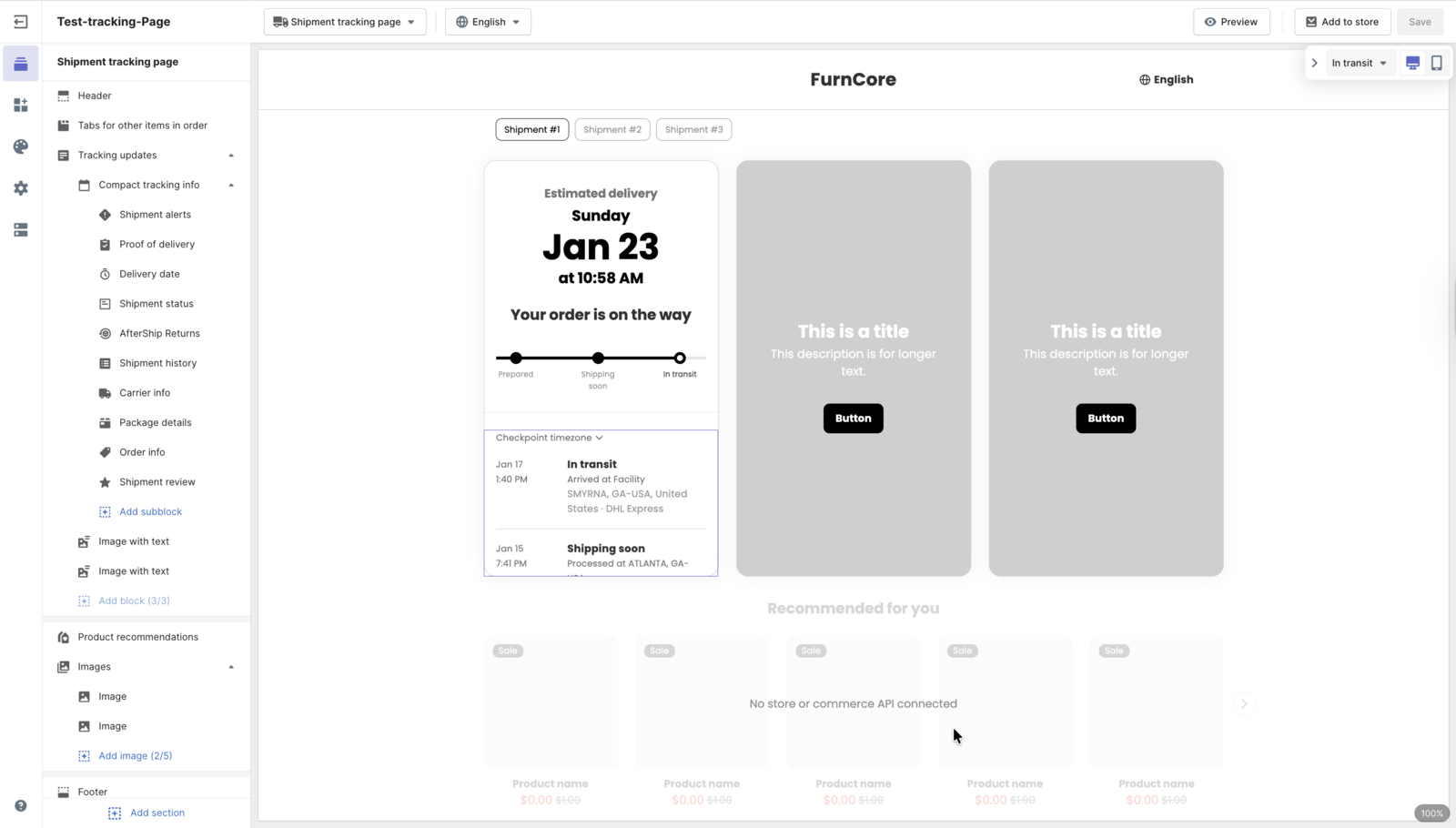
WISMO is the most expensive question in e-commerce, because customers ask it again and again. AfterShip Tracking answers it before they have to:
- A branded, self-service tracking page customers check instead of emailing support, covering 1,300+ carriers (1,321 live).
- Proactive delivery notifications at each milestone, so the customer hears from you before they start to worry.
- Exception alerts that flag delayed or stuck shipments while there is still time to act.
The result is fewer "where is my order" tickets, a lighter support load, and a calmer inbox.
Automate Returns & Recapture Revenue (AfterShip Returns)
Transparency shapes whether shoppers buy at all: Baymard found that 44% of sites don't display or link to return information on the product page, and 13% of shoppers have abandoned a site over an unsatisfactory return policy.
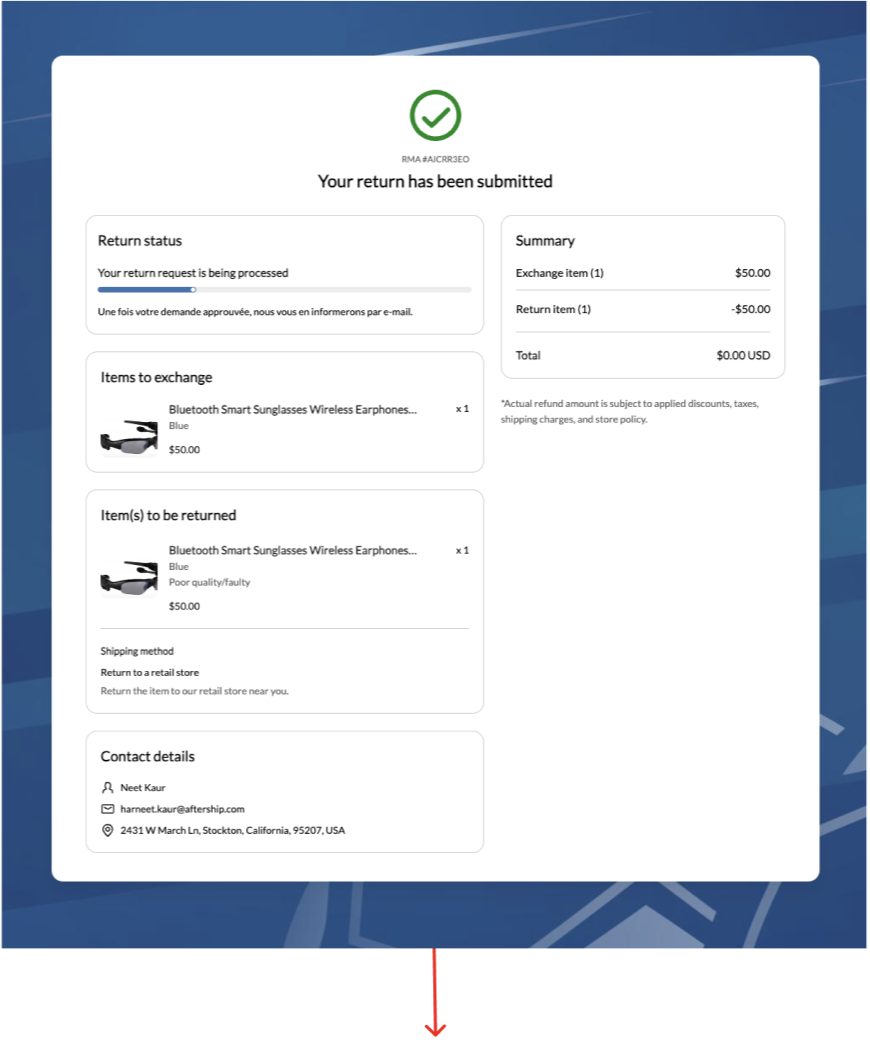
A return does not have to be lost revenue. AfterShip Returns reframes it as a second chance to keep the sale:
- A self-service returns portal that processes the request without a support agent, with automatic labels across 68 carriers.
- Automated return rules that route, approve, or flag requests by reason, product, or customer history.
- Exchanges presented before refunds, so customers swap rather than walk. Brands using exchange-first flows retain about 50% of the revenue that would otherwise leave as a refund.
The job is not just processing returns. It is turning the worst moment in the customer journey into retained revenue. Taken together, shipping, tracking, and returns are why post-purchase deserves to be a pillar in its own right, run on one connected platform instead of three disconnected tools.
The "Next Level" Stack
Once the four pillars are running, a second tier of tools earns its place. These are not day-one purchases. They are what you add when the basics are stable and you want compounding returns rather than another fire to put out. If you are exploring this layer, modern AI tools are reshaping what several of these can do.
Looker and Glew.io own business intelligence. The job is turning scattered data from every pillar into decisions: which products to reorder, which channels actually pay back, where margin quietly leaks. A founder who runs on instinct at 500 orders a month cannot run on instinct at 5,000, and these tools replace the guesswork with a dashboard.
Nosto owns on-site personalization. It tailors product recommendations and merchandising to each visitor, lifting average order value without buying more traffic. The job is making the storefront you already have convert better.
AfterShip Intelligence owns post-purchase analytics. Its Logistics AI analyzes your post-purchase data to standardize messy carrier tracking statuses, predict delivery dates, and flag carrier or delivery issues before they turn into support tickets. It converts the raw signal your shipping, tracking, and returns generate every day into something your team can act on.
Recharge owns subscriptions. For any brand with replenishable products, it runs recurring billing and subscriber retention, the engine behind predictable monthly revenue rather than a perpetual hunt for the next first-time buyer.
AfterShip Warranty rounds out the post-purchase pillar. It is a Returns add-on, not a standalone product, and its logic is rules-based rather than AI: you define the warranty rules, and the system applies them through a branded warranty portal and dashboard. The capability ships with Returns Premium, with the full suite available at the Enterprise level, so there is no separate price tag to weigh against the rest of your stack. Brands that mine their warranty claims for patterns report up to 80% improvement in product quality, because the data shows exactly which items fail and why.
Your Stack is a Living System, Not a One-Time Project
Your stack is never finished. It grows as you grow. The brand at 500 orders and the brand at 5,000 need different tools, and the most common mistake is buying for a scale you have not reached yet.
So build by pillar, not by hype. Get the storefront, marketing, customer experience, and post-purchase foundations solid first, then add the next-level tools when a real bottleneck demands them, not when a sales email does. The rule that matters most: choose tools that share data, because an integrated e-commerce tech stack compounds in value while a disconnected one only compounds in maintenance.
Post-purchase is the pillar most brands underestimate and customers feel the most. Owning it well, with shipping, tracking, and returns on one connected platform, is what quietly turns a one-time buyer into a repeat one. That is the difference between a stack that holds you back and one that scales with you.
Proactive shipment tracking that delights your customers, reduces WISMO tickets, and optimizes your delivery performance.
Book a demoFrequently Asked Questions
What's the best e-commerce platform for a growing DTC brand?
For brands shipping 500–5,000 orders a month, Shopify (and Shopify Plus at higher volume) is the most common pick for its app ecosystem and fast setup; BigCommerce suits large or B2B catalogs. The deciding factor is choosing a platform that shares order data openly with the rest of your stack.
Which marketing tools should an online store start with?
Begin with an email/SMS platform like Klaviyo for lifecycle messaging, a reviews tool (Yotpo or Judge.me) timed to delivery, and SEO/content tools (Ahrefs, Clearscope) to lower acquisition cost. Klaviyo's AfterShip Tracking integration can trigger flows on real delivery events using 16 flow triggers (18 on Enterprise), available on paid Tracking plans (Essentials, Premium, Enterprise). To reach social commerce, AfterShip Feed auto-syncs products, inventory, and orders to TikTok Shop and SHEIN Marketplace.
How do I reduce WISMO ("where is my order") support tickets?
Two moves: give customers a branded self-service tracking page with proactive delivery notifications so they can check status without emailing, and surface real-time tracking inside your help desk (e.g., Gorgias) so agents resolve "where is my order" questions in one reply. AfterShip Tracking provides the branded page and proactive alerts across 1,300+ carriers (1,321 live).
What does an all-in-one post-purchase platform do?
It runs the three jobs after checkout on shared data: shipping, tracking, and returns. AfterShip offers all three as separate, independently billed plans under one vendor: Shipping (130+ carrier integrations, 100+ supported carriers), Tracking (1,300+ carriers), and Returns (automatic labels across 68 carriers, with self-service exchanges over refunds). The value is shared data and a single vendor relationship, not one invoice.
When should I add advanced tools like BI or AI insights?
Add them once the four pillars are stable and a real bottleneck appears: BI (Looker, Glew.io) when decisions need data, personalization (Nosto) to lift average order value, and subscriptions (Recharge) for replenishable products. For post-purchase analytics, AfterShip Intelligence (aftership.com/ai) uses Logistics AI to standardize tracking statuses, predict delivery, and flag carrier issues. AfterShip Warranty is a rules-based add-on to AfterShip Returns (included with Returns Premium; full suite at Enterprise) with no standalone price. It is not an AI fraud tool.