
EasyPost vs Shippo: The Honest Verdict for Shipping APIs in 2026

You need a shipping API, and the choice has come down to EasyPost vs. Shippo. You're looking for the tie-breaker. Here it is: you're asking the wrong question. The best API for printing labels is only half the solution, and it's not the half your customers care about.
The label engine still matters, though, and picking the wrong one costs you weeks of rework. EasyPost and Shippo are the two default answers for multi-carrier label generation and rate shopping, and they solve that backend job in genuinely different ways. One leans toward raw developer control. The other leans toward a usable interface your ops team can run without an engineer on call.
So this guide does two things. First, it settles the backend question with a firm verdict: which API wins for which kind of team. Then it reframes the decision. Picture your shipping stack in two halves: the backend (labels and rates) and the frontend (the customer experience after checkout). EasyPost and Shippo compete on the backend. The frontend is a separate decision, and it is the one that moves repeat-purchase revenue. Hold that split in mind as you read.
The Short Answer: Who Wins in 2026?
If you only have two minutes, here is the verdict in one table. It maps each common use case to the tool that wins it, and why.
| Use Case | Winner | Why |
|---|---|---|
| Pure API Flexibility | EasyPost | Maximum developer control and custom logic, plus the widest carrier network for complex routing. |
| Ease of Use for Non-Devs | Shippo | A user-friendly interface and faster setup for non-technical ops teams. |
| Complete Customer Experience | AfterShip | The post-purchase frontend neither API owns: pre-purchase delivery dates, branded tracking depth, and native self-service returns. |
The pattern is consistent: EasyPost and Shippo split the backend between flexibility and ease of use, while the complete customer experience is a frontend job neither API was built to own.
Head-to-Head: The Core Shipping Engine
Strip away the marketing and both products do the same core work: connect to carriers, shop rates across them, and generate compliant labels through one API. The differences that matter sit in how you integrate, how many carriers you reach, and how you pay. We will compare them on exactly those three axes and nothing else. This is label generation and rate shopping only.
Developer Experience & API Reliability
EasyPost is the more developer-first of the two. It ships official SDKs in 7 languages, so most engineering teams find their stack supported out of the box. Shippo's own documentation lists SDKs in 6 languages, which means the real gap is one language, not the chasm some comparisons imply. (EasyPost's own compare page understates Shippo at "4"; trust Shippo's docs, not a competitor's tally.)
Reliability and rate limits are where the architectures diverge:
- EasyPost enforces 5 requests per second on its Index (list) endpoints, plus a dynamic load-based limiter that can throttle further under heavy traffic.
- Shippo's limits are per minute, split by environment (live / test): Shipment POST allows 500 per minute live (50 per minute test), and Tracking POST allows 750 per minute live (50 per minute test).
- On uptime, EasyPost advertises a 99.99% uptime SLA, which is a self-reported vendor claim rather than an audited number; Shippo publishes no comparable SLA, so weigh that gap as a claim to verify, not a guarantee.
For a developer-heavy team building custom fulfillment logic, EasyPost's granular control tends to fit better. If you want the underlying mechanics first, our guide to how you create shipping labels online walks through the basics.
Carrier Network & Rate Shopping
Carrier reach is the clearest separation between the two. Scoped to label-generation networks:
- EasyPost connects to 100+ carriers, with deep coverage of regional and international options.
- Shippo connects to roughly 40+ carriers, weighted toward the major US and common international names.
If your routing depends on niche regional carriers or complex cross-border lanes, EasyPost's wider network gives rate shopping more to work with.
USPS discounts look comparable on the surface but are quoted on different bases, so do not read them as a clean head-to-head. EasyPost advertises "up to 60% off USPS retail" as a specific, no-minimum figure, plus a blended "up to 88%" across services. Shippo advertises "up to 90%" on an aggregated, Commercial Plus basis. Each number is real; they simply are not measuring the same thing. Treat carrier reach, not the headline discount, as the decisive rate-shopping factor.
Pricing: Pay-per-label vs. Tiers
The pricing models are built for different buyers. EasyPost is pay-as-you-go: free for up to 3,000 labels, then $0.08 per label after that, with a bring-your-own-carrier plan at $20/mo. There are no tiers to climb, and cost scales directly with volume.
Shippo runs on tiers. Starter is free and bills 5 cents per label on your own carrier accounts, which fits a brand printing around 30 labels a month. Pro is a flat $17/mo ($205/yr), and Premier is "Contact us" for higher volumes, with overage at $0.08 per label beyond 10,000 labels a month. One caution: Shippo's in-app label price (5 cents) and its separate API label price (7 cents) are not the same number, so do not blend them when you model cost.
Break-even is straightforward to reason about. At low volume, EasyPost's free tier and Shippo's free Starter both keep you near zero. As volume climbs, EasyPost's per-label rate stays linear while Shippo's flat Pro fee spreads across more labels, so the better deal depends on your monthly label count and whether you value a predictable subscription over usage-based billing.
The Verdict: Choose EasyPost for Flexibility, Shippo for Simplicity
No hedging.
Choose EasyPost if your priority is maximum developer control and custom logic. Choose Shippo if you need a user-friendly interface for your ops team and faster setup.
Both tools are well-regarded on their own merits: EasyPost holds about 4.2 out of 5 on G2 across 121 reviews, and Shippo about 4.2 out of 5 across 77 reviews. This is a decision about fit, not quality.
That settles the backend. It only settles the backend. The harder question is what happens after the label prints, and that is where the EasyPost vs. Shippo debate stops being the one that decides your customer's experience.
Why Your Shipping API is Only 50% of the Solution
Here is the part EasyPost and Shippo were never built to handle. Both stop the moment a label prints. Everything the shopper actually experiences after checkout, the tracking, the delivery estimate, the return, sits outside the API's job.
That gap is not cosmetic. Baymard Institute found that 50% of respondents rank order tracking as the most important account feature, and that 67% of tested sites neglect key order-tracking details. Your label engine can be flawless and you can still lose the customer in the days between "shipped" and "delivered."
To be fair, both tools can bolt on a branded tracking page. EasyPost offers one through its Advanced Tracking add-on at roughly $0.01 per shipment, and Shippo includes one on its Pro tier. The page itself is the easy part. What neither does is show the shopper a delivery date before they buy, and neither runs a native self-service returns experience. Those two gaps are where repeat revenue quietly leaks out.

Enter AfterShip: The Customer Experience Layer for Your Stack
AfterShip is the layer that sits on top of whichever API prints your labels. It imports tracking numbers from 1,300+ carriers regardless of who generated the shipment, through store and platform sync or its own API and webhook.
This is data import, not a one-click EasyPost or Shippo connector. You keep the label engine you just chose and add the customer-facing layer on top. No rip-and-replace, no migration project, no second backend to maintain.
Transform Tracking from a Cost Center to a Marketing Channel
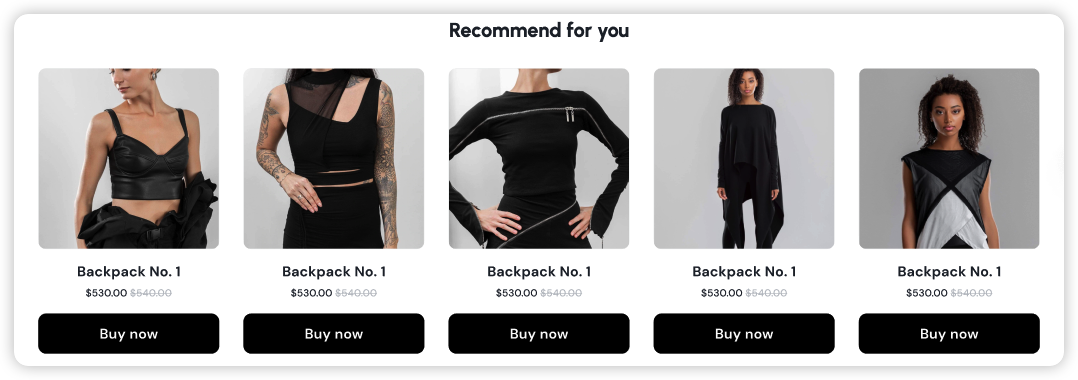
A logo on a tracking page is table stakes, and both backends can manage that. The depth is the difference. AfterShip's tracking pages carry an on-page AI delivery date, AI product-recommendation upsells, multilingual rendering, Apple Wallet passes, and 16 Klaviyo shipment-event triggers for downstream flows. That delivery date is not a guess: AfterShip's on-page estimates are accurate up to 95%, cover at least 80% of deliveries (versus under 40% for carriers alone), and are trained on 4.4B+ shipments.
That turns a status page into a channel. Brands have seen around 6.5% click-through on the product recommendations, and up to 25% of sales attributed to tracking-page traffic. Read those as outcomes brands have reported, not a guaranteed lift. For the full picture, AfterShip's tracking capabilities go well beyond what a label add-on can match.
Automate Returns and Win Customer Loyalty
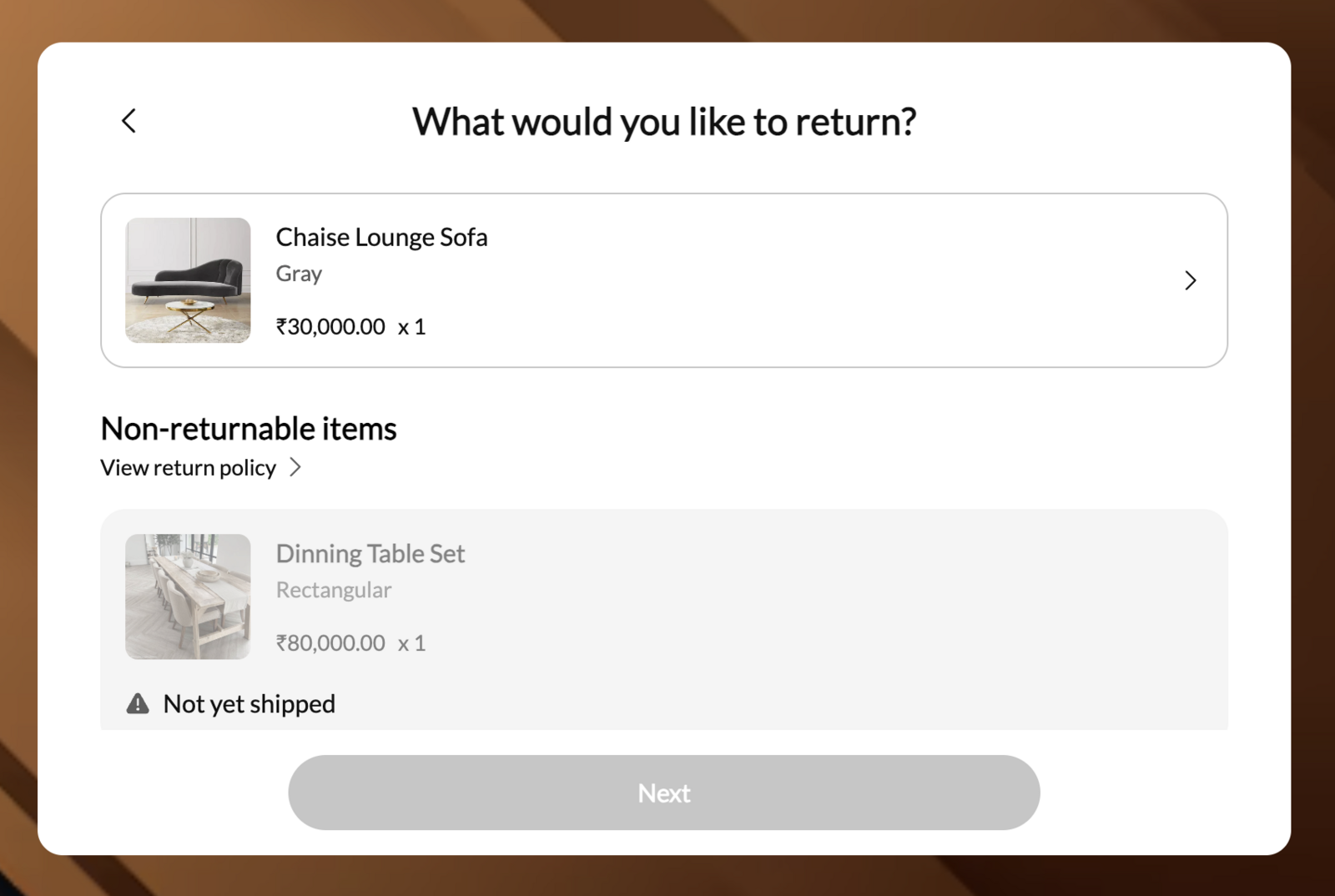
Returns expose the gap most clearly. EasyPost and Shippo give you return labels without a returns-experience platform. EasyPost generates return labels by QR or email and routes the actual portal to partners like Loop, Optoro, or ReturnLogic. Shippo generates scan-based return labels through its API, restricted to USPS, FedEx, and UPS, and only on the same carrier as the outbound shipment.
AfterShip Returns is a first-party branded portal: item selection, reason codes, and refund, exchange, or store-credit resolution, available starting on the Essentials tier. That is the difference between handing a customer a label and giving them an experience. Pick the label engine you like; the post-purchase layer is where you actually keep the customer.
The Ideal Post-Purchase Stack for 2026
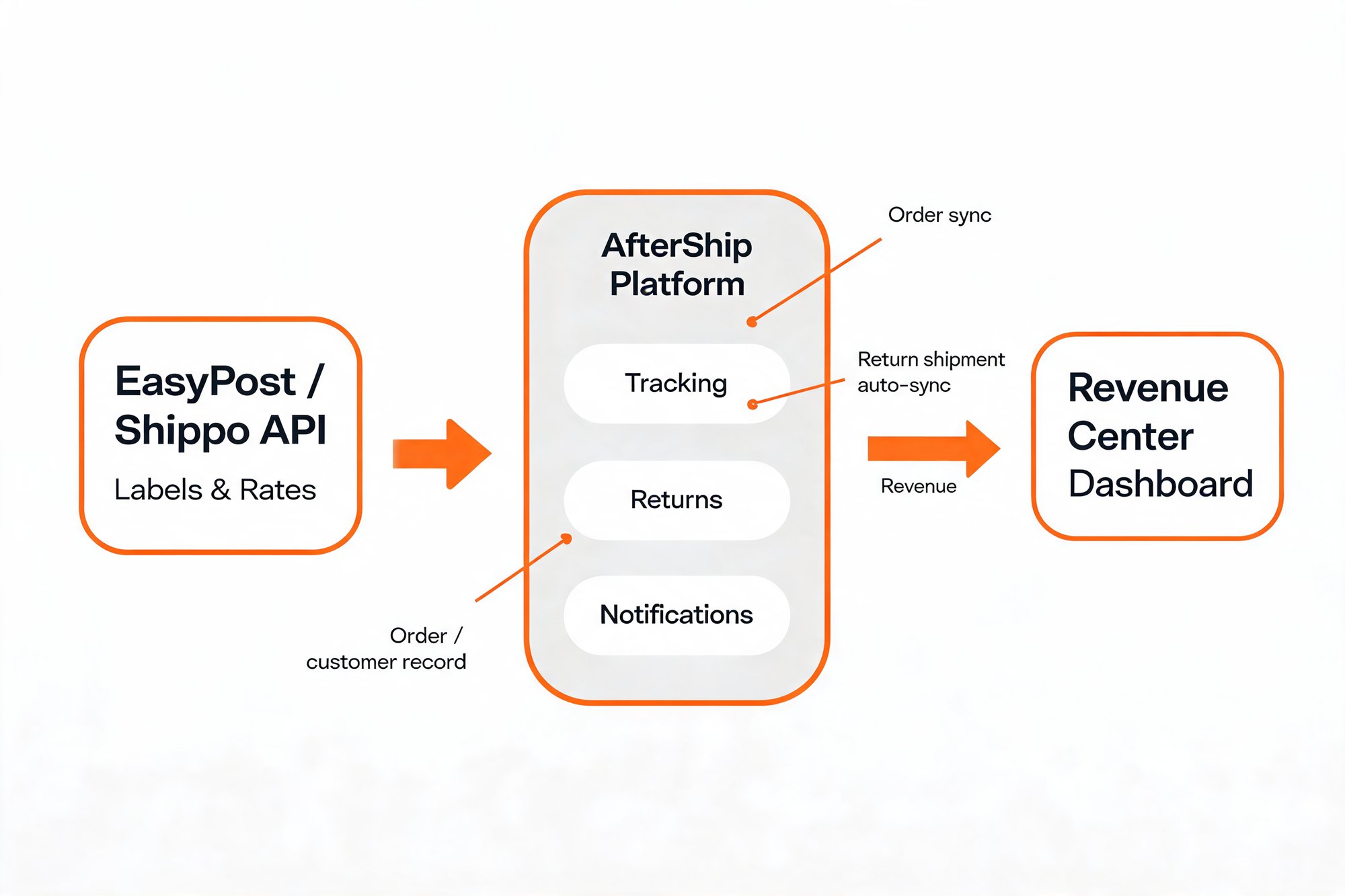
The smart build is not one tool, it is a stack. Keep the backend you picked, EasyPost or Shippo, for labels and rates. Layer the AfterShip Platform on top for everything the customer sees. The two halves connect through four automatic data flows, and that wiring is the whole point.
First, order sync pushes new orders into Tracking the moment they ship. Second, when a return label is generated, that return shipment auto-syncs back into Tracking, so inbound and outbound live in one timeline. Third, the order and customer record carries into Returns, so every claim opens with full context instead of a blank form. Fourth, revenue from tracking pages, upsells, and recovered returns rolls up into the Revenue Center Dashboard, where you can see what the post-purchase layer actually earns.
Built this way, the API and the experience layer stay loosely coupled. Swap label engines later and the customer-facing layer never notices.
What About an All-in-One? AfterShip Shipping
If you would rather not run two vendors, AfterShip Shipping is the consolidation option. It covers 130+ label carriers, more than EasyPost's 100+ and Shippo's roughly 40+, with bring-your-own-carrier on every tier. For a single-vendor brand, that puts labels, tracking, and returns under one roof and one data model. You can read more on it as an all-in-one alternative to EasyPost, or on the main AfterShip Shipping product page.
Be clear-eyed about cost. AfterShip prices its products as three separate subscriptions, not one bundle. A representative mid-tier stack at list price (direct on aftership.com) is Shipping Essentials at $9, Tracking Premium at $59, and Returns Pro at $59, which works out to about $127 per month, with 25% off the first year when you bundle 2 or more products. Treat $127 as a list-level figure, not an audited quote; your real number depends on the tiers your volume needs.
This will not beat Shippo on sticker price, and it is not meant to. The value is one vendor, one integration, and integrated data across the whole post-purchase flow. That trade, simpler operations for a higher line item, is the honest case for the all-in-one.
The proof shows up in WISMO load. In a StackCommerce case study, branded proactive tracking cut WISMO contacts by 71% year over year. AfterShip's own first-party benchmark puts the typical reduction at 65%. Different sources, same direction: the post-purchase layer takes real cost out of support.
Verified G2 review: rated 5 out of 5
"Integrates perfectly with Shipstation to track all our orders for all couriers."
Gabe C., G2, May 21, 2024
Final Verdict: Build a Stack, Don't Just Buy a Tool
The smart play was never EasyPost versus Shippo in isolation. Use one of them for backend logistics, and use AfterShip for the customer-facing experience. That is the decision that compounds.
Put plainly: AfterShip's job is the post-purchase layer, and it is the constant on both sides. The only open question left is who prints your labels. Settle that with the verdict from earlier, then build the layer that keeps the customers those labels are for.
Frequently Asked Questions
Is EasyPost or Shippo better?
Neither wins outright. Choose EasyPost for maximum developer control and the wider carrier network; choose Shippo for a user-friendly interface and faster setup for non-technical ops teams.
How much do EasyPost and Shippo cost?
EasyPost is pay-as-you-go: free up to 3,000 labels, then $0.08 per label, with a bring-your-own-carrier plan at $20/mo. Shippo has a free Starter (5 cents per label on your own carrier accounts), a flat Pro plan at $17/mo, and a Premier contact-us tier.
Do EasyPost or Shippo offer a returns portal?
Neither runs a native self-service returns portal. EasyPost generates return labels and routes the portal to partners like Loop, Optoro, or ReturnLogic; Shippo generates scan-based return labels via its API. AfterShip Returns provides a first-party branded portal with item selection, reason codes, and refund, exchange, or store-credit resolution.
How many carriers do EasyPost and Shippo support?
Scoped to label-generation networks, EasyPost connects to 100+ carriers and Shippo to roughly 40+. AfterShip Shipping, the all-in-one option, covers 130+ label carriers.
What does AfterShip add to a shipping API?
AfterShip is the customer-experience layer on top of whichever API prints labels. It imports tracking numbers from 1,300+ carriers and adds branded tracking pages with AI delivery dates and product recommendations, plus a self-service returns portal that EasyPost and Shippo do not provide.