
Tired of EasyPost's Shipping API Limitations? AfterShip's Verdict for Scaling E-commerce Brands


You've Outgrown Your Shipping API: 3 Signs It's Time to Leave EasyPost
Your shipping volume has 5x'd in the last year, but your engineering resources haven't. If you're spending more time debugging EasyPost rate limits and building custom tracking pages than you are improving your core product, you're not just facing a technical problem. You're facing a growth ceiling.
EasyPost was the right call when you were small. A clean, developer-friendly API for buying labels is exactly what an early-stage brand needs. The trouble starts when order volume climbs and a label API is asked to carry an entire post-purchase experience it was never built for. That gap is why most scaling teams start evaluating EasyPost alternatives in the first place.
Here are the three signs you've crossed that line.
- API reliability and rate limits. EasyPost caps Index endpoints at 5 requests per second and applies a load-based limiter on top, as EasyPost's rate-limiting documentation spells out. During a flash sale or a holiday peak, that ceiling becomes a fulfillment bottleneck: label calls queue, orders back up, and your team is firefighting instead of shipping the volume you worked so hard to win.
- Spiking WISMO costs. WISMO ("where is my order?") is one of the most common support tickets in eCommerce. Gorgias's first-party data, drawn from more than 12,000 brands, puts it at roughly 18% of all support tickets. When your tracking experience lives in a patchwork of raw carrier pages, your support team becomes a human tracking page, fielding the same question over and over. That cost scales with every order you add.
- The "Frankenstein" stack. To cover what a label API leaves out, you bolt on custom-built tracking pages, a third-party returns portal, a separate delivery-estimate tool, and hand-coded carrier-selection logic. Each piece is one more thing your engineers own and maintain, and every carrier or API change downstream becomes their problem to patch.
If two of these three describe your last quarter, the issue isn't your API. It's that you're running a platform's worth of work through a tool built for a single job.
AfterShip vs. EasyPost: It's Not an API, It's a Platform
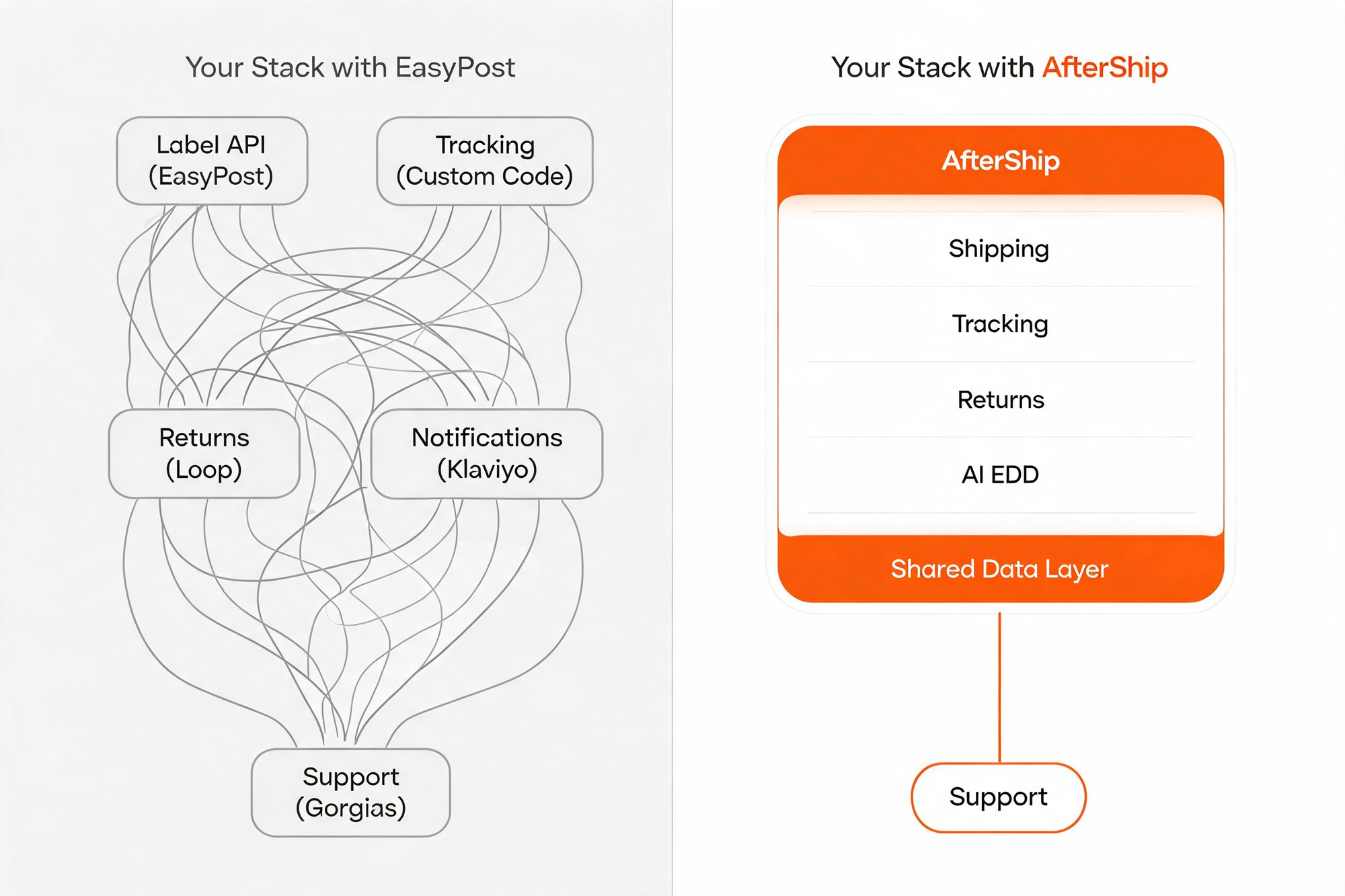
This is the reframe that matters: EasyPost is a label and rate API. AfterShip is a post-purchase platform. That distinction is the whole decision.
A label API does one thing well, generate and buy shipping labels, then leaves everything downstream to you. A platform treats shipping as one connected piece of the entire post-purchase journey, from checkout estimate to delivery to return.
AfterShip spans four products that share a single data layer: AfterShip Shipping, a complete multi-carrier shipping platform, for labels and routing rules, AfterShip Tracking for branded tracking and proactive notifications, AfterShip Returns for a self-serve returns portal, and AI EDD for pre-purchase delivery estimates. Each one is licensed separately, so you adopt only what you need. What makes it a platform rather than a bundle is that all four run on one source of order and shipment data, not four disconnected integrations you stitch together and reconcile yourself.
The practical payoff is code you no longer write. The branded tracking page, the notification logic, the returns flow, the carrier-selection rules: on a label-only stack those are permanent engineering projects you own. On a platform, they are configuration.
So the move from EasyPost to AfterShip isn't a like-for-like API swap. It's graduating from a tool you have to keep extending to a platform that already did the extending for you. If you're weighing EasyPost alternatives, the real question isn't which API is quicker to call. It's whether you still want to be in the business of building and maintaining post-purchase software at all.
Deep Dive: A Head-to-Head Comparison for Technical Evaluators
Marketing pages compare logos. Technical evaluators compare limits, SLAs, and what they will have to build themselves. AfterShip publishes a detailed, head-to-head comparison of the two, but here is the honest, criteria-by-criteria breakdown a logistics lead needs when weighing EasyPost alternatives in a real vendor review.
| Criteria | AfterShip | EasyPost |
|---|---|---|
| API rate limit | 10 requests/sec per organization; rateLimit-* headers for client-side backoff; no automatic queue or retry | 5 requests/sec on Index endpoints plus a load-based limiter; no automatic queue or retry |
| Carrier network (label generation) | 130+ carriers | 100+ carriers |
| Uptime / SLA | Contractual 99.9% monthly SLA with tiered service credits (standard on Enterprise) | Marketed 99.99% uptime; no contractual SLA percentage |
| Native returns portal | Yes, self-serve AfterShip Returns portal | No native portal; return labels plus partners (Loop, Optoro, ReturnLogic) |
| Pre-purchase AI EDD | Yes, product and checkout delivery-date widget | None |
| Carrier failover | No automatic failover; configurable rules engine for rule-based routing | No automatic failover; hand-coded carrier-selection logic |
| Developer experience | REST API plus a no-code rules engine | Established SDKs plus a branded tracking add-on (Advanced Tracking) |
The pattern is consistent. On raw API mechanics the two are comparable (AfterShip Shipping's rate-limit documentation lists 10 requests per second per organization), but AfterShip closes the gaps EasyPost expects you to engineer around on your own.
Beyond the Label: How AfterShip Solves Problems EasyPost Creates
A spec table tells you what is different. Production tells you what it costs you. Here are three problems a label-only stack creates, and how a connected platform removes each one.
WISMO is a tracking-experience problem, not a support-staffing problem. Both vendors can put your brand on a tracking page: EasyPost through its Advanced Tracking add-on, AfterShip natively through AfterShip Tracking. What differs is what the page is wired into. With AfterShip Tracking, you get an integrated, branded tracking experience: the branded page and proactive shipping notifications read from the same shipment data as your labels, so customers get a delivery update before they think to open a ticket. Mous saw the result firsthand. Running more than 1 million monthly shipments across 10 carriers, it cut its support contact rate from 12.9% to 5.9% after deploying AfterShip Tracking's branded tracking and proactive notifications, a 54% reduction in WISMO contacts.
For a team shipping 1,000 to 50,000 orders a month, that is the difference between a support queue that grows with every sale and one that flattens out.
The biggest gap EasyPost leaves is before the sale. EasyPost has no pre-purchase delivery-date widget. AfterShip AI EDD predicts delivery dates to reduce customer questions before they're asked. It puts an accurate estimated delivery date directly on the product and checkout pages, with up to 95% accuracy and at least 80% delivery coverage, compared with under 40% for carrier estimates alone, drawing on a model trained on more than 4.4 billion shipments. The business case is simple. A shopper who sees "arrives Thursday" converts with more confidence than one reading "ships in 5 to 7 business days." For a brand fighting cart abandonment, that confidence is conversion you forfeit every day the widget is not on the page.
Operations stops being a reconciliation exercise. A label API hands you raw data and lets you assemble the reporting yourself. Because each AfterShip product (licensed separately) reads from one shared data layer, you get a single analytics view across shipping, tracking, and returns instead of three exports you merge by hand. When a delivery exception spikes in one region, you see it in one dashboard rather than reconstructing it from carrier CSVs. The sharpest example is carrier selection. On EasyPost, the logic that decides which carrier wins each order is code your engineers write and maintain. On AfterShip Shipping, you build it as rules in a visual engine: one rule to send anything over 5 lbs headed to Zone 8 via UPS Ground, another to route lightweight domestic orders to the cheapest compliant USPS service. Non-Enterprise plans support up to 10 such rules, and changing one is a click, not a deploy.
One honest caveat belongs here. This is rule-based routing, not automatic failover. Neither AfterShip nor EasyPost reroutes live traffic the instant a carrier has an outage, so do not expect either to self-heal during a regional disruption. What AfterShip changes is ownership of the selection logic. It moves out of your codebase and into a configuration screen your ops team can edit without a release.
That is the real distinction between owning a label endpoint and owning the post-purchase experience. It is also the line a scaling brand has to cross to stop paying for that experience twice, once in engineering and again in support.
But Isn't the API More Expensive? Calculating the True Cost
Yes, on the line item EasyPost shows you. Let's be honest about that up front, because pretending otherwise insults a reader who has already done the math.
At raw per-label entry, EasyPost is genuinely cheaper. You can generate up to 3,000 labels for free, add a bring-your-own-carrier plan for $20 a month, pay $0.01 to $0.03 per shipment for tracking API calls, and insure shipments at roughly 1% of declared value. For a small catalog and a developer who enjoys wiring things together, that is hard to beat.
The catch is that the label fee is the smallest cost on the page. A label-only API quietly hands you a much larger bill elsewhere: the engineering and support work it does not do. You build and maintain the branded tracking page, the notification logic, the returns portal, the carrier-selection rules, and the delivery estimates yourself. None of those are one-time builds either. Every carrier API change, every new delivery promise, every returns-policy tweak lands back on your engineers, and your CX team absorbs every WISMO ticket the disjointed experience generates in the meantime.
That second number is the one that actually scales with order volume, and it rarely appears in a pricing comparison.
AfterShip's pricing reads differently because it replaces that custom code with first-party products you configure instead of build, each billed separately. AfterShip Shipping runs $9 or $69 per month billed direct ($11 or $89 through the Shopify App Store). AfterShip Returns follows its own ladder at $11, $59, or $239 per month. You are not buying a label endpoint. You are buying back the engineering roadmap you were spending on post-purchase plumbing.
The savings show up as time, not as a magic per-shipment discount. One technology provider running AfterShip Tracking trimmed hours of weekly manual work and cut delivery exceptions, simply by consolidating shipment visibility into one place.
With AfterShip Tracking's branded tracking and proactive notifications, Mous recorded 54% fewer WISMO contacts. That is support payroll you stop spending.
Resist the urge to model this as a fixed dollar saved per shipment. The honest claim is simpler. You trade a low, predictable label fee for a smaller engineering and support burden, and at scale that trade usually wins.
The Verdict: When Does It Make Sense to Migrate from EasyPost to AfterShip?
The decision comes down to one question: are you still buying a label, or are you buying an experience?
Consider the verifiable results for tech-focused brands that consolidating on AfterShip Tracking, part of the AfterShip platform, delivered for one technical team.
Supply Chain Visibility Technology Provider
“AfterShip Tracking acts as a one-stop solution for shipment visibility. The support team is responsive and helpful in addressing our concerns.”
Read their story →If you are getting started, or you genuinely only need a standalone API to print labels and nothing more, stay on EasyPost. It is a capable, well-documented tool, and at low volume its pricing is tough to argue with. That standing shows in EasyPost's G2 reviews, a 4.2 average across 121 ratings.
If growth is now constrained by your shipping tools, the calculus flips. When WISMO is eating your support team, when engineers maintain tracking and returns code instead of shipping product, and when you want shipping, tracking, returns, and delivery estimates reading from one data layer, you have outgrown a point solution. That is the moment AfterShip earns the switch.
Be clear-eyed about the move. There is no one-click EasyPost importer, neither platform does automatic carrier failover, and the contractual 99.9% SLA is standard on Enterprise, so confirm coverage on the lower Shipping tiers before you commit. None of that changes the conclusion. Among EasyPost alternatives, AfterShip is the one built for brands that are done treating the post-purchase experience as something to assemble by hand. This is graduating from a tool to a platform, not swapping one API for another.
Simplify shipping and order fulfillment across Shopify, TikTok Shop, and your carrier network.
Book a demoQuick answers to the questions technical evaluators ask most when comparing the two.
Frequently Asked Questions
How do AfterShip's API rate limits compare to EasyPost?
They are comparable, not faster. AfterShip Shipping allows 10 requests per second per organization, while EasyPost allows 5 requests per second on its Index endpoints, plus a load-based limiter. Both return rate-limit headers so you can handle client-side backoff, and neither automatically queues or retries throttled calls. A custom Enterprise rate limit is available on AfterShip if you need more headroom.
What's the process for migrating from EasyPost to AfterShip?
There is no one-click importer, so plan a staged migration in four steps. First, re-point your API calls to the AfterShip Shipping REST API. Second, re-create your carrier accounts; you can bring your own on every tier, or use AfterShip's USPS rates of up to 90% off with no minimum volume requirement. Third, rebuild your carrier-selection logic as rules in the engine, up to 10 on non-Enterprise plans. Fourth, parallel-run both systems, then cut over once you are confident. There is no guaranteed timeline; it depends on how much custom logic you are replacing.
Does AfterShip support my specific carrier integration?
AfterShip Shipping supports 130+ label carriers, and you can connect your own carrier accounts on every tier. If you already have negotiated rates with a carrier, you bring those accounts with you rather than starting over.