
Dotdigital vs Mailchimp? A Question That Misses Your Biggest Opportunity


Choosing between Dotdigital and Mailchimp is a critical decision for your pre-purchase marketing. But what if we told you the most opened emails you'll ever send won't come from either of them?
If you've spent the past week comparing these two platforms feature by feature, you're asking a fair question. Both are capable email service providers (ESPs), and the dotdigital vs mailchimp debate is worth settling before you take a business case to your stakeholders.
Here's the part most comparison articles skip. The platform you pick handles the emails customers expect to receive. The emails customers actually open happen after they buy, and that window usually belongs to no one on your team. We'll settle the ESP question quickly, then show you where the real engagement is hiding, and why the strongest setup pairs your chosen ESP with a dedicated post-purchase tool rather than swapping one for the other.
Dotdigital vs. Mailchimp: The 5-Minute Verdict for DTC Marketers
For a DTC marketer at a growing brand, the choice usually comes down to four things: how sophisticated the automation is, how granular the segmentation gets, how the pricing scales, and how cleanly it plugs into your existing stack.
Pricing is where the two diverge most visibly. Mailchimp runs on a contact-based model that lands at roughly $135 per month at around 10,000 contacts, though that figure is approximate and shifts as your list grows. Dotdigital starts from about $187 per month on the Shopify App Store. Treat both as ballpark numbers and confirm them against your own contact count and feature needs. If neither feels right, there are more Mailchimp alternatives worth weighing.
| Criterion | Dotdigital | Mailchimp |
|---|---|---|
| Automation Sophistication | Robust cross-channel journeys; enterprise depth | Capable multi-step journeys (Standard tier and up) |
| Segmentation Power | Advanced segmentation with built-in CDP/AI | Predictive and behavioral (Standard tier and up) |
| Pricing Model | From ~$187/mo (Shopify App Store); sales-gated at scale | Contact-based, ~$135/mo at ~10k contacts; self-serve |
| Key DTC Integrations | Shopify + Adobe Commerce/Magento depth | Shopify + broad app ecosystem |
Pricing is approximate and shifts with contact count and plan tier; confirm current rates with each vendor.
There's no universal winner here, and G2's Dotdigital vs Mailchimp comparison of real user reviews bears that out. Both platforms are genuinely strong, and on automation, segmentation, and integrations they're close enough that the right pick depends on your list size, your team's appetite for building flows, and the connectors you can't live without. Choose the one that fits your workflow and your budget.
That decision matters. It just isn't the decision with the biggest upside.
Your Real Engagement Goldmine: Transactional vs. Marketing Emails
Whichever ESP you choose, your marketing open rates will sit in familiar territory, even with sophisticated email marketing automation. A strong campaign might see around 30% of recipients open it. The emails that blow past that number aren't campaigns at all.
Shipping-confirmation emails average a 62.67% open rate — roughly 2–3× the typical marketing email (Omnisend, 2026).
One caveat worth holding onto: Apple's Mail Privacy Protection inflates reported open rates by pre-loading images, so read any open-rate figure as directional rather than exact. Even discounted, the gap between transactional and marketing email stays large and consistent.
The reason is psychological, not technical. A customer who just spent money sits in a state of anticipation, with a little anxiety mixed in. They want to know where their order is, when it will arrive, and whether anything has gone wrong. A "your order has shipped" email answers the exact question already on their mind, so they open it, often more than once.
That attention is the most valuable real estate in your entire email program. For most brands, it currently sits unused, handed off to a carrier's generic notification the moment the label prints.
Which reframes the whole evaluation. The question was never only Dotdigital vs Mailchimp. It's what you do with the highest-engagement emails your store sends, no matter which ESP comes out on top.
Why Your ESP's (or Shopify's) Default Notifications Are a Wasted Click
Both Dotdigital and Mailchimp can fire a shipping notification. So can Shopify, straight out of the box. The problem isn't whether the email goes out. It's what that email does once it lands.
Shopify's default notifications confirm that an event happened. They tell the customer an order was placed, fulfilled, or shipped. What they don't do is treat that 62% open rate as the marketing surface it actually is. The same goes for a basic ESP-triggered confirmation. The send works; the moment is wasted.
Here's where most default setups fall short:
- Unbranded. The email reads like a system receipt, not your store. No logo, no voice, no design that ties back to the brand the customer just bought from.
- No marketing or upsell. There's no room for a related-product block, a loyalty nudge, or a reason to come back. The most-opened email you send asks for nothing.
- Reactive, not proactive. Defaults confirm what already happened. They don't detect a stalled package, a carrier exception, or a delivery running three days late, which is exactly when the customer feels most anxious.
- Links out to a generic carrier page. The tracking link drops your customer onto a third-party site covered in someone else's ads, ending the journey on a page you don't control.
None of this means Shopify or your ESP is broken. They do what they were built to do. They just weren't built to turn the delivery window into a branded, proactive, revenue-generating channel. That's a different job, and it calls for a different tool working alongside the stack you already have.
How to Own the Post-Purchase Journey: From "Order Confirmed" to "Delivered"
Owning the journey means controlling every touchpoint between "order confirmed" and "delivered," and making each one feel like your brand instead of a carrier's.
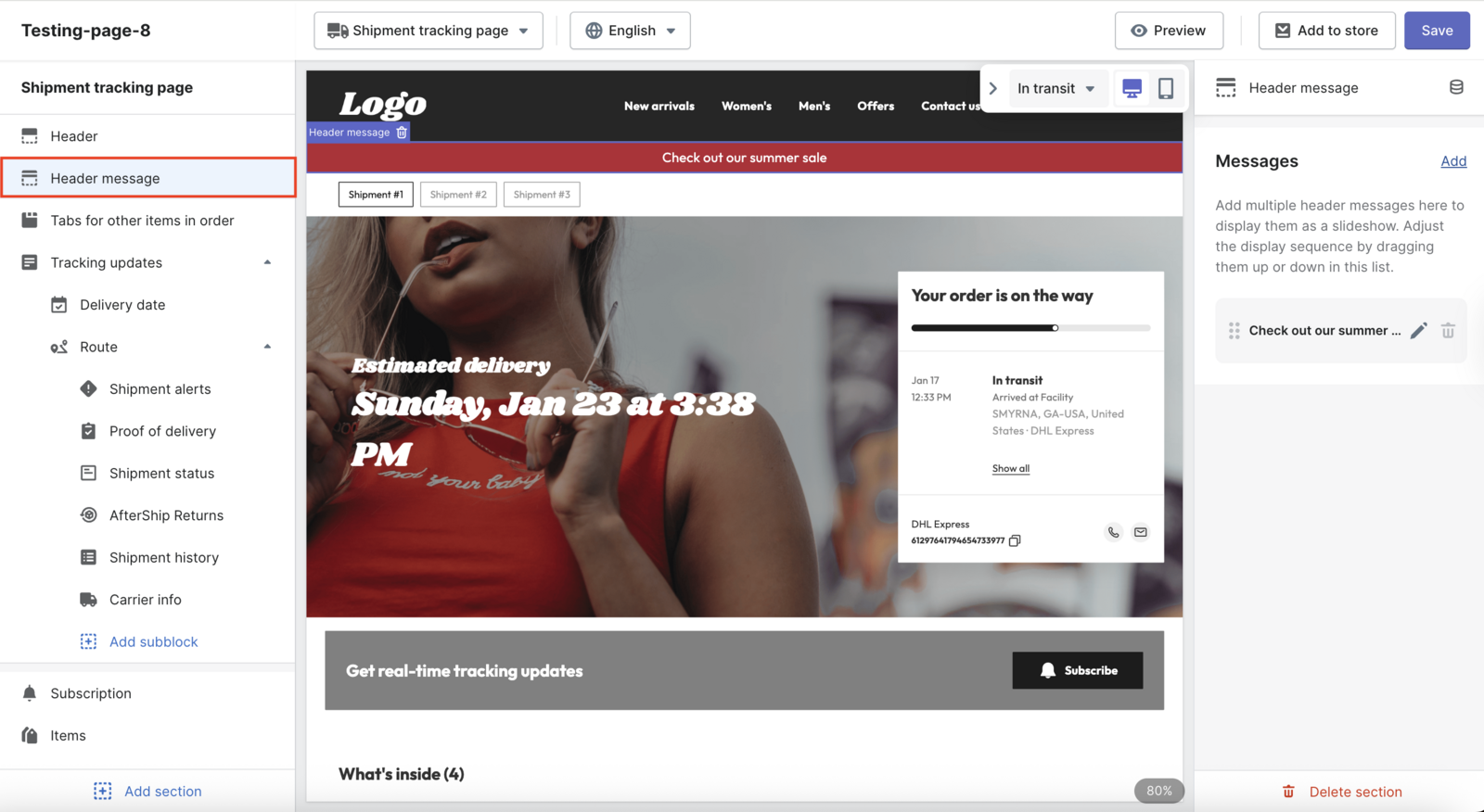
A branded tracking page is where that starts. With AfterShip Tracking on the Premium tier, you can host the tracking experience on your own custom domain, so customers stay on your site instead of bouncing to a carrier's. You can place marketing banners directly on the page and embed product recommendations next to the live shipment status, turning a routine status check into a second shopping session.
From the customer's side, it reads as an extension of your store rather than a third-party utility: your branding up top, the live shipment status in the middle, and your own marketing banner where a carrier would otherwise place its own. The embedded product recommendations sit right alongside that status, so the next purchase is one tap away while attention is still high.
Accuracy underpins the whole experience. AfterShip's AI estimated delivery date (EDD) predicts arrival with roughly 90% first-prediction accuracy and 80%+ coverage, which is about three times the under-40% baseline most stores see from raw carrier estimates. AfterShip tracks across 1,300+ carriers, so that prediction holds whether the parcel moves by a national post, a regional courier, or a last-mile startup.
The point isn't to replace your ESP. It's to give the post-purchase window an owner, so the highest-engagement moment in the customer journey finally works as hard as the rest of your marketing.
3 Ways AfterShip Turns Post-Purchase Into Your Next Sales Channel in 2026
Once you own the journey, the delivery window stops being a cost center and starts behaving like a channel. Three plays do most of the heavy lifting, and once they're live there are plenty more amazing post-purchase ideas to build on.
- Cut WISMO with proactive alerts. Instead of waiting for "where is my order" tickets, AfterShip sends in-transit, out-for-delivery, and delivery-delayed notifications before the customer has to ask. Mous used proactive tracking to drop its WISMO rate from 12.9% to 5.9%, a 54% reduction that freed up real support time. Other AfterShip merchants report the same pattern: StackCommerce cut WISMO tickets by 71% year over year, and Vivino by 50%.
- Drive repeat purchases on the page and in the email. Because you control the branded tracking experience, you can surface on-page product recommendations and discount codes at the exact moment attention peaks. The customer is already there, checking on a delivery and primed to buy again.
- Collect social proof automatically. When the "delivered" event fires, AfterShip can trigger a post-delivery review request at the one moment the customer is holding the product and feeling the satisfaction of a completed order. That timing turns more requests into actual reviews.

Stacked together, these aren't incremental tweaks. They convert your most-opened emails into a working sales and retention channel that sits alongside whichever ESP you chose rather than competing with it.
AfterShip + Your ESP: The Modern Stack for Customer Retention
The strongest retention stack isn't a single tool. It's a division of labor. Your ESP runs the campaigns and lifecycle flows it was built for, from welcome series to win-backs. AfterShip owns the delivery moment, the highest-engagement window in the journey, and feeds that signal back to whatever ESP you chose. Get that split right and the two reinforce each other instead of overlapping.
How tightly they connect depends on the ESP. Klaviyo has a deep native event integration with AfterShip Tracking: 16 flow triggers on the Premium plan and 18 on Enterprise. Those are paid Tracking plans (Essentials, Premium, and Enterprise), and the native events let Klaviyo react to a real shipping status without any middleware in between.
Mailchimp and Dotdigital work differently. Neither has a native Tracking event flow today, so delivery events reach them another way: through Shopify webhooks, an iPaaS connector such as Zapier or Make, or the AfterShip API. The integration is entirely doable. It just runs through a connector rather than a built-in event. That connector route is a standard setup for Shopify brands, so a non-native ESP can still act on AfterShip's delivery events.
Either way, the pattern holds. AfterShip detects the delivery event, and your ESP acts on it. The classic example: "package delivered 3 days ago → ESP sends a review request." The shipping signal comes from AfterShip; the campaign logic stays in the ESP you already know.

That's the modern stack. AfterShip captures the moment of peak attention, and your ESP turns it into a message. The ESP keeps its job; AfterShip simply hands it a better moment to act on. Neither replaces the other.
The Choice Isn't Dotdigital vs. Mailchimp
So which one should you buy? The honest answer is that it's the wrong question to end on.
Both Dotdigital and Mailchimp are strong pre-purchase platforms, and either can anchor your marketing program. But neither was built to own the post-purchase delivery window, the place where your highest open rates actually live. The best setup isn't one ESP beating the other. It's your ESP + AfterShip, never AfterShip instead of your ESP. Treat that pairing as one piece of a modern DTC marketing strategy, not the whole plan.
AfterShip is rated 4.7/5 from 311 reviews on G2.
Pick the ESP that fits your team and your budget, then pair it with a dedicated post-purchase tool. That's the stack that turns a 62% open rate into repeat revenue, no matter which side of the dotdigital vs mailchimp debate you land on.
Proactive shipment tracking that delights your customers, reduces WISMO tickets, and optimizes your delivery performance.
Book a demoFrequently Asked Questions
Is Dotdigital or Mailchimp better for post-purchase emails?
Neither is specialized for post-purchase. Both handle pre-purchase marketing well, but the transactional delivery emails that earn the highest open rates sit outside their core design. A dedicated post-purchase tool like AfterShip Tracking complements either one, which is why the choice between them matters less than adding that missing layer. Put differently, the winner of the dotdigital vs mailchimp comparison is whichever platform your team will use best, paired with a tool that owns the delivery moment.
What is the benefit of a branded tracking page?
A branded tracking page keeps customers on your site and on your brand instead of bouncing to a carrier's page. It reduces WISMO tickets by answering "where is my order" before the customer has to ask, and it opens an upsell surface where you can place recommendations and offers at the moment attention is highest.