
ClickFunnels vs Mailchimp: Why Your Choice Affects Post-Purchase


You're asking whether to use ClickFunnels or Mailchimp. It's the right question for 2018. In 2026, successful brands know that the real money isn't in the first sale - it's in the second, third, and fourth. And neither of those tools is built for that.
ClickFunnels vs. Mailchimp: The 60-Second Answer You Came For
But you came here for a straight answer, so here it is: ClickFunnels and Mailchimp aren't really rivals, because they do different jobs.
ClickFunnels is a sales-funnel builder. You use it to assemble landing pages, order forms, and upsell flows that turn cold traffic into a first purchase, which makes it a natural fit for single-product launches and digital goods. ClickFunnels 2.0 runs from Launch at $97/mo to Scale at $197/mo and Optimize at $297/mo, with a Dominate plan billed annually at $5,997/yr.
Mailchimp is an email marketing platform. Its job is to help you grow an audience and send campaigns and newsletters: a Free tier to start, Essentials from $13/mo (a 12-month introductory rate that climbs afterward), Standard at $20/mo, and Premium at $350/mo.
So the quick verdict. If you need a high-converting funnel for a specific offer, ClickFunnels. If you need to nurture a list and run campaigns, Mailchimp. A lot of brands weighing this comparison are really shopping for the best email platform, and there are plenty of top Mailchimp alternatives worth a look.
| Criteria | ClickFunnels | Mailchimp |
|---|---|---|
| Primary Goal | Build high-converting sales funnels (often single products / digital goods) | Email marketing - build an audience and send campaigns |
| Best For | Product launches, landing pages, upsell/checkout funnels | Newsletters, audience nurturing, welcome series |
| Core Weakness | Time/behavior-triggered automation only; no live shipping, delivery, or returns awareness | Basic post-purchase automations (e.g., 'order confirmed'); no insight into shipping status, delivery exceptions, or returns |
One thing to clear up before we go further: both tools send email, and both have automation. ClickFunnels has its Follow-Up Funnels, and Mailchimp has marketing automation. The real difference is what each is built around, a funnel versus a list, not whether one "can send email." Hold that thought, because it matters in a minute.
The Real Question: Are You Optimizing for the First Sale or the Second?
Here's the uncomfortable part: choosing between ClickFunnels and Mailchimp only ever answers a question about the first sale.
Both tools live at the top of your conversion funnel, the path a stranger walks from first click to first checkout. That work matters. But it's only half of a real business.
Every brand runs on two numbers. Customer Acquisition Cost (CAC) is what you spend to win a buyer. Lifetime Value (LTV) is what that buyer is worth over time. Pour all your budget and tooling into CAC while ignoring LTV, and you've built a leaky bucket: new customers pour in the top while one-time buyers drain out the bottom, faster than you can refill them.
The economics are brutal, and they're well documented. Acquiring a new customer is anywhere from 5 to 25 times more expensive than retaining an existing one (Harvard Business Review). A related Bain finding, that a 5% lift in retention can raise profits by 25% to 95%, is directional and openly debated, but the direction isn't in question: keeping a buyer is far cheaper than buying a new one.
So if you're a Shopify brand doing 100 to 1,000 orders a month, the most expensive customer you'll ever have is the one who buys once and never returns. You already paid to acquire them. The second, third, and fourth orders are almost pure margin, and they're exactly the orders your acquisition stack was never designed to win.
Put real numbers on it. Say it costs you $30 in ads to land a buyer on a $60 first order. After product and shipping, that order barely breaks even. The profit was always meant to come from order two, the one nobody in your current stack is actually working to earn.
That's the gap. The moments that earn a repeat purchase happen after checkout, while a customer waits on a package, fears it's lost, or tries to send something back. A funnel builder doesn't watch those moments. A campaign tool doesn't either. Neither one knows where the parcel actually is.
So this was never really a ClickFunnels vs Mailchimp decision. It's an unmanaged post-purchase problem, and it needs a tool built specifically for it. The brands pulling ahead in 2026 aren't the ones with the cleverest funnel. They're the ones who treat everything after "buy now" as a growth channel, not a cost center.
Why Your "Post-Purchase Funnel" is a Dead End with These Tools
Here's what both tools quietly have in common: their automation stops paying attention at the exact moment it matters most.
That's not a knock on their email. ClickFunnels and Mailchimp both automate sequences, and they do it well. The problem is what triggers those sequences.
ClickFunnels has Follow-Up Funnels, which are genuine automated email and message sequences. But they fire on time and behavior: a delay timer, an opened email, a clicked link. They have no idea whether the customer's package shipped, stalled in a sorting facility, or already landed on the porch.
Mailchimp has real marketing automation too. Its post-purchase automations, though, are basic and store-triggered: an "order confirmed" email, maybe a "thanks for your purchase" note. None of it reacts to shipping status, a delivery exception, or a return in progress.
The hard truth is that your post-purchase "funnel" runs blind. A parcel throws off a live stream of events as it travels (shipped, out for delivery, delivered, exception or delay), and a store-side automation fires on none of them. You're sending timed guesses while the one thing your customer actually cares about, the box, moves through a system your tools can't see.
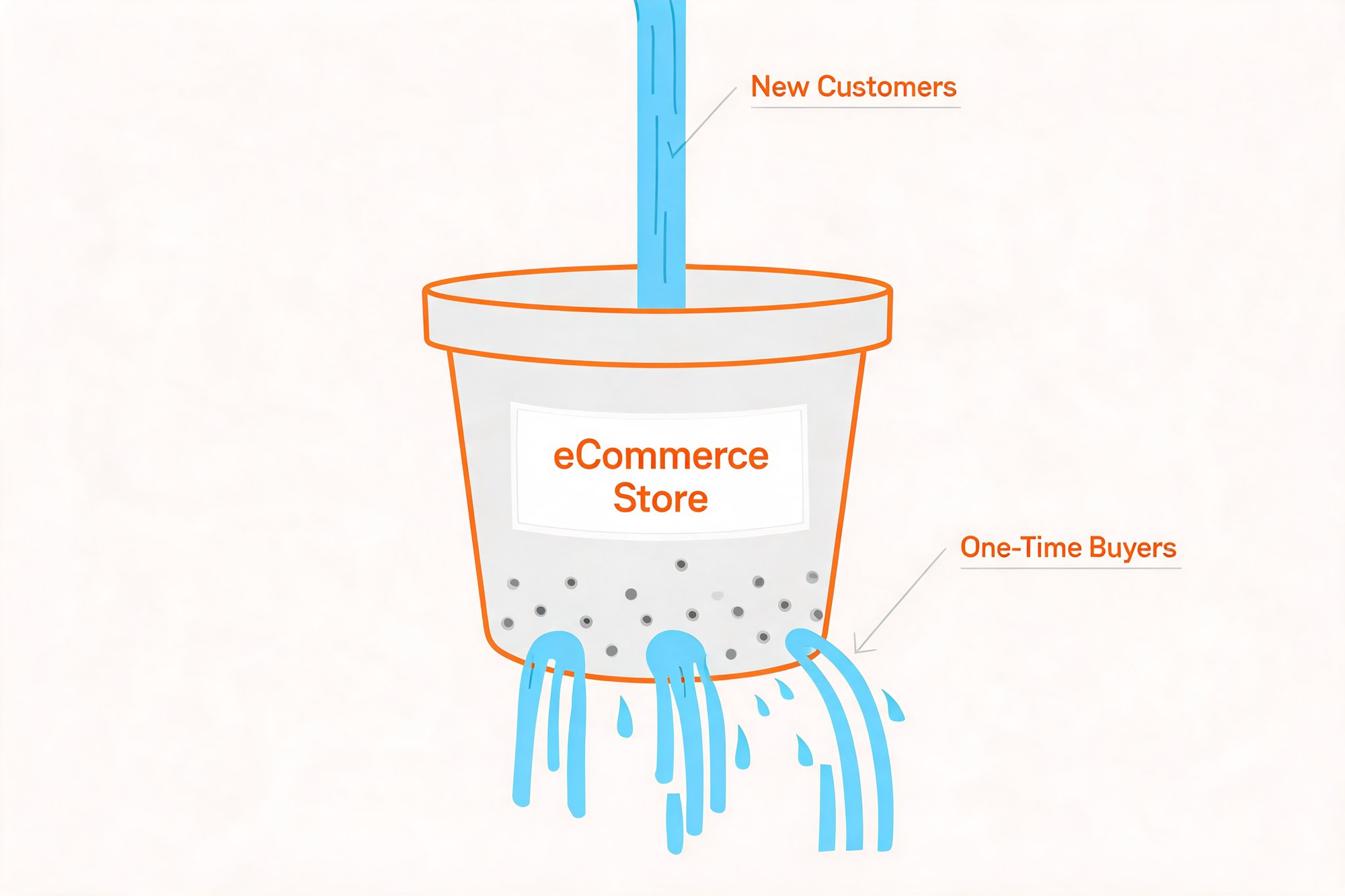
Remember the leaky bucket. Acquisition fills it; the unwatched post-purchase moments are the holes in the bottom. The 5-to-25-times gap from a moment ago is precisely what drains out: a one-time buyer you already paid to win, lost to a silent delivery and a clumsy return. Plug those holes and the same ad spend starts buying you repeat customers instead of just first orders.
Meet the Post-Purchase Experience Platform: Your Engine for the Second Sale
There's a whole category of software built for this exact blind spot, and it's called a post-purchase experience platform.
Instead of bolting onto your marketing, it plugs into the operational side of your business (shipping, tracking, and returns) and turns each step into a branded moment you control. The difference comes down to the trigger.
AfterShip fires branded email and SMS, plus live tracking-page updates, off real carrier events: "shipped," "out for delivery," "delivered," and "exception/delay," across 1,100+ carrier integrations. That's the capability no funnel builder or generic email platform has, because none of them are wired into the carriers in the first place.
Here's what that unlocks, in three pillars:
- Tracking: turn WISMO (where is my order?) anxiety into a branded revenue moment. A tracking page people actually open becomes a place to recommend products, not just read a status line. Inspire Uplift cut WISMO tickets by 75%; StackCommerce cut them by 71%.
- Returns: make sending something back so easy it builds the confidence to buy again. An exchange-first flow, store credit, and a branded self-service portal keep revenue inside the business instead of refunding it away. Pelagic Gear saw an 18% lift in purchases driven from the returns portal and a 12% drop in return contact tickets; Marc Nolan doubled its exchange rate and retained $125k in the last 90 days, with returns work falling from 35 hours a week to one, according to Director of Operations Nikolas Callas.
- Email & SMS: send notifications that are genuinely useful, like "Your package was just delivered," instead of one more promotional blast. Helpful messages get opened, and an open is a second chance to sell.
A quick word on cost, because it's fair to ask. On the Shopify App Store, AfterShip Tracking starts at Essentials for $11/mo, which includes the branded tracking page and branded email and SMS notifications. The AI-powered estimated delivery date and personalized product recommendations sit one tier up, on Premium at $70/mo. Essentials does not include the AI delivery date or the recommendations, so plan around the tier that matches what you actually need.
One clarification, since you're weighing email tools right now: AfterShip Email is not a Mailchimp replacement. It's a complement. Keep your ESP for newsletters and welcome series, then add AfterShip Email for the shipment-triggered moments after checkout. If you want something tactical to start from, there are plenty of amazing post-purchase ideas worth borrowing.
None of this is a funnel question or an email question. It's a layer your stack is missing, and it's where the second sale is actually won.
So, What's the 2026 Stack for a Growing Brand?
So here's the honest recommendation: you don't pick one tool, you build a stack where an ESP handles pre-purchase and a dedicated post-purchase layer handles everything after checkout.
And no, that doesn't mean ripping out Mailchimp. It means using each tool for the job it's actually good at:
- Acquisition: your Shopify store, where the traffic lands and the first sale happens.
- Pre-Purchase Marketing: an ESP like Mailchimp or Klaviyo for newsletters, welcome series, and the campaigns that warm up your list.
- Post-Purchase & Retention: AfterShip for everything after the buy button, the tracking, notifications, and returns that earn the second order.
The part founders worry about is cost, so let's be straight about it. You're not buying a four-product suite on day one. The on-ramp is a single product: AfterShip Tracking Essentials at $11/mo for the branded page and notifications. Set that against a funnel tool running $97 to $297/mo, and the post-purchase layer is the cheapest, highest-leverage line item in your whole stack.
One honest caveat: AfterShip is one platform, but not one invoice. Tracking, Email, and Returns each have their own pricing ladder and are billed separately. "One platform" means one login, one dashboard, and one data model, not one bundled bill. You add products as you grow, not all at once.
If you already run Mailchimp, you can connect Mailchimp with AfterShip to migrate your contacts and keep them in sync. Be clear on what that does, though: it's contact synchronization, not a pipe that pushes live shipping events into Mailchimp automations. Your shipment-aware flows run inside AfterShip Email, where the carrier data actually lives.
Proactive shipment tracking that delights your customers, reduces WISMO tickets, and optimizes your delivery performance.
Explore AfterShip TrackingFrequently Asked Questions
Can I use AfterShip for email marketing instead of Mailchimp?
Not instead of, alongside. AfterShip Email is built for post-purchase and shipment-triggered flows, and most brands run it next to their ESP rather than in place of it. Keep Mailchimp for newsletters and welcome series, then add AfterShip Email for the moments right after checkout, when a simple "delivered" message can tee up the next order.
What's the main difference between a post-purchase funnel and a sales funnel?
A sales funnel works to win the first purchase: landing pages, offers, and checkout flows. A post-purchase funnel starts the second the order is placed and works to win the next one, using live shipping status, delivery, and returns as its triggers. One fills the bucket; the other keeps it from leaking.
How much does AfterShip cost for a small business?
Adding a post-purchase layer is a $9 to $11/mo decision, not a second ClickFunnels-sized bill. Tracking Essentials is $11/mo for the branded page and notifications, and Email Essentials runs $9 to $11/mo for 500 contacts. Each product is billed separately, so you start with one and layer in the rest as you grow. There's no $97 to $297/mo commitment to get going.