
Claimlane vs AfterShip: Which is More Cost-Effective for Claims?


Quick Verdict: Who is More Cost-Effective in 2026?

You're trying to find the most cost-effective claims software, and you assume the focused tool is the cheap one. It isn't. Claimlane's entry plan starts at $499 a month; AfterShip's warranty-capable entry point starts at $119. AfterShip wins on the sticker, and the hidden costs your warranty process is bleeding in several places (agent time, fraudulent claims, and lost customer lifetime value) only widen the gap. This comparison looks beyond the monthly fee to find the truly more profitable solution for 2026.
So here is the short answer to Claimlane vs AfterShip, before you build the business case. AfterShip is the more cost-effective choice for any brand running, or planning to run, a modern post-purchase stack. It costs less to start, and it removes operational costs that a standalone tool leaves on your books.
The price comparison runs the opposite way to what most buyers expect. Claimlane Core lists at $499/mo (about 399 euros) for 1,000 tickets a year. AfterShip is roughly 4x cheaper at entry: Warranty access starts at AfterShip Returns Premium ($119/mo on Shopify; from $99/mo billed annually). Warranty is a feature inside AfterShip Returns, not a separate product, so that one plan covers it.
Claimlane is not a weak product. It holds 4.8/5 on G2, though from a small base of about 13 reviews, so read the score as directional rather than decisive. There is also one real scenario where it fits better, which we cover honestly further down. For most mid-market DTC brands, though, the math points one way, and the rest of this article shows why.
Beyond the Subscription: The 4 Hidden Costs of Warranty Claims
The monthly fee is the cost you can see. It is rarely the cost that matters most. A claims tool's true price is its total cost of ownership: the subscription plus everything your team spends working around the software's limits. The stakes are bigger than a software line item: Qualtrics XM Institute estimates that poor customer experiences put $3.7 trillion at risk globally every year.
Before we map those costs, one clarification, because two AfterShip products both say "claims." Protection covers shipping incidents, protecting shipments against damage or loss in transit, underwritten by InsureShield / UPS Capital, with around 95% of claims approved. Warranty covers product defects and recalls after the item is delivered. This comparison is about product warranty claims, where Claimlane competes, not transit insurance.
With that settled, here are the four hidden costs that decide which solution is actually cheaper:
- Agent labor. Every claim where an agent hunts across the store, the carrier site, and the helpdesk to confirm an order burns minutes that add up to headcount.
- Fraud and policy abuse. Claims filed outside the warranty window, and repeat offenders, quietly drain margin when the tool cannot see a customer's full history.
- Integration and data silos. A standalone tool means paying developers to connect it, or living with disconnected order, tracking, and returns data.
- Lost revenue and LTV. A disjointed claim experience costs you the next purchase. The customer who fought your process does not come back.
A point solution can look cheap on the invoice and still lose on all four lines. An integrated platform attacks them together, because the claim, the order, and the customer history already sit in one system. That structural difference, siloed tool versus connected platform, is the real story of this comparison.
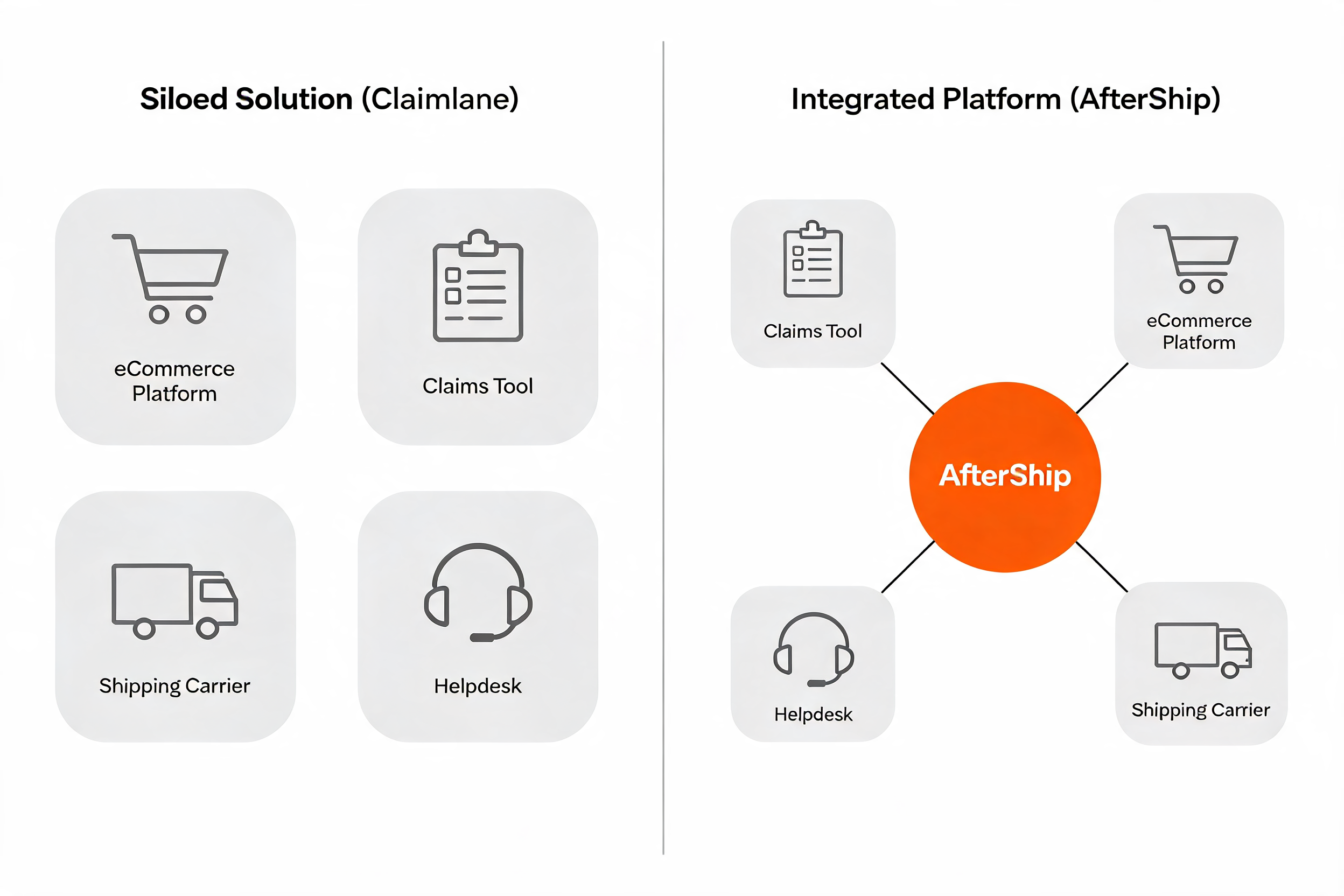
Claimlane vs. AfterShip: Comparing Total Cost of Ownership
The fairest way to compare Claimlane vs AfterShip is not feature by feature. It is cost driver by cost driver: the four hidden costs, plus the subscription you already know. Line them up that way and the pattern holds. AfterShip starts cheaper and stays cheaper, because the platform absorbs work that a standalone tool pushes back onto your team.
Read the pricing row first, then trace each cost down the table. Every row maps to a real driver of total cost of ownership: agent time, fraud, integration, recalls, warranty-window control, and the revenue you keep after a claim. Notice what the table is not. It is not a feature checklist. Features matter here only to the extent they remove a cost.
| Criteria | Claimlane | AfterShip Warranty |
|---|---|---|
| Entry pricing | Core $499/mo (about 399 euros), 1,000 tickets/yr; Plus $799/mo, 2,000 tickets/yr | Warranty access starts at Returns Premium: $119/mo on Shopify (100 returns/mo), or from $99/mo billed annually (1,200 returns/yr). No separate per-product Warranty add-on fee for self-serve merchants. |
| Agent Time Savings | Agents must switch between the claims tool, the eCommerce platform, and the helpdesk to verify order details. | Native Warranty RMA page shows the order, the issue, replacement tracking, and the claim timeline on one screen. Connected to a helpdesk (Gladly/Gorgias), shipments, returns, and warranty claims appear in one customer record. |
| Fraud Prevention | AI fraud detection reserved for the top Custom/Enterprise tier only (not Core or Plus). | Rules-based controls (configurable conditions: number of requests, return-weight difference, first-tracking-update date; actions: flag for review, add to blocklist), cross-referencing the customer's full order and return history, included from the $119/mo Premium tier. Not AI-powered. |
| Integration Cost & Data Silos | A standalone claims tool with disconnected order, tracking, and returns data. | Warranty lives inside the AfterShip Returns/post-purchase platform: one login, dashboard, and data model across tracking, returns, and warranty (each product billed separately). |
| Recall workflow | No advertised recall pathway. | Product Recall workflow (advanced/Enterprise tier): identify and notify affected customers and route them into a managed remediation/RMA process. |
| Warranty-window enforcement | Per-product and per-supplier windows supported. | Order-level enforcement only (honest limitation; best fit for single-SKU brands or catalogs with one uniform term). |
| Revenue/LTV Impact | Point solution; claims data not connected to the wider post-purchase journey. | Verified outcome at Goodr: 60% fewer support tickets, 75% fewer warranty claims (about 8,000 to 2,000 a month) via automated one-year warranty-window enforcement with AfterShip Returns + Warranty. |
Entry-price comparison, not unit cost. Claimlane Core bills on annual ticket volume (1,000/yr); AfterShip bills on monthly volume.
The rows below the pricing line are where the real money moves. Here is how the platform cuts each one.
How AfterShip's Integrated Platform Drives Down Total Costs
Start with agent labor, the cost that hides in plain sight. In a standalone tool, a single warranty claim can mean three open tabs: the claims app, the store admin, and the carrier site, just to confirm what the customer bought and where the replacement is. In AfterShip, the agent works from one screen. The native Warranty RMA page shows the issue, the linked order, the replacement shipping, the claim timeline, and internal notes together.
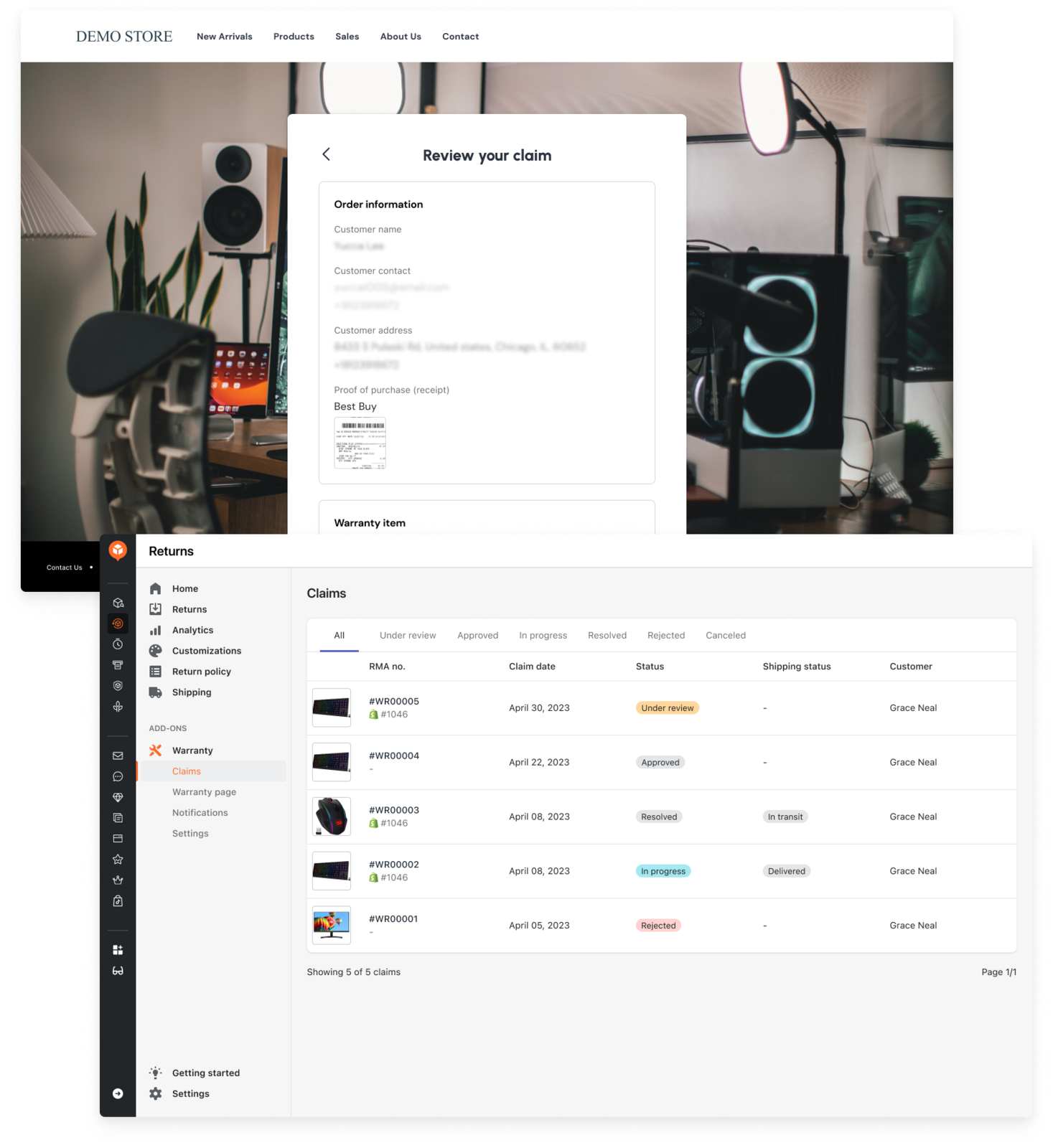
AfterShip's warranty claims management inside AfterShip Returns: each claim's status, order, and proof of purchase in one place.
Be precise about what that screen is and is not. It is one warranty claim in full context, not a company-wide customer history. The fuller cross-product record, a customer's shipments, returns, and warranty claims side by side, appears when AfterShip is connected to a helpdesk such as Gladly or Gorgias, which pulls those events into a single view of the customer journey. The result is the same either way: your agent stops hunting for data the system already holds. Trim even a couple of minutes from each claim and, illustratively, across thousands of claims a year that becomes real headcount you do not have to add.
Fraud is the second driver, and here the wording matters. AfterShip's controls are rules-based, not AI-powered. You configure the conditions that flag a claim, such as the number of requests from one customer, a difference in return weight, or the date of the first tracking update. The system then flags the claim for review or adds the offender to a blocklist, cross-referencing the customer's full order and return history as it does. These controls are included from the $119/mo Premium tier. Claimlane offers AI fraud detection, but only in its top Custom or Enterprise tier, not in Core or Plus, so the brands most focused on keeping costs down get the least built-in protection.
Integration is the quiet third cost, and it is the one a platform erases by design. Because AfterShip's automated warranty management solution lives inside a comprehensive returns management portal and the wider post-purchase platform, there is no separate claims tool to wire up, no developer time to budget, and no disconnected data to reconcile. Tracking, returns, and warranty share one login, one dashboard, and one data model. A standalone tool starts that race already behind, because every connection it needs is a project someone has to own.
Platform breadth then shows up in places a point tool never reaches. AfterShip includes a Product Recall workflow on its advanced and Enterprise tier: a managed remediation process that identifies affected customers, notifies them, and routes them into an RMA. It is an operational workflow, not a legal or compliance product, and it is the kind of capability you cannot bolt onto a standalone claims tool after the fact.
None of this is theory. Goodr ran the experiment and published the numbers.
“For us, AfterShip is a one-stop shop for delivery options and post-purchase support. We mainly use it for warranties and returns, where it helps with claims, processing, and customer service.”
Customer Service Team
Read their story →By automating one-year warranty-window enforcement with AfterShip Returns and Warranty, Goodr cut support tickets by 60% and warranty claims by 75%, from roughly 8,000 a month down to about 2,000. That is the four hidden costs falling at once: fewer agent hours, fewer abusive claims slipping through, no integration tax, and a cleaner experience that protects the next purchase. The broader signal is consistent, with AfterShip holding 4.7/5 on Shopify across more than 1,200 reviews. For a cost-conscious team, the takeaway is simple. The platform does not just do the point tool's job. It removes the costs the point tool leaves behind.
Is Claimlane Ever the Right Choice?
A fair comparison names where the other tool wins. For Claimlane, that place is real, and it has nothing to do with price.
The difference comes down to how each platform handles the warranty window. AfterShip enforces that window at the order level: one clock, tied to the order, governs the claim. Claimlane supports per-product and per-supplier windows, so different components on the same order can carry different warranty lengths and route to different suppliers.
For some brands, that is exactly the model they need. If you sell multi-component products where each part has its own warranty term, think of an item assembled from parts that each carry a separate manufacturer warranty, and your operation runs on multi-supplier, multi-warranty repair routing across many SKUs (the niche Claimlane's MaxGaming case study describes), Claimlane can be the better technical fit. That is a genuine functional gap in AfterShip, and pretending otherwise would not help you build an honest business case.
The practical test is simple. Look at a typical order and ask whether its items share one warranty term. If they do, order-level enforcement covers you cleanly. If a single order routinely mixes components with different warranty clocks and different suppliers, that is the signal Claimlane was built for.
Now the reframe, because this gap is narrower than it sounds. Most mid-market DTC catalogs are not built that way. If you sell single-SKU products, or a catalog that runs on one uniform warranty term, order-level enforcement is not a limitation. It is exactly what you want: one rule, applied automatically, with no per-line exceptions for your team to babysit. It is also what powered Goodr's results, where automated one-year-window enforcement drove the ticket and claim reductions covered above. Match the tool to your catalog, and for most brands the order-level model is the simpler, cheaper fit.
The Final Verdict: Choosing a Partner for Profitability, Not Just Price
Step back from the feature list and the Claimlane vs AfterShip choice is about what you are really buying: a point solution or a platform.
Claimlane gives you a focused claims tool. AfterShip gives you warranty inside a connected post-purchase system, where the claim already knows the order, the shipment, and the customer's history. That connection is what drives down agent time, fraud, integration cost, and lost lifetime value, the four hidden costs that decide total cost of ownership.
Here is the part most buyers get backwards. The platform is also the cheaper place to start. Claimlane Core lists at $499/mo; AfterShip's warranty-capable entry point, Returns Premium, starts at $119/mo on Shopify, or from $99/mo billed annually. AfterShip wins on total cost of ownership and on the entry sticker price at the same time, so you are not paying a premium for the platform's advantages.
There is one clear exception, worth repeating because it is the honest one. If your catalog is genuinely multi-component and multi-supplier, with different warranty windows per product, Claimlane's per-product and per-supplier model is the better technical fit. For everyone else, which is most scaling DTC brands, AfterShip is the more profitable choice: lower overhead, a better customer experience, and a lower entry price.
And the gap compounds. A point tool's hidden costs scale with your order volume: more claims mean more tab-switching, more fraud exposure, and more integration strain. A platform that already connects the data holds those operational costs flatter as you grow, so the total-cost-of-ownership advantage widens rather than narrows.
So treat this as a partner decision, not a line item. The right question is not which monthly fee is lower, because that one already favors AfterShip. It is which system will keep lowering your costs as you grow. See how an integrated platform can impact your bottom line. Talk to one of our warranty solution experts today.
Warranty automation that eliminates manual processes, enhances customer experience, and unlocks product insights.
Book a demoFrequently asked questions
Is Claimlane cheaper than AfterShip for warranty claims?
No. Claimlane Core starts at $499/mo (1,000 tickets/yr). AfterShip's warranty-capable entry point, Returns Premium (which includes Warranty), starts at $119/mo on Shopify, or from $99/mo billed annually (1,200 returns/yr). AfterShip is roughly 4x cheaper at entry and includes more annual volume. This is an entry-price comparison, not a unit-cost identity, because Claimlane meters annual 'tickets' and AfterShip meters 'returns.'
Does AfterShip Warranty have its own price?
No. Warranty is a feature inside AfterShip Returns, not a separately priced product. Access starts at Returns Premium ($119/mo on Shopify; from $99/mo billed annually). There is no separate per-product Warranty add-on fee for self-serve merchants; the /warranty page's 'Custom / Book a demo' block is the Enterprise contact path.
Is AfterShip's fraud prevention AI-powered?
No. It is rules-based. The merchant configures conditions (number of requests, return-weight difference, first-tracking-update date) and the system flags claims for review or adds offenders to a blocklist, included from the Premium tier. Claimlane's AI fraud detection exists only in its top Custom/Enterprise tier, not in Core or Plus.
Does AfterShip show one screen with tracking, returns, and warranty for a customer?
The native Warranty RMA page shows a single claim in full context (Issue, Order, replacement Shipping, Timeline, Notes). The full cross-product customer timeline (shipments + returns + warranty together) is delivered through a helpdesk integration such as Gladly or Gorgias, not a native all-in-one screen.
Can AfterShip handle different warranty lengths per product?
Not natively. AfterShip enforces the warranty window at the order level. Claimlane supports per-product and per-supplier windows, so for multi-component catalogs with mixed component lifespans that is a genuine functional gap. Order-level enforcement fits single-SKU brands and catalogs with one uniform term.
What is the difference between AfterShip Protection and AfterShip Warranty?
Protection covers shipping incidents (lost, damaged, or stolen packages in transit), underwritten and adjudicated by InsureShield (UPS Capital), with about 95% of claims approved. Warranty covers post-delivery product defects and recalls. Claimlane competes with Warranty, not Protection.