
What Are Branded Tracking Services? A 2026 Market Guide

Why Your Carrier's Tracking Page Is Costing You Customers
Your support team spent 40 percent of their day answering Where Is My Order tickets last month, except they probably did not. Gorgias's first-party data across 12,000-plus brands puts WISMO at 18 percent of all tickets, and Yuma's sample of 100,000-plus tickets across 100-plus brands puts it at 16 percent. The 30 to 50 percent figure most vendors cite is marketing that got repeated until it felt like fact. But here is what 16 to 18 percent really reveals: WISMO is still your single most frequent inquiry, and the default carrier tracking page is a dead end for it. Replacing it with a prettier page is solving the wrong problem. Here is why.
The carrier's tracking page is where that frequency turns into cost. It carries UPS or USPS branding, not yours. It shows a barcode and a status code, offers no help when a package stalls, and leaves the anxious customer with nowhere to go but your inbox.
It is dead space commercially, too. A carrier page cannot recommend a product, surface a promotion, or even show your logo. The single most-visited screen of the entire post-purchase journey is working for the carrier, not for you.
That matters most exactly when a delivery slips.
93 percent of US consumers say proactive shipping updates help offset the negative experience of late deliveries.
Locus survey, January 2026 (n=1,000 US consumers)
Read that in reverse. The cheapest way to protect a customer relationship through a late delivery is communication you control, and the carrier page hands you none of it. So the problem was never an ugly page. It is that the page belongs to someone else.
What Are Branded Tracking Services, Really?
A branded tracking service replaces that carrier page with an asset you own. It pulls the same shipment data from the carriers, then presents it on your domain, in your design, under your control. Instead of sending customers to a barcode on a third-party site, you give them a tracking experience that looks and behaves like the rest of your store.
By 2026, a handful of capabilities are simply table stakes. Any branded tracking service worth shortlisting should cover the basics:
- Custom domain: the tracking page runs on your own URL (for example, track.yourbrand.com) instead of a vendor subdomain. Custom domain is a paid-tier feature across vendors, AfterShip included (Premium and above), so treat it as standard but tier-gated when you compare plans.
- Brand elements: your logo, colors, and fonts on the page, never the carrier's.
- Order lookup: customers can find a shipment with an order number or email, no account required.
- Visual progress bar: a clear, step-by-step shipping timeline in place of a raw carrier status code.
Clear these and you have caught up to the category. You have not pulled ahead of it. Every credible branded tracking service does this much, which means the table-stakes checklist tells you almost nothing about which one to actually buy. The real question is what the tool does with the tracking data once it has it, and that is where these services start to diverge sharply.
The 5 Must-Have Features of a Top-Tier Tracking Service in 2026
The table-stakes list gets a branded tracking service into the room. These five features decide whether it deserves the budget. Use them to pressure-test every option on your shortlist.
1. Proactive, Multi-Channel Notifications
The fastest way to cut WISMO is to answer the question before the customer asks it. That means pushing shipment events out proactively, on the channels people actually check. AfterShip surfaces updates across Email, SMS, WhatsApp, Facebook Messenger, and Apple Wallet, with Apple Wallet added in March 2026.
Most tools stop at email. A 2025 parcelLab and ShipStation study found that roughly 66 to 68 percent of large US retailers still rely on email alone. In 2026, email-only notifications are the equivalent of a busy signal: technically a channel, practically a dead end.
2. 1,318 Carrier Integrations
A tracking page is only as useful as the carriers it can read. Every gap is a blank page and another ticket. AfterShip connects to 1,318 carriers, a figure worth confirming live on publish day since it climbs most months.
For contrast, Loop Tracking covers around 180. That gap barely registers for a single-carrier domestic brand, but it becomes a daily fire for anyone shipping internationally or across multiple 3PLs. The practical difference between 1,318 and roughly 180 is the difference between "we track everything" and "we track most things."
3. AI-Powered Predictive Delivery Dates
Customers do not want a status code. They want a delivery date they can trust. AfterShip's AI estimated delivery dates predict that window with up to 95 percent accuracy, trained on 4.4 billion shipments, with full coverage across 101 major carriers and partial coverage on 150-plus more. The model covers at least 80 percent of typical merchant deliveries, against the under-40 percent baseline most carrier-provided estimates manage.
This is where the field thins out fast. Loop's Delivery Promise is the closest comparable, publishing a documented greater-than-90 percent accuracy figure. Malomo, ParcelPanel/ParcelWILL, and Route do not publish documented AI-trained EDD accuracy figures at this carrier scale. When a vendor cannot point to a number, treat that silence as the answer.
4. Built-in Marketing and Upsell Assets
The tracking page draws more repeat visits than any other screen after checkout, and a top-tier service treats it as a revenue surface rather than a status lookup. Product recommendations, promotional modules, and editorial blocks turn a passive wait into a second shopping session.
The numbers back the idea. Vivino drives 30 percent of its repeat sales directly from the tracking page. That is the line between a cost center and a sales channel.
5. Actionable Analytics
You cannot fix what you cannot see, and the fifth feature is reporting that goes past "package delivered." Look for carrier performance scorecards, delivery-time trends, and on-site analytics that connect tracking-page visits to conversions.
That data tells you which carrier to drop, which shipping lane is dragging, and which upsell on the page is actually working. A point tool shows you a page. A real service shows you the operation behind it.
Beyond the Page: Why a Unified Platform Beats a Point Solution
Here is the trap most shortlists walk into. You can buy a branded tracking service that nails all five features and still end up worse off, because a tracking page is a feature, not a strategy.
Think of it this way. A point solution is like buying a gas gauge for your car. A platform is buying the entire dashboard, with the speedometer, engine lights, and GPS included.
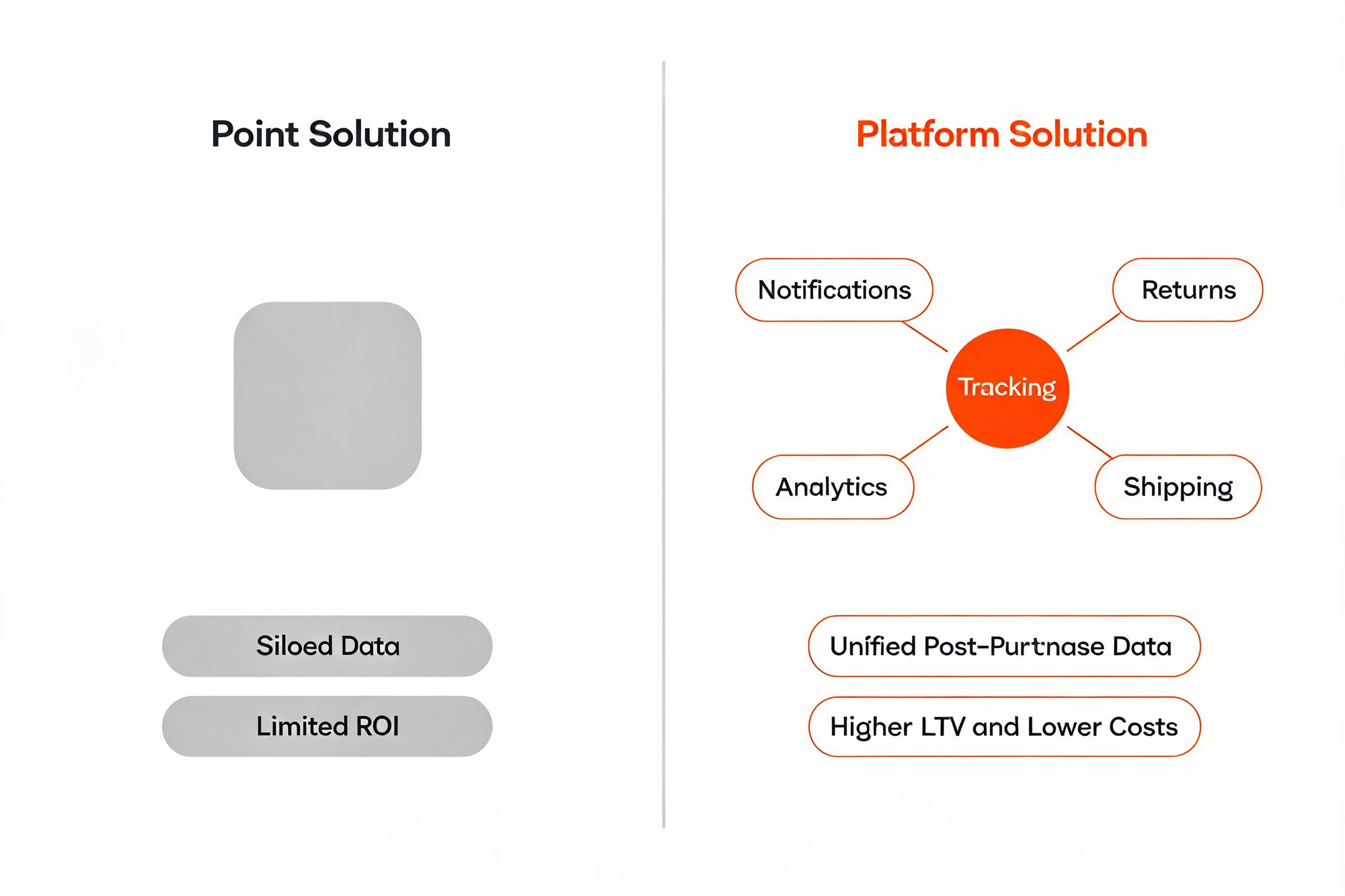
The difference is what your tracking data connects to once it exists. On a post-purchase platform, the same delivery events that trigger notifications also power the next step in the journey. AfterShip Returns, for instance, reads from that same carrier-confirmed delivery stream, so a return window can anchor to the date a package was actually delivered instead of the date the order was placed. The data does double duty rather than dying on the page. That continuity lays the groundwork for a unified customer experience.
That continuity changes the buying math. Moving from Tracking to Returns means enabling a module inside the same account, not launching a fresh vendor evaluation, a new integration, and another security review. More than 20,000 businesses already run on AfterShip's post-purchase platform, and adding a second product carries a 25 percent first-year bundle discount.
So before you score features, ask what happens to the data after the page loads. A point solution answers one question and stops. A post-purchase platform turns every shipment into the start of the next sale.
How AfterShip Tracking Sets the Industry Standard
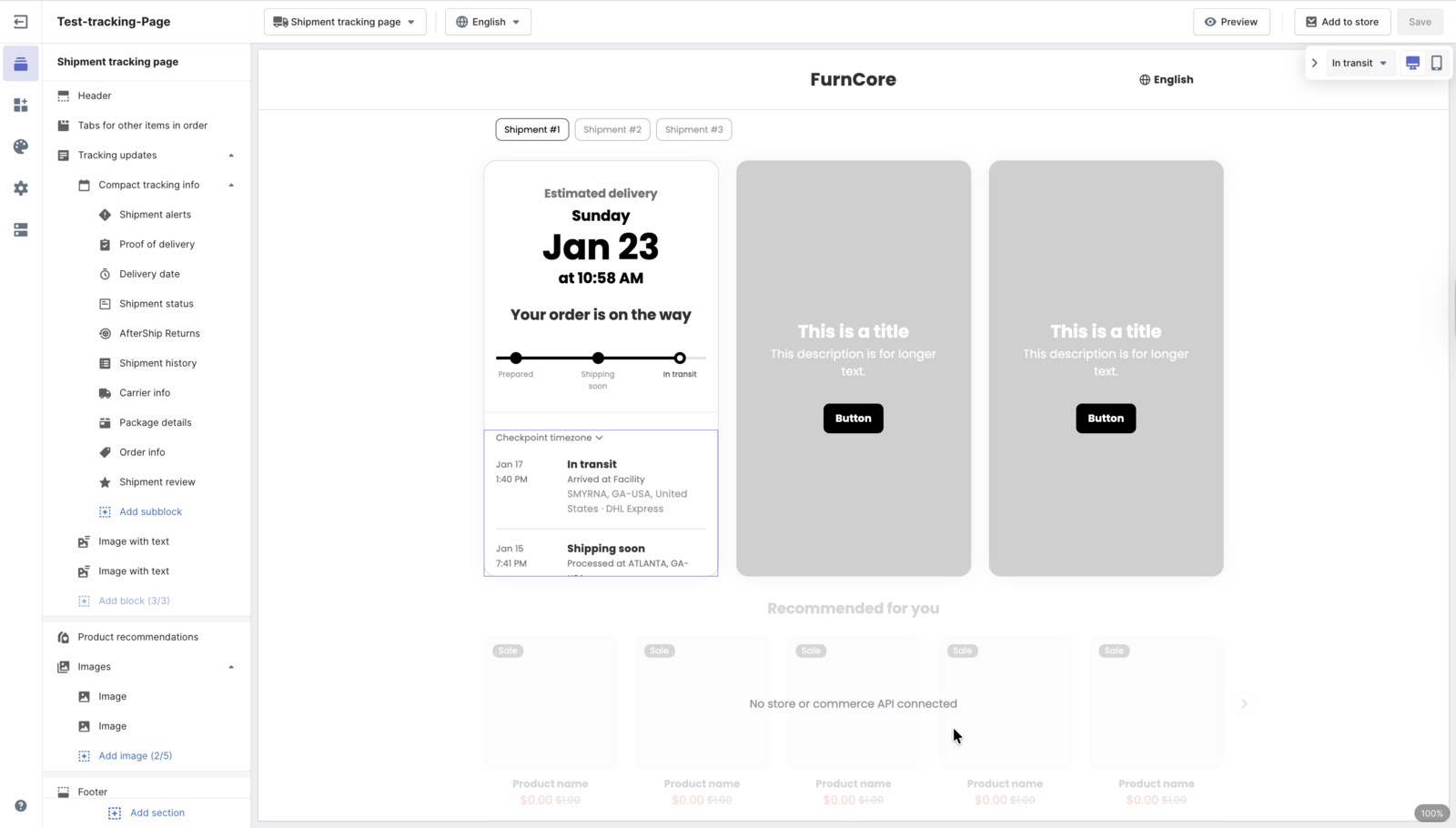
AfterShip Tracking, the leading ecommerce shipment tracking software, is the clearest example of the platform approach in practice. It is not an endpoint, it is the hub. The branded tracking page is built with a drag-and-drop editor, carries AI-powered product recommendations, and the shipment data it collects flows straight into AfterShip's Returns and AI estimated delivery products.
The third-party signals line up behind that positioning. AfterShip holds a 4.9 out of 5 rating across 468 reviews on Capterra as of March 2026, where it sits among 191 products in the Shipment Tracking category. Flowium's 2026 guide names AfterShip the "#1 Post-Purchase Customer Experience Platform," and AfterShip appears across several G2 categories, including Shipping, Package Tracking, and Returns Management.
The customer outcomes make it concrete. Mous, a DTC accessories brand, cut WISMO tickets by 54 percent and reduced transit time by 82 percent after switching to AfterShip. StackCommerce dropped WISMO 71 percent year over year while reaching 99 percent shipment visibility and 90 percent on-time delivery. Inspire Uplift saw a 75 percent WISMO reduction alongside 30 percent repeat sales, an 80 percent email open rate, and a 40 percent email click-through rate.
For balance, the pattern holds even in a competitor's own data. Loop's Casely case study reports a 76 percent WISMO reduction and $1,880 in monthly savings. Loop is a returns-led platform that added tracking by acquiring Wonderment, now Loop Tracking, so its tracking is the newer, bolted-on layer. That is why a tracking-led platform, where tracking is the foundation rather than an add-on, is the stronger place to start. The branded tracking page is the part customers see. The platform behind it is the part that moves the numbers.
Choosing the Right Branded Tracking Partner for Your Brand
Before you sign anything, put every vendor through the same five questions. They are built to surface the gaps that only show up after you have committed:
- Does the solution also manage returns from the same delivery data, or is that a separate vendor and contract?
- How deep are the analytics: carrier performance, delivery times, and conversions on the tracking page itself?
- Can it power predictive delivery dates with a documented accuracy figure you can actually check?
- How many notification channels does it support beyond email and SMS?
- Do its integrations fire event-level Klaviyo flows and feed a Gorgias AI agent, or are they URL-paste only?
The answers sort the market fast. For a brand-new store testing the waters, a simple branded tracking page from a point solution is a reasonable place to start. For any brand focused on scaling, controlling long-term operating costs, and growing customer lifetime value, a post-purchase platform is the only logical investment.
One caveat belongs in your evaluation, not in a footnote. AfterShip has drawn criticism in Shopify App Store reviews for moving features between pricing tiers without much warning, and custom-domain hosting in 2025 is the case merchants cite most. The current policy keeps custom domain on Premium and above, and AfterShip grandfathers existing paying customers on plans that already had it. The honest takeaway: if a capability is operationally critical to you, confirm its tier in writing during evaluation rather than assuming it will stay put.
Frequently Asked Questions
What does a branded tracking service cost?
AfterShip Tracking uses one pricing structure with a monthly or annual billing toggle (annual saves about 18 percent) plus a volume slider. The cleanest reference is the Shopify App Store monthly view: free under 50 shipments a month, $11 a month for Essentials (100 shipments, then $0.08 per extra shipment), and $70 a month for Premium (500 shipments, then $0.12 per extra shipment). A brand shipping 1,000 to 5,000 orders a month sits above Premium's 500-shipment quota, so Premium fits the low end of that range with per-shipment overage, while higher-volume brands have effectively outgrown Premium and should request an Enterprise quote. SMS is billed separately and varies by destination.
How long does it take to set up?
Setup is a Shopify install followed by tracking-page configuration. You connect the app, style your branded tracking page to match your store, and switch on the notification channels you want. The timeline depends on how much you customize, so treat it as a short configuration project rather than a fixed benchmark.
Does it integrate with Klaviyo and Gorgias?
Yes. The basic Klaviyo connector is on Essentials, the 16-trigger advanced flow integration is on Premium (status changes, split shipments, EDD-based and stalled-order scenarios), and an expanded 18-metric set is on Enterprise. Gorgias has had AfterShip's AI WISMO automation since August 2025, surfacing order and return details inside the agent for one-click resolution. AfterShip also natively supports Attentive, Omnisend, Sendlane, and Postscript; Zendesk, Freshdesk, Kustomer, and Intercom; and Shopify, BigCommerce, Wix, WooCommerce, Magento, and Salesforce Commerce Cloud. ActiveCampaign and Emarsys connect through webhook or REST API rather than a native integration.
Does AfterShip support a custom domain on my plan?
Yes, on Premium and above. On Premium and Enterprise your branded tracking page can run on your own domain, such as track.yourdomain.com. Essentials and the free plan still let you apply your logo and colors, but the page is hosted on an AfterShip URL rather than your own.
Proactive shipment tracking that delights your customers, reduces WISMO tickets, and optimizes your delivery performance.
Book a demo