
What Are the Best Return Portals? 5 Options Ranked for 2026


Is your returns "process" a chaotic mix of support emails, messy spreadsheets, and manually generating labels in a carrier portal? You are not just busy; you are losing money and frustrating customers. When a manual system breaks, it breaks hard. This is the moment most brands realize they do not have a returns problem; they have a systems problem.
If that sounds like your week, you are in the right place. You were probably told to "fix returns," given no real budget context, and dropped into a market full of jargon and near-identical feature lists. This guide is built to cut through that.
Here is the plan. First, we will look at why running returns by hand stops working at your volume. Then you will get a four-criteria framework for judging any tool on the things that actually matter to a scaling brand. Finally, we will rank the best return portals for 2026 and name which one fits which stage of growth, so you can make one confident choice instead of a guess you revisit in a year.
Why Your Manual Returns Process Is Unsustainable
Returns are not an edge case anymore. They are a permanent line item. The NRF reported an online return rate of roughly 19.3% in 2025, which means close to one in five of the orders you ship comes back. At 500 to 2,000 orders a month, that is anywhere from roughly a hundred to several hundred returns your team is touching by hand every month.
The fee you can see is never the real cost. Every manual return quietly draws down four budgets at once:
- Support hours. Each emailed request becomes a thread: approve it, find the order, generate a label, answer the follow-up. Multiply a few minutes by hundreds of returns and your team is processing returns instead of doing growth work.
- Customer trust. A slow, confusing return is the last impression a shopper takes from the order. Get it wrong and you do not just lose that sale; you lose the next three.
- Lost revenue. A spreadsheet can only refund. It cannot offer an exchange or store credit, so every return defaults to money leaving the business that a better flow could have kept.
- Error risk. Manual data entry produces wrong labels, missed return windows, and approvals that slip through the cracks. At ten returns a month you absorb it. At your volume it compounds.
There is also a hard per-return processing cost (warehouse handling, restocking, reverse shipping) that belongs in this math, and it is worth pinning down for your own numbers rather than guessing.
None of this is a discipline problem. Your team is not careless; the system is. Manual returns scale in a straight line with order volume, and your headcount does not. That widening gap is exactly what a return portal exists to close.
Put plainly: the same growth that proves your brand is working is what quietly breaks a manual returns desk.
How to Evaluate a Return Portal: 4 Criteria That Matter for Scaling Brands
A demo will show you a hundred features. You really only need to judge four things, and each one maps straight back to a cost you just read about.
- Customer experience. Can a shopper start and finish a return themselves, on a branded page, without emailing you? Self-serve is the difference between a return that resolves overnight and one that sits in your inbox for two days.
- Support-team efficiency. How much manual work does the tool actually remove? Look for automated approvals, auto-generated labels, and rules that clear the routine cases so your team only touches the genuine exceptions.
- Revenue retention. Does it actively keep the sale? The strongest portals steer shoppers toward exchanges and store credit instead of a refund, turning a moment of loss into revenue you hold onto.
- Scalability and total cost. Will it still fit at three times your current volume, and what are the hidden costs (per-label fees, carrier limits, paid add-on modules) that never show up on the pricing page? The cheapest tool today is often the one you rip out in 18 months.
If you want a deeper breakdown of how to choose the right software, these four criteria are the backbone of it.
Score every option on customer experience, support efficiency, revenue retention, and scalable cost, and the marketing noise falls away. That is the exact scorecard we will use to rank the five best return portals for 2026, starting next.
The 5 Best E-commerce Return Portals for 2026
There is no single "best" return portal. There is the best one for where your brand is right now and where it is headed next. The five tools below each win at a different stage of growth, so the goal is not to crown a universal champion. It is to match the tool to your trajectory. The order here is deliberate, too: it tracks the path most brands actually walk as they scale.
Here are the five best return portals for 2026: AfterShip Returns, Loop Returns, Happy Returns, ReturnGO, and Narvar. One is built for scaling automation, one for Shopify exchange flows, one for in-person drop-off, one for multi-platform flexibility, and one for the enterprise. Read each through the four-criteria lens, and the right fit for your team should get obvious fast.
1. AfterShip Returns: Best for Scalable, Multi-Carrier Automation
If you have outgrown spreadsheets but you are not yet an enterprise with a procurement team, this is the stage AfterShip Returns is built for. It pairs a branded, self-serve portal with a deep automation-rules engine, so the routine return resolves itself and your team only touches the genuine exceptions. Set a rule once, say, auto-approve a refund the moment the return scans with the carrier, and an entire category of tickets simply drops off your team's plate.
The carrier story is where it pulls ahead for a scaling operation. AfterShip Returns generates labels across 68 carriers and offers 40+ direct integrations, and it lets you bring your own negotiated carrier account rather than locking you into resold rates. As your lanes and 3PLs change, the platform changes with you.
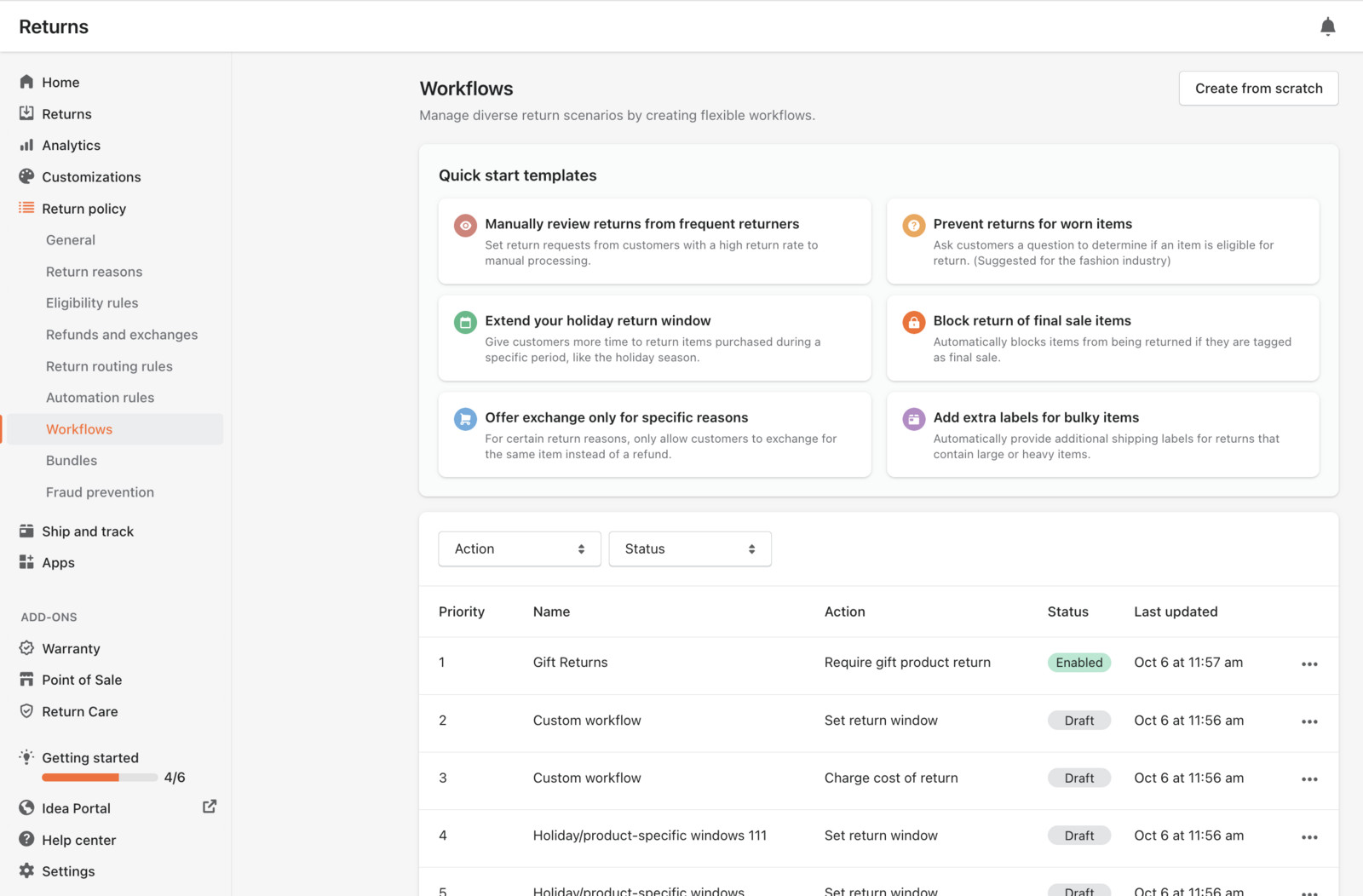
On retention, the portal does more than process a refund. It can recommend exchanges with AI, add bonus store credit to nudge an exchange over a refund, and it supports the Shopify Store Credit API, so the sale you were about to lose often stays in the business.
The proof is in what brands actually do with it. Footwear brand Marc Nolan cut the time its team spent on returns by 97% (from about 35 hours a week to roughly one), it roughly doubled its exchange-to-refund rate (about a 2x shift), and it saved $125,000 in 90 days. For the team, that meant returns went from a daily fire drill to a background process.
“It's just so easy and effortless for me to check in on things and work with the returns portal. I don't have to worry about it anymore. There's so much time that I've saved so that I can direct my focus elsewhere.”
Nikolas Callas, Director of Operations
Read their story →That experience holds up at scale: AfterShip Returns sits at 4.7/5 across about 1,270 Shopify App Store reviews. Pricing is public, too. The help-center ladder on aftership.com runs from $9/mo (Essentials, billed annually) to $49 (Pro) and $199 (Premium), so you can right-size as your return volume climbs instead of negotiating just to see a number.
The honest tradeoff is setup. Standing up a deep rules engine takes more configuration than flipping a single switch. For a brand that is scaling, that configurability is the point, not the price. Plan for a short onboarding window rather than a same-afternoon launch, and treat the setup time as the one-time cost of a system you will not outgrow in a year.
2. Loop Returns: Best for Shopify Brands Prioritizing Exchanges
If you are an early-stage Shopify brand whose top priority is turning refunds into exchanges, Loop Returns is a strong contender. It was originally built for Shopify and is now available on other platforms, so treat it as Shopify-first rather than Shopify-only.
Loop's real strength is its opinionated, exchange-first flow. Features like Shop Now and Instant Exchange are designed to keep revenue on the books, and for a simpler catalog the experience feels tightly wired into the native Shopify admin. For a brand doing a few hundred orders a month with a tidy product line, that opinionated simplicity is a feature, not a limitation.
That tight native feel is also the one place AfterShip asks more of you up front. For very simple use cases, Loop's prescriptive setup can feel cleaner than AfterShip's deeper, more configurable engine. The flip side is that the configurability you skip early is exactly what you reach for as your operation gets more complex, which is why scaling brands tend to grow toward the heavier engine, not away from it.
Loop's limits show up as you grow. It offers return labels through 21 carriers via shipping service providers, with no option to bring your own carrier account, and its international coverage is thinner than a global catalog needs. Reviewers also note the rules can feel rigid on edge cases. Paid plans start at $155/mo (Essential). Loop earns 4.7/5 across about 427 Shopify reviews, so the satisfaction for its core use case is genuine.
3. Happy Returns: Best for Brands with a Physical Drop-Off Strategy
Happy Returns is best understood first as a partner and second as a competitor. A UPS company (acquired from PayPal), it runs a box-free, label-free drop-off network, with nearly 10,000 Return Bar locations putting about 78% of the US population within 10 miles of one.
For shoppers, that convenience is the entire pitch: no box, no printer, no waiting on a label. The scale of that physical footprint is the proof point here, and it is something no software-only portal can replicate on its own.
Here is the twist for your team. AfterShip integrates the Happy Returns network directly, so you can offer those box-free, label-free return bars as a drop-off option while still running a full automation platform behind the scenes. You do not have to choose between physical convenience and operational depth.
Standalone Happy Returns is the right call when your shoppers are US-concentrated and in-person, box-free drop-off is the single feature they value most. If you also want rules, exchanges, and analytics wrapped around that drop-off layer, the integrated route gives you both at once. On its own, the network is a drop-off layer rather than a full rules-and-exchange engine, so brands that need automation tend to pair it with a platform instead of running it alone.
4. ReturnGO: Best for Multi-Platform Brands Wanting Configurable Returns
If your stack is not Shopify-only, ReturnGO belongs on your shortlist as the configurable, multi-platform option. It runs on Shopify, WooCommerce, BigCommerce, Magento, and custom builds, and it is genuinely strong on rule-based configuration. It holds 4.8/5 across about 91 G2 reviews. If you run different return policies across regions or sub-brands, that rule-based flexibility is where ReturnGO does its best work.
Quick context, since you may be wondering: what happened to Returnly? Affirm acquired Returnly for about $300 million in 2021, shut it down on October 1, 2023, and pointed merchants to Loop. Returnly is no longer a live option, which is exactly why ReturnGO, not Returnly, fills the configurable multi-platform slot in 2026.
Where AfterShip pulls ahead of ReturnGO is carrier coverage (68 carriers for labels, 40+ direct integrations) and the full post-purchase stack around the portal. If you want deep configuration on a non-Shopify platform, ReturnGO is a credible pick. If you also want carrier flexibility and a wider post-purchase system on one data model, weigh that tradeoff before you commit.
5. Narvar: The Enterprise-Grade Option
Narvar has earned its enterprise reputation, so let us start with what it does well. It powers returns and post-purchase experiences for 1,500+ brands, including names like Sephora, Levi's, and Patagonia. Its tracking and notification experience is strong, and its customization runs deep when you have a team to drive it.
The catch for a 500-to-2,000-order brand is the commercial model. Narvar is quote-only, with a basic plan in the rough range of $30,000 to $45,000 a year and total spend running past $250,000 a year once you add returns and AI modules. Contracts are annual and priced per module, and implementation is a multi-month project rather than a self-serve setup. For your size, the sticker shock is rarely the headline number; it is the per-module line items and the procurement runway before anything goes live.
That weight shows in the public scores: Narvar holds G2 4.2/5 across about 171 reviews and 3.7/5 across 21 Shopify App Store reviews. For a global enterprise with the budget and an implementation team, it is a serious platform.
For a scaling brand that wants enterprise-grade power without the enterprise overhead, the agile, self-serve mid-market is a better home. With all five profiled, the useful question becomes how they stack up side by side against the criteria your team actually cares about, which is exactly where we go next.
At-a-Glance: Which Return Portal Fits Your Business Stage?
You have the five profiles. Here is how they line up against the criteria your team actually weighs, side by side, so you can stop comparing marketing pages and start comparing fit.
| Criteria | AfterShip Returns | Loop Returns | Happy Returns | ReturnGO | Narvar |
|---|---|---|---|---|---|
| Best for | Scalable multi-carrier automation | Shopify-first exchange focus | Physical box-free drop-off | Multi-platform configurable returns | Large enterprise |
| Pricing (name the channel) | From $9/mo (Essentials, annual, aftership.com direct); Pro $49/mo; Premium $199/mo | Paid from $155/mo (Essential) | Network (reachable via AfterShip) | Published, self-serve | Quote-only; about $30K-$45K/yr basic, past $250K with modules |
| Exchanges / store credit | Yes + AI exchange recommendations + bonus credit via native Shopify Store Credit API | Yes (core strength) | Drop-off focused | Yes, configurable | Yes (enterprise) |
| Automation rule depth | Deep conditions/actions engine + auto-refund on shipment status | Can feel rigid on edge cases (reviewer-noted) | Limited (drop-off layer) | Strong, rule-based | Deep (with implementation team) |
| Carrier network / flexibility | 68 carriers for labels, 40+ direct integrations (bring your own account) | 21 via shipping service providers (no own-account) | Drop-off network (nearly 10,000 US locations) | Multi-carrier | Enterprise carrier support |
| Platform | 14 platforms | Shopify-first (now multi-platform) | US network | Shopify, WooCommerce, BigCommerce, Magento, custom | Enterprise/multi-platform |
| Key integrations | Gorgias, Klaviyo, Attentive, ShipBob/ShipMonk/ShipHero, Rise.ai, Shopify POS | Klaviyo, Gorgias and other Shopify-ecosystem tools | UPS Store and partner network | Multi-platform connectors | Enterprise stack |
Read down the column that matches your stage, and your shortlist usually narrows to one or two fast. When two columns tie, the tie-breaker is almost always the last thing you will feel: total cost as you scale.
Beyond the Portal: Don't Forget Integrations and Support
A return portal is never an island. It has to live inside the stack your team already runs every day, and that is where a tool either saves you hours or quietly creates new ones.
AfterShip Returns connects to the systems a scaling brand actually uses. Its Gorgias integration lets the AI agent surface real-time return status and pre-filled portal links right inside the support conversation, so your agents stop tab-hopping mid-ticket. Klaviyo and Attentive pick up return-lifecycle events to trigger the right email and SMS flows. ShipBob, ShipMonk, and ShipHero keep your WMS and 3PL in sync. Rise.ai and the native Shopify Store Credit API handle store credit, and Shopify POS brings in-store returns into the same system.
Here is the honest version of the integration story. The advantage is not that AfterShip integrates and the others do not. Loop connects to Klaviyo, Gorgias, and the rest of the Shopify ecosystem too. The real difference is that AfterShip runs tracking, returns, shipping, and more on one data model, so the entire post-purchase journey shares a single source of truth instead of being stitched together by hand.
So when you evaluate, map each tool against the systems you already pay for. The right portal removes integration work for your team; it does not add it.
Support belongs in this column too. A portal you can configure yourself, with clear documentation and a responsive team behind it, keeps you moving without waiting on an account manager for every rule change. As you scale, that self-serve control is the difference between adjusting a policy in an afternoon and filing a ticket for it.
The Verdict: Your Best First Step Into Returns Automation
Match the tool to your stage and the picture gets clear. Loop is the early-stage Shopify pick when converting refunds into exchanges is the priority. Happy Returns wins when in-person, box-free drop-off is what your shoppers want most. ReturnGO is the configurable choice for multi-platform stacks. Narvar is the enterprise option for teams with the budget and the implementation runway.
For the brand this guide was written for, though, the ambitious SMB that has outgrown manual returns and plans to keep growing, AfterShip Returns is the winner. It brings the deepest automation rules, real carrier flexibility (68 carriers for labels, plus the option to bring your own account), and a platform that scales from mid-market to enterprise without forcing a re-platform in 18 months. That is the difference between buying a tool for this year and building a system for the next three.
Your best first step is small. Map your current returns flow against the four criteria from earlier, then trial a complete returns management solution and count how many manual touches disappear in the first week. That number, more than any feature list, will tell you whether you have finally turned returns from a daily problem into a system that runs itself.
Returns automation that enhances the returns and exchanges experience, reduces costs, and retains more revenue.
Book a demoFrequently Asked Questions
What are the best return portals in 2026?
The five best return portals for 2026 are AfterShip Returns (best for scalable multi-carrier automation), Loop Returns (Shopify-first exchanges), Happy Returns (physical drop-off), ReturnGO (multi-platform configurable returns), and Narvar (enterprise).
Is Loop Returns only for Shopify?
No. Loop Returns was originally built for Shopify and is now available on other platforms, so it is best described as Shopify-first rather than Shopify-only.
What happened to Returnly?
Affirm acquired Returnly for about $300 million in 2021, shut it down on October 1, 2023, and pointed merchants to Loop. ReturnGO now fills the configurable multi-platform slot.
How much does Narvar cost?
Narvar is quote-only, with a basic plan in the rough range of $30,000 to $45,000 per year and total spend running past $250,000 per year once returns and AI modules are added.