
Best Email Platforms for Shopify Brands in 2026 (Ranked)


Your emails get 40% open rates, but your repeat-purchase rate is flat and your team is drowning in WISMO tickets. WISMO (the "where is my order?" question) is the symptom of a deeper problem: most "best email platforms for Shopify" roundups rank tools on pre-purchase firepower and go quiet on everything that happens after checkout. This guide reranks them on the part of Shopify email marketing that actually compounds revenue, the post-purchase journey.
Why Your Promotional Email Platform Has a Post-Purchase Blind Spot
Your promotional email platform was built to win the sale, not to carry the relationship after it, and that blind spot quietly leaks repeat revenue.
Acquisition flows are where promo-first tools shine. Welcome series, abandoned-cart, win-back, and campaign sends all run on data Shopify already holds: browsing, carts, and past orders. The moment a customer hits "order confirmed," though, the richest signals move off-platform into the carrier network, where a standard ESP has no native visibility.
That is the post-purchase communication gap. Customer anxiety peaks during transit, not at checkout, yet the only message most brands send is a generic "your order shipped" with a raw carrier link. Nothing fires when a shipment hits an exception or runs two days late.
The cost shows up in your support queue first. AfterShip estimates that as much as 65% of customer inquiries are WISMO-related, and the brands that close the gap feel it fast: StackCommerce deflected 71% of those tickets with proactive, data-rich updates, and MyDeal cut WISMO contacts by 25%. A post-purchase blind spot costs brands loyalty and inflates support volume at the same time.
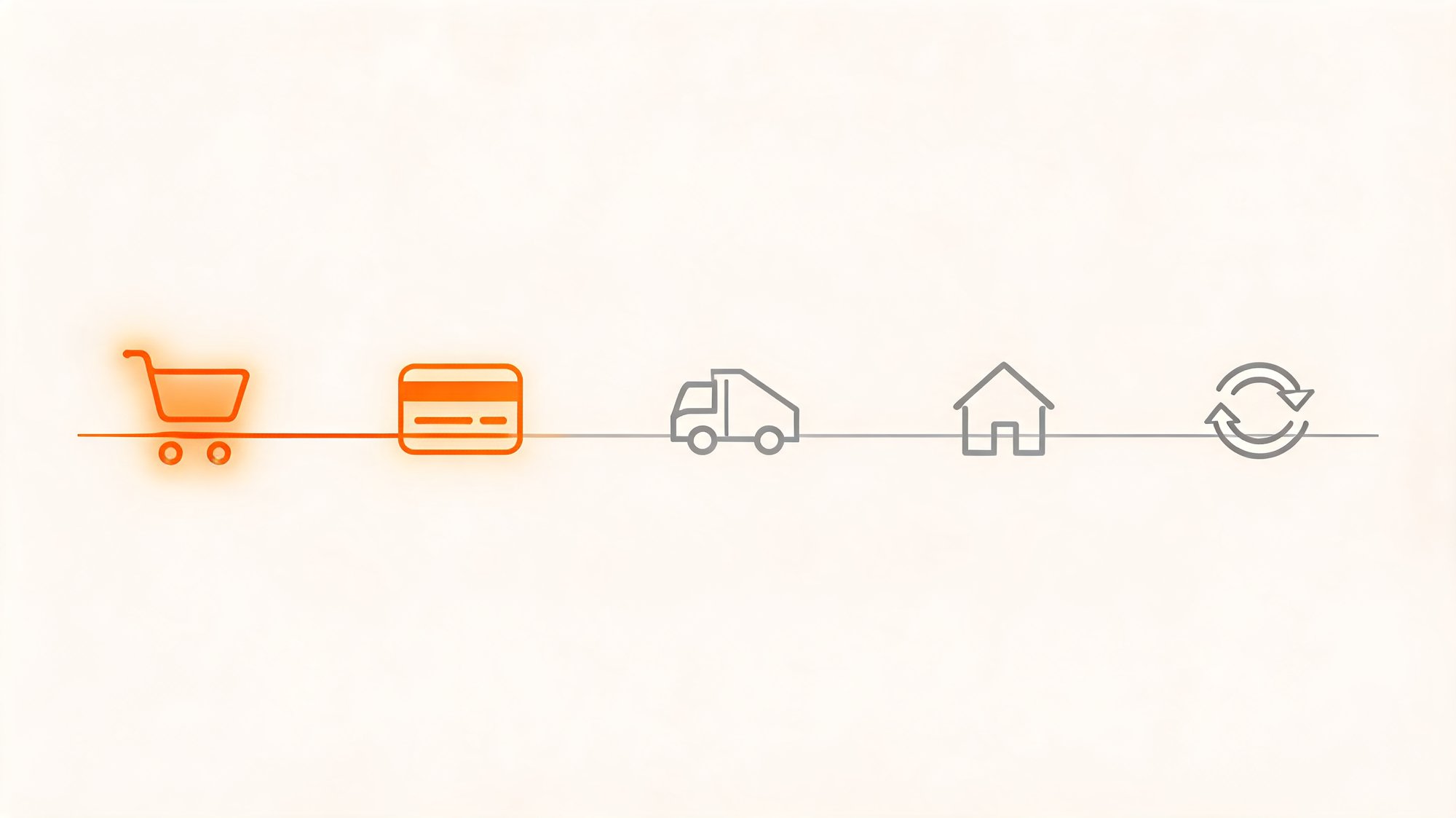
Close the gap and that same journey becomes your highest-engagement channel. That is why a serious 2026 evaluation has to start after checkout, not before it.
The 5 Criteria That Actually Matter for Shopify Email in 2026
If you are shortlisting email platforms in 2026, score them on post-purchase capability, because that is where the data, the loyalty, and the incremental revenue now sit.
These five criteria separate a promo tool with a tracking add-on from a platform that runs the whole journey. Use them as your evaluation rubric.
- Deep Shopify data sync. The baseline is real-time order and fulfillment data, ingested through Shopify webhooks the instant status changes, then enriched with multi-carrier tracking across 1,300+ carriers polled roughly hourly. Look for a tool that syncs customer tags, segments, subscription status, and line items into a built-in CRM, so your email segmentation strategies run on fulfillment signals, not just browse data. The real differentiator is owning that live carrier layer, which a promo-only ESP can read only secondhand.
- Logistics-based automation. Promo platforms trigger on clicks and carts; a post-purchase platform triggers on shipment events like in-transit, delivery exception, and delivered. AfterShip Email fires on four named shipment events, Tracking watches seven core statuses, and that same data pushes 16 automatic triggers one-way into Klaviyo for both flows and segments. A generic ESP cannot manufacture this, because it has no carrier feed.
- Unified customer view. Email and SMS should share one profile, one CRM, and the customer's full shipment history, with returns connected so a return can trigger its own messages. Helpdesk is not native here; the unified agent view arrives through Gorgias and Zendesk integrations. Judge platforms on whether email, SMS, tracking, and returns actually read from the same record.
- Post-purchase revenue attribution. You need to see which touchpoints drive orders, reported at the product and touchpoint level, not down to a single Order ID. AfterShip uses the same click-window model as Klaviyo and Mailchimp: a 5-day window for off-site tracking emails and pages, a 1-day window for on-site product recommendations, multi-touch counted once, Shopify-only, with off-site data updating the next day. Frame the question as "which scenario earns revenue," not "prove ROI on one notification in isolation."
- Scalability and reliability. At real volume, weigh the contractual guarantee over the marketing number: AfterShip's Enterprise tier carries a 99.9% uptime SLA backed by service credits. The API runs around 10 requests per second per account, raised for Enterprise after review. For proof at scale, eBay routes 650+ carriers through AfterShip and auto-corrects 200,000+ packages a month, saving more than $1M; brands near 50K orders a month sit in Enterprise territory with custom volume, SSO, and a dedicated CSM.
Run any platform you are considering through these five, and the ranking stops being about who sends the prettiest campaign. It becomes a question of who owns the post-purchase data, and that is the lens for ranking the best email platforms for Shopify in the sections ahead.
2026 Email Platform Rankings for Shopify: The Verdict
The right answer in 2026 is a stack, not a single tool, so rank these platforms by the job you need done.
If you came for a ranked list of the best email platforms for Shopify, here it is, scored on the six dimensions that decide post-purchase outcomes. The table names the winner per dimension; the deep dives below explain why.
| Dimension | AfterShip (suite) | Klaviyo | Omnisend | Mailchimp |
|---|---|---|---|---|
| Promotional / pre-purchase flows | Secondary to post-purchase | Best - deep segmentation and A/B testing | All-in-one campaign sends | Starter-level sends |
| Post-purchase automation | Best - fires on live shipment events | Customer Hub on secondhand data | Basic order and shipping emails | Minimal |
| Real-time logistics data sync | Best - own feed across 1,300+ carriers | Relies on third-party tracking apps | Limited | No native carrier feed |
| WISMO / CX impact | Best - proactive updates deflect WISMO | Reactive; no proactive shipment alerts | No logistics-triggered WISMO deflection | No proactive delivery updates |
| Post-purchase revenue attribution | Best - product and touchpoint, 5-day window | Click-window model, pre-purchase focus | Basic | Click-window model |
| SMB entry price | Free Tracking tier (channel-dependent) | Not the value entry | Best - from about $11.20/mo | Best - from $13/mo |
The pattern is clean: Klaviyo owns the pre-purchase column, AfterShip owns the post-purchase column, and the value players own price. Ranked one to four, that is AfterShip Suite for post-purchase, Klaviyo for pre-purchase, Omnisend for all-in-one SMB, and Mailchimp as the starter most brands eventually outgrow.
Klaviyo: Best for Pre-Purchase & Complex Promotional Flows
If your priority is sophisticated promotional sends and deep predictive segmentation, Klaviyo is the better primary engine, full stop.
Give Klaviyo its due first. Its segmentation and multi-variate testing are best-in-class, its predictive analytics (customer lifetime value, churn risk, next-order date) are genuinely useful, and its marketplace dwarfs the field. The scale backs it up: Klaviyo's FY2025 results show 193,000+ customers and $1.234B in revenue, up 32% year over year, alongside a 4.6 rating from 1,300+ reviews on G2.
Now the pivot. Klaviyo does run post-purchase through its Customer Hub, but that view is secondhand: it leans on Shopify order data and third-party tracking apps rather than its own carrier feed. For shipping status and delivery logic, you are acting on data Klaviyo borrowed, not data it owns. That is the gap the next platform closes.
AfterShip: The Unbeatable Choice for Post-Purchase Loyalty & CX
For the post-purchase journey, no standalone ESP matches AfterShip's data layer.
The reason is structural. AfterShip Email sits on the same platform as Tracking, Returns, and AI EDD, so a delivery exception becomes a first-class event your email flows fire on instantly, enriched by tracking across 1,300+ carriers. These are separately-billed products on one login, and the headline play, logistics-triggered flows, runs on Tracking and Email together.

The payoff is not either-or with Klaviyo. AfterShip standardizes carrier statuses and pipes them one-way into Klaviyo as metrics, so your existing flows and segments get smarter without leaving Klaviyo. On its own surface, AfterShip earns a 4.7 from 300+ reviews on G2. Read ratings per surface, though: on the Shopify App Store the order flips on volume, where Klaviyo sits at 4.7 from 2,900+ reviews against AfterShip Tracking's 4.5 from 1,200. Different surface, different population, so do not blend the two.
Omnisend & Mailchimp: Understanding Their Place
Both are solid for their stage, but neither is built to own a logistics-driven post-purchase program.
Omnisend trades depth for breadth, bundling email, SMS, and push in one all-in-one tool that suits price-sensitive SMBs, with paid plans from about $11.20/month. Mailchimp is the familiar starter brands launch on and outgrow, from $13/month scaling to around $350 as lists and features grow. For comparison, AfterShip's own entry point starts free on Tracking, though exact quotas differ by channel, the Shopify App Store versus aftership.com direct, so compare like for like.
On the one dimension where Omnisend and Mailchimp win, SMB entry price, they earn their place. On post-purchase automation, they sit a clear tier below. The 2026 decision is not which single tool to crown; it is which engine runs each half of the journey, and that sets up how you wire the two leaders together.
How to Bridge the Gap: Use AfterShip with Klaviyo
The most sophisticated move in 2026 is not crowning one platform, it is running both, with Klaviyo on pre-purchase and AfterShip on post-purchase.
Picture one stack with a clear division of labor. Klaviyo keeps doing what it does best: welcome, abandoned-cart, win-back, and promotional campaigns. AfterShip owns the post-checkout journey and feeds what it sees back into Klaviyo so your flows get smarter.
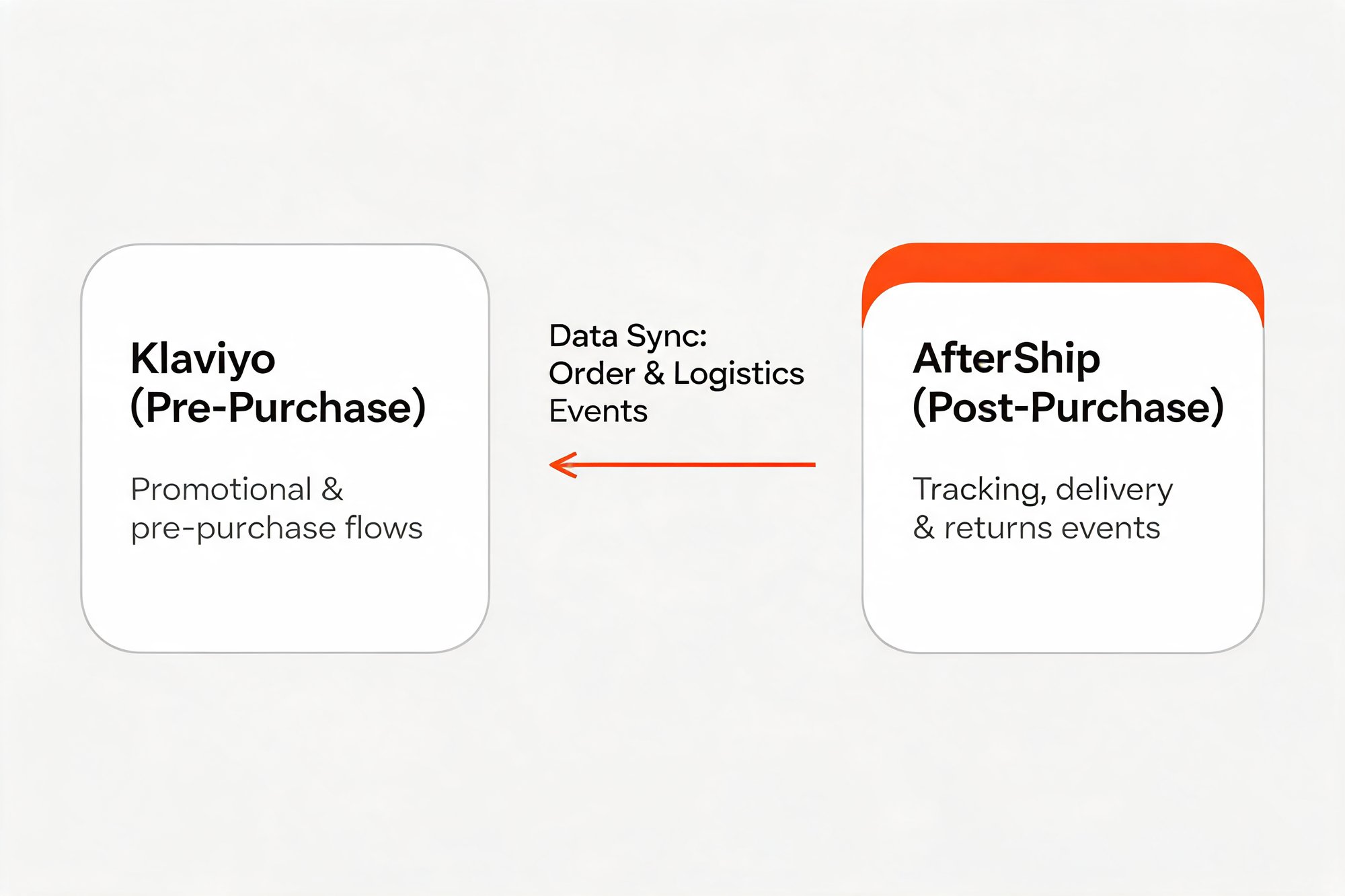
Here is how the loop works. AfterShip standardizes raw carrier updates into clean, real-time statuses, then pushes them one way into Klaviyo as metrics. Those metrics work two ways: as flow triggers and as segment definitions. You can fire a flow the moment a shipment hits a delivery exception, and you can build a segment of every customer who hit one this month.
That single feed powers 16 automatic triggers in Klaviyo, scoped against the 7 core shipment statuses AfterShip tracks. Klaviyo stays your promotional engine; AfterShip becomes the post-purchase data layer underneath it, and you can integrate AfterShip to handle the entire post-purchase journey without leaving the Klaviyo flows you already run.
eCommerce email automation that delivers targeted messages, converts more sales, and engages shoppers throughout their journey.
Book a demoFrequently Asked Questions about Shopify Email Platforms
What is the best email platform for Shopify in 2026?
There is no single winner. Klaviyo leads on pre-purchase promotional flows, while AfterShip's suite leads on the post-purchase journey. The strongest 2026 setup runs both together.
Can Klaviyo handle post-purchase email automation?
Yes. Klaviyo runs post-purchase flows through its Customer Hub. The difference is the data source: Klaviyo leans on Shopify data and third-party tracking apps, while AfterShip owns a real-time feed across 1,300+ carriers.
Do I have to replace Klaviyo to use AfterShip?
No. AfterShip augments Klaviyo rather than replacing it. It pushes standardized logistics events one way into Klaviyo as metrics you can use as both triggers and segments, so you keep your promotional engine and add a post-purchase data layer.
How does AfterShip attribute revenue to post-purchase emails?
It credits revenue at the product and touchpoint level, not down to a single Order ID. The model uses a 5-day click window for off-site tracking emails and pages, counts multi-touch once, stays Shopify-only, and updates off-site data the next day.
Is AfterShip reliable enough for high-volume stores?
Yes. Its Enterprise tier carries a 99.9% uptime SLA backed by service credits, and eBay runs 650+ carriers through AfterShip while auto-correcting more than 200,000 packages a month.
What is the post-purchase blind spot?
It is the visibility gap that opens after checkout, when a promotional ESP loses sight of shipping, delivery, and returns. That gap drives WISMO, which can reach 65% of support inquiries, and quietly erodes repeat purchases.