
Best Returns Platforms for eCommerce? Our 2026 Top Picks


Beyond the Portal: Why Your Returns 'Platform' Matters in 2026
Your returns portal is only 10% of the problem. The real cost of returns is hidden in your warehouse, your support tickets, and your P&L. If you are still evaluating returns software on the customer-facing experience alone, you are focusing on the wrong thing. Let us talk about the other 90%.
A portal is a feature. A platform is the system that runs the entire reverse-logistics lifecycle: the return request, the routing logic that decides where an item goes, the label that gets generated, the 3PL that receives it, the refund or exchange that closes the loop, and the analytics that explain why it happened. The best returns platforms for ecommerce operate across all of that. A portal just collects the request and hands the hard part back to your team.
That gap matters more in 2026 than it did two years ago, because the money at stake has outgrown the "cost of doing business" label. The National Retail Federation's 2025 returns research projects $849.9 billion in U.S. merchandise returns, with 19.3% of online sales returned and roughly 9% of returns flagged as fraudulent. DHL's 2025 e-commerce research goes further, calling reverse logistics a "front-line strategic differentiator" rather than a back-office cost center, and noting that bracketing behavior (buy several, keep one) pushes return rates above 50% in some categories.
For a brand shipping 1,000 to 50,000 orders a month, none of that is abstract. It is warehouse hours, carrier spend, support headcount, and refunded revenue you may never see again. A single mishandled return can touch four teams before it is resolved. A portal can make the request look clean, but only a platform can make the economics behind it work.
So the real evaluation question has changed. It is no longer "which portal looks best to my customer?" It is "which platform controls the cost of every return after the customer clicks submit?"
How We Evaluated the Top Returns Platforms (Our Criteria)
We scored each platform on the criteria an operations leader has to defend in a budget meeting, not the ones that demo well. Five categories, weighted toward backend impact:
- Operational efficiency and automation: how much of the reverse-logistics workflow runs without a human touching it. This covers automation rules, routing logic, and the depth of 3PL and WMS integration that keeps items moving from customer to warehouse to restock without manual data entry.
- Revenue retention and cost reduction: whether the platform actively recovers revenue through exchanges and store credit, and whether it cuts the hard costs of return shipping and processing labor instead of just passing them through.
- Customer experience: portal branding, proactive communication, and the self-serve flow. It still counts. It is just not the whole scorecard anymore.
- Analytics and insights: whether your return analytics let you see why products come back, drill into return reasons, and feed that signal into merchandising and inventory decisions. Dashboards that drive action, not vanity charts.
- Ecosystem and scalability: API access, carrier network depth, and global reach. The platform you pick at 5,000 returns a month has to hold up at 50,000 without a re-platform.
Notice where the polish of the customer-facing portal sits: well below the operational measures, not at the top. For this persona, a clean customer experience is table stakes, and the operational backbone is where the decision is actually won or lost.
Score any contender against these five criteria and the shortlist narrows quickly. The best returns platforms for ecommerce are the ones that win on the operational measures, because that is where the cost, the recovered revenue, and the room to scale all live.
AfterShip Returns: The Operations-First Command Center
Most returns tools are built for the shopper. AfterShip Returns is a complete returns management solution built for the operator. The customer-facing portal exists and is fully brandable, but the part that earns its place in your stack is the backend: the Returns Management dashboard where your team triages, routes, and resolves every request without leaving one screen.
That operator view is the line between a portal and a platform. Open any request and you see the rule that fired on it, the refund or exchange in flight, the fraud flag, and exactly where the item sits in the reverse-logistics flow. Nothing gets lost in an inbox, and nobody is copying tracking numbers into a spreadsheet.
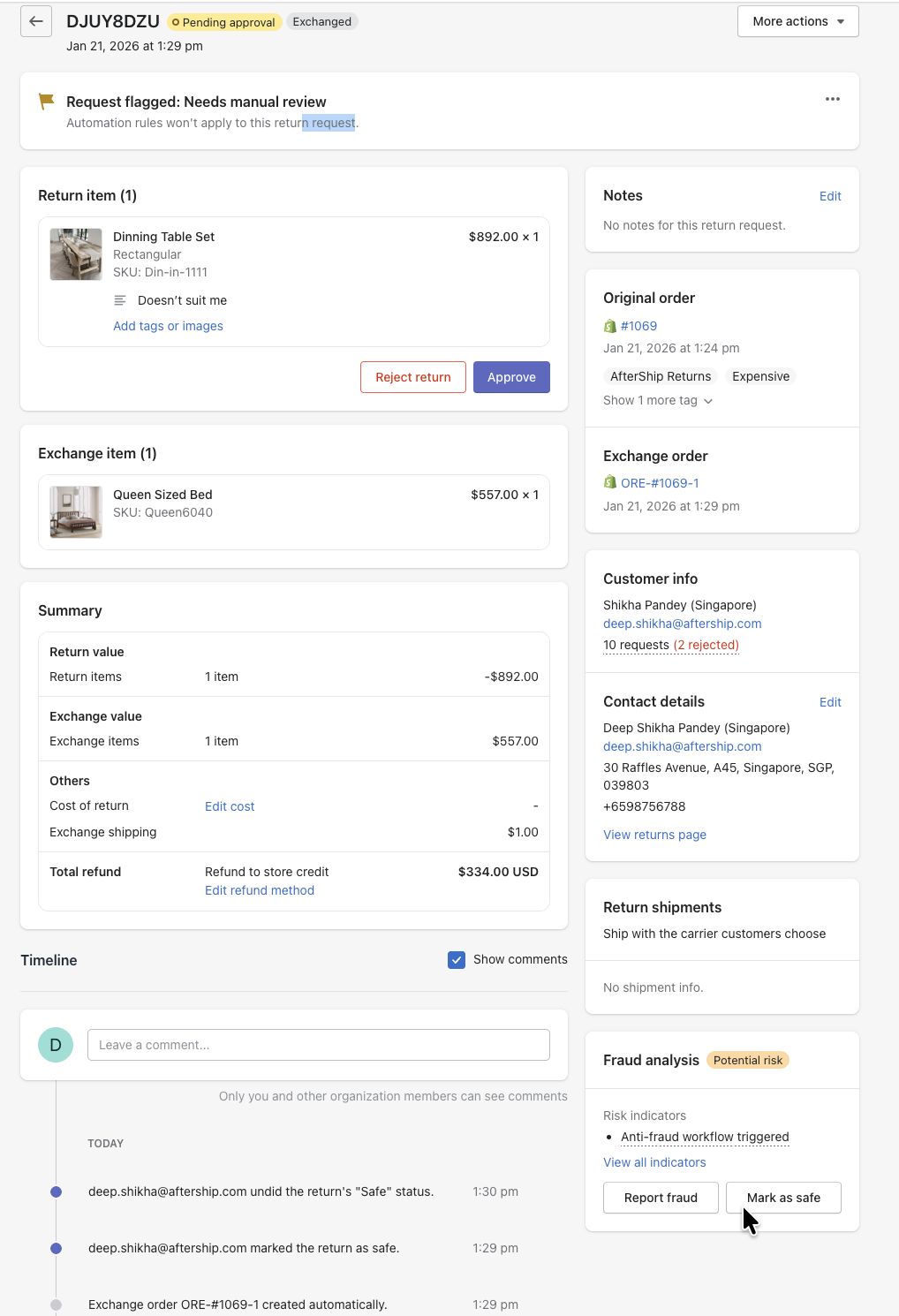
Start with carrier flexibility, because returns stall in the last mile of the reverse trip. AfterShip Returns generates labels across 68 carriers, with 23 supported for in-app automatic label generation, and reaches 550-plus carriers through its Easyship connection when you bring your own carrier accounts. Another 40-plus direct integrations cover the regional and specialty carriers a growing brand actually ships with. The point is not the count. It is that you keep your own negotiated rates instead of being pushed onto someone else's pricing.
Then comes automation, which is where the labor cost actually hides. AfterShip Returns runs advanced automation rules on a conditions-and-actions engine: stack rules that read the order, the return reason, the item, and the customer, then route, approve, charge a fee, or offer an exchange with no human in the loop. Build one rule for bulky items, a different one for suspected fraud, and a third for high-value repeat buyers, and they execute in priority order. Every rule that fires is a ticket your team never has to touch.
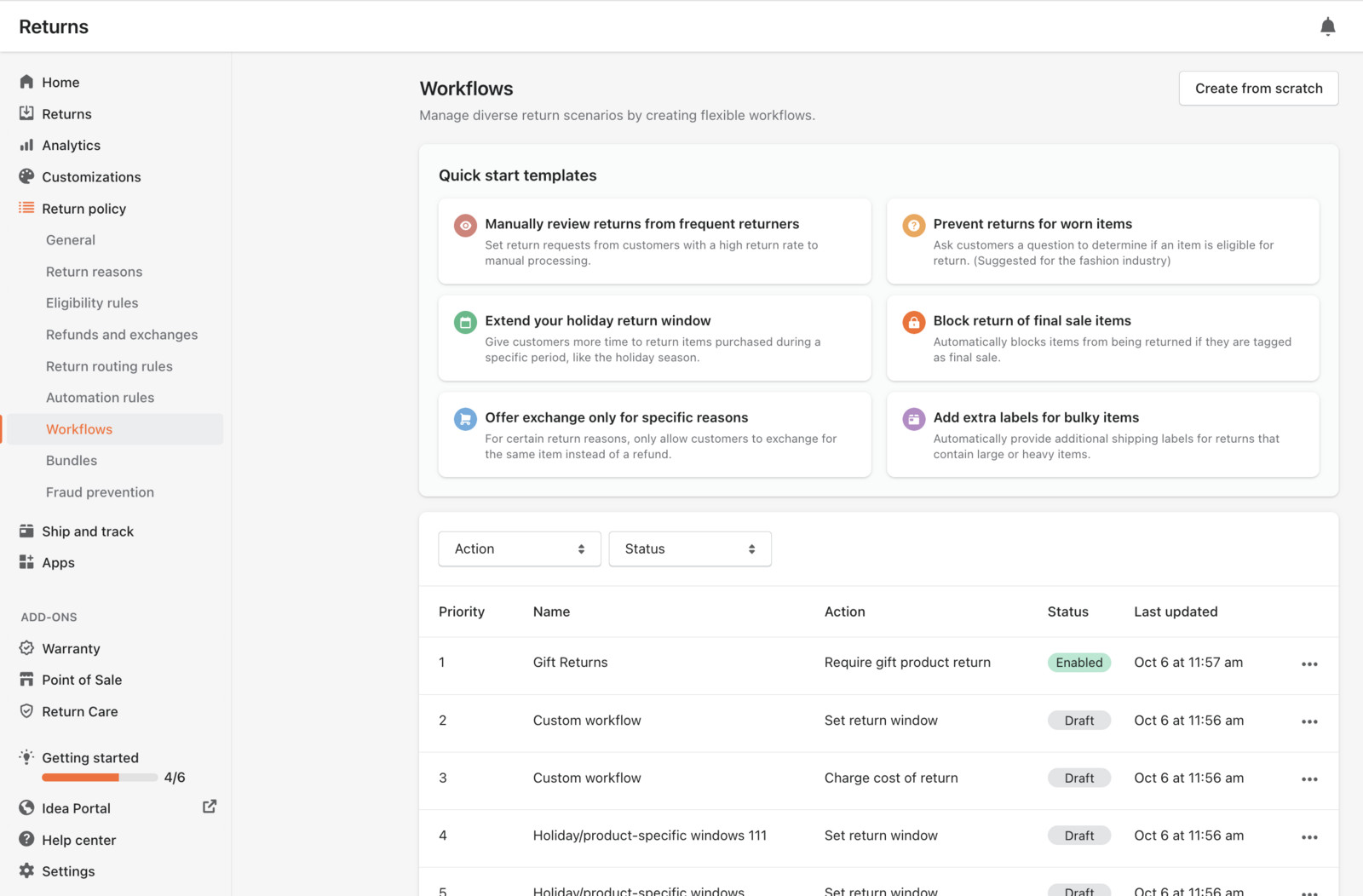
The 3PL and WMS integration is what separates a returns app from returns infrastructure. AfterShip Returns ships named connectors for ShipBob, ShipHero, and the Peoplevox WMS, and it handles the unglamorous work that keeps a warehouse honest: ASN generation, so your 3PL knows what is inbound before the box arrives, and item-receipt automation, so a scan at the dock closes the loop in your system automatically. For anything custom, a platform-agnostic Returns API and webhooks push return events into your OMS, TMS, or WMS. You are not locked into one fulfillment model, and you are not waiting on a vendor to build the connector you need.
Analytics close the loop on why. AfterShip Returns gives you SKU-level return-reason data, so you can see that a specific product keeps coming back for color, quality, or size, then feed that straight to merchandising or your supplier. That is a concrete product-quality signal, not a vague satisfaction score.
Retention is the other half of the math. AfterShip Returns is built to keep the sale, not just process the refund: exchanges with AI-driven product recommendations, store credit, and an optional bonus credit that nudges shoppers toward an exchange over a refund. It uses the native Shopify Store Credit API where you run Shopify, and it works with either Shopify Payments or Stripe, so finance is not stuck reconciling a separate payment rail. Every exchange you save is revenue you keep instead of a dollar you hand back.
On cost, the /returns pricing ladder on aftership.com is transparent: Essentials from $16 a month, Premium from $99 a month, and Enterprise as a custom quote scoped by returns volume. For a brand past a few hundred returns a month, that reads as the best value at this scale, not the cheapest tool on the shelf. That is the trade an operations leader should want: pay for the backend that lowers total cost, not for a portal that only looks good.
And it travels. For brands shipping internationally, AfterShip Returns connects major global carriers, auto-generates commercial invoices, captures HS codes, consolidates returns at in-country partners, and offers Green Returns for low-value items that are cheaper to refund than to ship back. Because Tracking, Returns, and Shipping share one login and one data model, a return is never a data silo: the shipment that triggered a delay alert is the same record your team is now processing back through the warehouse. The platform you buy at 5,000 returns a month is the one still running at 50,000.
Operators who pick AfterShip Returns for the backend usually point to the same two things: its automation depth and its analytics.
For an operations team, that is the whole point. AfterShip Returns is not a nicer request form. It is the command center that controls what every return costs you.
Best Returns Platforms for 2026: A Head-to-Head Comparison
Here is what most comparison articles get wrong: on core returns capability, the serious platforms are closer than any vendor will admit. AfterShip, Loop Returns, and Happy Returns all handle branded portals, exchanges, store credit, and automated approvals well, and both Loop and Happy Returns bring real 3PL hooks. The separation is in depth and control, not in whether a feature exists at all.
Credit where it is due. Loop Returns is genuinely strong on exchange-first flows and is deeply Shopify-native, with pricing from $155 a month. Happy Returns, a UPS company, runs a box-free, label-free drop-off network across the U.S. that no software-only competitor can replicate. Both bring real warehouse hooks too: Loop maintains its own ShipBob, ShipHero, and RyderShip/Whiplash connectors, and Happy Returns reaches WMS systems through a tech-partner ecosystem such as Celigo. Each is the right answer for a specific kind of brand.
Where AfterShip pulls ahead is the operational layer this persona lives in: carrier flexibility on your own accounts, platform-agnostic 3PL and WMS control, and SKU-level analytics. Loop, by contrast, reaches returns carriers through shipping service providers (21 carriers, no own-account), which is fine until the day you want to keep your negotiated rates. Score the three against the five criteria and the differences stop being marketing and start being operational.
| Criteria | AfterShip Returns | Loop Returns | Happy Returns |
|---|---|---|---|
| 3PL / WMS | Named connectors (ShipBob, ShipHero, Peoplevox), ASN + item-receipt automation, platform-agnostic Returns API/webhooks | Built/maintained connectors (ShipBob, ShipHero, RyderShip/Whiplash); Shopify-first out of the box | Tech-partner / iPaaS ecosystem (e.g., Celigo); fewer native one-click WMS connectors |
| Automation rules | Deep conditions/actions engine; stackable routing; bulky-item and fraud rules | Strong, exchange-oriented | Network-driven; lighter software automation |
| Carrier network / flexibility | 68 carriers for labels (23 in-app auto-label), 550+ via Easyship, 40+ direct integrations, bring your own carrier accounts | 21 carriers via shipping service providers (no own-account) | U.S. drop-off network (Return Bars) |
| Return-reason analytics | SKU-level (color, quality, size); product-issue analytics (not carrier/delivery) | Returns analytics | Network/operational reporting |
| Revenue retention | Exchanges + AI recommendations, store credit, bonus credit, native Shopify Store Credit API; works with Shopify Payments or Stripe | Exchange-first (core strength); advanced exchanges require Stripe | Exchanges/store credit via software |
| International | Major international carriers, auto commercial invoices, HS codes, in-country consolidation, Green Returns | Cross-border returns (Shopify-first) | U.S.-only network |
| Pricing (name the channel) | /returns on aftership.com: Essentials from $16/mo, Premium from $99/mo, Enterprise custom; Enterprise about $1/return at volume | From $155/mo; revenue-share model | Network model |
| Platform coverage | 25+ platforms incl. headless | Shopify-first (now multi-platform) | Software + U.S. physical network |
The pattern is consistent: comparable on the surface, divergent on the operational backbone. Which of those differences should decide your purchase depends entirely on your brand, and that is the verdict we turn to next.
AfterShip vs. Loop Returns vs. Happy Returns: The Verdict
So which one do you buy? It depends on what your brand is built around, and these three are built around different things.
Choose AfterShip Returns if you are an operations-focused, multi-channel brand that needs control of the entire reverse-logistics lifecycle. This is the platform for the team that thinks in cost-per-return, 3PL integration, and carrier flexibility, and that expects to scale past a single sales channel. You trade a little more configuration up front for a backend you actually own, which is the right trade once returns become an operational line item rather than an afterthought.
Choose Loop Returns if you are Shopify-native and exchange-first, and your single most important metric is swap rate. Loop is genuinely best-in-class at turning a refund into an exchange, and its Shopify-native flow is hard to beat for a brand that lives entirely inside that ecosystem. If you will never leave Shopify and exchanges are the whole game, Loop is a strong pick. If you are weighing the two head to head, a direct comparison of AfterShip and Loop goes deeper.
Choose Happy Returns if your top priority is a box-free, label-free U.S. drop-off network. As a UPS company, Happy Returns gives shoppers a physical, no-packaging return experience that pure software cannot match. For a U.S.-centric brand that wants returns to feel effortless at the curb, that network is the differentiator.
For most growing, multi-channel brands that treat returns as an operational and financial problem, AfterShip is the strongest all-around choice, because it controls the part of the return that actually costs money.
The most expensive returns tool is the one that does not talk to your warehouse. A portal that cannot push a return into your 3PL or WMS forces your team back into manual data entry: re-keying RMAs, emailing the warehouse, reconciling receipts by hand. That hidden labor scales with volume, and it shows up as headcount, not as a line on the software invoice. Before you sign anything, ask the vendor exactly how a return reaches your fulfillment system, and what happens when it does not.
How to Build the Business Case for a New Returns Platform
Your CFO does not care about the feature list. They care about the number. Here is how to build it in four steps.
Step 1: Calculate your current cost-per-return. Most brands underestimate this because they only count postage. A realistic fully-loaded baseline is around $15 per return: roughly $8 in return shipping, $4 in warehouse and processing labor, and $3 in software and admin overhead. Pull your own figures, but start there.
Step 2: Model the automation savings. The labor and overhead lines are where a platform earns its keep. AfterShip publishes a 50% reduction in returns processing time as a benchmark, which compresses the $4 labor line and part of the $3 overhead line directly. Apply that to your monthly return volume to size the saving.
Step 3: Project the retained revenue. A refund is lost revenue; an exchange or store credit keeps it. AfterShip publishes 50% revenue retained through exchanges as a benchmark. Multiply your refunded revenue by a conservative slice of that, and you have a recovery line that is usually larger than the cost saving itself.
Step 4: Present the ROI. Stack the cost saving and the retained revenue against the platform cost. AfterShip's /returns ROI calculator on aftership.com models about $109,463 in annual value for a brand at 25,000 orders a month, a $100 average order value, and a 10% return rate. For Enterprise scoping past the published Essentials and Premium tiers, a useful planning rule is roughly $1 per return; treat that as a modeling input, not a quote.
The benchmarks are not hypothetical. Footwear brand Aetrex processes more than 120,000 packages a year and cut return processing by 86%, support tickets by 74%, and operating expense by 50%, while lifting NPS by 141 points. Those are one brand's results, not a platform-wide guarantee, but they show what the two 50% benchmarks look like when a real operation puts them to work.
Build the model with your own numbers and the case usually makes itself. The platform is not a cost center. It is the lever that turns returns from a margin leak into a managed, recoverable line, which is exactly why the best returns platforms for ecommerce pay back the investment at this scale. When you are ready to pressure-test vendors against that model, this framework for choosing the right ecommerce returns software is a useful next step.
Returns automation that enhances the returns and exchanges experience, reduces costs, and retains more revenue.
Book a demoFrequently Asked Questions (FAQs)
A few questions come up in almost every evaluation. Here are straight answers.
Which returns platforms integrate with my WMS or 3PL?
AfterShip Returns has named connectors for ShipBob, ShipHero, and the Peoplevox WMS, plus ASN generation, item-receipt automation, and a platform-agnostic Returns API/webhooks for OMS/TMS/WMS. Loop maintains its own ShipBob, ShipHero, and RyderShip/Whiplash connectors (Shopify-first out of the box). Happy Returns reaches WMS systems mainly through a tech-partner/iPaaS ecosystem (e.g., Celigo).
How do these platforms handle international returns?
AfterShip integrates major international carriers (bring your own accounts), auto-generates commercial invoices, requires HS codes, consolidates returns at in-country fulfillment partners, and offers Green Returns for low-value items. Loop markets cross-border returns but is Shopify-first. Happy Returns' Return Bar network is U.S.-only.
What is the real cost of a 'free' return for the merchant?
An illustrative fully-loaded cost-per-return is around $15 (about $8 return shipping, $4 warehouse/processing labor, $3 software/admin overhead) before automation. Platform automation compresses the labor and overhead lines; AfterShip publishes a 50% reduction in returns processing time.
Which ladder is AfterShip Returns' real price?
For this article we cite the /returns product-page ladder on aftership.com: Essentials from $16/mo (under 100 returns/mo), Premium from $99/mo (100-400 returns/mo), Enterprise custom (400+ returns/mo). The help-center and Shopify App Store are separate channels with different packaging.