
Banyan vs AfterShip Shipping: Freight API Value Verdict


Your business is scaling, and now you are shipping freight. Your parcel stack is solid, but your tracking and customer experience are fragmenting: parcels get a branded tracking page, freight gets a raw carrier link. Do you bolt on more tools and fragment further, or consolidate the parts that actually create hidden costs? This is not just a technical choice. Let us calculate it.
The Core Dilemma: Specialist Freight API vs. Unified Post-Purchase Platform
Banyan and AfterShip are not fighting over the same lane, so the real question is whether you need to book freight or only see it. Get that straight and the comparison stops being a feature bake-off and becomes a total-cost-of-ownership decision.
Banyan Technology is a specialist freight execution API. It rates, books, and dispatches freight, generates the BOL and POD paperwork across truckload, LTL, final mile, and parcel, and audits freight bills on the back end. If your team needs to programmatically rate-shop an LTL lane and tender a load, that is the job Banyan is built for, and it is a genuinely deep one.
AfterShip plays a different role. It executes parcel shipping across 130+ parcel carriers (this is its multi-carrier shipping software), and it provides one unified tracking and post-purchase experience across both parcel and freight. The distinction that matters for a freight-literate buyer: AfterShip tracks freight, but it does not rate, book, or label it. There is no single API doing parcel and freight execution together here, and AfterShip does not replace Banyan. For a mixed-mode shipper, AfterShip runs alongside a freight tool, owning the parcel-execution layer plus the visibility layer that sits on top of every shipment, no matter the mode.
That is why the decision reduces to one test. If you only need to see freight move and keep the customer informed, AfterShip consolidates the parts of the stack that quietly run up cost. If you need to book and audit freight in-house, you keep a freight execution tool and let AfterShip own parcel and visibility around it.
Banyan vs. AfterShip: What Each Platform Actually Does
A flat feature checklist will mislead you here, because these two products own different layers of the stack rather than competing across the same one. Banyan owns freight execution; AfterShip owns parcel execution plus unified visibility and post-purchase experience across every mode, including the freight a tool like Banyan books. Read the division of labor below with that in mind, and note that the two carrier numbers describe two different jobs: 130+ parcel carriers for AfterShip Shipping execution, and a separate 1,300+ carrier network for AfterShip Tracking visibility.
| Layer | AfterShip | Banyan (or similar freight API) |
|---|---|---|
| Parcel rate shop + label + manifest | Yes (130+ parcel carriers) | Partial (parcel is secondary) |
| Freight rate / book / BOL / freight-bill audit | No | Yes (TL, LTL, Final Mile) |
| Tracking visibility, parcel | Yes | Limited |
| Tracking visibility, freight (LTL/FTL) | Yes (1,300+ tracking network incl. LTL carriers and freight forwarders) | Yes, for its own booked freight |
| Branded tracking page + WISMO notifications across all modes | Yes | No |
| Post-purchase CX (returns, EDD, warranty) | Yes (separate AfterShip products) | No |
Calculating the True Cost of Ownership: Beyond the API Price Tag
The sticker price on an API is the smallest number in this decision, so judging the two tools on per-call cost will steer you wrong. Total cost of ownership is where a fragmented stack actually bills you, and it does so in three places: what your engineers spend keeping integrations alive, what your operations team loses jumping between systems, and what your customers cost you when their post-purchase experience falls apart. Each one is a cost center a fragmented stack creates and a consolidated platform is built to remove. Price the decision on those three, not on the cost of an individual API call, and the cheaper-looking option often turns out to be the more expensive stack.
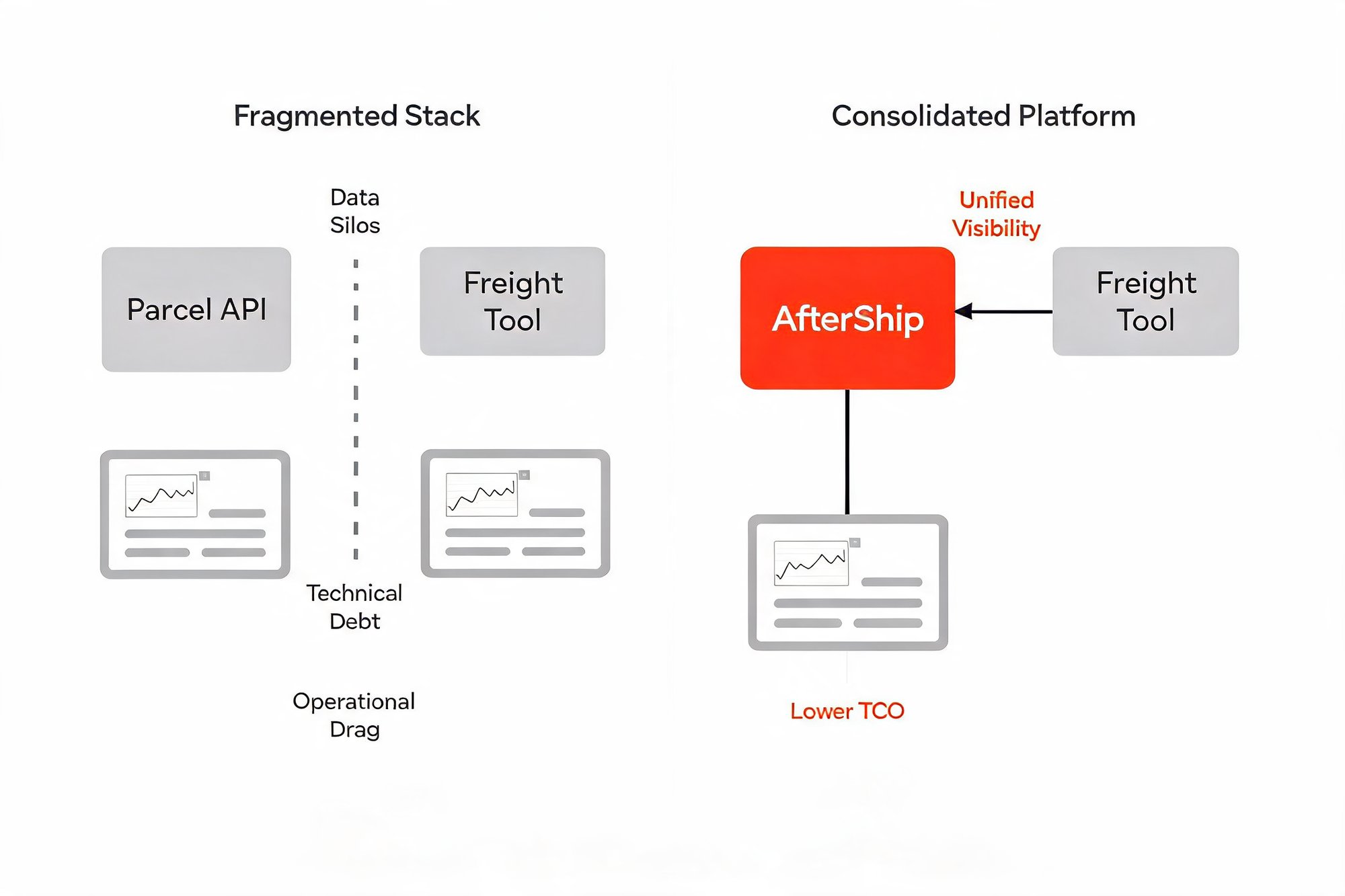
1. Developer & Maintenance Costs: The Price of Extra Integrations
Every integration you run is a standing liability, not a one-time build. On a fragmented stack the hidden bill looks like this:
- Separate API keys and credentials to provision, rotate, and secure for every parcel carrier and every freight tool.
- More documentation to read and keep current as each provider versions its endpoints on its own schedule.
- More points of failure: each connection is one more thing that can break, rate-limit, or silently change behavior in production.
- Double maintenance: when a carrier changes a field or a tool ships a breaking update, someone on your team owns the fix, every time, for every connection.
Here is where AfterShip earns a real but bounded win. Its single Shipping API consolidates the parcel layer, so 130+ parcel carriers sit behind one integration, documented in our comprehensive API documentation, that your engineers maintain once rather than carrier by carrier. That is a genuine reduction in technical debt on the side of the stack where most of your shipment volume lives. Be precise about the limit, though: it does not remove the freight integration. If you book freight, you still run Banyan or another freight tool and maintain that connection too. The "one API" consolidation is real for parcel and only partial overall, and an honest TCO model should book it exactly that way. What you should expect is one fewer integration to staff and patch, not zero, and that single subtraction compounds every time a parcel carrier ships a change you would otherwise have chased down by hand.
2. Operational Drag: The Cost of Swivel-Chair Management
The expensive inefficiency is not booking freight in a freight tool; it is everything your team does after the shipment already exists. Picture a single order with a parcel item and an LTL item. The parcel side is rated and labeled in AfterShip. The freight side is booked in your freight tool, exactly where it should be. The drag begins the moment someone has to answer a simple question: where is this whole order right now?
On a fragmented stack, answering that means one browser tab for the parcel carrier, another for the freight carrier portal, and a third for the helpdesk, with an agent stitching the story together by hand. That swivel-chair tax is what consolidation takes out. Because AfterShip tracks both the parcel leg and the freight leg, both shipments surface in one AfterShip view, against the same order and the same customer record. The freight is still booked elsewhere; what changes is that nobody has to leave one system, log into another, and reconcile two versions of the truth to see status. The cost you remove is the visibility and customer-communication swivel-chair, not the freight booking, and on a mixed-mode order that is the cost that repeats hundreds of times a week. When the LTL leg throws a delivery exception, the same unified view flags it next to the parcel status, so your team catches it before the customer does instead of after the angry email lands.
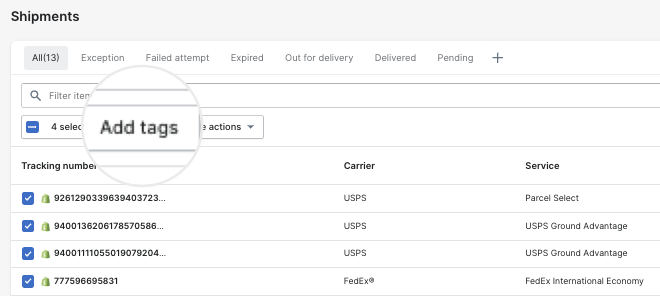
3. Customer Experience Blindspots: The Cost of a Disjointed Journey
Your customer does not know or care whether their order moves by parcel or by pallet; they only want to know where it is. A fragmented stack answers that question two different ways, and one of them is bad: parcels get a clean branded tracking page, while freight gets forwarded to a raw carrier link that looks nothing like your brand and tells the shopper almost nothing. That gap is where confidence leaks out and "where is my order" tickets come in.
AfterShip closes it by giving both modes the same treatment. Because it can natively track freight carriers like UPS Freight, the freight leg gets the same branded tracking experience and proactive notifications as a parcel order, so the customer gets a consistent, on-brand status update whether the box arrives by van or the pallet arrives by LTL. Deflecting those status questions across modes is not a soft benefit; it shows up directly in support volume. After unifying its post-purchase experience on AfterShip, Mous cut WISMO inquiries by 54%, the kind of reduction that pays for the platform out of saved support hours alone.
The Unfair Advantage: How Unified Visibility Data Creates Better Decisions
The real payoff of one dataset is not a tidier dashboard; it is better carrier decisions you simply could not make while parcel and freight lived in separate tools. Because AfterShip tracks both modes in one system, our delivery and carrier performance analytics report on-time rate, exception rate, and transit time from a single dataset, broken out by carrier and by lane, and exportable to your warehouse. That surface is AfterShip Tracking analytics, and the point is performance, not spend. It tells you which carriers and lanes are letting you down across parcel and freight, so the decisions you make are about service quality rather than guesswork.
That is not a theoretical benefit. Mous used exactly this kind of cross-mode performance data to identify an underperforming carrier and switch it, cutting its lead times within Canada from two weeks to 2.5 days, an 82% reduction driven by the analytics rather than by the shipping itself. The data found the problem; the switch fixed it. This is also where the broader market is heading: top performing supply chain organizations are investing in artificial intelligence and machine learning (AI/ML) to optimize their processes at more than twice the rate of low performing peers (Gartner, February 2024). A single source of cross-mode truth is what makes that kind of optimization possible in the first place, and it is precisely the layer a fragmented stack can never assemble on its own.
The Verdict: Who Should Choose Banyan vs. AfterShip in 2026?
The decision comes down to one honest question: do you need to book freight, or only to see it? If you only need to see it, consolidate on AfterShip for parcel execution plus unified visibility and customer experience, and let the fragmentation costs fall away. If you must rate, book, generate BOLs for, or audit freight in-house, run AfterShip for parcel and visibility alongside a freight tool like Banyan; the two are complementary, not interchangeable.
Give Banyan its due, because the honest case is the convincing one. Banyan wins decisively on freight execution: multi-mode rating and booking across truckload, LTL, and final mile, dispatch, BOL and POD, freight-bill auditing, and deep TMS and ERP integrations. AfterShip is not a freight TMS and does not rate or book freight. What AfterShip owns is the parcel-execution layer and the unified visibility and post-purchase experience across every mode, which is where mixed-mode shippers actually lose time and rack up WISMO. Banyan alone fits a pure, 100% freight operation with no parcel and no direct-to-consumer post-purchase needs; for everyone shipping a mix, the alongside model is the lower-TCO answer. If parcel and visibility are your bottleneck, AfterShip, one of the top multi-carrier parcel management solutions, is the layer worth consolidating first. eBay is the proof at marketplace scale: on AfterShip Tracking, auto-correction makes 200,000+ additional packages trackable every month, has lifted the valid tracking rate by more than 20% since 2017, and has saved millions of dollars in reduced delivery disputes - a multi-carrier tracking and visibility result.
eBay
“With our other aggregators, we must identify issues with carriers and report them ourselves, which leads to a high operational load for our team. AfterShip has a superior monitoring system.”
Skyler Loth, Product Manager - Shipping Tracking
Read their story →Proactive shipment tracking that delights your customers, reduces WISMO tickets, and optimizes your delivery performance.
Book a demoFrequently Asked Questions
Does AfterShip Shipping have a freight API?
AfterShip tracks freight; it does not rate, book, or generate labels or BOLs for freight. AfterShip Shipping is a parcel product (130+ parcel carriers); freight is supported through AfterShip Tracking for visibility only.
What LTL carriers does AfterShip support?
AfterShip Tracking follows major LTL carriers, including UPS Freight and Estes, as part of its 1,300+ carrier tracking network, and is always adding more. This is tracking visibility, not rating or booking.
Can I use AfterShip just for freight?
Only for freight tracking and post-purchase customer experience, not for freight rate-shopping, booking, or label generation.