
Attentive vs Klaviyo SMS: The Honest Verdict for DTC Marketers


You are looking at two of the best SMS platforms for DTC brands. Both are expensive. Both are capable. And choosing the wrong one can lock you into a costly contract that frustrates your customers and your team. So, Attentive or Klaviyo? Here is the honest verdict, beyond the sales pitch.
The Short Answer: Which Is Better in 2026?
There is no universally "better" platform here, only a better fit for how your brand grows. Both Attentive and Klaviyo sit at the top of the DTC SMS market in 2026, and the right call comes down to two questions: how you build your list, and how much hands-on help you want running the program.
Here is the split that actually matters:
- Choose Klaviyo if you already run email on Klaviyo and want one unified customer profile across email and SMS, plus transparent self-serve pricing you can model before you sign. Klaviyo excels for brands seeking a unified email and SMS customer profile.
- Choose Attentive if your priority is aggressive list growth and a managed, concierge-style service that runs much of the program for you. Attentive is a strong choice for aggressive SMS list growth and concierge service.
One useful gut check comes from the agency Subjectlime, a Klaviyo partner (so weigh it accordingly): they argue Klaviyo tends to win for brands under $20M in GMV, while Attentive pulls ahead for brands over $20M that carry a dedicated SMS budget above $10,000 a month.
Whichever way you lean, hold one thing in mind before you sign anything. The platform is only half the decision. Both Attentive and Klaviyo become dramatically more valuable once you feed them real-time post-purchase data from AfterShip, and that is exactly where most brands leave money on the table. More on how in a moment.
Core Feature Showdown: Where They Win and Lose
Strip away the marketing and the two platforms diverge along six lines that matter to an operator. Here is who has the edge on each, and why it counts.
On list growth, Attentive is purpose-built: its sign-up units and two-tap opt-in flows are the core of its pitch, and brands treating SMS as a primary acquisition channel feel the difference. On automation and flow-builder flexibility the two are close, but Klaviyo's builder reuses the same logic marketers already know from its email product, which shortens the learning curve. Segmentation depth is Klaviyo's structural advantage: because email and SMS live in one customer profile, you can trigger an SMS flow off email open history or on-site behavior, something a standalone SMS tool cannot do.
Support and onboarding tilt toward Attentive, and the verified G2 sub-scores bear it out. Attentive leads Quality of Support at 9.3 versus 8.4, its clearest win, and Ease of Use at 9.1 versus 8.7. Klaviyo answers on Meets Requirements at 9.0 versus 8.8 and on ecosystem breadth, with 350+ integrations to Attentive's 100+. One number needs a caveat: on the specific SMS Marketing feature, Klaviyo nudges ahead 8.0 to 7.9, but that score rests on far fewer ratings (172 versus 811), so it reads as a statistical tie, not a reason to say Klaviyo wins SMS.
The full side-by-side is below.
| Criteria | Attentive | Klaviyo | The Verdict and Why It Matters |
|---|---|---|---|
| List Growth Tools and Methods | Purpose-built: sign-up units and two-tap opt-in flows for fast acquisition | Capable sign-up tools, but list growth is not its headline strength | Edge: Attentive. If aggressive list building is the goal, its acquisition units lead. |
| Automation and Flow-Builder Flexibility | Capable Journey builder; concierge can build and run flows for you | Flow builder reuses the same logic as its email product, shortening the learning curve | Close. Klaviyo is easier if you already run Klaviyo email; Attentive offers more done-for-you help. |
| Segmentation Depth (vs email data) | Strong SMS segmentation, but SMS data lives in its own profile | Email and SMS share one customer profile; trigger SMS off email open history or on-site behavior | Edge: Klaviyo. The unified profile is a structural advantage a standalone SMS tool cannot match. |
| Pricing Models and Scalability | Usage-based, no public rate card ("Get a demo"); any figures are third-party estimates | Credit-based and transparent self-serve; you can model cost before signing (figures third-party) | Edge: Klaviyo on transparency. At around 50,000 subscribers, raw messaging cost is roughly comparable. |
| Onboarding and Support Level | G2 Quality of Support 9.3 and Ease of Use 9.1; concierge, white-glove model | G2 Quality of Support 8.4 and Ease of Use 8.7; self-serve model | Edge: Attentive. Support and ease-of-use scores are its clearest G2 win. |
| Integration Ecosystem (beyond AfterShip) | 100+ integrations | 350+ integrations | Edge: Klaviyo. Broader ecosystem, and it leads Meets Requirements on G2 (9.0 vs 8.8). |
The Pricing Puzzle: How Much Will You Actually Pay?
Neither platform makes pricing easy to compare, because they are shaped differently. Klaviyo is credit-based and transparent: a credit is the cost of sending one message to one recipient, a US SMS costs one credit and an MMS costs three, and your bill is simply credits times recipients times the number of segments a message breaks into. Its free tier covers up to 250 profiles, 500 emails, and 150 mobile credits a month, enough to test but not to run a real program.
Attentive sits at the other end. It is usage-based with no public rate card; the site routes you to "Get a demo," and pricing is negotiated per contract.
Because neither publishes the numbers most buyers want, treat every figure below as a third-party estimate, not a quote. For Klaviyo, third-party trackers put a combined email and SMS plan from about $35 a month at the entry level, with a per-US-message cost landing in a range of roughly $0.0092 to $0.0120, a volume range that moves with your tier rather than a single flat rate. For Attentive, the figures that circulate are a base around $300 a month, roughly $0.01 per SMS, and quarterly minimums in the $2,000 to $3,000 band, and again, these are third-party estimates only.
Model it for a real program. Take a 50,000-subscriber list running four campaigns plus three automated flows a month: at that volume, and on these estimated ranges, the two platforms land roughly comparable on raw messaging cost. The takeaway is liberating. Stop agonizing over the per-message delta. The real cost driver is how you use the platform, not the sticker on the envelope.
One line item belongs in this budget that most comparisons skip: AfterShip. For a brand in the $5M to $50M GMV range, AfterShip Tracking anchors on Premium for the $1M to $10M GMV band and Enterprise (custom pricing) above $10M; the advanced Attentive and Klaviyo integration, including the webhook triggers this entire strategy depends on, lives on Premium and above. Budget it as a deliberate add-on alongside your SMS contract, the same way you would treat any core piece of infrastructure.
Beyond the Blast: The Post-Purchase Angle No One Talks About
Here is the uncomfortable truth about SMS marketing: the promotional blast is a depreciating asset. Send too many and your list punishes you. Third-party research is blunt on this point. Roughly 61% of consumers unsubscribe from a brand's SMS specifically because of too many messages, and about 78% say they feel annoyed by brand texts in the first place. A campaign-only strategy is, by design, racing toward that wall.
The same data points to the way out. Around 68% of subscribers opt in specifically to get shipment tracking and order updates, not coupons. They want to know where their order is. That is a permission you already have and most brands waste.
Triggered, transactional messages also outperform broadcasts by a wide margin. A message fired within five minutes of a real event reaches roughly 36% click-through, against about 9% for a standard broadcast, and personalized SMS converts about 22% better than generic sends. Each of those figures is third-party benchmark data, not an AfterShip number. The lesson is clear: the money is in the moment something happens, not in the Tuesday discount blast.
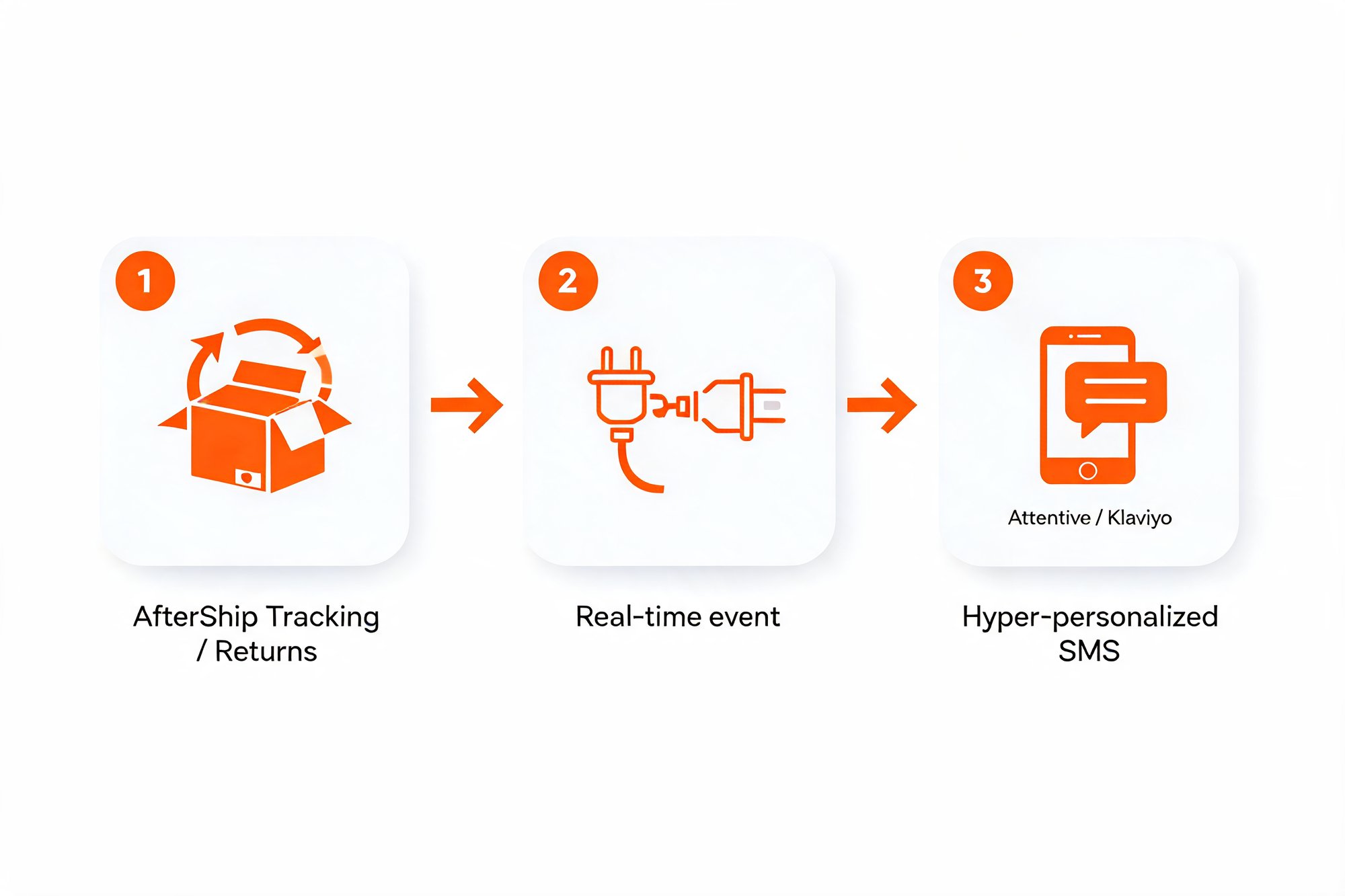
This is where AfterShip enters, and its role is worth stating precisely. AfterShip is the post-purchase event source. It does not send the text. It detects the moment (In transit, Out for delivery, Failed attempt from Tracking, or Return request Submitted and Approved from Returns) and pipes that event, in near real time, into Attentive or Klaviyo, which sends the message. Integrating AfterShip data unlocks profitable post-purchase SMS automation on either platform.
What is that worth in revenue terms? Look at AfterShip's own post-purchase results with the wine marketplace Vivino: 3 times more website visits per order from its delivery notifications. Those are post-purchase, notification-channel outcomes, not SMS-channel-only figures, but they show what high-intent post-purchase moments are worth once you actually use them. The brand Mous tells a similar operational story, cutting its WISMO contact rate from 12.9% to 5.9%, a reduction of more than 50%.
Example Use Case: Attentive + AfterShip
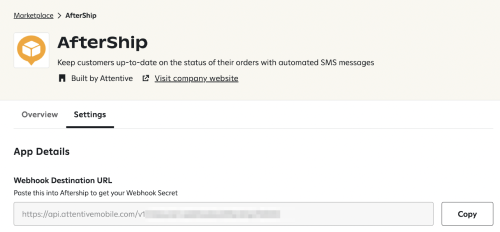
Take Attentive first, because its strength is conversational commerce: two-way SMS that reads like a text from a friend. AfterShip makes that conversation smart. Once you connect Attentive with AfterShip, the connector feeds Attentive eight shipment statuses as pre-built triggers inside Attentive Journeys, and the core ones you will reach for most are In Transit, Out for Delivery, Delivered, and Exception. The connection runs over a webhook and event API in near real time, so the trigger fires moments after the carrier scan.
Picture the classic friction point. A customer texts "Where is my order?" In a promo-only setup, that question sits in a queue. With AfterShip wired in, the moment the shipment flips to out for delivery, an Attentive Journey fires a proactive message before the customer even has to ask: "Hi Name, your order #Order Number is out for delivery with Carrier. Track it here: AfterShip Tracking Link." The WISMO question never gets typed.
One honest boundary belongs here. On returns, Attentive receives a coarser RMA-status feed rather than the named, granular return events that Klaviyo gets, so while you can still turn returns into repurchases with status-based messaging, this pairing is the shipment-tracking half of the story at full strength. The deeper, named-event returns automation lives in the Klaviyo example below.
Example Use Case: Klaviyo + AfterShip
Klaviyo's edge is the unified customer profile, and post-purchase data is what makes that profile worth having. Because email and SMS share one record, an AfterShip event can trigger a flow that also knows the customer's purchase history, email engagement, and lifetime value, so the message is not just timely, it is targeted. The AfterShip integration for Klaviyo runs over the same webhook and event API as Attentive, near real time, with no difference in the underlying plumbing.
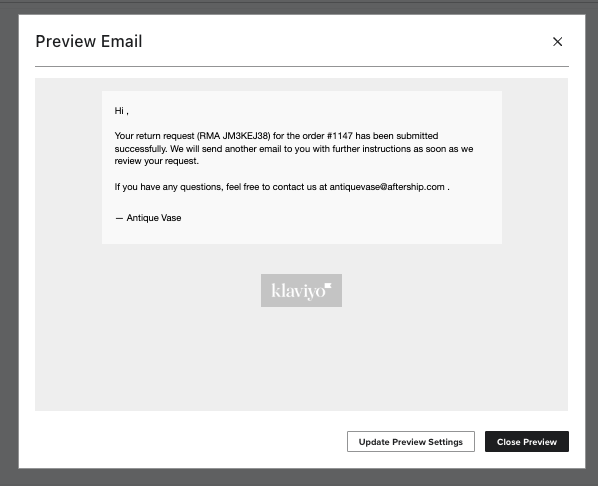
The returns flow is where this gets powerful, and it is richer on Klaviyo. When a customer starts a return through the AfterShip Returns portal, AfterShip sends the named return event, Return request Submitted, followed by Return request Approved, Rejected, Expired, or Resolved as the case moves along, into Klaviyo, which triggers the SMS while enriching customer profiles with each return's status. A "Return request Submitted" event can fire: "We have received your return request for order #Order Number. We will notify you once it is approved. In the meantime, browse our new collection: Link." A return becomes a retention touchpoint instead of a silent refund.
Two setup realities are worth knowing before peak season. First, those returns metrics come from the separate AfterShip Returns connector, not the Tracking connector, so you have to enable it specifically. Second, by default AfterShip checks and sends only the email identifier to Klaviyo, which means phone and SMS is a separate opt-in you switch on in Klaviyo, or the flow has no number to text. Wire both up before you need them.
Final Verdict: How to Make Your Choice
So how do you actually choose? Reduce it to two steps, taken in order.
Step one is the platform. If your growth plan leans on aggressive list building and you want a concierge team running the program, pick Attentive. If you are already a Klaviyo shop and value one unified email and SMS profile plus pricing you can model yourself, pick Klaviyo. Both are excellent, and neither choice is a mistake on its own merits.
Step two is the one most brands skip, and it is what actually justifies a five-figure contract: immediately integrate your chosen platform with AfterShip. A campaign blaster sends discounts; a platform fed real-time post-purchase events sends the messages customers actually opted in for, which is where retention and WISMO savings live. Skip this layer and you are paying premium prices for a glorified broadcast tool.
There is one honest limitation, and it is a feature rather than a bug. AfterShip does not send the text; Attentive or Klaviyo does. That is by design. AfterShip is the post-purchase data layer and the SMS platform is the interchangeable pipe. The pipe is replaceable, the data is not, which is exactly why feeding your platform real-time events matters more than which platform you picked. Get the data layer right and you can swap pipes later without losing the part that drives revenue.
That layer has a track record you can lean on. AfterShip Order Tracking holds a 4.5 out of 5 rating across about 1,200 Shopify App Store reviews, and brands like Vivino attribute 30% of repeat sales to the tracking-page experience it powers.
Proactive shipment tracking that delights your customers, reduces WISMO tickets, and optimizes your delivery performance.
Book a demoFrequently Asked Questions
How much does Attentive cost vs Klaviyo for SMS?
Klaviyo is credit-based and transparently self-serve. Third-party estimates put email+SMS from about $35/month and roughly $0.0092-$0.0120 per US message (a volume range, never a flat rate). Attentive is usage-based with no public rate card ('Get a demo'); circulating figures ($300/month base, ~$0.01/SMS, $2,000-$3,000 quarterly minimums) are third-party estimates only. At ~50,000 subscribers both land roughly comparable on raw messaging cost; the real cost driver is how you use the platform, not the sticker.
Should I choose Attentive or Klaviyo for SMS?
Choose Attentive for aggressive list growth and a high-touch concierge service; choose Klaviyo for ecosystem unity, a unified email+SMS customer profile, and transparent self-serve pricing. One Klaviyo-agency benchmark (Subjectlime, not objective fact) puts Klaviyo ahead under $20M GMV and Attentive ahead above $20M with a dedicated SMS budget over $10k/month.
Can AfterShip integrate with both Attentive and Klaviyo?
Yes. AfterShip connects to both via webhook/event API in near real time, feeding post-purchase events (shipping, delivery, returns) into SMS journeys. AfterShip is the post-purchase data layer; the SMS platform sends the text. Klaviyo receives the richer named return events (Return request Submitted, Approved, Rejected, Expired, Resolved); Attentive receives a coarser RMA-status feed, so the two are not at parity on returns.
Does Klaviyo or Attentive win on features?
It depends on the criterion. On verified G2 sub-scores, Attentive leads Quality of Support (9.3 vs 8.4) and Ease of Use (9.1 vs 8.7); Klaviyo leads Meets Requirements (9.0 vs 8.8) and has the broader integration ecosystem (350+ vs 100+). On the SMS Marketing feature the two are effectively tied (Klaviyo 8.0 vs Attentive 7.9) but on far fewer ratings (172 vs 811), so it is not a clear SMS win for either.