
AfterShip vs Track123: The Honest Verdict for DTC Order Tracking


Track123 is one of the most popular tracking apps on Shopify for a reason: it's simple, affordable, and gets the job done when you're just starting out. But now, your "Where is my order?" tickets are climbing, your team is manually checking carrier sites, and your post-purchase experience feels disconnected from your brand. Is AfterShip the answer, or just a more expensive alternative? Here is the honest verdict for 2026.
AfterShip vs. Track123: The 30-Second Verdict
If you only have thirty seconds, here is the at-a-glance comparison across the four things that actually drive the decision.
| Criteria | AfterShip | Track123 |
|---|---|---|
| Best For | Brands scaling past a few hundred orders/month that treat post-purchase as a revenue channel | Hobbyists, dropshippers, and sub-100-orders/month stores on a tight budget |
| Price (Shopify App Store) | Free 50 / Essentials $11 / Premium $70 / Enterprise custom | Free 50 / Growth $9 / Advanced $49 / Enterprise $699 |
| Branded Experience | Brands the page, plus a purpose-built AI delivery date, ~3.2 views/order, and deeper Klaviyo flows running on it | Brands the page with a simpler feature set |
| Key Limitation | Overkill if your only goal is the cheapest tracking number | Carrier-dependent EDD with documented accuracy complaints |
Why Brands Start with Track123 (And When They Outgrow It)
Track123 is widely used for good reason: it earns its popularity. It is genuinely cheaper per order at low volume, with a free plan covering your first 50 orders a month and a Growth tier at $9 a month. It is also one of the most loved tracking apps on the Shopify App Store, sitting at 4.9 out of 5 across roughly 1,449 reviews - that is not an accident. Track123 front-loads the things newer brands care about: branded tracking pages even on its free and low tiers, AI-powered product recommendations, and multilingual pages. It also ships dropshipping origin-masking that hides supplier and country-of-origin details, a deliberate fit for dropshippers that AfterShip does not center on.
For a store finding its feet, that combination is hard to beat. As one Track123 merchant on the Shopify App Store (KachiGhaani.com, February 2026) puts it, the app offers "quick and easy support."
The trouble starts when you grow. The same simplicity that made Track123 easy to adopt becomes a ceiling. Its notification and Klaviyo flow depth is shallower than a scaling brand needs, so orchestrating proactive customer messaging gets harder. Its delivery estimates are carrier-dependent, which surfaces as accuracy complaints in its own reviews once volume climbs. Its analytics stay light at exactly the point you need to see exception rates and transit times by carrier. And because it is a single-purpose tracking app, there is no returns, shipping, or AI layer to grow into - the moment your post-purchase needs widen, you are back to evaluating tools.
Head-to-Head Comparison: Where AfterShip Pulls Ahead
Once you have outgrown a basic tracker, the comparison comes down to four jobs: branded experience and customer trust, automation and operational efficiency, ecosystem and scalability, and analytics and business intelligence. We will work through each in turn.
First, let's clear the one number Track123 wins outright. Track123 advertises 1,700+ carriers on its pricing page, more than AfterShip's 1,100+ on its Shopify listing (and 1,300+ across AfterShip's full network). Concede it honestly - then put it in perspective. Past the handful of couriers you actually ship with, raw carrier count is a vanity metric. Track123's network skews toward niche international and dropshipping couriers; AfterShip's advantage is depth per integration - standardized sub-statuses that turn messy carrier events into accurate, customer-facing answers. The real question is not how many carriers a tool lists, but how well it explains the shipment sitting in front of your customer right now.
Branded Experience: A Generic Page vs. A True Brand Extension
Give Track123 its due here, because this is not a case of one tool having a feature the other lacks. Track123 genuinely brands the tracking page, supports Apple Wallet passes, serves AI product recommendations, runs multilingual pages, and reports basic analytics. If your bar is "a page that carries my logo," both tools clear it. The differentiator is not feature presence - it is depth and revenue.
AfterShip's case is about what runs on the page. Its branded tracking page shows a purpose-built, AI-predicted delivery date directly to the shopper, rather than passing through whatever estimate the carrier happens to provide. And because shoppers come back to check - AfterShip sees an average of 3.2 tracking-page views per order - the page becomes real estate worth merchandising. The published customer outcomes are concrete: up to 65% fewer WISMO tickets when the branded page answers the question for the shopper, Vivino attributing 30% repeat sales to the tracking page, a 6.5% click-through rate on product recommendations, and 25% of sales traced to tracking-page traffic. Treat each of those as a case-study result, not a guarantee you will hit the same number, but they show what the surface can do.
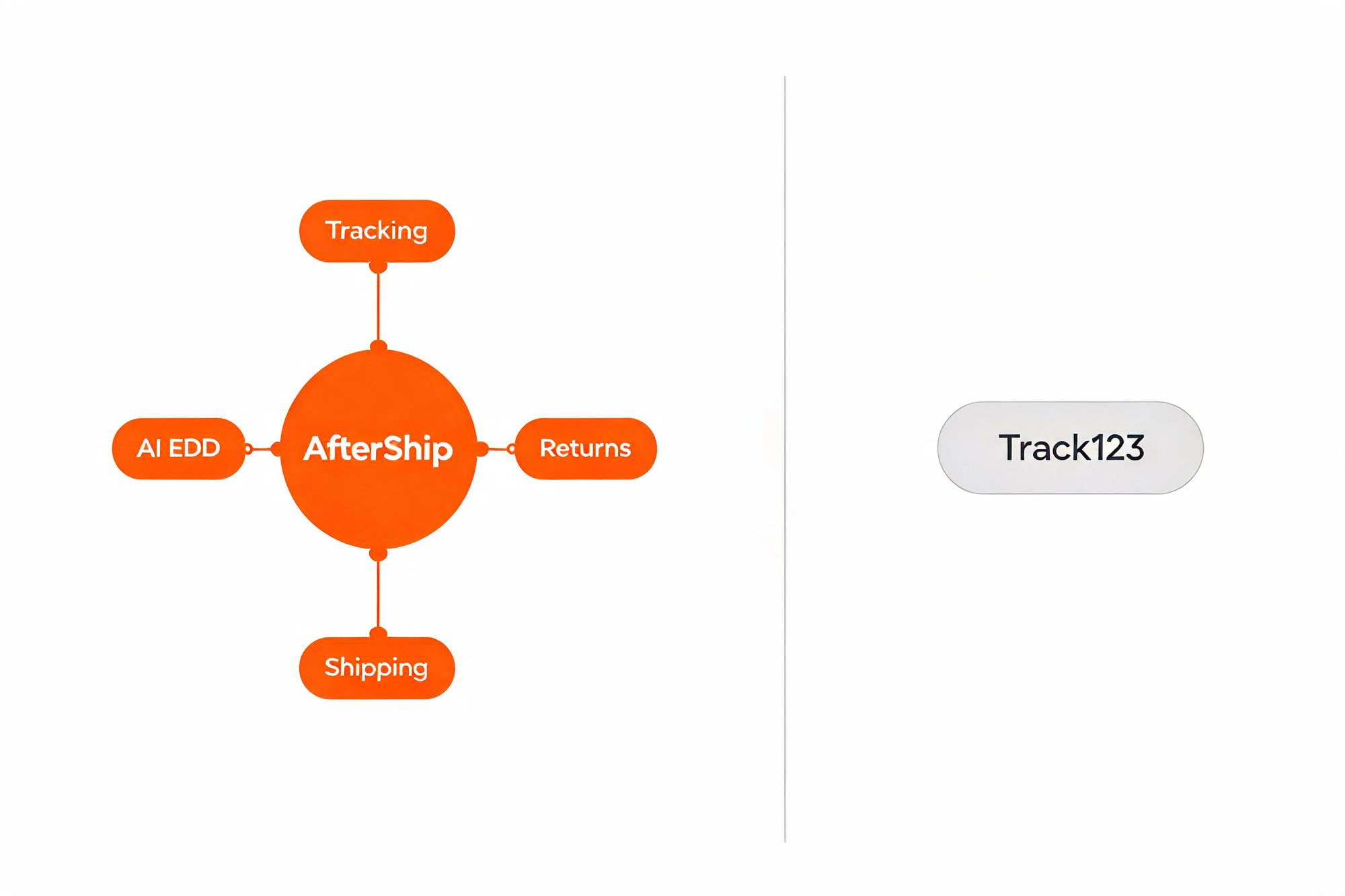
The deeper advantage is what sits behind the page. Because Tracking, Returns, Shipping, and AI EDD share one record, the "Start a return" button, the recommendations, and the delivery prediction all draw from the same order and customer data. A branded page on a standalone app cannot reach back into a returns flow or a shipping record it was never connected to.
Automation: From Manual Lookups to Proactive CX
Track123's model is reactive: the customer has to come to the page to learn anything. That is fine until WISMO volume climbs and your team becomes the fallback, manually checking carrier sites. AfterShip flips the direction of the conversation. It sends proactive email and SMS updates across 7 key shipment statuses and 40+ sub-statuses, and on Premium it fires 16 Klaviyo flow triggers (more on Enterprise), with native support for Klaviyo, Attentive, and Omnisend. Instead of waiting for the "where is my order" email, you get ahead of it.
Mous cut WISMO tickets 54% with AfterShip, and StackCommerce reduced WISMO 71% year over year - both are customer-reported outcomes rather than independently audited benchmarks. Across AfterShip's case studies, reported WISMO reductions land roughly in the 25% to 75% range (Mous 54%, StackCommerce 71%, Inspire Uplift 75%).
The other half of proactive CX is the delivery estimate itself. Lead with coverage: AfterShip's AI EDD generates a prediction for 80%+ of shipments, where most carriers' native estimates cover under 40%. Accuracy is a separate question - roughly 91% for a single-date prediction and 96% for a two-day range - and it applies to the about 101 to 150 carriers the model supports, not the full 1,100+/1,300+ tracking network. You may see "up to 95%" in marketing; read it as an as-marketed ceiling. Coverage gets a confident date in front of more shoppers; accuracy keeps that date trustworthy.
Ecosystem & Scalability: A Single App vs. A Full Platform
Track123 is a tracking app. That is the whole point of it, and it is not a criticism - it just defines the ceiling. AfterShip is a platform: Tracking, Returns, Shipping, and AI EDD run under one login, one dashboard, one vendor, and one unified data layer. Be precise about what "one platform" means, though, because it is not one consolidated invoice. Each product is billed separately on its own surface; what you get is shared data and a single place to work, not a single line item.
The economics are built for adding as you scale. Bundling 2 or more products takes 25% off your first year, and team seats are shared at $10 per seat per month. Returns, the most common second product, runs on its own annual ladder: Essentials $9, Pro $49, Premium $199, and Enterprise at a custom quota (not a fixed "400+/mo" figure), with reverse-carrier entitlements of 1, 3, 5, and unlimited drawn from a 68-carrier pool. The knockout difference: with Track123 you add a vendor every time your post-purchase needs widen; with AfterShip you add a module under the same login.
Analytics: Basic Data vs. Actionable Insights
Track123 gives you a lighter shipment-analytics dashboard - enough to glance at, not enough to act on at scale. AfterShip includes far more inside the plan you are already paying for: on-time and transit-time reporting, exception rates by carrier, and customer-engagement reporting in Tracking, plus cost-by-carrier and return-reason analytics once Returns is in the mix, with up to 3 years of data retention to spot trends across seasons. That is the difference between knowing a parcel is late and knowing which carrier is responsible for your exceptions this quarter. As a customer-reported example, Mous used AfterShip's transit-time reports to switch carriers and cut its Canada lead times 82%, from two weeks to 2.5 days.
Underneath all of it sits AfterShip's Logistics AI, one of three Intelligence layers (alongside Catalog AI and Discovery AI) built on billions of shipment data points, which standardizes raw carrier data and powers the delivery predictions. One clarification so the comparison stays honest: the analytics embedded in Tracking and Returns are included, but AfterShip Intelligence is a separate, custom-priced product, not something bundled free. The point is not a single named report; it is that the same data feeding your tracking page and notifications also feeds the decisions you make about carriers and cost.

Pricing: Comparing Cost vs. Long-Term Value
First, how AfterShip's pricing works: it is one structure shown on two surfaces. The ladder below is the Shopify App Store view, since that is where Track123 is quoted and where most readers will buy; aftership.com/pricing/tracking shows the same tiers on annual billing. Same plan, two places.
On the Shopify App Store, AfterShip runs Free for your first 50 shipments, Essentials at $11 (100 shipments, $0.08 per shipment overage), Premium at $70 (500 shipments, $0.12 overage), and Enterprise at custom pricing. Track123 runs Free for 50, Growth at $9 (300 orders, $0.05 overage), Advanced at $49 (2,000 orders), and Enterprise at $699. Be honest about it: at low volume Track123 is cheaper per order and front-loads brand-ready features into its lower tiers. If sticker price is your only metric, Track123 wins.
The catch is that the sticker is not the whole cost. Take a brand doing 1,750 orders a month. On the invoice line, Track123 lands around $588 a year against AfterShip Premium plus overage at roughly $2,640 a year - Track123 wins that line outright. But that same brand fields roughly 438 WISMO tickets a month. At a mid-range $8 per ticket - a cited industry estimate, not an AfterShip claim and not a Gartner or Forrester figure - that is about $42,000 a year in support labor. Proactive notifications and an accurate AI EDD typically deflect 30% to 50% of it - about $12,600 to $21,000 a year. That nets positive in year one, before any tracking-page revenue.
Don't just compare the monthly fee. A basic tracker is cheapest on the invoice line, but the cheapest line item and the lowest total cost are rarely the same thing. Calculate the WISMO labor a sharper tracker prevents and the revenue a deeper page captures, and the "expensive" tool often pays for itself.
The Final Verdict: Which Tracking App Is Right for Your Brand in 2026?
Track123 is an excellent place to start, and nothing here changes that. It is simple, cheap, genuinely loved on the Shopify App Store, and for a young store it does the one job it sets out to do. The calculus changes when you cross a few hundred orders a month and start treating post-purchase as a revenue channel rather than a cost.
Who should stick with Track123? Hobbyists and stores under about 100 orders a month; dropshippers who need supplier origin-masking; brands whose only goal is the cheapest possible branded page; and anyone who needs single-purpose tracking and nothing more. If that is you, paying more for AfterShip would be overkill - and it is worth saying plainly that AfterShip does not offer dropshipping origin-masking and trails Track123 on Shopify stars (4.5 to 4.9). The picture flips on G2, where AfterShip holds a 4.7 rating and Track123 has no reviewed presence - a reminder that the two tools draw different buyers. For the job Track123 is built for, it is the right tool.
Who should upgrade to AfterShip? Brands scaling past a few hundred orders a month; established brands treating post-purchase as a revenue channel; brands where WISMO labor and tracking-page revenue now move real money; and teams that want tracking, returns, shipping, and AI EDD on one platform. The honest test is not "which app is better" in the abstract - it is "has post-purchase become big enough to be worth a platform?" Once the answer is yes, AfterShip is the clear choice.
Proactive shipment tracking that delights your customers, reduces WISMO tickets, and optimizes your delivery performance.
Book a demoFrequently Asked Questions
Is AfterShip better than Track123?
It depends on your stage. Track123 is better for sub-100-orders/month budget stores and leads the Shopify App Store on stars (4.9 vs 4.5). AfterShip is better for brands scaling past a few hundred orders/month that treat post-purchase as a revenue channel, with deeper automation, a purpose-built AI EDD, and a platform spanning Tracking, Returns, and Shipping.
What are the main differences between AfterShip and Track123?
Track123 is a low-cost order-tracking point solution - cheaper per order at low volume, with dropshipping origin-masking and branded pages on its lower tiers. AfterShip is a post-purchase platform: Tracking, Returns, Shipping, and AI EDD under one login and dashboard, with proactive notifications across 7 statuses and 40+ sub-statuses, 16 Klaviyo flow triggers on Premium, and a branded tracking page built to drive revenue.
Is AfterShip worth the price compared to Track123?
On the Shopify App Store ladder, AfterShip runs Essentials $11 and Premium $70 versus Track123 Growth $9 and Advanced $49, so Track123 wins the invoice line at low volume. AfterShip's value is the WISMO labor it deflects and the tracking-page revenue it captures: its AI EDD covers 80%+ of shipments (vs under 40% for most carriers) at about 91% single-date and 96% two-day-range accuracy, which can net positive in year one for higher-volume brands.