
Route, Navidium, Extend: AfterShip's Shipping Protection Verdict for DTC


The Hidden Cost of Standalone Shipping Protection
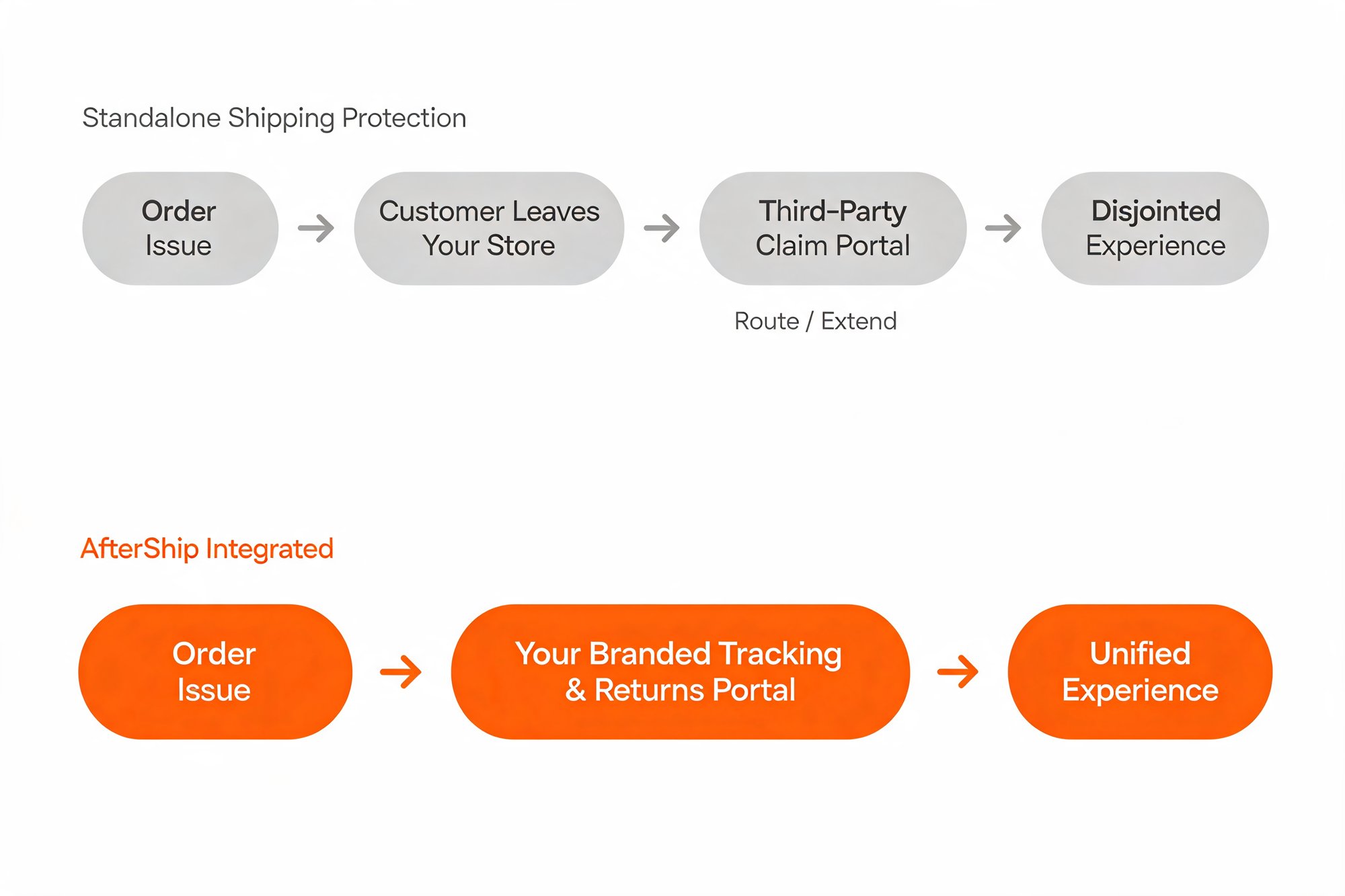
You pay for shipping protection to reduce customer anxiety, but what if the claims process itself is creating a new kind of frustration? When a customer has to leave your site to file a claim on a third-party portal, you've broken the brand experience at the worst possible moment.
Tools like Route, Navidium, and Extend solve a real problem: the cost of a lost, stolen, or damaged package. The issue is what happens next. The moment a parcel goes missing, the customer is already on edge, and that is exactly when most standalone apps send them somewhere else.
Route sends claimants to an off-site Resolve Center. Extend routes them to a separate Customer Portal. Both sit outside your brand. Your customer fills out a form on a page that does not look like your store, waits on a resolution you do not control, and walks away with an impression of a company that is not yours. Navidium keeps claims on your store, but it is still a separate, single-task layer bolted onto your stack.
For an ops manager who was just told to consolidate the tech stack, that is the quiet tax: another vendor, another dashboard, another support flow your team has to learn and your customer has to navigate.
There is a second blind spot worth naming. Across all four products, a late-but-delivered parcel is not a covered event. Shipping protection covers loss, damage, and theft, not lateness. So the delay complaints that flood your inbox during peak season are not what these tools were ever built to absorb.
Add it up and the real hidden cost is not the premium. It is the handoff. Every off-site claim is a moment where you lose control of the conversation, the timeline, and the customer data that should have stayed with you.
The Verdict Up Front: AfterShip's Integrated Suite vs. Standalone Apps
Here is our position, stated plainly. For a scaling DTC brand that measures success in customer lifetime value, an integrated post-purchase platform beats a standalone protection app. A standalone tool is a checkout checkbox. An integrated suite is the entire experience that follows the sale.
The gap shows up at the exact moment a standalone app is weakest: when something goes wrong. AfterShip files and resolves a protection claim inside the same branded tracking and returns pages your customer already knows, and the resolution (a reship, refund, or store credit) happens in that same place. No redirect, no unfamiliar portal, no second brand inserted into your relationship.
This is not a styling preference. It is a customer-anxiety problem. In fact, according to Security.org's 2025 Package Theft Report, 62% of online shoppers feel anxious while waiting for a package to arrive.
Most of your buyers are already uneasy in the gap between "order placed" and "delivered." Routing them to a stranger's portal at the first sign of trouble is the opposite of reassurance. That is the lens to keep as you weigh AfterShip vs Route shipping protection, or any standalone tool against an integrated one: the question is not only what a claim costs, but where it happens and whose brand absorbs the moment. Keep it inside your own experience, and a shipping failure becomes a reason to trust you more. That is the case the rest of this comparison will prove.
Head-to-Head: AfterShip Protection vs. Route, Navidium & Extend in 2026
A feature list rarely settles a buying decision. What an operations manager needs is the four options side by side on the criteria that actually move cost and CX, and then a read on what each row means in practice.
| Criteria | AfterShip Protection | Route | Navidium | Extend |
|---|---|---|---|---|
| Customer claims experience | Filed and resolved inside the branded AfterShip tracking/returns experience; resolution = reship, refund, or store credit | Off-site Resolve Center (with AIR auto-resolution) | On-store branded claims, merchant-managed | Off-site Extend Customer Portal |
| Admin management | Single integrated dashboard across the post-purchase suite | Route dashboard, standalone | Navidium app, standalone | Extend portal, standalone |
| Pricing model | ~1.5% of merchandise value, starts at $1 per $100 (banded; $99=$1.50, $101=$2, $199=$2), $0 software fee, advance notice before changes; payer is merchant/consumer/hybrid | Opaque: Route's own page publishes no rate (varies by industry/seasonality/claims history, recalibrated over time); AfterShip characterizes it as 1.5-5%, changeable without notice | Self-funded: merchant sets its own per-order fee and keeps 100%; Navidium app subscription is $29.99 / $49.99 / $99.99 (+ Free 50/mo) | Quote-based, scales by category and AOV (Extend's docs cite ~2-3% of cart; no single published merchant rate) |
| Integration with suite | Tracking + Returns + Shipping + AI EDD + Email/SMS + Warranty on one data layer | Has added tracking + returns, but not a deep unified suite | None (point tool) | None (point tool) |
| Customization & branding | Fully branded tracking/returns pages | Limited; Route-branded redirect | On-store branding | Extend-branded portal |
| Speed of payout | Approved on average within 4 days (insurer verification 2-5 business days); 95% of valid claims paid | Seconds (via AIR) to hours; approval rate not publicly disclosed | Merchant-controlled (self-funded) | Replacement or gift card via the portal |
| Coverage | 120% of merchandise value; lost/damaged/porch-pirated; cosmetic damage covered; no police report; anywhere-to-anywhere internationally | Merchandise value only; excludes shipping/taxes/premium/duty; cosmetic damage not covered; may require police report/notarized statement | Self-underwritten by the merchant | US, Puerto Rico, and Canada only; loss payee model |
| Insurer / liability | Third-party insured via InsureShield / UPS Capital Insurance Agency; AfterShip is the interface, the insurer carries liability once the premium is paid | Route in-house adjudication | Merchant self-insures (is the de facto insurer) | Insurer-backed (Marine Open Cargo Policy via Overtime Insurance Solutions Corp) |
The row that should catch your eye first is pricing, because it is where the four diverge most. AfterShip Protection publishes a rate you can model: roughly 1.5% of merchandise value, starting at $1 per $100, with a $0 software fee and advance notice before any change. Route publishes no rate on its own page, and the figure shifts with industry, seasonality, and claims history. For a finance team building a forecast, a modelable line beats an opaque one every time.
Coverage is the second divergence, and it is the one your customers feel. AfterShip Protection covers 120% of merchandise value, approves 95% of valid claims, and asks for no police report. Route covers merchandise value only, excludes shipping, taxes, and duty, and may require a police report or notarized statement. That is the difference between a customer made whole in days and a customer handed paperwork.
Liability is the third. AfterShip is third-party insured through InsureShield and UPS Capital, so once the premium is paid the insurer carries the risk. Navidium runs a self-funded model where you set the fee, keep 100% of it, and underwrite every claim yourself. Neither bet is wrong in the abstract; they simply place the risk in different hands. If you want the full row-by-row detail, we keep a direct comparison with Route that goes deeper than this table.
Speed of payout looks like a Route win at first glance, since its AIR engine can auto-resolve a claim in seconds. But Route does not disclose its approval rate, so "fast" is only half the picture. AfterShip approves 95% of valid claims and pays out in about four days on average, with insurer verification running two to five business days. Predictable beats fast when you are the one answering the customer. And because every one of these criteria lives in a single dashboard rather than three standalone apps, the tool you adopt also shrinks the stack you were asked to consolidate.
The pattern is consistent: AfterShip leads on modelability, coverage depth, and insured liability, while the standalone tools trade those for consumer brand recognition or self-funded margin.
Beyond Claims: How AfterShip's Ecosystem Turns Problems into Profits
This is where the integrated model pulls away. A standalone app resolves a claim and stops. AfterShip treats a claim as one moment inside a longer relationship, and the products around it do real work to shrink the problem before it ever becomes a claim.
Start upstream, with AfterShip Tracking. Most claims are preceded by anxiety, and most anxiety surfaces as WISMO (where-is-my-order) tickets. Proactive delivery notifications cut that volume, and AfterShip's own customers show how much: Mous reduced WISMO contacts by 54%, and StackCommerce by 71%. Fewer panicked "where is my order" messages means fewer customers reaching for a claim in the first place.
Now move downstream, to AfterShip Returns. When a claim is approved, the resolution happens inside your own branded experience: a reship, a refund, or a refund to store credit, handled on the same pages your customer already trusts. There is no programmatic one-click handoff between products. What unifies them is shared infrastructure, so a claim filed against AfterShip Protection and a resolution issued through our self-service returns portal draw on one branded URL, one customer profile, and one data layer.
That shared layer is the quiet advantage. When an approved claim resolves to store credit, the customer lands back at your checkout instead of watching a refund leave your ecosystem, and a shipping failure becomes a second sale. Over a customer's lifetime, that recovered order is worth far more than the premium that funded the claim.
Protection itself is presented at checkout through a widget, and you decide whether the brand, the shopper, or a hybrid of the two covers the premium. It is not shopper-paid by default; the payer model is yours to set.
Route has added tracking and returns of its own, but as separate capabilities rather than one unified data layer; Navidium and Extend remain point tools. The AfterShip difference is not simply owning the pieces. It is running them on a single branded layer, so an inquiry never has to become a claim and an approved claim can flow back into revenue inside your brand.
Customer Experience: The Branded Journey vs. The Third-Party Redirect
The comparison table settles the economics. Customer experience settles everything the table cannot price.
Picture the two journeys at the moment a parcel goes missing. With a standalone tool, the customer clicks a claim link and lands on Route's off-site Resolve Center, a page that does not carry your logo, your copy, or your support voice. With AfterShip, that same customer files and resolves the claim on the branded tracking and returns pages they have used since checkout. Same problem, two very different impressions of who is taking care of them.
That continuity is not a nice-to-have. McKinsey's research on customer journeys found that consistency across the entire journey builds more trust and loyalty than excelling at any single touchpoint, and every off-brand redirect chips away at it.
The brands that feel this most are the ones whose customers expect a single, unified experience, and it tends to show up in how they talk about the tools they keep.
When the resolution lives inside your brand, the customer comes away reassured by you rather than handed off to a stranger.
The Final Verdict: Who Should You Choose?
No hedging. Here is the call.
Choose AfterShip Protection if you are a scaling DTC brand that:
- treats post-purchase as part of the brand experience, not a cost center to outsource
- wants to consolidate tracking, returns, and protection into one stack and one dashboard
- runs on Shopify or Shopify Plus in the US, ships more than 5,000 orders a year, and holds a claim ratio at or below 3%
Consider Route, Navidium, or Extend if you:
- are very small or not on Shopify, or you need the absolute fastest possible setup
- specifically want Navidium's self-funded model, where you keep 100% of the protection fees and underwrite the claims yourself
Two honest caveats. Route has earned real consumer brand recognition and a famously quick install, and if that recognition is your goal, it is a genuine point in its favor. Navidium's self-funded economics can also beat AfterShip on a merchant's P&L, because AfterShip does not let you keep the premium. AfterShip's deliberate trade runs the other way: third-party insured liability through UPS Capital, plus a branded, integrated experience, instead of a reserve you manage yourself.
The eligibility bar is the last thing to name plainly. AfterShip Protection is US-Shopify-only, above 5,000 annual orders, with a claim ratio at or below 3%. Read that not as a wall but as underwriting discipline: the same rules that exclude a 1,000-order hobby store are what keep payouts fast and premiums modelable for the brands that qualify.
World-class shipping protection that captures lost revenue, drives customer satisfaction, and improves claims operations.
Book a demoFrequently Asked Questions
Does AfterShip Protection cover international shipments?
Yes. Coverage is anywhere-to-anywhere for lost, damaged, and porch-pirated parcels. One limit to know up front: a late-but-delivered parcel is not a covered event, so a delay on its own does not qualify for a claim.
How does AfterShip's pricing compare to Route?
AfterShip Protection runs about 1.5% of merchandise value, starting at $1 per $100 (so a $99 order is roughly $1.50), with a $0 software fee and advance notice before any change. Route publishes no rate on its own page; the cost varies with industry, seasonality, and claims history and can change without notice, with AfterShip characterizing it as roughly 1.5-5%. The practical difference is that one number is modelable and the other is not.
Can I use AfterShip Protection without AfterShip Tracking?
Yes. Protection works on its own. The value compounds when you pair it with Tracking and Returns, because all three then run on one branded experience and one shared data layer, which is where the inquiry reduction and in-brand claim resolution come from.