
AfterShip vs. Returnly: Which Is Better for Driving Exchanges?


Returnly's "Instant Credit" was one of the most compelling ideas in eCommerce returns. It promised to stop refunds in their tracks by issuing merchant credit the moment a return was initiated. But what if releasing value before the item is even back is the wrong goal? This article explores a more powerful and far less risky objective: turning a return into a higher-value exchange, with credit issued only after the return is verified, and why that's a fundamentally different and more profitable strategy.
One fact reframes the whole AfterShip vs Returnly question before you compare a single feature: Returnly is no longer a product you can adopt. Affirm wound the service down, and Returnly stopped processing returns on October 1, 2023, with Loop Returns named as its successor. So if you are reading this, you are almost certainly in one of two camps: migrating off a platform that has gone dark, or running a fresh evaluation and weighing what made Instant Credit attractive in the first place.
Either way, the goal is the same: keep revenue inside the business when a customer wants to send something back, without tying up cash you cannot yet account for. That makes this less a question of "which is better" and more a question of strategy. Is it better to issue instant credit before a return is verified, or to engineer optimized exchanges that release value only after a verified return? AfterShip approaches the post-purchase journey as the leading Returns and Exchanges solution, and the difference in timing is where the financial argument begins.
The Real Goal Isn't Retaining a Sale - It's Maximizing Lifetime Value
A flat refund-to-credit swap, the core of Returnly's model, treats a return as damage to contain. You stop the refund, hand back store credit, and hope the customer spends it. That protects the current transaction, but it leaves the larger prize untouched.
The larger prize is lifetime value. A return is one of the few moments when a customer tells you exactly what went wrong: wrong size, wrong color, wrong fit. A guided exchange turns that signal into a better-matched product, a more satisfied buyer, and a reason to come back. A flat refund ends the relationship at the worst possible moment, right after a letdown. A customer who exchanges into something they actually wanted is worth more over time than one who takes the cash and leaves.
That is why exchange-first design pays off.
AfterShip reports 50% revenue retained with exchanges. Source: AfterShip Returns product page (aftership.com/returns).
For an operations or finance leader, that reframes the brief. The job is not to suppress refunds, which frustrates customers and invites chargebacks. It is to move as many returns as possible into exchanges that keep the customer, the margin, and the relationship intact.
Feature Head-to-Head: How AfterShip and Returnly Approach Exchanges
The two platforms answered the same problem with opposite philosophies. Read the comparison below as a strategy map, not a spec sheet: it weighs them on the criteria that actually drive this decision, including exchange flexibility, revenue growth, financial risk, carrier and platform reach, automation, and fraud control. Returnly's figures are last-known values from when the product was live.
| Capability | AfterShip Returns | Returnly (last known, discontinued) |
|---|---|---|
| Core method | Exchange-first tools, bonus credit; value released after verification | Instant Credit issued at return initiation, to repurchase immediately |
| Exchange flexibility | Exchange for any item ('Shop now') across the catalog | Primarily Instant-Credit-to-repurchase, not a guided item-for-item flow |
| Revenue growth | Upsell capture + bonus, pre-discount, and extra credit incentives | Retained sale via flat instant credit |
| Financial risk | Low: no store credit or refund floated before a verified return; the only instant flow (Instant Exchange) uses a card hold ($1 or full item value), not pre-funded credit | High: merchant credit released before the item is returned or inspected; vendor took the product-return risk |
| Carrier reach | 68 carriers in the Returns label pool | 9 carriers via EasyPost |
| Platform support | Shopify, WooCommerce, BigCommerce, Salesforce, and more (10+ platforms) | 2 platforms |
| Automation | Rule-based routing across 9 documented conditions (reason, product type, order value, and more; no native customer-LTV field); auto-approve | More basic, credit-focused rules |
| Fraud controls | Card hold on Instant Exchange; once-per-order bonus cap; return-window enforcement | Open fraud window by design (payout before verification) |
The contrast comes down to one lever versus a toolkit. Returnly had a single primary move: issue instant credit so the shopper re-buys immediately. AfterShip runs a full exchange-first toolkit, with exchange for any item, bonus credit, pre-discount credit, extra credit, and rule-based automation, and it releases value only after the return is verified. One platform optimized for speed at the cost of unverified risk. The other builds for control, flexibility, and long-term value, which is the foundation for everything in the AfterShip vs Returnly comparison that follows.
Deconstructing 'Instant Credit': The Promise and the Peril
Returnly's Instant Credit was a repurchase-acceleration engine. The moment a shopper initiated a return, the platform issued merchant credit so they could buy a new or replacement item immediately, instead of waiting for the return to be inspected and processed. Affirm, which acquired Returnly, described the model plainly: Returnly "takes the product return risk and settles orders in real time."
It was a clever idea, and worth understanding before you dismiss it. For a shopper who wanted resolution now, it felt instant and generous, and it kept the customer in a buying mindset at the exact moment most refunds send them out the door. That is the promise, and it is a real one.
The peril sits in the timing. Instant Credit released value against an unverified event. The return had been requested, but the item had not arrived, had not been inspected, and might never come back, or might come back as the wrong product. Issuing credit at that moment opens a fraud window by design and creates a near-term obligation tied to an outcome that is still unresolved.
For the finance leader in the room, that maps to a familiar concept. A contingent liability is a potential obligation that depends on how a future event turns out. Under the ASC 450 framework, a loss is recognized once it is both probable and reasonably estimable. Instant Credit effectively booked the obligation before the triggering event, the verified return, had occurred.
The risk was not theoretical, and the design made it structural rather than occasional.
Warning: Releasing credit before a return is verified creates a near-term obligation against an unresolved event and opens a fraud window by design. Return fraud now runs at roughly 9% of all returns (NRF, 2025).
None of this makes Instant Credit a bad idea. It makes it a narrow one: fast for the shopper, but built on releasing value before verification, and tied to a small EasyPost carrier set and two supported platforms. The question for a 2026 buyer is whether speed is worth carrying risk that a verified-first model avoids.
The AfterShip Alternative: Driving Upsells with 'Exchange for Any Item'
AfterShip starts from the opposite end. Instead of converting a return into instant credit to re-buy the same thing, it invites the shopper to exchange for any item in your catalog through a guided "Shop now" flow. They can swap into a different size, a different style, or a more expensive product, and that last case turns a potential refund into upsell revenue.
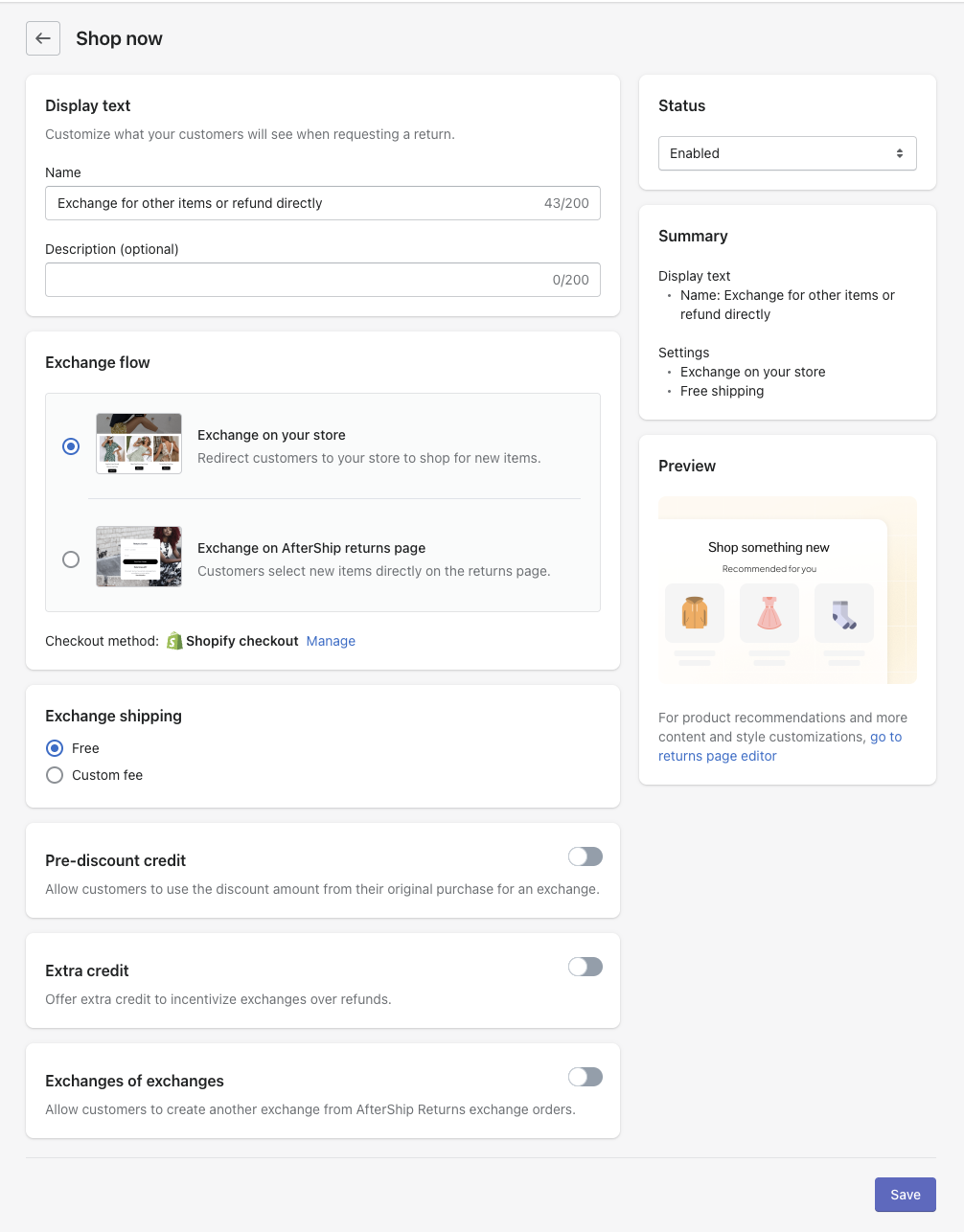
The timing rule is where the financial argument lands. AfterShip does not float store credit or refunds before a return is verified. There is exactly one bounded exception, and it is opt-in: Instant Exchange. With Instant Exchange, the platform places a hold on the shopper's card, either a nominal $1 or, at the merchant's choice, the full item value. It is a card hold, not pre-funded merchant credit, and the card is only charged if the item is not sent back within the return window.
Read the eligibility plainly so no one is misled. Instant Exchange for a cross-item swap requires Shopify plus Stripe at checkout. Same-item replacement works more broadly, across Shopify, WooCommerce, BigCommerce, and Salesforce. If your stack does not include Stripe, the instant cross-item path is not available to you, and that is worth knowing before you build the case internally.
Be honest about the liability ledger, too. Store credit and bonus credit are themselves liabilities a brand carries until they are redeemed or expire, exactly like any gift-card balance. AfterShip does not erase that obligation. What changes is when and how you book it: the liability is created after a verified return, it is trackable, and it can expire. That is the difference between a normal deferred obligation and value handed out against an event that has not resolved. When you are setting up your exchange rules, that timing is the lever you are actually pulling.
So the AfterShip alternative is not "faster credit." It is the same shopper immediacy through Instant Exchange, without the merchant float, paired with an exchange flow designed to grow order value rather than simply refund it back.
Putting Your Exchange Strategy on Autopilot
You do not grow exchanges by switching off refunds. You grow them by making the exchange the easiest, most rewarding path for the shopper, then letting rules do the steering at scale. AfterShip gives you three things to work with: incentives, eligibility, and automation. Used together, they turn a one-off save into a repeatable system.
The incentive levers are where most of the revenue lift comes from:
- Bonus store credit: add a fixed or percentage incentive on top of store credit, applied once per order, so an exchange is worth more than a refund.
- Conditional bonus: raise the incentive for specific situations, for example +$10 when the reason is a damaged item or when the shopper chooses an exchange over a refund.
- Pre-discount credit: carry the original order discount into the exchange, so a customer who bought on promotion is not penalized for swapping.
- Extra credit on exchange: a fixed amount or a percentage of the original item price, nudging the shopper toward keeping the value in-store.
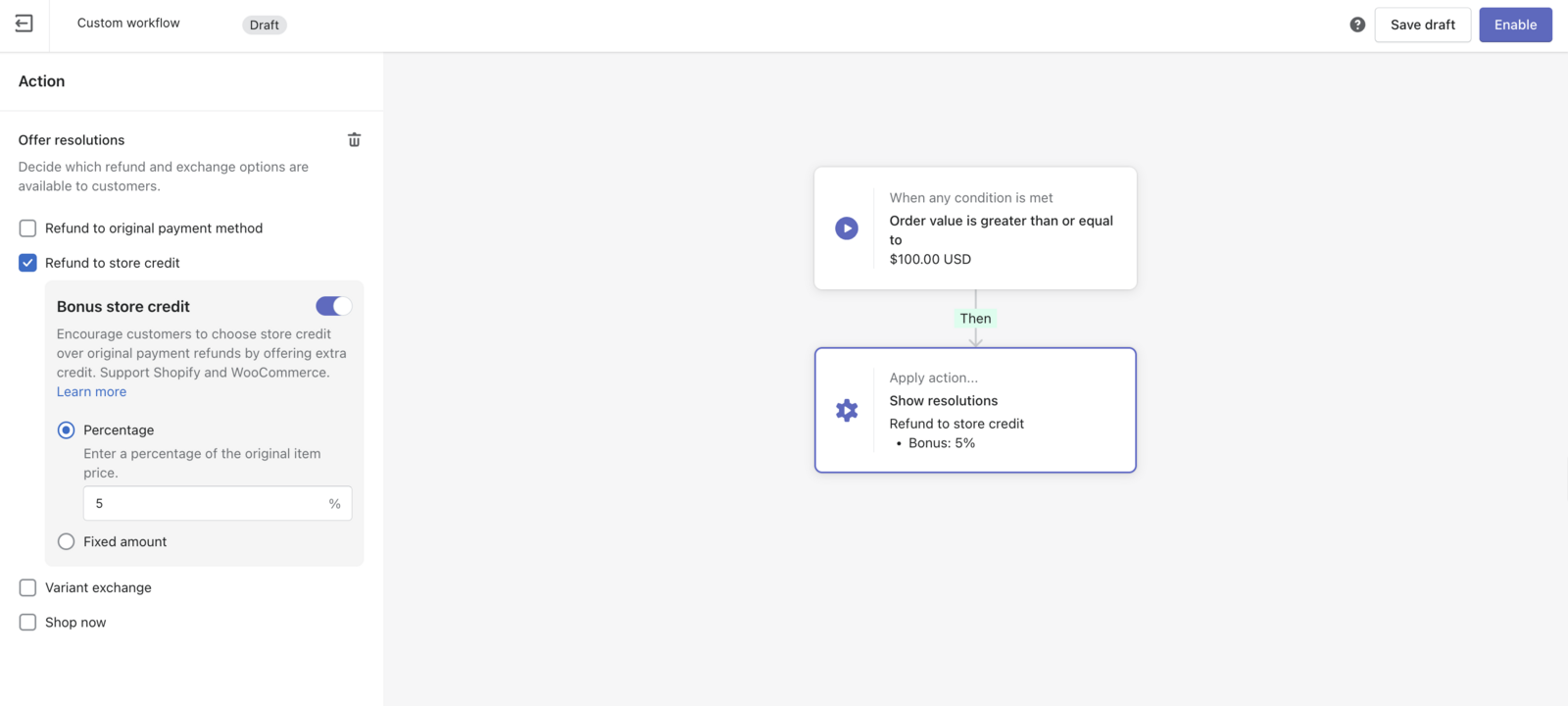
Incentives only pay off if they reach the right return. That is what eligibility routing is for. AfterShip lets you route across nine documented conditions, including return reason, product type, and order value, and pair them with auto-approve so the steered path runs without a human touching it. Two example rules show the pattern: "IF return reason is too small, THEN add bonus credit to exchange for the right size," and "IF customer tag = VIP, or order value is above a set threshold, THEN allow exchange for any item."
One caveat to keep you accurate internally: AfterShip has no native customer-LTV routing field. The way to approximate it is with the documented proxies, a VIP customer tag or an order-value threshold, not a built-in lifetime-value score. Build the rule on what the system actually exposes. When you are ready to automate your exchange strategy, these are the conditions you will be wiring together.
Here is how that plays out in practice. A shopper requests a return because a jacket runs small. Your rule reads the reason, keeps the refund option on the table, and surfaces a same-style swap one size up with a small bonus credit attached. The shopper gets the right product, you keep the revenue, and no one on your CX team had to touch the ticket.
The Verdict: Which Platform is Right for Your Growth Strategy?
The verdict is not close. AfterShip is the platform for brands that treat returns as a lifetime-value and profit lever, because it releases value only after a return is verified and gives you real tools, exchange for any item, bonus credit, pre-discount credit, extra credit, and rule-based automation, to grow order value in the process.
Returnly was a single-tactic tool. It did instant credit well, but it carried return risk by releasing value before verification, and it is now discontinued. For a brand still on Returnly or leaving it, that settles the practical question: the search is no longer "AfterShip vs Returnly" as a live race, it is which exchange-first platform to migrate to, and AfterShip is the recommended Returnly alternative.
“This exchange feature took every problem away. It's also saved a lot of revenue, saving us $125k in the last 90 days.”
Nikolas Callas, Director of Operations
Read their story →Proof like that is the point. A verified-first exchange model is not the cautious choice at the expense of growth. It is how a brand grows revenue from returns while keeping the financial control its CFO expects.
It is also fair to name the trade-off. AfterShip's deepest integrations are with its own stack, which some reviewers read as ecosystem dependence. The flip side is single-platform depth: Tracking, Returns, and Shipping running off one system, with genuine connections to the tools brands actually use, including Shopify, WooCommerce, BigCommerce, Salesforce, and Stripe. For most growing DTC brands, that consolidation is an advantage, not a constraint.
Frequently Asked Questions
Which is better for exchanges, AfterShip or Returnly?
AfterShip is better for flexible, strategic exchanges; Returnly (now discontinued) focused on instant store credit.
Is Returnly still available?
No. Returnly ceased processing returns on October 1, 2023; Loop Returns is Affirm's named successor.
Does AfterShip ever release credit before a return is verified?
No, except the opt-in Instant Exchange, which uses a card hold, not pre-funded merchant credit.
Can AfterShip do instant exchanges?
Yes, Instant Exchange ships the replacement first, secured by a card hold; the cross-item flow needs Shopify plus Stripe.
Ready to Build a More Profitable Returns Strategy?
Strip the comparison to its core and the decision is simple. Optimized, verified exchanges beat credit released before verification. One approach grows order value while keeping your liabilities booked against real, inspected returns. The other moved fast by paying out against an event that had not resolved, and it is no longer on the market.
If you are evaluating fresh or planning to make the switch from Returnly, the next step is to map your current return reasons to a set of exchange incentives and eligibility rules, then turn on auto-approve for the paths you trust. That is a configuration task, not a replatforming project. Start with the return reasons you already understand, prove the exchange lift, then widen the rules from there.
Returns automation that enhances the returns and exchanges experience, reduces costs, and retains more revenue.
Book a demo