
AfterShip vs ParcelPanel: The Honest Verdict for Shopify Brands


The Quick Verdict: AfterShip vs. ParcelWILL for Skimmers
You have hit a ceiling with Shopify's default tracking and you are drowning in "Where is my order?" tickets. You have found two potential solutions: ParcelWILL (formerly ParcelPanel), the easy, affordable fix, and AfterShip, the powerful platform. Is "good enough" for today the right choice for tomorrow? Let's be honest about what happens when your brand starts to scale.
That is the real question behind every AfterShip vs ParcelPanel search: not which app wins a feature checklist, but which one still fits when your order volume triples. If you only have thirty seconds, here is the honest summary, scored on what actually matters to a growing Shopify brand.
| Criterion | AfterShip | ParcelWILL |
|---|---|---|
| Best For | Ambitious, growing Shopify and DTC brands planning for scale (Shopify: 4.5 stars, ~1,203 reviews) | Budget-first or sub-100-order stores wanting a simple branded tracking page (Shopify: 5.0 stars, ~2,541 reviews) |
| Price-to-Value | Higher sticker; earns it once WISMO is a measurable cost, you add returns, or delivery accuracy is revenue-relevant (App Store: Free / $11 / $70) | Lower sticker, and decisively cheaper at scale (about $59 at 2,000 orders/month). The rational budget pick |
| Scalability | AI-predicted delivery dates, automation depth, and a unified Tracking + Returns + Shipping + Intelligence platform; reads 1,300+ carriers | Tracking app plus a separate Returns app; rule-based EDD with no prediction engine. Lists more carriers on raw count (~1,611) |
| Brand Experience | Branded page with logo on Essentials; custom domain on Premium (1) / Enterprise (up to 5) | Branded page on every tier; remove-branding on Professional. More generous at the entry level |
| The Verdict | The platform you grow into once tracking becomes an operations problem | The rational pick while tracking is just a checkbox |
The short version: ParcelWILL is the rational pick if you are budget-first or shipping under 100 orders a month, and it earns its 5.0 Shopify rating. AfterShip is the better bet the moment tracking stops being a checkbox and becomes an operations problem.
Why Your Tracking App Choice Matters More Than You Think
Choosing a tracking app feels like a small operational decision. It is not. The tracking page is where customers land most often after checkout, so the choice quietly shapes customer retention, brand perception, and your support cost per order.
This is the Good Enough Trap. A simple app is genuinely fine while tracking is just a status checkbox. The trouble starts when volume turns that checkbox into an operations problem, and by then you have already built your workflows around the limits of the cheaper tool.
So before you decide, run an honest self-diagnosis. You have likely outgrown a basic tracking app if you recognize three or more of these signals:
- WISMO is now a budget line, not a nuisance. "Where is my order?" tickets typically run 30 to 50 percent of DTC support contacts, at roughly $5 to $15 each to resolve. Even 100 WISMO tickets a month works out to about $18,000 a year in support time.
- Support hours scale with orders. Headcount climbs in lockstep with volume instead of staying flat.
- Delivery dates affect revenue. Late or unclear ETAs now drive cart abandonment, refunds, or chargebacks.
- You are adding returns or shipping. Your post-purchase stack is growing beyond a single tracking page.
- The brand experience has to be yours. You need a custom domain, third-party branding removed, and revenue modules living on the tracking page.
- Carrier decisions need data. You are choosing carriers on measured performance, not a hunch.
Here is why most brands wait too long to switch. The WISMO cost is diffuse: it hides inside agent hours rather than showing up as a line item. So it stays invisible until volume forces a new support hire, or until peak season breaks the manual process all at once.
The payoff for fixing it is retention, not just deflection. Keeping the customers you already won is far cheaper than constantly chasing new ones, and a clear post-purchase experience is one of the few levers that move both numbers at the same time.
What does that look like in practice? Premium phone-case brand Mous cut WISMO tickets by 54 percent and shipping transit time by 82 percent with AfterShip Tracking.
“AfterShip allowed us to set up KPI dashboards to see how well everything is going and troubleshoot before it becomes a problem.”
Rosie Jennings, Head of Logistics
Read their story →The takeaway is simple. While tracking is just a checkbox, the cheaper app is the right call. The moment it becomes a cost center, the tool you picked for today becomes the constraint you fight tomorrow.
Feature Breakdown: What Really Separates AfterShip and ParcelWILL?
Both apps put a branded tracking page on Shopify and send notifications. Where they diverge for a growing brand shows up only when you push the tools.
Branded Experience
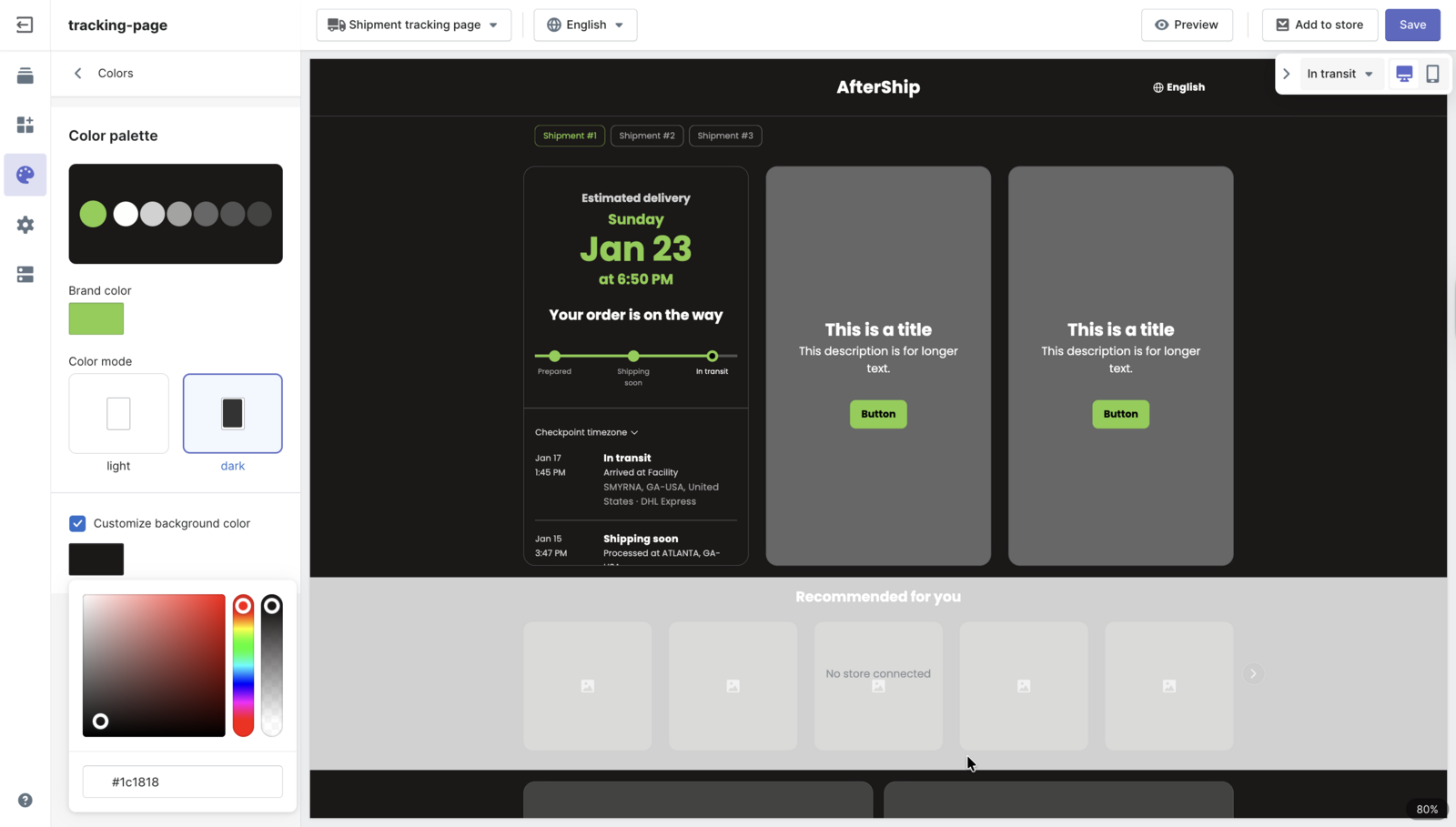
AfterShip's branded experience is built to scale. You get a branded tracking page with your logo on Essentials ($11), a custom domain like track.yourbrand.com on Premium ($70, 1 domain), and up to 5 custom domains on Enterprise.
Here is an honest concession: ParcelWILL puts a branded tracking page on every tier and only gates removing its own branding to its Professional plan ($59). For a brand-new store that just wants a clean, logo'd page, ParcelWILL is genuinely more generous.
The difference shows next: a custom domain makes the tracking page a true extension of your storefront, not a third-party page wearing your logo, which matters once the post-purchase journey becomes part of how you sell.
Proactive Notifications
Both tools send notifications. The question is how intelligently, and into which marketing stack. AfterShip's full milestone trigger set, plus native depth with Klaviyo, Attentive, and Omnisend, sits on Premium, as do the 16 automatic Klaviyo triggers (as marketed) and advanced Gorgias automation. Those three are the native ESP integrations; others connect via webhooks or the REST API.
ParcelWILL is competitive on entry here. It unlocks Klaviyo and Gorgias at its Professional tier ($59 for 2,000 orders), cheaper to reach than AfterShip Premium.
AfterShip's argument is not the price of entry. It is the depth of the trigger set and the exception classification underneath it, which lets you message a delayed shipment differently from an out-for-delivery one. At scale, that is the difference between a notification and a recovered sale.
Carrier Network & Accuracy
AfterShip Tracking reads 1,300+ carriers, so coverage is rarely the constraint. On raw count ParcelWILL actually lists more (around 1,611), a fair point in its favor. But raw count is not where the real gap lives.
The real gap is accuracy. AfterShip's AI-predicted delivery estimates are generated from historical shipment data. ParcelWILL's estimated delivery date is rule-based: the merchant sets a start point, fulfillment workflow, non-business-day exclusions, and per-zone transit times, with no prediction engine. One learns from what actually happened; the other repeats what you told it.
The numbers are specific. AfterShip's AI EDD covers 80 percent or more of deliveries, versus under 40 percent for most carriers on their own, roughly 2 to 3 times the baseline. Across about 150 carriers it reaches about 91 percent single-date accuracy and about 96 percent two-day-range accuracy (the "up to 95 percent" figure you may see is a marketing ceiling, not a guarantee). One caveat: only those ~150 carriers get AI-predicted dates, so the accuracy does not apply to the full 1,300+ tracking set. AI EDD requires Premium.
Analytics & Insights
Every paid AfterShip plan includes real analytics: carrier scorecards (on-time rate, average transit time, exception rate, carrier or service comparison) plus engagement analytics like tracking-page views (averaging 3.2 per order) and notification open and click rates. The full suite is on Premium, a lighter version on Essentials, with up to 3 years of history.
ParcelWILL is not a blank slate here either. It offers genuine analytics: delivery performance by carrier, exception patterns, and conversion. The honest differentiator is not "they have none."
It is the closed loop. AfterShip turns those insights into action: delay prediction, proactive alerts, exception workflows, and (with the separate Intelligence product) a correlation between delivery delays and return rates. Analytics you can read is table stakes; analytics that triggers an automated response is what scales your operation without scaling headcount.
Why this is worth the effort: increasing customer retention by just 5 percent can lift profits by 25 to 95 percent. A clearer, more accurate post-purchase experience is one of the most direct ways to protect that retention.
The Elephant in the Room: AfterShip vs. ParcelWILL Pricing
Let's address cost head-on, because it is the real reason most teams hesitate. First, a clarification: AfterShip has one pricing structure shown on two surfaces, a monthly or annual toggle plus a volume slider. It is not two different offers.
Because you are comparing two Shopify apps, the fair surface to quote is the Shopify App Store view, and we will name it as such. There, AfterShip is Free, then Essentials at $11 (100 shipments), then Premium at $70 (500 shipments), with metered overage at $0.08 and $0.12 per extra shipment respectively, and no hard spend cap. The same tiers appear on aftership.com with different billing terms and volume (Essentials $29, Premium $59, 6,000 shipments per year). Same structure, different surface, not a hidden second deal.
Now the honest part. Under 100 orders a month, both tools are free. Above that, ParcelWILL's sticker is lower, and at scale the gap is real. At 2,000 orders a month, ParcelWILL Professional is $59 for 2,000 credits, while AfterShip Premium runs about $250 ($70 base plus 1,500 overage at $0.12 = $180). ParcelWILL wins decisively on sticker price at that volume, and pretending otherwise would not be honest.
The value question differs from the price question. AfterShip earns that premium once WISMO is a measurable support cost, once you add returns, or once delivery-date accuracy affects conversion. Until then, the cheaper tool is the right call.
A note on feature-gating. One thing to watch with any post-purchase platform, AfterShip included, is feature-gating across tiers. A public 1-star review reports a custom-domain disruption and a perceived move toward a higher tier. AfterShip's current, live documentation places custom domain on Premium (1 domain) and Enterprise (up to 5), not Enterprise-only. The broader lesson for a growing brand: confirm in writing which tier carries the feature you depend on, a custom tracking domain in particular, before you commit, because feature placement can shift between plan revisions on any vendor.
Read honestly, the pricing question is not "which is cheaper." ParcelWILL is. It is whether the cheaper tool still pays for itself once WISMO becomes a number you can measure.
Beyond Tracking: The Ecosystem That Future-Proofs Your Brand
Here is the structural difference that outlasts any single feature. ParcelWILL is a tracking app with a separate Returns & Exchange app, a different Shopify listing with its own reviews, and no shipping-label or AI EDD product. Running returns means installing and managing a second tool.
AfterShip runs Tracking, Returns, Shipping, and Intelligence from one login and one dashboard on a shared data model. The proof is concrete: a support agent sees the outbound shipment and the return on a single screen, because return shipments sync automatically into the Tracking dashboard.
For a growing brand, the consolidation pays off four ways:
- One dashboard for tracking and returns, so your team works from a single view instead of switching tools.
- AI-predicted delivery estimates, including a pre-purchase EDD widget on product pages, to lift conversion and cut failed deliveries.
- Native returns and exchanges on the same platform, not a second bolt-on app to configure.
- Carrier scorecards feeding an automated exception loop, so delays trigger action, not just a line in a report.
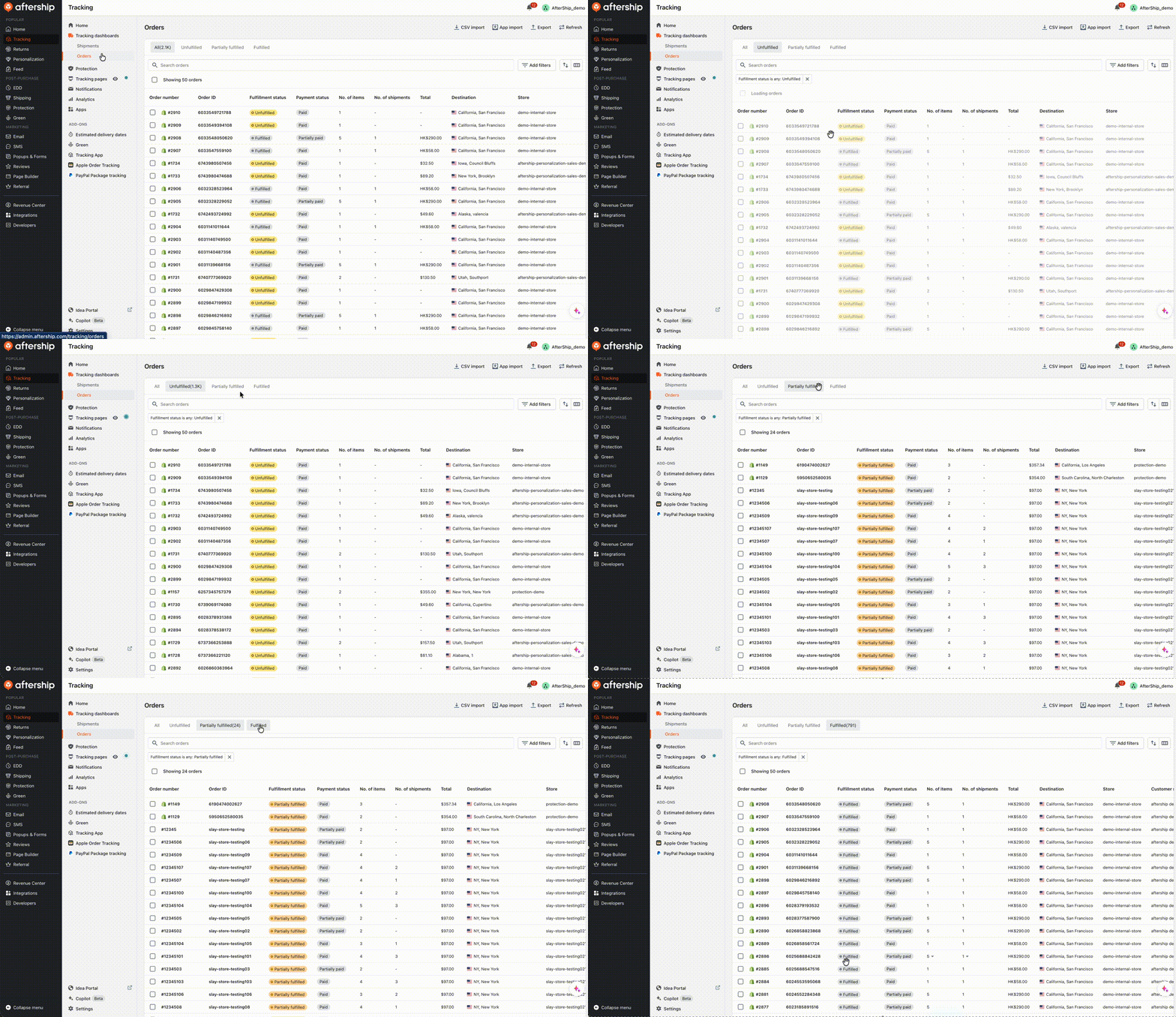
AfterShip also adds multi-carrier shipping software to the same stack. Keep the scopes straight: Tracking reads 1,300+ carriers, Returns runs on a pool of 68, and Shipping covers 130+. Separate networks for separate jobs, not one number.
One clarification, because it trips people up. "One platform" means one login, one dashboard, and one shared data model. It does not mean one invoice: each product is billed separately, with a 25 percent first-year discount when you run two or more, and shared team seats at $10 per member per month billed annually. AfterShip is also an official UPU Consultative Committee Member, a useful credibility marker when vetting a long-term vendor.
A point solution solves today's problem. A platform absorbs the next three.
The Final Verdict: Who Should Choose AfterShip in 2026?
Here is the honest line, drawn by capability, not a magic order number. If you are under about 100 orders a month, or your post-purchase need is genuinely just a branded tracking page, ParcelWILL is the rational pick. It is cheaper, and it rates 5.0 on Shopify.
AfterShip earns its higher price the moment tracking stops being a checkbox and becomes an operations problem: when WISMO volume is a real support cost, when you want AI-predicted delivery dates instead of carrier guesses, or when you are ready to run returns and tracking on one platform. That consolidation is exactly the kind that pays off, as DTC brands like Pelagic Gear have found when they moved returns onto the same stack.
So the crossover is not an order count. It is a capability you have outgrown: pick the cheaper tool while tracking is a checkbox, and switch to AfterShip the moment it becomes a cost center you can measure.
Getting Started with AfterShip on Shopify
Switching is simpler than most teams expect. Three steps get you live:
- Install the AfterShip Order Tracking app from the Shopify App Store.
- Configure your branded tracking page: add your logo on Essentials, or set up a custom domain on Premium.
- Set up your first email and SMS notifications, and on Premium, connect Klaviyo for the automatic triggers.
That replaces generic Shopify emails with a branded, proactive experience on day one. Add AI EDD, returns, and analytics as you grow.
Proactive shipment tracking that delights your customers, reduces WISMO tickets, and optimizes your delivery performance.
Book a demoFrequently Asked Questions
A few specific questions come up every time a brand weighs this decision.
Is AfterShip harder to set up than ParcelWILL?
No. The Shopify app onboarding is just as simple. AfterShip offers more depth, including a custom domain, AI EDD, and advanced notification triggers, for the brands that need it.
Can I migrate from ParcelWILL to AfterShip?
Yes. Install the AfterShip app, import your tracking history, and rebuild your branded page and notification flows. Plan the cutover before peak season, not during it.
Does AfterShip work with Klaviyo and Gorgias?
Yes. The 16 automatic Klaviyo notification triggers (as marketed) and advanced Gorgias WISMO automation require the Premium plan. Native ESP integrations are Klaviyo, Attentive, and Omnisend only; ActiveCampaign and Emarsys connect via webhooks or REST API.
Is a custom tracking domain Enterprise-only?
No. Live documentation places a custom domain on Premium (1 domain) and Enterprise (up to 5 domains). One public 1-star review reports a disruption and a perceived move to a higher tier, so confirm in writing which tier carries the feature you depend on before you commit.
How accurate is AfterShip's AI EDD?
About 91 percent single-date and about 96 percent two-day-range accuracy across about 150 carriers, covering 80 percent or more of deliveries. These are descriptive benchmarks, not a guaranteed SLA; the "up to 95 percent" figure is a marketing ceiling.