
AfterShip vs Parcel: The 2026 Verdict for Growing Shopify Stores


The Quick Verdict for Busy Founders
Your Shopify store's growth is exciting, but the flood of "Where Is My Order?" emails isn't. You've correctly identified that you need a real tracking solution, and you've narrowed it down to AfterShip and Parcel. The choice you make now isn't just about a tracking page; it's about the kind of business you're building for 2026 and beyond.
Here's the answer before the details: if your store is built to grow, choose AfterShip. It's a post-purchase platform where tracking sits alongside returns, shipping, and AI delivery estimates on one shared dataset. Parcel (the Shopify app "Parcel - Order Tracking," from the Parcel Panel / ParcelWILL family) is a functional, well-built tracking app, and a fair pick if basic tracking is genuinely all you need.
The trap in this aftership vs parcel decision isn't picking a bad app. It's picking a narrow one.
⚠️ Warning: Choosing a tracking-only app based on today's needs alone can create costly integration debt tomorrow, when you buy and wire up separate returns and shipping tools.
That single distinction, point solution versus platform, drives every comparison below.
AfterShip vs. Parcel: Core Tracking Features Head-to-Head
Let's start where you're focused: the tracking page and the notifications around it. Both apps do this part well, and Parcel carries the "Built for Shopify" badge with 4,000+ strong reviews, so this isn't a quality argument. It's a depth-and-reach argument.
Carrier coverage is the clearest example. AfterShip Tracking connects to 1,300+ carriers (read-only tracking integrations), and that matters more than the number suggests: 1,300+ carrier integrations means your tracking page keeps working when you switch to a new 3PL or pick up a regional carrier. That reliability rests on direct carrier relationships, including a recent USPS data agreement ensuring uninterrupted tracking data.
Notifications are the other half of WISMO ("where is my order?") control. The goal is simple: tell customers what is happening before they have to ask. AfterShip automates proactive email and SMS updates across key checkpoints like in transit, out for delivery, delivered, and exception, so fewer shoppers ever open a ticket. Parcel sends tracking notifications too; the practical question for you is how granular the triggers and branding stay as your order volume climbs.
Branded customization is the third pillar. The more your tracking page looks and behaves like your store, with your logo, your colors, product recommendations, and a custom domain, the more it works as a marketing surface instead of a carrier-styled dead end. This is where a growing brand starts to separate a tracking tool from a tracking experience.
Here is how the two stack up on the features this persona actually cares about:
| Feature | AfterShip | Parcel (ParcelWILL / Parcel Panel) |
|---|---|---|
| Branded tracking page | Fully branded page with logo, colors, and product recommendations; custom domain on Premium | Branded, multilingual tracking page with product recommendations |
| Carrier integrations (tracking) | 1,300+ carriers (read-only tracking integrations), so your page keeps working when you switch 3PLs or add a regional carrier | 1,400+ carriers |
| Proactive notifications | Automated email and SMS across key checkpoints (in transit, out for delivery, delivered, exception) | Email and SMS notifications |
| Estimated delivery dates | AI-predicted EDD on 80%+ of deliveries (Tracking Premium), shown on tracking and product pages; most reliable on domestic lanes | Rule-based delivery dates (Shopify, carrier, or custom) |
| Shopify integration depth | Same Shopify connection extends into Returns, Shipping, and EDD; own flow builder (7 status triggers) plus named events into Klaviyo | Built for Shopify; 50+ app integrations (Klaviyo, Gorgias); tracking-focused |
| Growth path beyond tracking | Native Returns and Shipping on one dashboard and data model (separate subscriptions) | Tracking-focused; returns and shipping handled by separate apps |
| Shopify App Store standing | 4.5 stars, Built for Shopify (4,700+ reviews) | 5.0 stars, Built for Shopify (4,200+ reviews) |
What a table can't show is how the page feels to your customer. A well-designed branded tracking page turns a dead-end "where is it?" moment into an on-brand touchpoint that can earn a repeat visit.
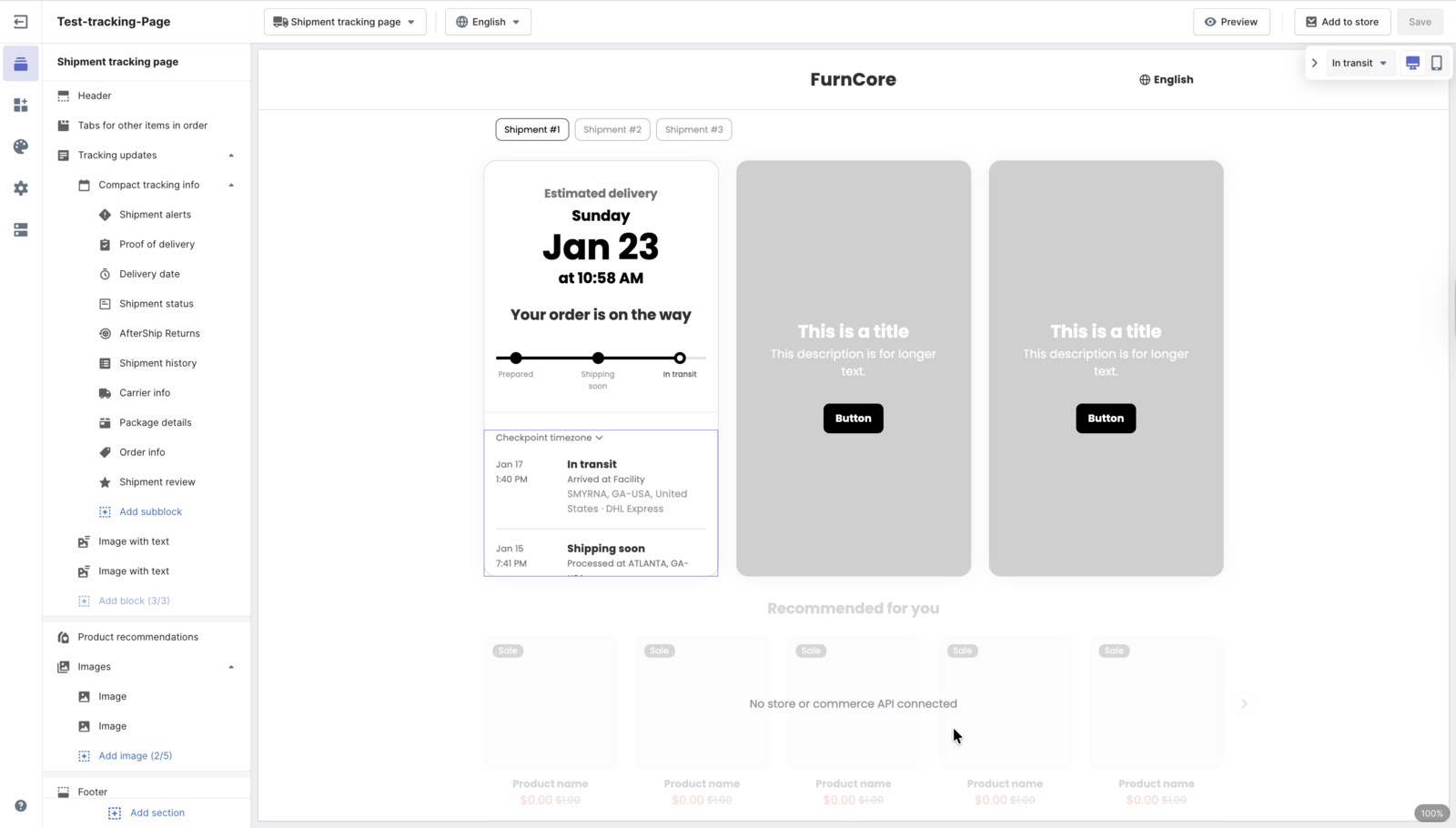
On core tracking, both apps will get the job done today. The difference is what happens when "today" changes, and that is where the comparison really begins.
Beyond Tracking: Where Parcel Stops and Your Growth Begins
A tracking page solves the problem you have this month. It does nothing for the three problems waiting for you at higher volume.
Picture your store six months from now. Order volume is up, and with it come three new headaches: customers want to send things back without emailing you, your shipping bill has quietly become a top-three expense, and shoppers increasingly decide whether to buy based on the delivery date they see before checkout. A tracking-only app like Parcel leaves each of these to a separate tool.
This is the real difference between a point solution and a platform. AfterShip puts those next three problems on the same login, dashboard, and customer data model as your tracking:
- AfterShip Returns gives customers a self-service portal to request returns and exchanges, turning a support drain into a structured, on-brand flow.
- AfterShip Shipping lets you compare carrier rates and buy labels in-house, so you stop overpaying as volume grows.
- AI EDD (estimated delivery dates) predicts arrival windows and shows them on your tracking and product pages, most reliably on domestic lanes and on the Tracking Premium plan.
A quick honesty check: "one platform" does not mean "one invoice." Tracking, Returns, and Shipping are separate subscriptions. What you share is one dashboard, one customer record, and one set of post-purchase data, instead of three disconnected apps you have to wire together yourself.
Parcel does surface estimated delivery dates too, so this is not an all-or-nothing gap. AfterShip's edge is that its dates are AI-predicted across more deliveries and feed named automation events you can actually act on.
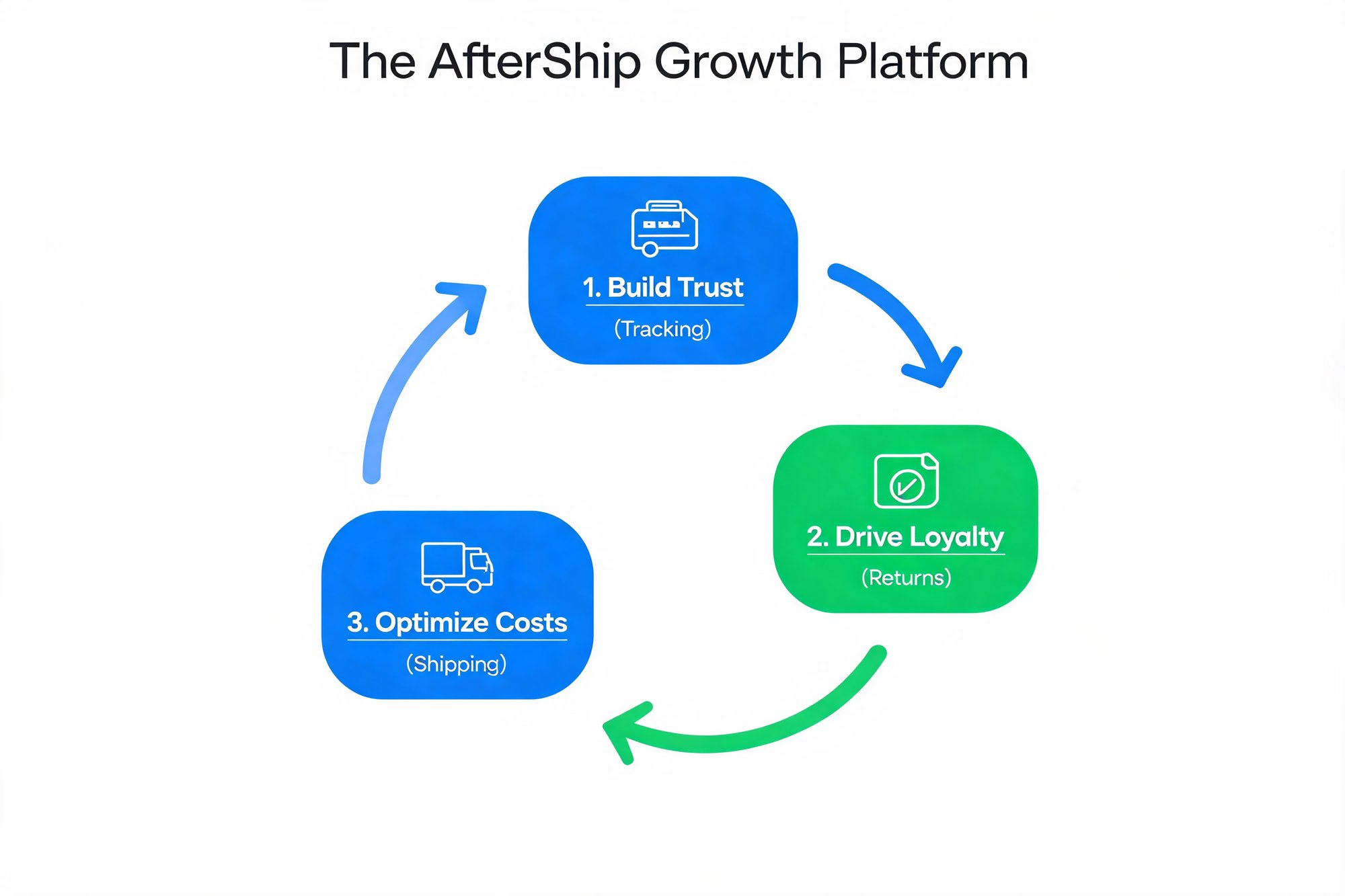
Let's take the two biggest of those problems in turn.
The True Cost of Returns
Returns are not a rounding error. They are one of the largest and most underestimated costs in eCommerce.
$849.9 billion in merchandise is projected to be returned by U.S. shoppers in 2025, according to the National Retail Federation. Yet 97% of shoppers say a positive return experience makes them more likely to buy again, according to Route.
Read those two numbers together and the strategy writes itself. Returns are unavoidable, but the experience around them decides whether a return ends the relationship or extends it. A tracking-only app can tell a customer their refund is on the way; it cannot run the return itself. AfterShip Returns turns that cost center into a retention moment with self-service exchanges, automated approval rules, and store-credit incentives that keep revenue in your business. And because the return data lives next to your tracking data, you can see which products drive the most returns and why, then fix the listing or the sizing before it costs you again.
When Shipping Costs Start to Matter
There is a moment every growing store hits when saving $0.50 a label stops being trivial. At 500 orders a month it is real money; at 5,000 it funds a hire.
That is the point where shipping software earns its place. AfterShip Shipping is a true multi-carrier shipping solution that compares live rates and generates labels across 100+ carriers (marketed as 130+), a label-generation network that is separate from the 1,300+ carriers AfterShip reads for tracking. Keep those two numbers distinct: one set moves your parcels, the other watches them. Rate shopping across carriers on the same order can shave a meaningful slice off every shipment, and at scale that compounds into thousands of dollars a year.
Tools like ShipStation do this job well, and plenty of brands run them happily. The real question is whether you want shipping living inside the same platform as your tracking and returns, or bolted on as a fourth tool with its own login, its own data, and its own learning curve.
The Shopify Experience: Native Feel vs. Another App
Both apps install cleanly on Shopify, and Parcel's "Built for Shopify" badge confirms it meets Shopify's quality bar. So the honest question is not which app is faster. It is how far each one's Shopify connection actually reaches.
A tracking-only app's integration stops at the tracking page. AfterShip extends the same Shopify connection into returns, shipping, and delivery estimates, so your post-purchase data stays in one place as you add capabilities. Both apps work with Shopify Flow, so that is not the dividing line.
Here is what "one place" buys you in practice: when a customer files a return, AfterShip already knows the carrier, the delivery date, and whether the parcel arrived late. That context lets you spot when delays are driving returns, something you cannot see when tracking and returns live in two unconnected apps.
The real automation story is what AfterShip does on top of Shopify. Its own flow builder fires on seven shipment-status triggers (info received, in transit, out for delivery, available for pickup, delivered, exception, and failed attempt), with trigger filters and email or SMS actions, and it pushes rich named events into Klaviyo so your marketing can react to delivery moments. That is the kind of depth a growing brand grows into, and it is worth seeing how we stack up against other Shopify-focused apps before you commit.
★★★★★ "AfterShip's suite (tracking, returns, referrals) is easy to plug in and saves time."
From a merchant review on the Shopify App Store
AfterShip Order Tracking carries a 4.5-star rating and the Built for Shopify badge on the App Store, the same quality bar Parcel meets. The difference shows up later, when "the apps" you plug in include returns and shipping on the same platform.
Pricing Analyzed: The Cost of a Tool vs. The Value of a Platform
Let's be fair about price, because this is where Parcel looks most attractive. Parcel offers a free plan and low entry tiers, and at very low volume it can cost less than AfterShip. If your only metric is the monthly line item this quarter, that is a real point in its favor.
Now let's read the actual numbers. On the Shopify App Store, AfterShip Tracking lists three tiers a growing store will care about:
- Free: $0 for 50 shipments a month.
- Essentials: $11 a month for 100 shipments, then $0.08 per extra shipment.
- Premium: $70 a month for 500 shipments, then $0.12 per extra, and it unlocks a custom domain plus AI EDD.
Here is the part the sticker price hides. At 500 orders a month on Essentials, you pay $11 plus 400 extra shipments at $0.08, which works out to $43 a month. At that volume, Premium at $70 gives you 500 shipments with no overage and the fuller feature set, so it is both easier to predict and more capable. Budget roughly $43 to $70 a month for Tracking alone, before Returns.
That last phrase matters: before Returns. "One platform" does not mean one bundled bill. AfterShip Tracking and AfterShip Returns are separate subscriptions, though bundling two or more products earns 25% off your first year and team seats are shared across them.
So compare the real alternatives. With AfterShip you run Tracking and Returns as two subscriptions that share one dashboard and one customer record. With Parcel, you run a tracking app plus a separate returns app like Loop: still two bills, but now you are also stitching two disconnected data sets together by hand. The second bill is the same. The integration tax is the difference.
The 2026 Verdict: Which Tool Future-Proofs Your Shopify Store?
So which one should you install this week? It honestly depends on where your store is heading.
Choose AfterShip if:
- You plan to expand your product line and expect returns volume to climb with it.
- You see returns as a retention opportunity, not just a cost to process.
- You want a single source of truth for post-purchase data across tracking, returns, and shipping.
AfterShip is a complete post-purchase platform for growing stores. AfterShip integrates tracking, returns, shipping, and delivery estimates on one platform, which is exactly what a scaling brand stops wanting to assemble by hand.
Consider Parcel if:
- You are a solo founder who needs a branded tracking page live this week with the least possible setup.
- Returns and shipping optimization genuinely are not on your roadmap in the next 6 to 12 months.
- Your budget today only stretches to the cheapest functional tracking page, and you accept you may migrate later.
That last group is a real and reasonable place to be. Parcel is primarily a shipment tracking point solution for Shopify, and for a store that only needs that, it is a well-built, well-reviewed choice.
Here is the honest bridge, though. AfterShip's free or Essentials tier also gets a tracking page up fast, and you can add Returns and Shipping later without switching platforms. The difference is the ceiling: with Parcel you will eventually buy and integrate separate tools; with AfterShip you grow into one. If you are still weighing the field, it is worth evaluating other post-purchase platforms too, and scanning the broader shipping-software landscape on independent review sites, before you commit.
Proactive shipment tracking that delights your customers, reduces WISMO tickets, and optimizes your delivery performance.
Book a demoFrequently Asked Questions
Is AfterShip or Parcel better for a growing Shopify store?
For a store planning to grow, AfterShip is the stronger long-term choice because tracking, returns, shipping, and AI delivery estimates share one platform and data model. Parcel is a well-built, Built for Shopify tracking app, and a fair pick if basic tracking is all you need today.
How does AfterShip pricing compare to Parcel on the Shopify App Store?
Both offer free plans. AfterShip Tracking runs roughly $43 to $70 a month at 500 orders (Essentials with overage, or Premium with 500 shipments included). Parcel's entry tiers can look cheaper at low volume, but a tracking-only app means you later pay for and integrate separate returns and shipping tools.
Does Parcel offer returns and shipping like AfterShip?
No. Parcel (ParcelWILL / Parcel Panel) focuses on order tracking and notifications. AfterShip adds native Returns and Shipping as separate subscriptions on the same dashboard and customer data model, so you grow into one platform instead of stitching several apps together.
Is AfterShip worth it if my store is still small?
If your budget is tight and returns or shipping optimization are not on your roadmap yet, AfterShip's free or Essentials tracking tier still gets a branded page up quickly. The advantage over Parcel is the ceiling: you can add Returns and Shipping later without changing platforms.