
AfterShip vs. Parcel Perform: The Honest Verdict for US Retailers

The Real Question: Who Can Actually Turn On a Full Post-Purchase Stack This Week?
You've scaled past your simple tracking app. WISMO tickets (that's "Where Is My Order," and by widely cited industry estimates it runs up to ~50% of ecommerce support inquiries) are overwhelming your team. Everyone in 2026 pitches "unify your post-purchase stack," including Parcel Perform. The real question isn't whether to unify; it's who can actually deliver tracking, returns, shipping, and AI delivery dates on one platform that a Shopify brand can turn on this week. That's where AfterShip and Parcel Perform part ways.
So let's set the frame correctly, because most AfterShip vs. Parcel Perform comparisons get it wrong. The old "unified platform vs. tracking-only point solution" angle is dead. Parcel Perform now markets a six-module suite and runs the same "single source of truth" pitch AfterShip does. Consolidation is the category default, not a differentiator.
The real split is about how you buy and how fast you can deploy. AfterShip is self-serve, transparently priced, Shopify-native, and US-based. Parcel Perform is demo-only, custom-quoted, enterprise-weighted, and EU/APAC in origin. For a US mid-market DTC brand running 1,000 to 50,000 orders a month, that business-model gap is the decision.
One clarification before we score the rounds. "One platform" here means one login, one dashboard, one data model, not one invoice. Tracking, Returns, and Shipping are billed as separate subscriptions. The benefit is unified data and operations across your post-purchase flow, not a single line item on your statement.
Quick Verdict for Busy Ops Leaders
Here's the answer before the detail.
For most US Shopify DTC brands, AfterShip is the stronger choice. It installs free on Shopify and upgrades from $11/month on the Shopify App Store, or from $29/month direct, so you can launch this week without a procurement cycle. It runs tracking, returns, shipping, and AI estimated delivery dates (EDD) on one data model, and it's US-based.
Parcel Perform is a strong fit for a different buyer: global, EU/APAC, enterprise brands that buy through a sales cycle and want a custom-quoted suite spanning checkout to logistics.
The decisive factor isn't a missing feature on either side. It's buyer fit:
- Adoption model: self-serve install vs. demo-and-quote sales motion
- Platform fit: Shopify-native app vs. enterprise integration project
- Geography: US-based support and carrier focus vs. EU/APAC origin
- Time to live: this afternoon vs. a multi-week onboarding
If you're Sarah in ops, shipping 1K to 50K orders a month on Shopify, the rest of this article is your defensible case.
Round 1: Shipment Tracking & US Carrier Coverage
Tracking is where every comparison starts, so let's get it out of the way: both platforms track well. AfterShip supports 1,200+ carriers worldwide, with proactive notifications triggered at each shipment milestone and a branded tracking page you control. Parcel Perform's tracking is genuinely capable too. Treat real-time tracking as table stakes in 2026, not the thing that decides your shortlist.
| Criteria | AfterShip | Parcel Perform |
|---|---|---|
| US carrier coverage & reliability | 1,200+ carriers. Signed USPS API licensing agreement (effective Apr 1, 2026) keeps US tracking data uninterrupted on paid plans | Capable multi-carrier tracking; strongest in global/cross-border visibility |
| Branded experience & customization | Self-serve branded tracking page editor; custom domain on the Premium tier | Capable post-purchase experience; richest customization via enterprise integration |
| Proactive CX (AI EDD + notifications) | AI EDD trained on 4.4B+ shipments, 80%+ coverage, ~91% accuracy; one-click Shopify widget (Premium) + automated milestone notifications | "Date of Arrival" ML engine, delivered through enterprise integration |
| Integrated returns | AfterShip Returns: self-serve, Shopify-native branded portal, launch same day | Returns Experience module inside a demo-only enterprise suite |
| Integrated shipping / labels | AfterShip Shipping: multi-carrier rate shopping + label generation | Logistics Experience module (enterprise suite); not a self-serve Shopify label app |
| Shopify & US stack integration + proof | Native Shopify, Klaviyo, Gorgias, Attentive; ~1,200 Shopify reviews at 4.5/5 | Parcel Monitor Track & Notify free Shopify app (tracking + notifications only); 2 reviews at 5.0/5 |
| Buyer journey & TCO | Self-serve, transparent: free install, from $11/mo (Shopify App Store) or $29/mo direct | Demo-only, custom quote; enterprise / mid-size positioning |
The differentiator for a US operator sits underneath the carrier count: data continuity. In 2026, USPS moved to a paid, licensed model for third-party tracking access, effective April 1, 2026. Accessing USPS tracking data now requires a signed API licensing agreement, a monthly fee, and Mailer-ID authorization.
AfterShip signed a formal API licensing agreement with USPS to keep that data flowing without interruption, and now pays for that access. This is what gives AfterShip unmatched reliability for US shipments on its paid plans. It's a direct, formal agreement, not an exclusive partnership, and USPS tracking runs on AfterShip's paid tiers rather than for free.
The strategic point: the change most exposes unofficial, free, aggregator-style consumer lookups, which is the model a consumer tracker runs on. A US brand on a free consumer tracker carries more USPS-data continuity risk than one on a paid, USPS-licensed platform. On the tracking round, both platforms clear the bar, but only one has put a signed USPS agreement behind your US delivery data.
Round 2: The Customer Experience Beyond the Tracking Page
A tracking number is the floor. What happens on the page after the customer clicks is where you either build a repeat buyer or leak one back to support. This is where the two platforms start to feel different in daily use.
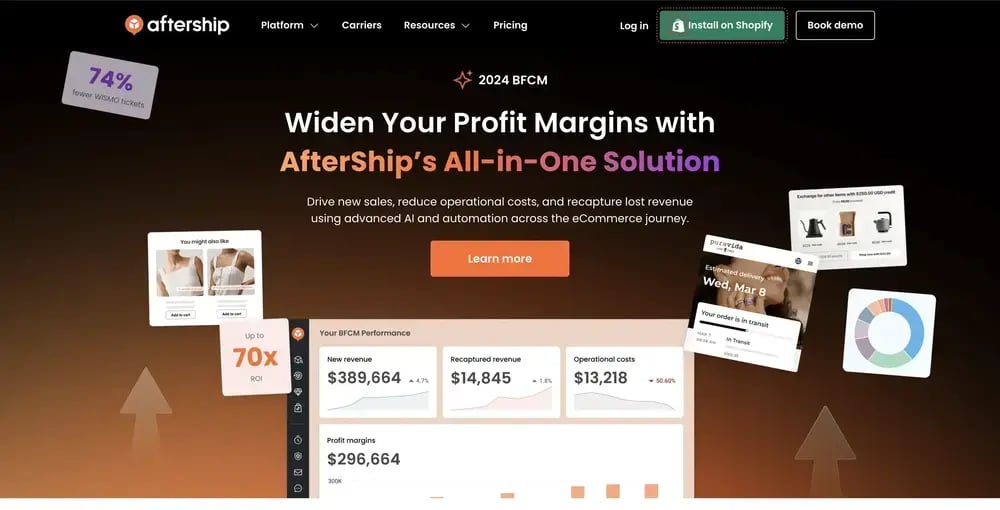
AfterShip's branded tracking pages are built to be a marketing surface, not just a status screen. You get theme options, banners, marketing assets, and product recommendations that turn a "where's my order" visit into a second purchase, and you deploy all of it yourself. No ticket to a solutions engineer, no integration sprint.
Parcel Perform delivers a capable post-purchase experience too, but its richest customization tends to arrive through enterprise integration rather than a self-serve editor. For a brand with a solutions team and a timeline, that's fine. For a Shopify ops lead who wants the page live before the next promo, the difference in effort is real.
One honest caveat so you budget correctly: custom-domain tracking pages are a Premium feature on AfterShip, not a free-tier perk. Price the plan you'll actually run, not the $11 entry tier. The capability is published and clear; just put the real number in your total cost of ownership.
Can it predict delivery delays before they happen?
Both platforms ship machine-learning delivery prediction, so the question isn't whether Parcel Perform has an estimated delivery date engine. It does, branded "Date of Arrival" and fed by its parcel-event data. The real question is how productized and accurate that prediction is, and how hard it is to turn on.
AfterShip's AI EDD is the more packaged answer for a Shopify brand. It deploys as a one-click widget on the Premium plan, showing a predicted delivery date right on the product and checkout pages where it reduces pre-purchase hesitation and post-purchase anxiety.
AfterShip's AI EDD is trained on over 4.4 billion shipments. It covers at least 80% of deliveries, versus under 40% for most carriers, with roughly 91% accuracy (up to 95% as a marketing ceiling). That coverage gap matters: a prediction engine that can only speak for 40% of your parcels leaves most of your customers guessing.
Parcel Perform's engine is strong, but it reaches your storefront through enterprise integration rather than a one-click Shopify install. Same category of capability, very different adoption path. For Sarah, the one she can switch on this afternoon is the one that starts paying down delay-related tickets this week.
Round 3: Returns & Shipping - Who Lets a Shopify Brand Turn Them On This Week?
Returns are no longer a back-office afterthought. The NRF projects $849.9 billion in US returns in 2025, with an estimated 19.3% of online orders sent back, and 82% of shoppers citing free returns as a major purchase factor. If your returns experience is clunky, you're paying for it twice: in reverse-logistics cost and in lost repeat revenue.
Here's the reframe that matters. Both AfterShip and Parcel Perform have returns. So the question isn't "can it do returns," it's "can a Shopify brand turn returns on without a sales cycle."
AfterShip Returns is a comprehensive returns management system you launch yourself: a branded, self-serve returns portal, automated rules, and exchange-over-refund flows that recover revenue instead of bleeding it. You can have it live this afternoon, on the same data model as your tracking. AfterShip Shipping rounds out the stack with multi-carrier shipping software for rate shopping and label generation, so fulfillment and post-purchase share one source of truth.
Parcel Perform offers returns too, inside its Returns Experience module. The catch for your buyer profile is the buying motion: it lives within a demo-only enterprise suite, quoted and onboarded through sales rather than installed from an app listing.
So ask the forward-looking question. Will you need returns and self-serve shipping in six months? If yes, the platform that lets you flip them on without a procurement cycle is the one that fits how a Shopify brand actually grows. On adoption speed, this round isn't close.
Round 4: Integrations, the Shopify Ecosystem & Proof of Adoption
Let's kill a myth: Parcel Perform does have a merchant app. It's called Parcel Monitor Track & Notify, a free Shopify app offering unlimited tracking, automated email notifications, and a branded tracking page. What it doesn't do is returns, labels, or a productized EDD widget inside the app. It's a focused consumer-style tracker, and it currently carries 2 reviews at 5.0 on the Shopify App Store.
That review count is the tell. AfterShip Order Tracking carries roughly 1,200 merchant reviews at 4.5 stars. Both vendors sit at 4.7/5 on G2, so the rating itself isn't a differentiator. Adoption volume is. Twelve hundred merchants leaving feedback is a different evidence base than two.
Depth of integration is the other half. AfterShip plugs natively into Shopify plus the tools a US DTC stack actually runs on: Klaviyo for email and SMS, Gorgias for support, and Attentive for messaging. That means tracking events and delivery status flow into the systems where you already work, not into a separate silo.
“AfterShip's solutions are making our customer service agents' day-to-day operations easier. At a corporate level, it has also really helped us empower our logistics and operations teams.”
Kari Beiswanger, Senior Product Manager, Retail & Operations
Read their story →Now the honest weakness, because a credible verdict needs one. AfterShip isn't perfect. The features that matter most to a growing brand (custom-domain tracking pages, AI EDD, and API access) sit on the Premium tier, so budget for the Premium plan from the start. Reviews also occasionally flag integration setup friction, such as a Klaviyo connection that took effort to get into production. The flip side, cited just as often, is fast, responsive support and an easy Shopify install. Factor the real plan cost into your total cost of ownership and go in clear-eyed.
The Final Verdict: Choosing Your Partner for Growth in 2026
Credit where it's due. Parcel Perform is genuinely strong where it's built to be: global, EU/APAC, enterprise-scale parcel logistics, where it ranks #1 in G2's Summer 2025 Europe Regional Grid for Multicarrier Parcel Management and serves brands like Nespresso and Decathlon. By Parcel Perform's own data, around 63% of US domestic parcels in Q2 2025 were collected at pickup-and-dropoff points, so its visibility strengths are real. If you're an enterprise shipping across borders at scale, it deserves a serious look.
But if you're a US Shopify DTC brand, that's not your fight. Yours is shipping reliably in the US, launching a branded post-purchase experience without a sales cycle, and adding returns and shipping on the same platform. That's AfterShip's home turf, and its Shopify listing even shows "Based in USA."
So the AfterShip vs. Parcel Perform decision comes down to who you are, not who has more features. For a US mid-market Shopify brand, AfterShip wins on US carrier reliability backed by a formal USPS agreement, self-serve adoption you control, one data model spanning tracking, returns, shipping, and AI EDD, and roughly 1,200 merchant reviews of proof. If your shortlist also includes other post-purchase platforms, it's worth seeing how AfterShip stacks up against other platforms like Narvar before you commit.
The smart long-term call for a Shopify brand isn't the platform with the longest module list. It's the one you can turn on this week and still be growing on in three years.
Frequently Asked Questions
Is AfterShip or Parcel Perform better for US retailers?
For a US mid-market Shopify DTC brand, AfterShip is the stronger choice. It is self-serve, Shopify-native, US-based, and runs tracking, returns, shipping, and AI EDD on one data model. Parcel Perform is a better fit for global, EU/APAC, enterprise brands that buy through a sales cycle.
Does Parcel Perform offer returns and a merchant app?
Yes. Parcel Perform markets a six-module suite that includes a Returns Experience module, and it has a free Shopify app, Parcel Monitor Track & Notify, for tracking and notifications. The difference is the buying motion: its returns live inside a demo-only enterprise suite, while AfterShip Returns is self-serve.
How much does AfterShip cost?
AfterShip installs free on Shopify, then upgrades from $11/month on the Shopify App Store or from $29/month direct. Custom-domain tracking pages, AI EDD, and API access sit on the Premium tier, so budget for the plan you'll actually run. Parcel Perform is demo-only with custom quotes.
What changed with USPS tracking in 2026?
On April 1, 2026, USPS moved to a paid, licensed model for third-party tracking-data access, requiring a signed API agreement and monthly fee for service providers. AfterShip signed a formal API licensing agreement with USPS to keep US tracking data uninterrupted on its paid plans.
Proactive shipment tracking that delights your customers, reduces WISMO tickets, and optimizes your delivery performance.
Book a demo