
AfterShip vs Onward VIP Protection: Honest Reviews for DTC Brands

The Real Cost of Shipping Anxiety
Your support team is drowning in tickets for lost, stolen, and damaged packages. You're considering a tool like Onward VIP Protection to solve it. That's a reasonable first step, but it only solves half the problem. What if the real fix wasn't just insuring packages, but preventing the customer anxiety that fuels those tickets in the first place?
Here's the reframe that should shape how you weigh AfterShip vs Onward VIP Protection: the thing eroding your CSAT isn't shipping. It's post-purchase anxiety, the stretch between "payment confirmed" and "package in hand" when the customer has no idea what's happening. Every silent tracking day, every vague carrier scan, every porch-piracy story they've read primes them to email you first and trust you a little less.
That anxiety carries a measurable cost. A single lost-package thread can run three or four replies before it's resolved, and a rough delivery is one of the fastest ways to turn a first-time buyer into a one-time buyer. In a 2026 delivery-experience survey, half of shoppers said a negative delivery experience stopped them buying from a brand again.
At 1,000 to 50,000 orders a month, that math compounds fast. The fallout doesn't land on the customer alone. It lands on the ops lead refreshing carrier dashboards at 7pm trying to figure out which 40 packages are actually stuck.

Two schools of thought have emerged for dealing with this. One says: insure the package, and when something goes wrong, manage the claim. The other says: shrink the anxiety upstream so fewer things feel like they've gone wrong, then resolve the genuine failures through a transparent claims process. Those are not the same strategy, and the gap between them is the entire decision.
The Two Philosophies: Point Solution vs. Unified Platform
Onward VIP Protection is a point solution. It does one job: it adds shipping protection at checkout and gives shoppers a portal to file claims when a package is lost, stolen, or damaged. Onward runs on a self-funded model, which means you, the merchant, collect and keep the premium, and you pay claims out of your own pocket. The kept premium is the revenue stream. The claim risk is also yours.
AfterShip comes at the same symptom from the opposite end. It's an insurance-backed unified platform spanning tracking, proactive communication, protection, and returns in one system. With AfterShip Protection, premiums go to a licensed insurer (UPS Capital / InsureShield), and claims are adjudicated by that insurer rather than by you. We'll get into how that changes the trust equation in the next section.
Now the honest part, because you've probably already wondered about it. Onward and AfterShip Tracking can run side by side. There's no technical conflict, and plenty of merchants do exactly this on AfterShip's free or Essentials tier. Coexistence isn't the real question.
The real question is what you give up by keeping protection in a separate silo:
- No claim button on your branded tracking page, which is exactly where the anxious customer already is.
- No protection status visible inside the tracking flow.
- No unified analytics tying delivery exceptions to claim spikes.
- No cross-product automation, like auto-routing a lost-package case into a one-click reorder.
- Two vendors, two invoices, two data sets that never talk to each other.
So when is each one enough? If you're an early-stage store that wants a simple, revenue-generating protection add-on and nothing more, a point solution does the job. If you're scaling and you treat the post-purchase experience as part of the brand, you need the platform, because the symptoms you're fighting are connected, and your tools should be too.
Quick Verdict: Who Is AfterShip For? Who Is Onward For?
You shouldn't have to read 2,000 words to get the gist, so here's the answer up front. These two tools are built for two different stages of business.
| Dimension | Onward VIP Protection | AfterShip |
|---|---|---|
| Best for | Early-stage Shopify stores wanting simple, merchant-funded protection as a revenue line | Scaling mid-market and enterprise DTC brands owning the end-to-end post-purchase experience |
| Protection model | Self-funded: you collect and keep premiums, you pay claims | Insurance-backed: premiums go to UPS Capital / InsureShield; claim risk transferred off your books |
| Who decides claims | You, the merchant | A licensed insurer (UPS Capital / InsureShield) |
| What you're really buying | A protection point solution plus a kept-premium revenue stream | A unified post-purchase platform: tracking, communication, protection, returns |
| Choose it when | You want fast setup, no eligibility gate, you keep the premium, and protection is all you need | You're scaling, fragmentation already hurts, and you want risk transfer plus one system |
The pattern holds across every criterion that follows. Onward is built for simplicity and a kept premium. AfterShip is built for an owned, insurer-backed post-purchase experience that scales with you.
Head-to-Head: How AfterShip and Onward Handle Package Protection
Both tools let a shopper recover the value of a lost, stolen, or damaged package. How they get there is where they split, and it comes down to one word: who decides.
With AfterShip Protection, the shopper files the claim themselves, self-service, right from your branded tracking page. They pick the reason (Lost, Porch piracy, or Damaged), and the claim goes to UPS Capital / InsureShield, a licensed insurer, for adjudication. AfterShip facilitates the flow but does not decide the claim. AfterShip reports that roughly 95% of valid claims are approved, with an average of about four days to a decision, no police report required for porch piracy, and a claims window of up to 90 days.
Once a claim is approved, you, the merchant, execute the resolution, a refund or a reship, and auto-resolution triggers can handle that step automatically. For the customer, the no-police-report rule on porch piracy and the long filing window remove the two things that usually make a claim feel like a fight.
Onward works differently, because it is self-funded. You collect the premiums, you keep them, and you decide and pay claims yourself. Because you've pre-authorized the rules, Onward's self-service portal can resolve simple cases on the spot.
Here's the honest trade-off. A merchant who pre-approves their own claims can reship faster than an insurer that takes a few days to adjudicate, and that speed is real. But it carries a structural conflict of interest: in a self-funded model, every approved claim is money straight out of your own pocket, so the incentive to scrutinize a borderline claim sits with the same party that has to pay it.
Insurer adjudication is slower by a few days, but it's transparent, and that incentive to deny doesn't sit on your side of the table.
There's a second worry every ops lead raises here: won't charging a protection premium at checkout dent conversion? It's a fair question, given that unexpected extra costs are the single biggest reason shoppers abandon carts.
The difference is that AfterShip Protection is opt-in and clearly priced at around 1.5% of cart value, so it reads as a visible, optional add-on rather than a hidden surcharge. When the cart widget is placed well, roughly 57% of shoppers choose to add it.
The point isn't that one claims model wins everywhere. It's that insurer-backed adjudication takes you out of the seat of judging claims against your own bank account, and that matters more with every claim you process.
The Platform Advantage: What Onward Can't Do
Claims handling is table stakes. The reason a scaling brand outgrows a standalone protection app is everything that sits around the claim, the parts a point solution structurally can't reach. Three capabilities define the gap.
1. Proactive tracking and communication. The cheapest claim is the one that never gets filed, because the package arrived when the customer expected it to. AfterShip's proactive, branded notifications keep shoppers updated at every milestone, which shrinks the anxiety that drives both WISMO tickets and panic claims. AfterShip reports that Tracking cuts WISMO tickets by 65% across its customer base.
Now the honest limitation, because no notification system is flawless. Accuracy depends on carrier data freshness, and stale or batch-updated scans, especially from regional and last-mile carriers, can occasionally fire a premature or false alert that actually raises anxiety. AfterShip leans on AI status standardization to clean up messy carrier data, and a sharp ops manager can tune the triggers, for example suppressing "Out for delivery" and firing only on a confirmed "Delivered," to keep false positives down. It rewards a little configuration discipline rather than a set-and-forget switch.
2. Branded tracking pages. A standalone protection portal lives off to the side. A branded tracking page turns the most-visited post-purchase moment, the "where is it?" check, into an owned marketing channel, and it places the claim button exactly where the worried customer already is.
3. Integrated returns. When a package is genuinely lost, the fix often isn't just a refund, it's getting the right product into the customer's hands. With tracking, protection, and returns in one system, a lost-package case can flow straight into the returns and exchange portal for a one-click reorder, instead of bouncing the customer between disconnected tools.
That single dashboard is the whole argument. Protection isn't a bolt-on. It lives on the same customer record as the tracking event that triggered the claim and the return that resolves it.
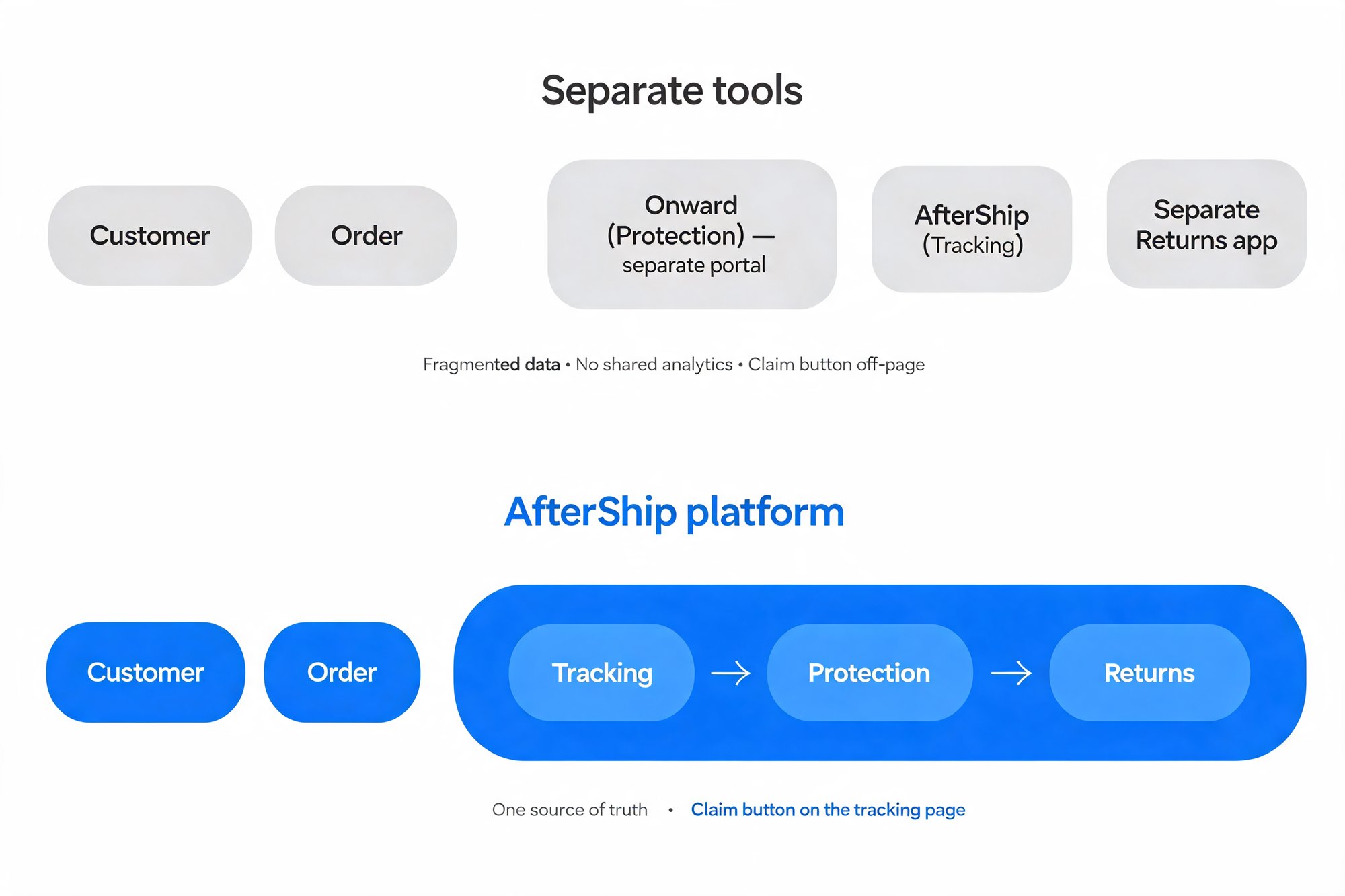
Onward can protect a package. What it can't do is see the journey that package took, or the relationship that hinges on how the whole thing felt.
Feature Breakdown: AfterShip vs. Onward VIP Protection
Lined up against the criteria a scaling ops team actually weighs, the AfterShip vs Onward VIP Protection comparison stops being close. Here's the detail behind the quick verdict.
| Criteria | AfterShip | Onward VIP Protection |
|---|---|---|
| Solves core job (claims management) | Yes | Yes |
| Claims model | Insurance-backed (UPS Capital / InsureShield) | Self-funded: merchant funds and keeps the premium |
| Who decides claims | A licensed insurer | The merchant |
| Cost / economics | $0 base; premium ~1.5% of cart value paid by shopper, 100% to the insurer; coverage up to 120% of value; ~57% opt-in | $0 to install; merchant sets and keeps 100% of premium; self-funds claims |
| Reduces WISMO tickets (via Tracking) | Yes: AfterShip reports a 65% reduction | No: protection only, no tracking layer |
| Customer self-service claim filing | Yes, from the branded tracking page | Yes, from a separate portal |
| Unified customer experience | Yes: tracking + protection + returns in one system | No: standalone protection |
| Drives repeat purchases | Yes: branded pages plus integrated returns and exchanges | Limited |
| Integration & API depth | Broad: helpdesk and marketing integrations, Protection API; also WooCommerce, BigCommerce, SFCC, Magento 2 | Focused on protection |
| International coverage & eligibility | Ships from the US including international; insurance model requires US Shopify/Shopify Plus, USD, 5,000+ annual orders, claim ratio ≤3%; excludes shipping, taxes, duties | No insurer geographic gate, but the merchant bears 100% of international claim risk |
| Scalability for growth | High: risk transferred to the insurer, unified data | Limited by merchant-borne claim risk |
| Reporting & analytics | Unified across tracking, protection, and returns | Protection-only, siloed |
Read the table as one story, not eleven rows. Onward wins on setup speed and keeping the premium. AfterShip wins on everything tied to scale, risk, and owning the customer relationship.
The Verdict: Why Scaling Brands Choose a Platform Over a Point Solution
Let's be fair to Onward. For an early-stage Shopify store that wants to add package protection in an afternoon and turn it into a small revenue line, it's a sensible choice. Fast to install, no insurer eligibility gate, and the premium is yours to keep.
Then peak season hits.
Because Onward is self-funded, a single bad stretch, a carrier meltdown, a porch-piracy wave, a regional weather event, can spike claims past the premium pool you've collected. At that point the "revenue stream" inverts, and you're covering losses out of margin during the busiest, most cash-sensitive weeks of your year. That structural risk is baked into any merchant-funded model.
AfterShip answers that two ways. It transfers claim risk to UPS Capital, so a claim spike is the insurer's exposure, not yours. And it unifies tracking, communication, protection, and returns, so the data and the customer journey stop living in separate boxes.
The clearest proof is what unified post-purchase tooling does to operational load. Aetrex (Tracking + Returns) cut WISMO tickets by 74%, lifted NPS by 141 points, and reduced operating costs by 50%. When the tools share one system, the gains compound.
A second example is worth its precise scope. Goodr used AfterShip Returns + Warranty, not Protection and not Tracking, to cut support tickets by 60% and warranty claims by 75%. That's evidence that consolidating post-purchase tools lightens the operational load, not a claim about the protection product itself.
The Hidden Cost of "Simple." A standalone protection app looks cheaper and easier on day one. The bill arrives later: self-funded claim risk you carry alone, customer data fragmented across vendors, multiple invoices to reconcile, and a post-purchase experience that feels stitched together instead of designed.
None of this makes AfterShip the right fit for everyone. The insurance model carries real constraints: a US Shopify or Shopify Plus store, USD currency, 5,000+ annual orders, and a claim ratio at or below 3%. And proactive notifications are only as good as the carrier data feeding them. If you're below that scale and want the simplest possible protection add-on, Onward may still be your answer.
But if you're scaling, and the reason you're reading this is that fragmentation already hurts, the verdict is clear. A platform that prevents anxiety and transfers risk beats a point solution that only manages claims after the fact.
World-class shipping protection that captures lost revenue, drives customer satisfaction, and optimizes claims operations.
Book a demoFrequently Asked Questions
Does AfterShip integrate with Gorgias and Klaviyo?
Yes. AfterShip connects with major helpdesk and marketing platforms, so tracking and post-purchase events flow into the tools your team already uses. With Klaviyo, delivery milestones can trigger email and SMS flows; with Gorgias, shipment status can surface inside support tickets so agents resolve WISMO questions without leaving the helpdesk.
Is AfterShip Protection similar to Route Protect?
They sit in the same category, and AfterShip Protection is the newer standalone product of the two. The reliability question, though, isn't about the app's age. AfterShip Protection claims are adjudicated by UPS Capital / InsureShield, a licensed cargo insurer that has underwritten shipments since 2000, so the track record rests on the insurer rather than the product's launch date. If you're weighing the category, it's worth comparing against a similar tool, Route Protect.
How does AfterShip Protection's insurance model compare to Onward's self-funded model?
It's a fundamentally different risk model, and it is not a revenue-share product. With AfterShip Protection, premiums go 100% to the insurer (UPS Capital / InsureShield), and the insurer adjudicates and pays valid claims, so the risk sits off your balance sheet. Onward is self-funded: you keep 100% of the premium but also fund and decide every claim yourself, carrying the full claim risk.
Does AfterShip Protection cover international orders?
Yes, for shipments originating in the US, including international destinations. The insurance model requires a US Shopify or Shopify Plus store, USD currency, 5,000+ annual orders, and a claim ratio at or below 3%. International adjudication can take longer, untracked claim windows are extended, and coverage excludes shipping fees, taxes, and customs duties; customs seizures and delays are not covered.