
AfterShip vs Narvar vs ParcelLab: The Honest Verdict for Mid-Market DTC Brands in 2026


The 30-Second Verdict: Who Wins in 2026?
You've narrowed your post-purchase platform choice down to the three titans: AfterShip, Narvar, and ParcelLab. Now comes the hard part. This isn't just about picking a tracking page; it's a multi-year strategic bet. We're not going to give you a laundry list of features. We're going to give you the honest verdict, including the trade-offs each platform makes you live with, on which philosophy (legacy, managed, or unified ecosystem) will actually scale with your DTC brand into 2026.
Here is the fast version, because you have a recommendation due in two weeks. The "aftership vs narvar vs parcellab" decision really comes down to three different bets. Narvar is the enterprise standard: reliable tracking with a Tier-1 brand roster, sold the old enterprise way. ParcelLab is the white-glove service: managed / high-touch customer experience designed for you by a hands-on team. AfterShip is the unified platform: tracking, returns, shipping, and AI insights on one stack that you own and operate.
The table below scores each one on the four criteria a mid-market Ops or CX leader actually defends in a budget review: platform breadth, AI and innovation, self-serve control, and pricing transparency.
| Criteria | AfterShip (Unified Platform) | Narvar (Enterprise Standard) | ParcelLab (Managed Service) |
|---|---|---|---|
| Verdict | Best for unified platform & data-driven control | Best for enterprise-grade tracking | Best for white-glove (managed) CX service |
| Platform Breadth | Tracking, Returns, Shipping, Warranty, Protection, AI EDD, Feed, all first-party | Tracking-centric; Returns/EDD/fraud are paid add-ons | Communications-first; expanding into returns & AI analytics; no shipping label gen or warranty |
| AI & Innovation | Leader: AI EDD on 10B+ shipments, returns insights | Follower: Promise EDD is a paid add-on | Emerging / catching up: Copilot AI, NL analytics, Predict delay-detection |
| Self-Serve Control | High: full control of rules & branding (rules engine has a real learning curve) | Medium: more dev/support; PS-queue dependent | Low to Medium: managed model; Copilot adds some self-serve |
| Global Carrier Network | 1,300+ carriers; no customer credentials required | Claims 1,000+; ~300 effective; requires customer carrier credentials | Comms-focused; not a carrier-coverage leader |
| Pricing Transparency | High: published tiers/overage (but multi-product line items) | Low: no public pricing; 2 to 3 yr terms; renewal true-up; add-on/cross-sell tax | Low: custom-quoted; managed-service fees scale with volume |
| Best for... | Mid-market DTC brands wanting a complete post-purchase suite they operate | Large enterprises needing stable, reliable tracking | Brands wanting to outsource CX comms to a managed / high-touch team |
The short answer: for a growing mid-market DTC brand that wants to own its post-purchase experience and use data to cut costs, AfterShip is the safest future-proof bet. The rest of this article shows you exactly where that holds, and the three places where it doesn't.
The Core Showdown: Tracking & Notifications
Tracking is table stakes, so the real question is what your team can do with it without filing a ticket. AfterShip's branded tracking page uses a self-serve drag-and-drop editor, which means your ops and marketing teams publish changes themselves. On Narvar, updating the branded tracking page typically runs through your account manager, a dependency that bites hardest during peak season when you most need to change something fast.
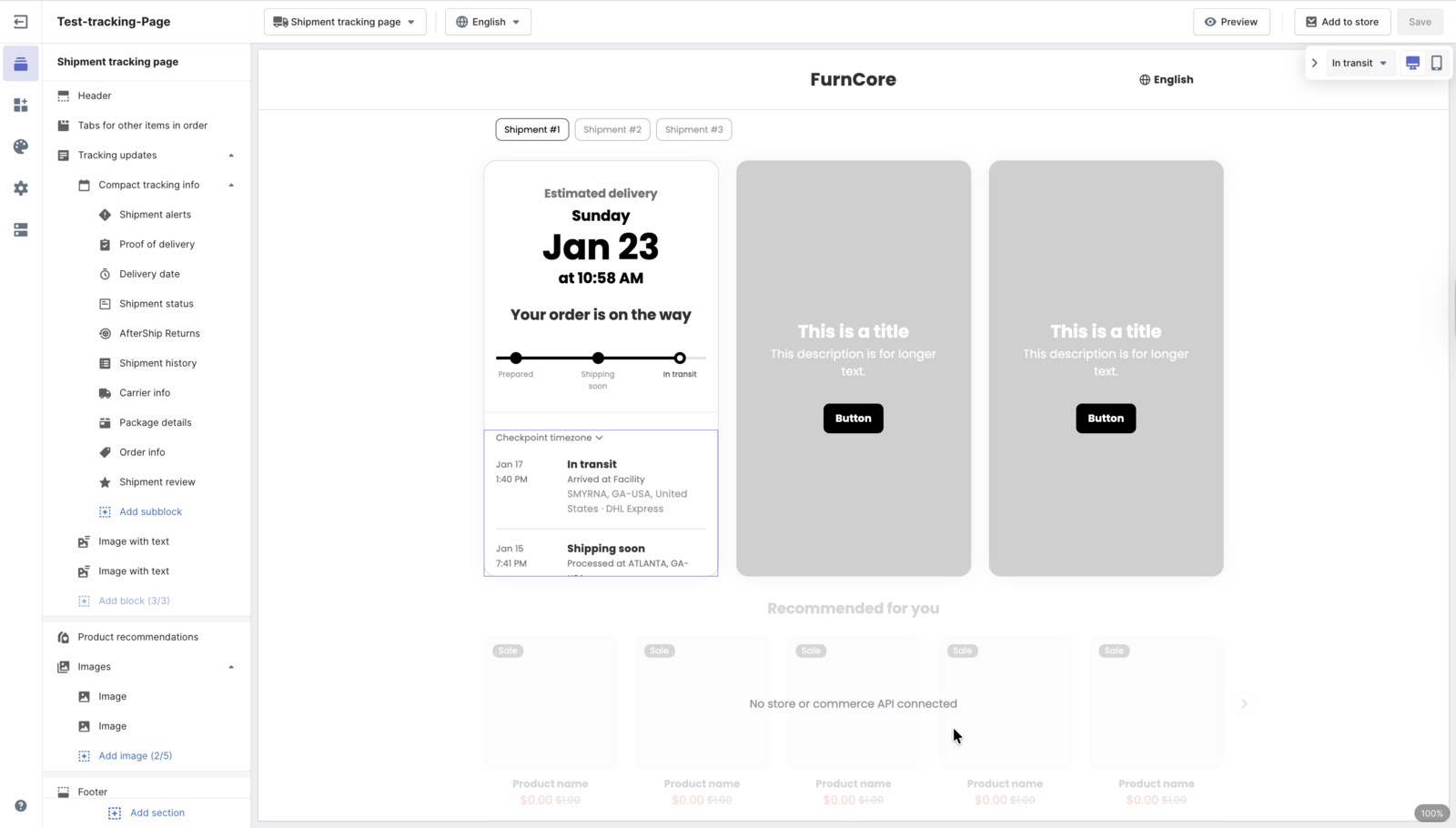
Proactive notifications are where the gap widens. AfterShip ships 33+ notification triggers across email and SMS, so you can map a specific failure (stuck at customs, attempted delivery, lost) to its own message. Narvar Notify runs a much flatter set, in the range of 3 to 5 triggers, which makes targeted exception messaging harder to build.
Then there is delivery accuracy, the metric that quietly drives WISMO volume. AfterShip's AI estimated delivery date (EDD), the predicted arrival shown to the shopper, is trained on 10B+ shipments and 4.4B+ tracking data points. It delivers roughly 90% first-prediction accuracy at 80%+ shipment coverage, about three times the coverage of typical carrier-native estimates. Narvar's Promise is a capable EDD product, but it is sold as a separate paid add-on rather than included in the core subscription.
Here is the honest qualification, and it applies to everyone in this category. AI EDD is strongest on domestic US lanes and established US, Canada, and EU routes. Accuracy gets more variable on emerging-market and multi-leg international shipments, where customs variability and sparse regional data make any single date a guess. AfterShip mitigates this with a configurable date-range display and dynamic re-prediction that updates the estimate mid-transit. A believable date range beats a confidently wrong date.
Neither Narvar's Promise nor ParcelLab's Predict (which leans toward a binary at-risk or on-track signal) solves international EDD accuracy either. This is an industry-wide limit, not a vendor failure. The differentiator is how gracefully each platform handles the uncertainty, and a self-updating range is the more honest answer.
The Profit Center: Returns & Exchanges
Returns are not a cost center to minimize; they are a retention moment to engineer, and the platform you choose decides how much revenue you keep. Roughly one in five online orders comes back, according to NRF's 2025 Retail Returns Landscape, so this is not a niche workflow to bolt on later.
“Enforcing our return policy has become seamless. Thanks to AfterShip's customizable return windows and non-refundable tagging, we can now effectively deter fraud.”
Rui Kojima, Senior Director of eCommerce
Read their story →AfterShip Returns runs on a configurable rules engine. You can auto-approve VIP customers, flag weight discrepancies as potential fraud, bundle returns with prorated refunds, and route conditional workflows by reason, order value, or customer segment. It is the same playbook DTC brands using automation rely on to keep returns from eroding margin. The footwear brand Aetrex reported 86% faster return processing and a 74% drop in WISMO tickets after moving to it. Narvar's Shield covers the returns basics, but capabilities like instant exchanges and returns fraud prevention sit behind its paid Assist add-on rather than coming included.
Now the honest limitation, and this one is on AfterShip. That rules engine is powerful precisely because it is configurable, and configurable means there is a learning curve. A brand at $15M to $30M GMV with a lean ops team should plan on one to two weeks of initial setup, plus ongoing maintenance as return reasons and SKU mix shift. Self-serve control only pays off if someone on your team actually has the bandwidth to use it. AfterShip is shipping an AI-assisted setup flow in 2026 that pre-fills configuration from your return policy, moving you from builder to reviewer.
This is the real AfterShip-versus-ParcelLab tension, and it is worth being clear-eyed about. If your team has zero bandwidth, ParcelLab's managed model removes the configuration burden entirely; a hands-on team designs and runs it for you. You pay for that convenience in response time when you need a change, in cost as volume scales, and in portability if you ever want to leave. AfterShip bets the other way: you invest a little operating capacity up front and keep the control, the data, and the lower long-run cost. Which bet is right depends on one question you can answer today: who on your team will own this platform?
The Ecosystem vs. The Point Solution
Do you want one platform, or a collection of tools that you stitch together and reconcile yourself? That single question separates these three vendors more than any feature spec does.
AfterShip runs the widest first-party suite of the three: Tracking, Returns, Shipping (with label generation across 130+ carriers), Warranty, Shipping Protection, AI EDD, and Feed, all on one stack with one data layer. That matters because a return, a re-ship, and a warranty claim on the same order share context instead of living in separate tools.
Narvar takes the opposite shape. Its capabilities ship as discrete products (Track, Notify, Shield, plus paid add-ons like Promise for EDD and Assist for fraud), each with its own contract line and its own data silo. It is tracking-centric by design, which is a strength at the very top of the enterprise market and a constraint if you want one system of record.
ParcelLab deserves a fair and current description here, because the lazy take is wrong. It is no longer a tracking-and-comms point solution. In 2025 and 2026 it expanded aggressively with Copilot AI, an AI Email Editor, natural-language analytics, Predict for delivery-delay detection, benchmarking, and a growing returns product. The accurate framing is that ParcelLab is communications-first and expanding, with a returns product that is still catching up and no shipping label generation or warranty of its own.
So the unified-platform argument is structural, not a cheap shot at anyone's roadmap. AfterShip still owns the most complete first-party set (deep returns, shipping label generation, warranty) under a single contract. AfterShip's first-party breadth remains the decisive, structural advantage today.
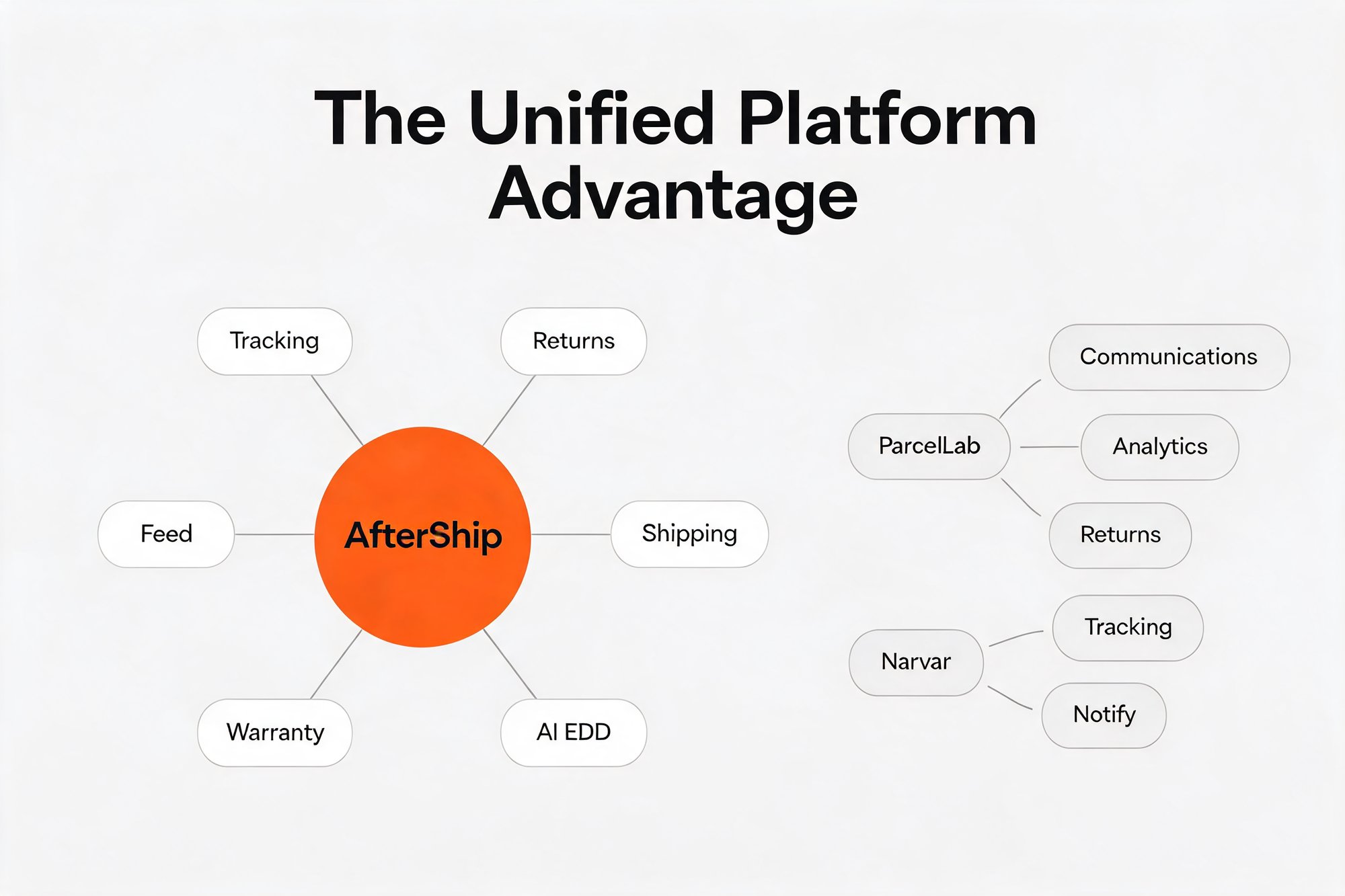
If your goal is to own the entire post-purchase experience rather than integrate four vendors, the unified model is the one that compounds in your favor as you add products. It is the difference between bolting point tools together and building a unified customer experience across the order lifecycle.
Proactive shipment tracking that delights your customers, reduces WISMO tickets, and optimizes your delivery performance.
Book a demoBeyond the Features: Integrations, Support, & Scalability
Features get demoed; integrations, support, and carrier coverage get lived with. Three areas decide whether a platform actually fits your stack and your team.
- Tech stack integration depth. AfterShip is Built for Shopify certified (February 2026), Shopify's highest app tier, and Narvar is not. In practice that means native Checkout extensibility, Customer Accounts, Shopify Flow, POS for in-store returns, Payments-native exchanges, a Store Credit API, a no-code EDD widget, and Apple Wallet tracking. AfterShip tracking data also syncs back onto the native Shopify order, so the Order Status page and the Shop app reflect it. Narvar typically renders tracking on narvar.com with a "Powered by Narvar" mark. Narvar does carry a longer enterprise Shopify Plus history (brands like Gap and Levi's), which is a real trust signal, but it is a historical one. Current integration depth is what your team touches daily, and brands including Mejuri, Aetrex, Away Travel, and Dr. Squatch moved from Narvar to AfterShip for exactly that.
- Implementation and support. AfterShip mid-market plans include dedicated onboarding, a CSM, and a Solutions Architect during setup. Once configured, your brand owns the day-to-day, which realistically looks like one ops associate spending two to four hours a week. That is a different model from ParcelLab's managed or agency approach, where the vendor runs changes for you, and from Narvar's enterprise professional-services queue, where changes route through their team.
- Global carrier scalability. AfterShip connects 1,300+ carriers (1,321 on the Tracking page, with roughly 50 added monthly) and holds UPU Consultative Committee access. It connects them through web-crawl and standardized-parser infrastructure, so you do not supply carrier credentials. Narvar advertises 1,000+ but its effective coverage in deals runs closer to 300, and it requires you to provide your own carrier accounts, which adds onboarding friction. One honest caveat: tier-3 regional carriers in Southeast Asia and Latin America have inherently less consistent event frequency across the whole industry. AfterShip's edge there is wider coverage (fewer "carrier not supported" gaps) plus AI standardization across 45+ sub-statuses. If you ship heavy regional volume, test your specific carrier mix before you commit. And if you run a 3PL-heavy operation, this is where your choice impacts your 3PL partners too.
One number to keep straight, because vendors blur it: 1,300+ is the read-only tracking integrations on AfterShip Tracking. The 130+ figure is the label-generation carriers on AfterShip Shipping. They are different capabilities, so never let a comparison conflate them.
The ROI Conversation: Pricing Models & TCO
Lead your ROI case with risk, not features, because the most expensive thing about Narvar is not its sticker price. It is the lock-in. Narvar has no public pricing and a sales-led motion, runs two-to-three-year contracts, and public pricing sources put its base plan around $30K to $45K per year. Core modern capabilities (AI EDD via Promise, fraud via Assist, shipping protection via Secure) are paid add-ons on top of that base.
The renewal true-up is the trap that catches finance teams off guard. Order-volume overages are typically absorbed during the term, then the contract is repriced to your actual volume at renewal, so the number jumps. By then your Gorgias macros, Klaviyo flows, and internal processes are all built around Narvar, which is what makes "expensive to exit" a real cost rather than a talking point. There is also a cross-sell tax: adding Returns (Shield) to a Tracking deal typically lifts ARR by 60% to 80% of the Tracking line before any discount, and that pattern compounds with each add-on. For a line-by-line view of the two stacks, see our deep-dive comparison against Narvar.
Now AfterShip, honestly. The pricing is transparent (published tiers and overage rates) but it is multi-product, not a single line. Tracking and Returns are billed separately, and Shipping, Intelligence, and Protection each add their own line item. A realistic figure for Tracking plus Returns at published rates, including overage, lands around $12K to $20K per year, helped by a 25% first-year bundle discount for two or more products, and that is materially below the equivalent Narvar scope. Above roughly $10M GMV you should request an Enterprise quote. And because each product bills independently, cancelling Tracking does not cancel Returns. Transparent is not the same as simple, so do the math for your own volume.
The payoff: Inspire Uplift cut "Where Is My Order?" tickets by up to 75% after deploying AfterShip Tracking (Source: Inspire Uplift case study, aftership.com/customers/inspire-uplift).
That is the TCO story in one line: a lower, published, self-right-sizing cost base, against a model where the bill grows quietly with your volume and your switching cost grows with it.
The Final Verdict
There is no universally correct answer here, only the right answer for your brand, your team, and your next three years. The mistake is choosing a philosophy that fights how your team actually works. For an outside gut-check, G2's verified reviews put AfterShip at 4.7 out of 5 against Narvar's 4.3.
Before you sign: match the platform to your operating model, not to a logo roster. Picking a managed service when you want control, or a self-serve platform when you have no one to run it, is how good budgets turn into shelfware.
Choose Narvar if you are a large, risk-averse enterprise where stability outweighs innovation speed, you mainly need dependable, well-established tracking, and you can absorb opaque, sales-led pricing and multi-year terms with renewal repricing. For that buyer, the safe, familiar choice is a defensible one.
Choose ParcelLab if you have a significant customer-experience budget, you want to fully outsource post-purchase communications design to a hands-on team, and you value bespoke communications orchestration over day-to-day operational agility. Go in clear-eyed that the model scales with professional-services fees and that quick changes route through their queue, which is a real constraint at peak season or during a fast policy update.
Choose AfterShip if you are a growing mid-market DTC brand that wants a single unified platform to own the entire post-purchase experience, use AI and data to cut costs, and future-proof your operations. The one condition: you have, or will build, the lean internal resource (think one ops associate, a few hours a week) to run a self-serve platform. Meet that condition, and AfterShip is the smartest, most future-proof bet of the three.
A Note on Migration
Migration anxiety is the number-one reason teams delay a decision they have already made. So let's defuse it with a real timeline, not a sales promise.
For a $15M to $50M GMV brand, plan on four to six weeks end to end. A small DTC store can switch in hours to days; a complex enterprise can run six to ten weeks. The phases break down cleanly:
- Weeks 1 to 2, discovery and connections. Connect your platform, carriers, helpdesk, and marketing tools. AfterShip Tracking needs no carrier credentials from you, and you rebuild your Gorgias macros and Klaviyo flows against AfterShip URLs and webhooks using templates.
- Weeks 2 to 3, configuration. Build the tracking page in the drag-and-drop editor, set up 5 to 10 notification triggers, and configure your Returns rules. Returns is the most time-intensive piece, roughly 3 to 5 business days for a complex policy. Drop in the no-code EDD widget.
- Weeks 3 to 4, testing and parallel run. Run both systems side by side for 5 to 10 business days to validate data and notifications before you commit traffic.
- Weeks 4 to 6, cutover. Put 301 redirects in place, train your CX team, monitor WISMO closely, and decommission the old tool.
Compare that to a Narvar enterprise implementation, which commonly runs 6 to 8 weeks and can stretch to six months, bottlenecked by their professional-services queue. The proof that switching works is in the switchers: Mejuri consolidated a five-platform stack down to two on AfterShip and, during a carrier strike, redirected return volumes in about five minutes without a vendor call. Aetrex described onboarding as exceptionally smooth and flexible. Ashley Stewart moved from Narvar to AfterShip at roughly half the cost.
Reframe the risk before you present. The bigger risk is not switching. It is locking into another two-to-three-year contract while your competitors modernize their post-purchase operations around you.
Frequently Asked Questions
A few questions come up in nearly every "aftership vs narvar vs parcellab" evaluation. Here are direct answers you can take into your recommendation.
Frequently Asked Questions
How do AfterShip's AI capabilities compare to Narvar's?
AfterShip's AI EDD is trained on 10B+ shipments and delivers roughly 90% first-prediction accuracy at 80%+ shipment coverage, about three times typical carrier-native estimates. Accuracy is strongest on domestic and established US, Canada, and EU lanes and more variable on emerging-market international routes. It is included in core Tracking, whereas Narvar's Promise EDD is a paid add-on built on a narrower coverage base.
Which platform offers the best Shopify Plus integration?
AfterShip is Built for Shopify certified (February 2026), Shopify's highest app tier, with native Checkout extensibility, Customer Accounts, Shopify Flow, POS for in-store returns, and Payments-native exchanges. Narvar has a longer enterprise Shopify Plus history but is not Built for Shopify certified, and its tracking pages typically render on narvar.com rather than syncing back to the native Shopify order.
What is the typical implementation timeline for a mid-market brand?
For a $15M to $50M GMV brand, expect four to six weeks end to end with a dedicated Solutions Architect and CSM. Returns configuration is the most time-intensive step. A Narvar enterprise implementation commonly runs six to eight weeks and can extend to six months.
Is AfterShip's pricing really transparent?
Yes. AfterShip publishes its tiers and overage rates, unlike Narvar's sales-led, quote-only model. The honest caveat is that pricing is multi-product: Tracking, Returns, and add-ons like Shipping and Protection are separate line items, so transparent does not mean single-line. Do the math for your own order volume.