
AfterShip vs Loop Returns: The Honest Verdict for Shopify Returns Managers


The Short Answer: When to Choose AfterShip vs. Loop Returns
You've narrowed your returns platform search to two of the biggest names in the Shopify ecosystem: AfterShip and Loop. Loop is a returns-first solution built for Shopify. AfterShip is a longstanding full post-purchase platform with market-leading carrier coverage, built for brands at scale across Shopify and other eCommerce platforms. Choosing the right one isn't just about features, it's about deciding what kind of business you're building.
The table below gives you the four-line verdict. Read it first, then read why.
| Criteria | AfterShip Returns | Loop Returns |
|---|---|---|
| Best For | Scaling brands optimizing the whole post-purchase journey, from SMB to enterprise | Earlier-stage brands with less operational complexity, especially Shopify apparel and lifestyle |
| Core Strength | Unified post-purchase platform across tracking, shipping, returns, warranty and more, connected by over a decade of data to reduce returns at the source | Simple, Shopify-native setup with intuitive, automation-friendly returns workflows |
| Scalability | • Market leader with 1,300+ global shipping carrier integrations • Built for Shopify certified, Shopify Plus partner, and compatible with 30+ eCommerce platforms • Over a decade of carrier and shipment data powering cross-product insights • Built for operational complexity, offering bundles, multi-brand orgs, multi-warehouse, and custom-coded discounts | • 180 global shipping carrier integrations • Tailored to Shopify, but not Built for Shopify certified |
| Pricing Model | • Return Care: free software and return shipping, customer pays an upfront fee at checkout • Essentials plan starting at $16/mo | • Checkout+: free software and return shipping, customer pays an upfront fee at checkout • Essential plan starting at $155/mo |
Loop can be a great choice for earlier-stage eCommerce brands with lower operational complexity, looking for streamlined returns management. AfterShip is the stronger long-term bet when returns are one piece of a post-purchase journey you intend to grow. It delivers a more mature tracking platform, better shopper communication, and data insights across the full post-purchase journey to reduce unnecessary returns at the source, not just process them once they've happened.
Check out AfterShip's detailed comparison page for a deeper breakdown. Both apps hold a 4.7 rating on the Shopify App Store, with AfterShip Returns Center carrying the Built for Shopify badge and 1,200+ reviews, and Loop having 400+ reviews. This isn't a quality comparison, it's a fit decision.
It's Not Just Features, It's a Different Philosophy
The most useful way to frame this choice isn't feature by feature. It's philosophy. If you're earlier in your search, start with our primer on choosing the right returns software.
While AfterShip and Loop offer similar returns capabilities for smaller and less complex DTC brands, growing brands consistently report that Loop quickly becomes expensive at scale, and struggles to support complex business logic. AfterShip has been carefully tailored alongside Enterprise brands to support their operational needs, from multi-warehouse logic to native support for bundle returns, multi-label, automatic language translation, custom-coded discounts and more.
And differences in AfterShip and Loop's returns management solutions are only one piece of a larger puzzle. While Loop now offers tracking in addition to returns, through the acquisition of Wonderment in 2024, AfterShip has nearly a decade in-market as a complete post-purchase solution, inclusive of tracking, returns, shipping, warranty and post-purchase intelligence in one stack. What that means for your team:
- One account, one dashboard, less switching between disparate tools and systems.
- A single contract or bundled pricing so you save on platform fees.
- A unified data layer across the full post-purchase experience, with intelligence that brings top insights and automation opportunities to the forefront.
Here's what a unified post-purchase experience looks like on a Tuesday morning. When a customer's order runs late, your tracking data already knows. When that late delivery turns into a return, AfterShip's policy logic can read the verified carrier delivery date instead of the order date, so the eligibility window is right the first time. On a point solution, that context lives in a separate tool, a spreadsheet, or your support inbox. The platform difference isn't abstract. It's fewer places to look.
While a dedicated point solution for returns or tracking solves one problem cleanly, a full post-purchase platform solves the problems you have today plus the ones you'll inherit once you scale, expand internationally, or add channels.
So the real decision isn't "which has more features." It's this: do you want to solve returns well, or build a foundation for your entire post-purchase experience? Hold that question. The feature matrix below only matters once you've answered it.
Head-to-Head: AfterShip vs. Loop Returns Feature Breakdown
Here's where the philosophy meets the spreadsheet. The matrix compares the two platforms on the criteria an operations lead actually evaluates: the customer returns experience, the automation engine, carrier and logistics depth, Shopify integration, the wider platform, and total cost as you scale.
| Criteria | AfterShip Returns | Loop Returns | The Verdict |
|---|---|---|---|
| Returns Portal & Experience | In-app and on-store exchanges, any-product exchange via Shop Now, instant exchanges, AI-powered exchange recommendations, refund-to-store-credit plus bonus credit; 3+ resolution options correlate with 30%+ revenue retention across 1,400+ merchants | Shop Now, Bonus Credit, and Instant Exchange (ships before the item is received) | Loop for instant exchange specifically; AfterShip for the wider set of resolution paths and store-credit incentives |
| Automation & Rules Engine | Condition-and-action engine, up to 50 conditions; tier-gated routing, Green Returns, VIP, auto-refund, fraud management, webhooks, and Returns API | Automation plus Fraud Tools 2.0 | AfterShip for no-code rule depth; fraud is present on both |
| Carrier Management & Logistics | 68-carrier returns pool, pre-negotiated rates bundled on every tier (save up to 91%), BYO accounts supported; box-free drop-off via ~10,000 Happy Returns Bars | Ship by Loop runs on EasyPost rates, or bring your own carrier | AfterShip for carrier depth and bundled rates |
| Shopify Integration | Order sync, Shopify POS for in-store returns, Shopify Store Credit API, conditional workflows | Shopify POS (in beta), Flow, Checkout, and native Shopify store credit (March 2026) | Parity on the basics; AfterShip adds Store Credit API depth and more mature omnichannel and conditional workflows |
| Platform & Ecosystem | Returns, Tracking, Shipping, AI EDD, Warranty, and Protection on one shared data layer; return windows anchor to verified delivery events; AI EDD 80%+ coverage at up to 95% first-prediction | Returns plus Wonderment tracking as separate products, with a >90% EDD marketing claim | AfterShip for single-layer unification |
| Scalability & Pricing | Volume-tiered: Essentials $16, Premium $99 per month (annual), Enterprise custom; per-return overage above plan limits; Return Care available as a pay-at-checkout alternative | Flat monthly from $155, no published per-return overage; Checkout+ available as a pay-at-checkout alternative | AfterShip is cheaper on self-serve and, with Return Care, delivers enterprise-grade returns at a lower total cost than Loop's Checkout+ model, and beyond returns, a lower total cost of ownership across your full post-purchase stack |
Read the matrix and a pattern emerges. On the core returns workflow the two are close to parity, and both are quality tools, though AfterShip carries roughly 3× Loop's Shopify review volume and the Built for Shopify badge. AfterShip pulls ahead where scale lives: a 68-carrier returns pool with pre-negotiated rates on every tier, deeper automation, and a unified platform that Loop's two-product stack cannot match. Where you land in that trade-off is the heart of the AfterShip vs Loop Returns decision, and the rest of this guide walks each row in detail.
The Customer Returns Experience
The returns portal is the one part of your returns operation the customer actually sees. In the AfterShip vs Loop Returns comparison, both platforms handle it well, so the real question is what each one lets the customer do once they land there.
AfterShip's portal is fully brandable and built around keeping revenue in the store. Customers can run in-app and on-store exchanges, swap into any product in your catalog through Shop Now, accept a refund as store credit with a bonus-credit incentive, or accept an AI-powered exchange recommendation that surfaces the right swap at the right moment. Every one of those is a path that ends in retained or even incremental revenue instead of a full refund.
The logic is simple: the more resolution paths you offer, the more refund revenue you keep. AfterShip's own returns data backs it up. Merchants offering three or more resolution options retain more than 30% of would-be-refund revenue, measured across 1,400+ merchants.
Automation & Operational Efficiency
This is the half the customer never sees and the Ops Manager lives in all day.
AfterShip runs returns on conditional workflows, which is AfterShip's own rules engine, not a wrapper around a Shopify Flow connector. You can chain up to 50 conditions in a single rule, including country or region, product type, return reason, resolution type, order tag, customer tag, order value, and warehouse. That's enough logic to encode the policy your team currently keeps in someone's head.
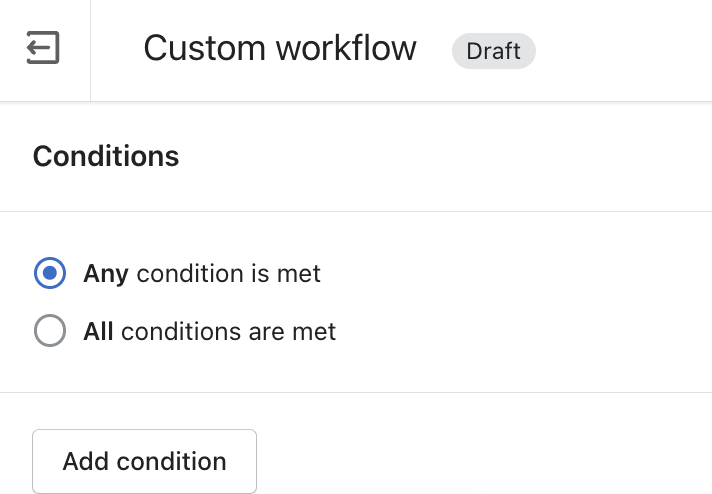
What you can automate scales with your plan:
- Essentials and above: warehouse routing, Green Returns (refund without requiring the item back), and VIP auto-approve.
- Premium and above: auto-refund, auto-mark-received, Return Fraud Management, and webhooks.
- Enterprise: the full Returns API.
The piece that matters most for a growing operation is the 3PL link. AfterShip has native two-way integration with ShipBob and ShipHero, so RMA, ASN, receipt, and restock events flow both directions automatically. An approved return updates your inventory without anyone re-keying it into a second system.
For a team drowning in manual approvals and copy-paste, this is where the hours come back.
Beyond Returns: The Post-Purchase Ecosystem Advantage
This is the difference that never shows up as a checkbox in a feature list.
AfterShip Returns reads from the same data layer as AfterShip Tracking. Return-eligibility windows anchor to verified carrier delivery events, not the order-placed date and not a manual override. So a customer whose order arrived ten days late gets a return window that starts when the box actually landed, not when they clicked buy.
Because returns data and shipment data live on one layer, you can analyze return reasons against carrier on-time performance, for example asking which carrier drives more damage-related returns. That is an analytical capability you unlock, not a single canned report you click. The value is in being able to ask the question at all.
AI delivery estimates sit on the same foundation. AfterShip's AI EDD runs natively across Tracking and Returns with 80%+ shipment coverage, roughly three times the under-40% coverage typical of carrier-provided estimates, at up to 95% first-prediction accuracy backed by over a decade of shipment and carrier data.
Here's the honest framing. Loop has tracking through its Wonderment acquisition and markets a delivery promise above 90%, so this is not "Loop has no delivery estimates." The advantage of AfterShip's complete post-purchase suite is having returns, tracking, and EDD on one stack with native single-layer integration, rather than stitched across two separate products.
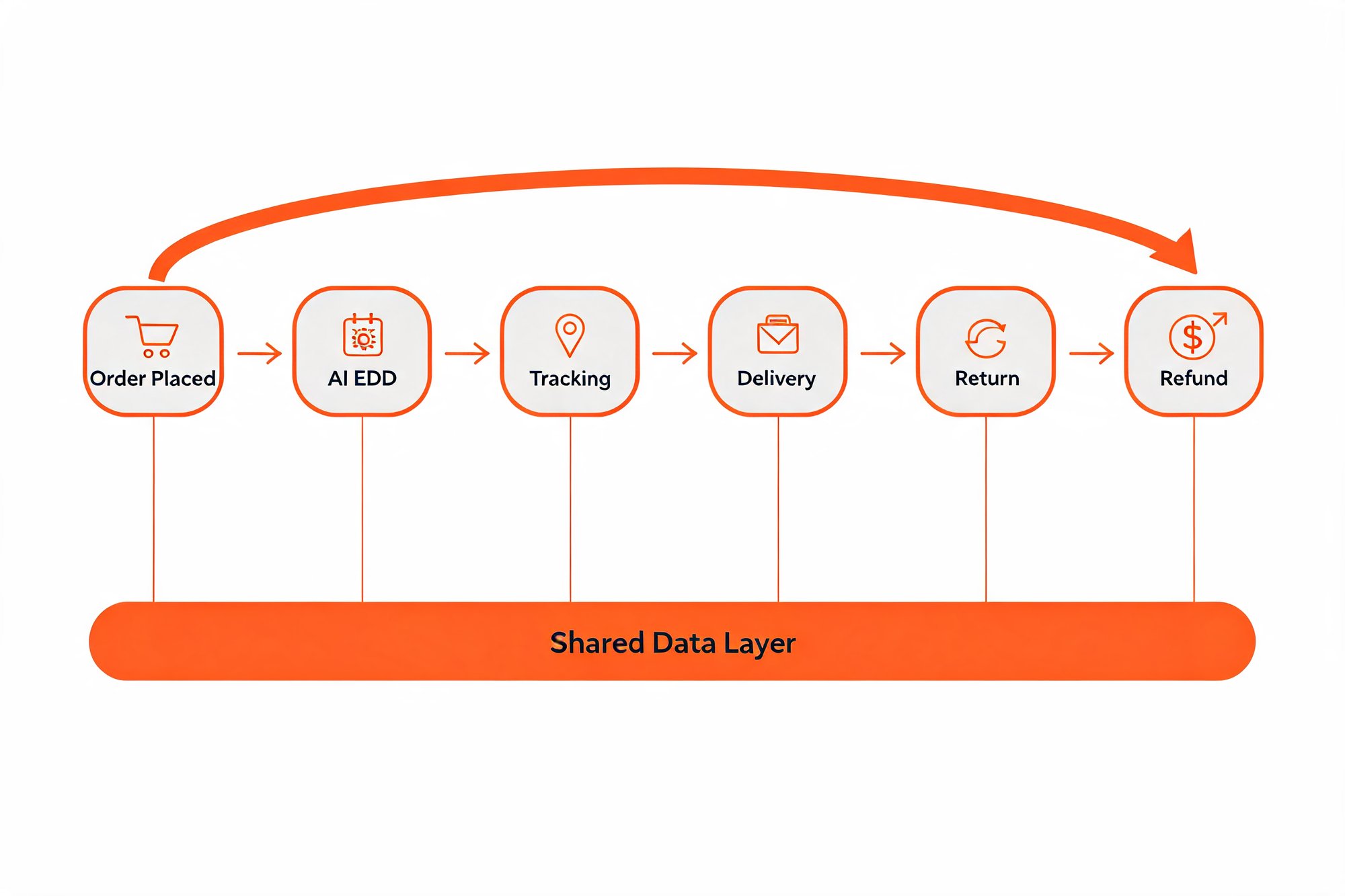
If returns are the only problem you are solving, this layer is invisible and you won't miss it. The day you start asking why your returns happen, and how to prevent them, it becomes the whole point.
Which is Better for Your Shopify Tech Stack?
If you run on Shopify, start with the good news: you can't really go wrong on the basics. Both AfterShip and Loop integrate deeply with Shopify. They sync orders and customer accounts, support in-store returns through Shopify POS, and connect to the tools you already run like Gorgias and Klaviyo. AfterShip Returns, in particular, connects seamlessly with your Shopify store. Both also support Shopify store credit.
If your stack is Shopify and nothing else, integration depth probably won't be your deciding factor. The difference shows up the moment you look past Shopify.
AfterShip's real edge is reach. It runs natively across a wider set of 30+ platforms including Shopify, BigCommerce, Wix, WooCommerce, Magento, and Salesforce Commerce Cloud.
Pair that with a deeper carrier and 3PL library, and you get a returns layer that travels with you when you replatform, add a second storefront, or expand into a market a Shopify-only tool can't follow you into. Loop is excellent on Shopify. AfterShip is built to outlast any single platform.
The Honest Verdict for 2026
For an early-stage apparel or lifestyle brand that lives entirely on Shopify and wants a simple, focused returns app, Loop is a reasonable choice. Onboarding is quick, the workflows are intuitive, and the automation handles the basics well. If a lightweight, single-purpose returns tool is all you need right now, that focus is a real advantage.
For everyone else, from SMB to mid-market to enterprise, AfterShip is the clear strategic choice. Instead of stitching three separate tools together as you grow, you get one platform that scales with you, so post-purchase never becomes overwhelming. Returns, tracking, shipping, and AI delivery estimates run on one data layer, and AfterShip is actively pushing that stack toward an AI- and agentic-driven post-purchase future. You are not buying a returns tool. You are buying the foundation the rest of your post-purchase operation will stand on.
This was never about being the cheaper option. It is about what you get for the money, and the clearest evidence is the operational outcome brands report after they switch.
“It's just so easy and effortless for me to check in on things and work with the returns portal. I don't have to worry about it anymore.”
Nikolas Callas, Senior Director of eCommerce
Read their story →The migration signal points the same way. Capterra carries verified Loop-to-AfterShip reviews from 2026, with switchers naming pricing and customer support as the reasons they moved.
So as you close out your AfterShip vs Loop Returns decision, the choice resolves cleanly. Pick Loop if you want a simple, Shopify-first returns app with clean onboarding and intuitive, automation-friendly workflows. Pick AfterShip to keep revenue in-house and build a post-purchase platform that scales with you.
Returns automation that enhances the returns and exchanges experience, reduces costs, and retains more revenue.
Book a demoFrequently Asked Questions
Is AfterShip or Loop Returns better for Shopify?
It depends on your goals. Loop suits early-stage, Shopify-only apparel and lifestyle brands that want a simple, focused returns app. AfterShip suits brands that plan to scale, sell on more than one platform, or run the whole post-purchase journey on one platform, connected by an intelligent data layer to help deepen automation and insights.
How do AfterShip and Loop Returns pricing compare?
AfterShip Returns is volume-tiered with per-return overage, from $16 a month (Essentials, annual) to custom Enterprise. Loop is flat monthly from $155 with no published overage. Both also offer a pay-at-checkout model, AfterShip's Return Care and Loop's Checkout+, but AfterShip is cheaper on self-serve and, with Return Care, delivers enterprise-grade returns at a lower total cost than Loop's flat rate.
Which platform offers more returns automation?
AfterShip runs a conditional-workflow engine with up to 50 conditions and tiered actions like routing, Green Returns, auto-refund, and fraud management. Loop also automates returns and adds fraud tooling on Advanced. AfterShip offers deeper no-code rules.