
AfterShip vs. Competitors: Enterprise Tracking on Price & Speed


Beyond the Dashboard: The Two KPIs That Define Enterprise Tracking ROI
Your tracking contract is up for renewal, and the quote came in higher than last year. Before you sign, two numbers deserve more scrutiny than the sticker price: how fast your tracking data actually moves, and how predictable that bill stays as your volume grows.
Most enterprise package tracking systems demo well. They show a clean dashboard, a branded tracking page, and a carrier list as long as your arm. The dashboard is the easy part. The return on a tracking platform is decided by two operational KPIs that rarely make it into the sales deck.
The first is data speed and reliability. When a carrier scans a parcel, how long until that status reaches your customer, your CX team, and your systems? Latency here is not a technical footnote. Slow or unreliable data drives WISMO ("where is my order?") tickets, and every ticket carries a real support cost.
The second is pricing predictability and TCO. Total cost of ownership is more than the annual license. It includes overage exposure, paid add-on modules, services fees, and the support headcount you need when data quality slips. A model that looks cheap per shipment can become the least predictable line in your budget.
For a logistics leader building a case for a VP or CFO, those two KPIs are the whole argument. Speed protects your customer experience and your support budget. Predictable pricing protects your forecast.
How Tracking Data Speed Is Measured (and Why It Matters)
Data latency is the lag between a carrier event and the moment that event reaches you. There are three common ways a platform gets that data, and they are not equally fast.
The first is a direct API and webhook connection, where the carrier pushes each event to the platform and the platform pushes it on to you. The second is a standardized feed, where data is collected and normalized on a schedule. The third is scraping, where a public tracking page is read and parsed. Push beats poll, and a scheduled feed beats nothing, but only direct push gives you near-real-time status.
AfterShip delivers instant delivery status updates via webhook, so there is no polling delay between a carrier scan and the update your customer sees. That speed sits on a 99.9% monthly uptime SLA, backed by a 10% service-credit remedy if it is missed, with marketed uptime of 99.99%+ for the multi-carrier tracking API. For an enterprise buyer, the SLA matters as much as the speed: it is a contractual commitment, not a marketing line.
Here is why latency lands on your P&L, not just your dashboard.
The hidden cost of slow tracking data
WISMO inquiries account for 10-25% of all support contacts, at roughly $4-$12 each to resolve. And nearly 70% of shoppers are less likely to buy again after a delayed delivery when they aren't kept informed. Slow data inflates both numbers at once: more tickets today, fewer repeat customers tomorrow.
That is the link the sticker price hides. Faster, more reliable data is not a feature you admire on a demo. It is a lever on support cost and customer retention, and it belongs in the same business case as the license fee. You can run the same speed-and-reliability test against other leading platforms like ParcelLab before you commit.
Comparison: AfterShip vs Narvar on Data Speed & Carrier Network Depth
On the two axes that decide data quality, carrier network depth and how updates reach you, here is how AfterShip and Narvar line up.
| Criteria | AfterShip | Narvar |
|---|---|---|
| Carrier network depth | 1,323 carriers (1,300+), majors connected directly | 1,000+ carriers (marketed/peer figure) |
| Data speed & update method | Instant webhook push; 99.9% uptime SLA (10% service credit); 99.99%+ marketed | Real-time webhook updates |
| Data source quality | Direct carrier agreements, including the USPS direct partnership | Standardized multi-carrier data; merchants typically provide their own carrier accounts |
| Global reach / cross-border | Broad global and cross-border coverage | Strongest in US-centric enterprise retail |
| Pricing model & TCO | Tiered, predictable, published model | Volume-based, quote-only; core capabilities as separate paid add-on modules; renewal true-ups |
Carrier depth is the clearest gap. AfterShip connects a network of 1,323 carriers (1,300+ in round terms), while Narvar markets a network of 1,000+ carriers. Both counts cover the major global players, and both platforms support real-time webhook events, so this is a comparison between two serious enterprise options, not a mismatch.
Depth only helps if the data is trustworthy at the source. AfterShip holds a direct partnership agreement with USPS that keeps that carrier's tracking data flowing without interruption, and connects directly to the other majors such as UPS, FedEx, and DHL. Across the long tail of regional and last-mile carriers, it uses the broadest practical mix of connection methods rather than a single approach.
For a global or cross-border operation, that combination of carrier depth and direct, contractually backed data access is what keeps WISMO down and forecasts intact. On data speed and network depth, AfterShip is the more reliable foundation for an enterprise package tracking system.
Unpacking Enterprise Pricing Models: Why Per-Shipment Costs Lie
The speed case protects your customer experience. The pricing case protects your forecast, and it is the one most enterprise buyers get wrong.
A headline per-shipment rate is the most quoted number in a tracking deal and the least useful. It tells you almost nothing about what you will actually pay at renewal. Two models dominate this market, and they behave very differently as you scale.
A tiered model bundles a committed volume into a fixed fee, then charges a flat, published rate for anything over it. You can see the overage rate before you sign, and you can forecast against it. A volume-based model prices on usage and is usually quote-only, so the real number arrives after a sales cycle and moves with your volume.
The reason per-shipment costs lie is that the headline rate is rarely the whole invoice. Core capabilities can sit behind separate paid modules. Services and onboarding add a percentage on top. Overages can be trued-up at renewal rather than billed as you go, so the bill you forecast and the bill you renew are different documents.
Before you compare any two vendors on price, pin down the parts of the model that never appear on the rate card.
⚠️ Questions to ask any tracking vendor before you sign
- Overage charges: What is the rate for shipments above my committed volume, and is it published or quote-only?
- Carrier-ping / per-carrier charges: Am I billed to add a new carrier mid-contract, or per tracking request?
- Peak surcharges: Does my rate change during Q4 or other peak periods?
- Paid add-ons: Which capabilities I consider core are actually separate line items?
- True-ups: If my volume grows during the term, is the difference billed now or corrected at renewal?
Ask those five questions and the option that looked cheapest per shipment often stops being the cheapest.
Price & TCO Showdown: AfterShip vs Narvar
On total cost of ownership, the deciding factor is not the rate, it is how predictable the model stays as you grow.
“It only took 1-2 weeks for our engineers to implement it.”
Habib-Sylvain Gourguet, Director of Customer Relationship
Read their story →AfterShip uses a tiered, published model, as major marketplaces like Rakuten France discovered when consolidating dozens of couriers onto one platform. Pricing is transparent enough to right-size before you talk to sales: the same tiers are visible across channels, for example direct list pricing of roughly $29 and $59 per month versus $11 and $70 on the app-store channel, with a flat published overage rate and quota alerts so a spike never becomes a surprise. The point is not the sticker number, which can change. The point is that you can see it and plan around it.
Narvar runs a volume-based, quote-only model. Core capabilities that many buyers treat as table stakes, such as AI estimated delivery (Promise), fraud (Assist), and API access, are packaged as separate paid add-on ARR lines, and order-volume overages are typically trued-up at renewal rather than billed in-term. Each of those choices is defensible on its own. Together they make the total harder to forecast, which is the part a CFO feels.
For an enterprise weighing TCO rather than sticker price, a predictable, published model is the lower-risk choice. AfterShip is built to be forecast; a quote-only, add-on-driven model has to be re-priced every time you grow.
Beyond Tracking: Leveraging Your Data with AfterShip Intelligence
Every tracking event you pay for is also a data point about how your carriers actually perform. Most platforms use it once, to fire a notification, then discard the signal. AfterShip Intelligence turns that same stream into carrier-performance analysis you can act on.
AfterShip Tracking Analytics gives operations teams a set of dashboards built for exactly this. On-time shows delivery reliability against promised dates. Transit time breaks down how long shipments actually take by carrier and lane. Exceptions surfaces where parcels stall, fail, or get misrouted. Benchmarks rates your performance against industry percentiles, so you know whether a 4-day average is strong or quietly costing you repeat customers.
That data earns its keep when it changes a routing decision. On a marketplace like Rakuten France, sellers can compare a courier's delivery performance side by side, and AfterShip recommends courier services based on delivery time and shipping performance. Shipment Alerts flag anomalies before they become a wave of WISMO tickets.
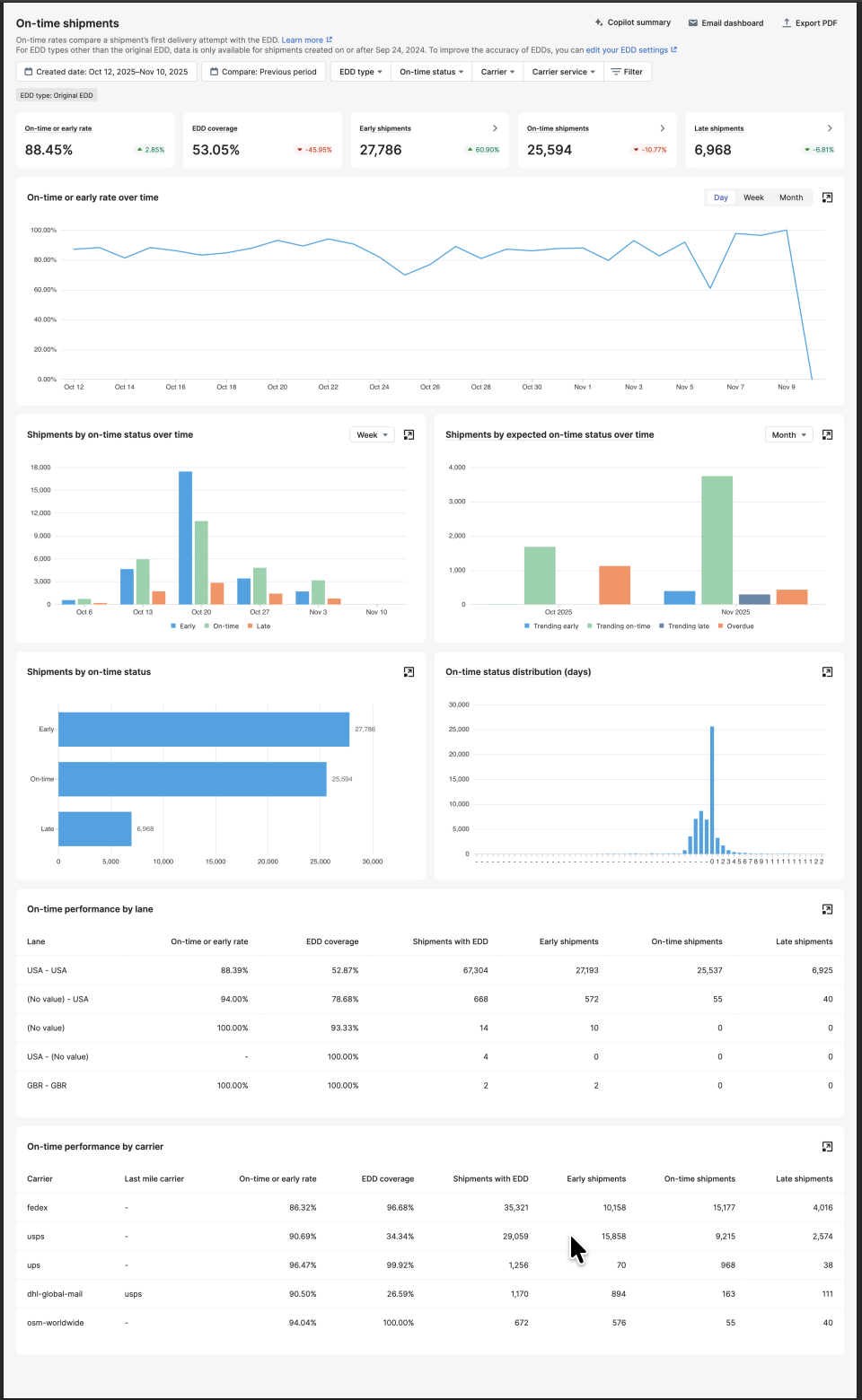
The takeaway is simple. The tracking data already on your invoice can tell you which carriers to trust and which to drop. That is analysis, not just visibility.
Making the Right Choice for Your 2026 Growth Strategy
There is a real case for staying with a single, established provider. One vendor, one contract, and a relationship you already know is genuinely simpler than running a fresh evaluation, and that simplicity has value. So be honest about what you would be trading for it.
For a global or cross-border enterprise with high shipment volume, a complex multi-carrier mix, or multi-warehouse operations, AfterShip is the stronger 2026 choice. The argument is the one this comparison has built: deeper carrier coverage at 1,323 carriers, instant webhook data on a 99.9% SLA, and a predictable, published pricing model that protects your TCO as you scale. That enterprise reliability is well documented, including at a leading supply chain visibility provider that runs on the platform.
Narvar remains a credible option, and it is fair to say where. Its genuine edge is incumbency: long-standing Tier-1 US enterprise-retail relationships and the brand prestige that comes with them. For a US-centric, non-Shopify retailer running post-purchase inside a Salesforce Service Cloud, Kustomer, or Gladly agent workspace, that established footprint carries real weight.
Narvar's Connect and Care embed is real. Kustomer's own press release documents a Narvar app that surfaces real-time shipping status inside the Kustomer agent view. The point worth correcting is that this is closer to parity than a Narvar moat. AfterShip integrates with the same helpdesks through its own connectors, including Kustomer, Gladly, Salesforce, Zendesk, and Gorgias. Evaluate the depth of the integration for your specific helpdesk rather than assuming it lives on only one side.
The decision is not really about a single feature. It is whether you want a platform built for carrier depth, data speed, and predictable cost as you grow.
Proactive shipment tracking that delights your customers, reduces WISMO tickets, and optimizes your delivery performance.
Book a demoEnterprise Tracking FAQ
What are AfterShip's API rate limits for enterprise tracking?
The default tracking API rate limit is 10 requests per second per account, and requests beyond it return a 429 response. For enterprise accounts, that limit is raised through your account manager. Because the cap is per second rather than per day, design around bulk import and webhooks instead of tight polling loops.
Does AfterShip support multi-warehouse and multi-origin tracking?
Yes. AfterShip is carrier- and origin-agnostic, so shipments from every warehouse or origin appear in one dashboard. There is no per-warehouse connection limit, and you can segment shipments by tag or order attribute to view performance by location.
Is AfterShip compliant with enterprise security standards?
AfterShip Tracking holds SOC 2 Type II, ISO 27001, and GDPR compliance. Access is governed by role-based access control (RBAC), with AES-256 encryption at rest and TLS 1.2 in transit. HIPAA compliance is not claimed.
How fast does AfterShip deliver tracking updates?
AfterShip pushes delivery status updates instantly by webhook, so there is no polling delay between a carrier scan and the update your customer sees. That speed is backed by a 99.9% monthly uptime SLA with a service-credit remedy, and marketed uptime of 99.99%+ for the multi-carrier tracking API.
Can I buy AfterShip Tracking on its own?
Yes. AfterShip Tracking is sold standalone. The wider suite (Returns, Shipping, Email and SMS, Warranty, Protection, and AI Intelligence) runs on the same platform and data layer and is billed per product, so your total cost reflects only the modules you deploy.