
AfterShip Tracking Alternatives: The 2026 Verdict on Price, Features, and Ease for DTC Brands


Why "Cheaper" Is the Most Expensive Word in Post-Purchase
Your monthly bill for your tracking app seems reasonable, but your Gorgias queue is still overflowing with "Where is my order?" tickets. You're paying for a tool, but you're still paying to solve the problem. Let's talk about the real cost of your post-purchase experience.
The sticker price on a tracking app is the one number that tells you the least. The cost that actually hits your P&L is what we call the Total Cost of Post-Purchase, or TCOP: the subscription fee plus everything a less expensive but less effective tool quietly pushes back onto your team.
That hidden cost shows up in three places. WISMO tickets (short for "where is my order") that your support team answers by hand, one copy-pasted carrier link at a time. Customers who churn after a confusing delivery and never come back, taking their lifetime value with them. And developer hours burned patching brittle carrier integrations that break the week before Black Friday, when you can least afford it.
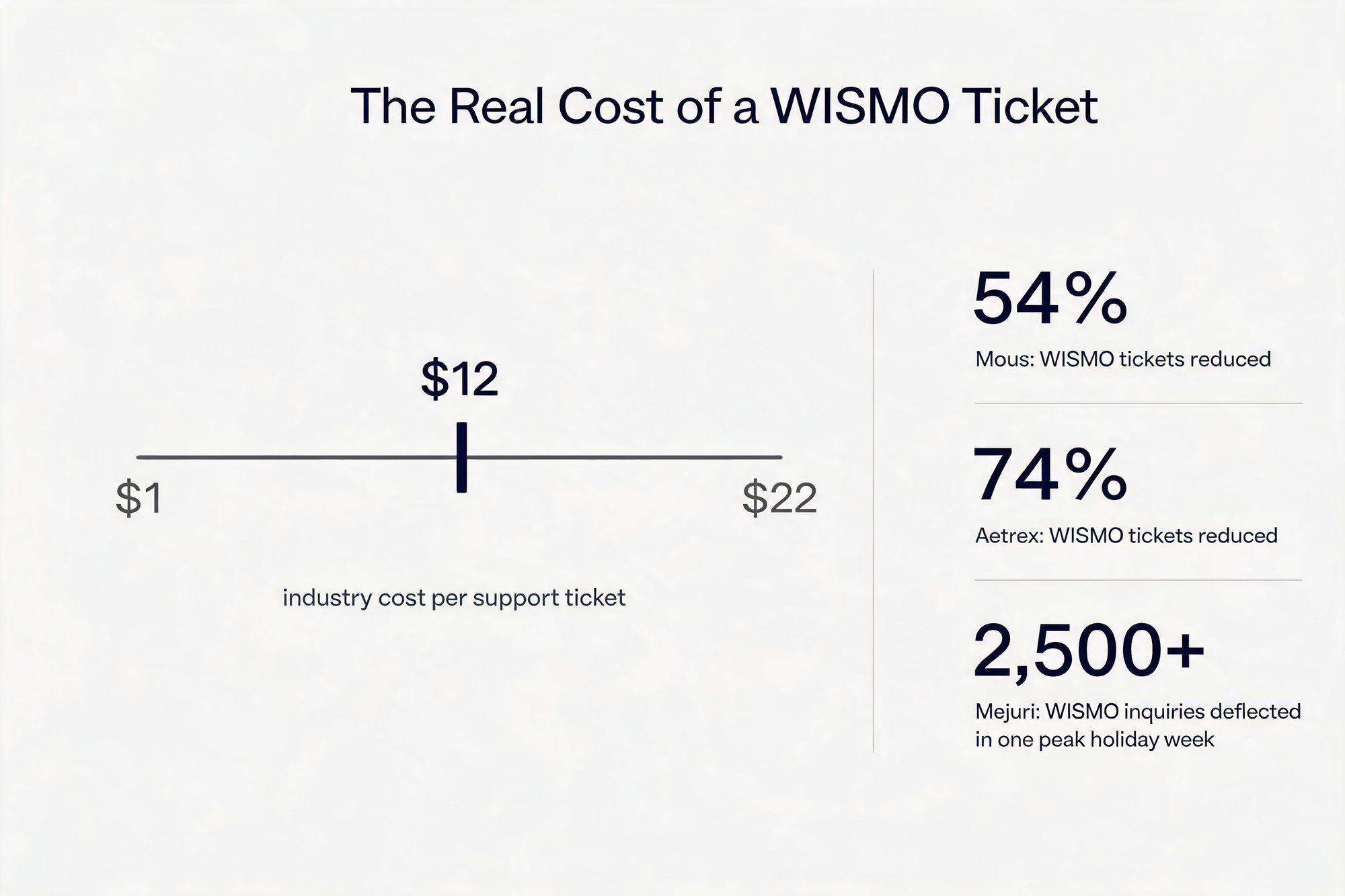
Put a number on the first one. Industry estimates for the fully loaded cost of a single WISMO ticket range from roughly $1 on the low end to $22 on the high end, with a defensible midpoint around $12 once you count agent time and tooling. At a few thousand tickets a month, that line item dwarfs any difference in subscription price, and it scales with your order volume rather than shrinking as you grow.
The math is what makes "cheaper" a trap. A plan that saves a few hundred dollars a month but leaves a large share of your delivery questions in the support inbox is a discount on the software and a surcharge on everything else you run.
Now look at what happens when the tool actually does its job. AfterShip merchants have cut that ticket volume hard: Mous reduced WISMO tickets by 54%, Aetrex cut them by 74%, and during one peak holiday week Mejuri deflected more than 2,500 WISMO inquiries before they ever reached an agent. That is the spread a cheaper plan hides from you.
So the real question is not "which tool is cheapest this month." It is "which tool gives me the lowest total cost over the next two years." Every section below is scored on that basis.
The 2026 Shortlist: AfterShip Alternatives DTC Brands Actually Consider
If you are shortlisting AfterShip alternatives in 2026, four names come up, and each wins attention for a different reason. Knowing what each one is actually best for saves you weeks of demos.
Here is the field, framed by the job each tool is hired to do:
- Narvar is a more enterprise option, built around professional services and large, sales-led deployments. It fits retailers with the budget for a heavy implementation, alongside enterprise-level alternatives like parcelLab.
- Track by Loop is a newer part of the Loop ecosystem, originating from Loop's acquisition of Wonderment in 2024. Wonderment was built for Shopify and Klaviyo-first brands, and is now integrated with 180+ carriers, the majority of which are North America based.
- Redo Order Tracking is also a newer part of the Redo ecosystem, originating from the acquisition of Malomo in 2026, and best fit for smaller brands with less complex tracking needs.
- ParcelWILL (formerly ParcelPanel) is a low-cost Shopify starter, aimed at early-stage stores that want a tracking page live quickly and cheaply.
One name you may be expecting is deliberately missing: ShipStation. ShipStation handles label printing and fulfillment workflows, the steps that happen before a package leaves your warehouse. This comparison focuses on the customer-facing layer that takes over once the label is printed: tracking, notifications, and returns. AfterShip covers that layer end to end, and because the same platform also includes AfterShip Shipping for multi-carrier label workflows, brands that want both layers can run them on one stack instead of stitching two vendors together.
That distinction matters for scope. The comparison that follows weighs tracking-and-post-purchase platforms against each other, where carrier reach alone separates the field. AfterShip connects with 1,300+ carriers, while Track by Loop sits closer to 180, and everything here flows from that gap. If you want to see how the category lines up more broadly, the package tracking software landscape on G2 offers a neutral third-party view.
Head-to-Head: AfterShip vs. The Competition on What Matters
On the criteria that actually drive total cost, AfterShip wins on platform depth and carrier reach, while the alternatives work when it comes to narrower, stage-specific needs.
A useful scorecard includes the factors a scaling operations lead feels every week: true cost, branded-experience control, WISMO prevention, event depth, and whether the tool grows into a platform or stays a point solution.
Two of those rows decide most evaluations. Carrier coverage sets the ceiling on how many of your shipments the tool can even track accurately, which is why the gap between AfterShip's 1,300+ carriers and the roughly 180 that Track by Loop covers matters the moment you ship outside a single domestic lane. Event depth decides how much of your post-purchase messaging you can automate to provide shoppers more visibility and control, thus reducing WISMO tickets, whether you use Klaviyo, another marketing platform, or want to host your notification templates directly in your tracking tool. AfterShip fires 33+ notification triggers through a native Klaviyo integration, with core events like shipped, in transit, delivered, and exception on its Essentials tier and advanced triggers such as estimated-delivery and split-shipment events on Premium. Narvar's native Klaviyo integration runs on a shallower set of roughly 3 to 5 triggers, so the connection is there but the automation surface is narrower.
| Criteria | AfterShip | Narvar | Track by Loop | Redo | ParcelWILL |
|---|---|---|---|---|---|
| True Cost (TCOP) | $ - lowest total cost: mid-range plan, but WISMO deflection and low dev/setup keep the full cost down | $$$ - enterprise quote-only pricing plus paid add-ons (AI EDD via Promise, fraud via Assist) | $$ - two separate subscriptions (Returns + Tracking), each with its own quota and renewal | $$ - $0.08 per tracked order. AI agents, one-click upsell, and other features priced separately | $$ - least expensive plan, but remaining WISMO and manual work raise true cost at scale |
| Branded Experience Control | Full white-label on Premium, custom domain with auto-managed SSL, drag-and-drop editor | Tracking-page edits typically routed through an account manager | Polished tracking page; custom statuses not supported | Branded portal; lighter customization as you scale | Basic branded tracking page |
| WISMO Reduction Potential | 1,300+ carriers, 33+ notification triggers, AI EDD included on Premium | 1,000+ carriers claimed (effective coverage reported lower by third-party reviewers); 3-5 notification triggers; EDD via paid Promise add-on | ~180 carriers; basic + email notifications; EDD on Plus tier only | Malomo tracking is basic with limited carrier coverage; checkout-only EDD | High-level starter tracking |
| Notification & Event Depth | Native, 33+ triggers via Flow Editor (core events on Essentials, advanced triggers on Premium) - also integrated with Attentive, Omnisend and more and offers native templates in-platform | Native on a shallower ~3-5 trigger set | Native by design (Klaviyo-first) | Native by design (Klaviyo-first) | Varies |
| Ease of Setup (Shopify) | One-click install, Built for Shopify certified (Shopify's highest app tier) | Sales-led, services-heavy implementation | Shopify-native setup | Shopify-native setup | Basic Shopify install |
| Platform Scalability | Unified stack: Tracking + Returns + Shipping + AI EDD + Warranty + Protection | Discrete products, each a separate add-on line | Returns + Tracking as separate products | Returns + Malomo tracking; multi-language, multi-currency, and multi-store not supported | Point solution for Order Tracking only |
Cost rating = estimated total cost of ownership at 1,000-20,000 orders/month (plan + remaining WISMO + dev/setup), not sticker price. $ = lowest, $$$ = highest.
Read top to bottom, the pattern is consistent. AfterShip leads on carrier coverage, branded-experience control, and platform scalability; Narvar competes at the enterprise tier but AI EDD and returns fraud are separate paid add-on packages; Track by Loop and Redo are strong starting points that thin out as your operational complexity grows (as our head-to-head comparison with Malomo breaks down further); and ParcelWILL stays a budget entry point. The lowest sticker price and the lowest total cost are rarely the same column.
The same pattern shows up in independent reviews, not just AfterShip's own case studies.
The scorecard tells you where each tool fits. The next question is the honest one: when is an alternative actually the smarter call for your brand?
Deep Dive: When an AfterShip Alternative Is the Right Choice
There are a couple scenarios where AfterShip may not be the ideal post-purchase solution for your brand yet.
The first is the pre-launch or very early brand. If you are shipping under 200 orders a month, a lighter, marketing-led tool like Track by Loop or Redo Order Tracking can be a cleaner starting point for brands that prioritize a Klaviyo-native experience. At that volume, the math behind a dedicated post-purchase platform simply has not kicked in yet.
The second is the large enterprise with a services-heavy mandate. If your post-purchase rollout needs a multi-million-dollar budget, a dedicated implementation team, and a vendor that staffs the project end to end, Narvar's professional-services model is built for that. It is a sales-led, quote-based engagement rather than a self-serve setup with more enterprise support when you need it, which is the right shape for some enterprise buying processes and the wrong shape for most scaling DTC brands.
None of this changes the verdict for the brand this article is written for. It sharpens it. If you are a scaling North America DTC brand past that early threshold, none of these exceptions apply to you, and the decision comes down to what a connected platform can do that a point solution cannot.
The Platform Advantage: Why a Tracking Point Solution Hits a Wall
A standalone tracking app solves one problem well and then stops, while a connected platform compounds value across every post-purchase touchpoint, and the brands running the full stack have the numbers to prove it.
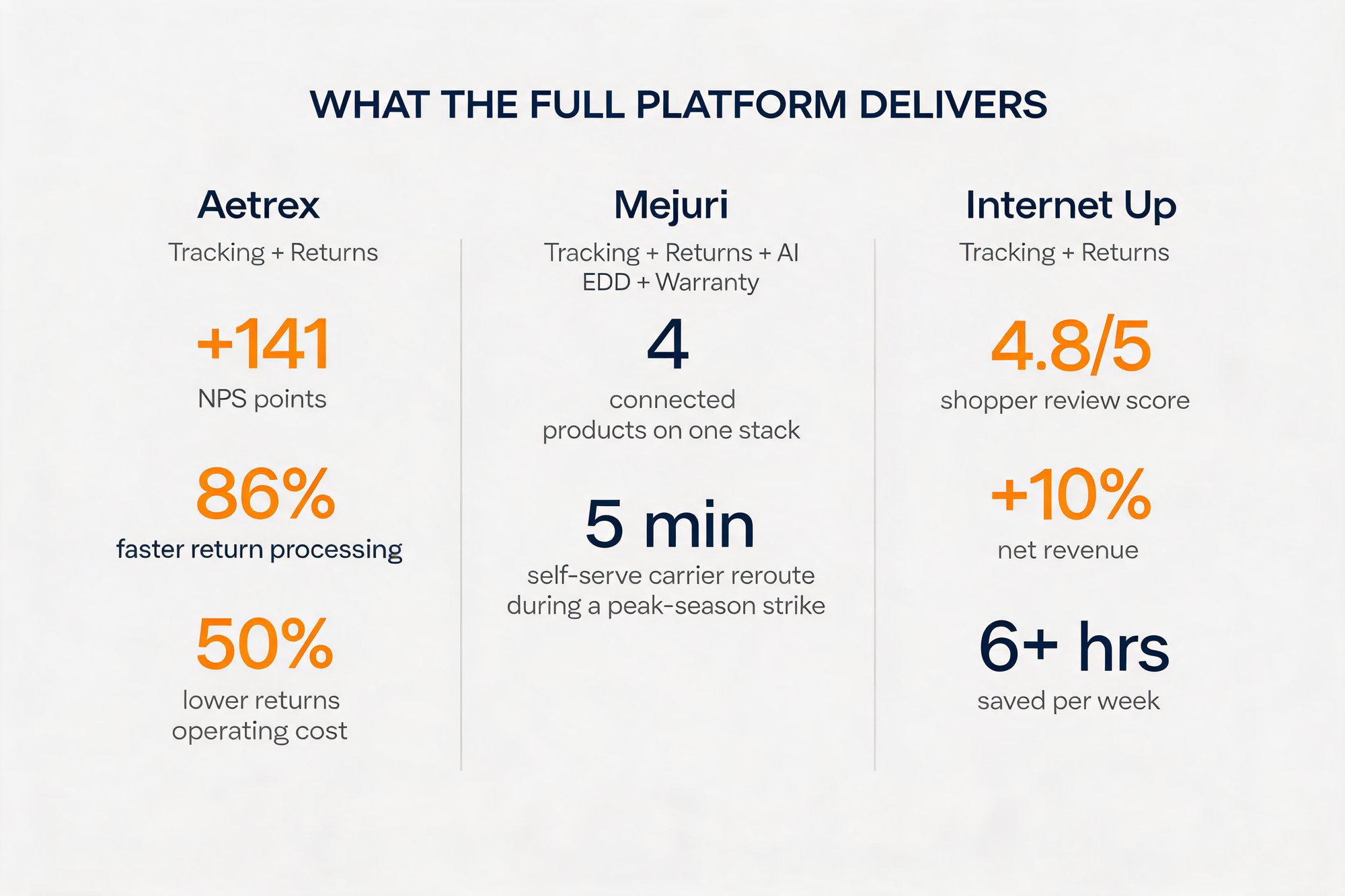
Start with Aetrex. Running AfterShip Tracking and Returns together, the footwear brand lifted its NPS by 141 points, cut return processing time by 86%, and reduced its returns operating cost by 50% across more than 120,000 annual packages. Those are not three separate wins from three separate tools. They come from tracking and returns sharing one data layer, one customer profile, and one set of automations.
Mejuri shows what that looks like under pressure. The jewelry brand runs Tracking, Returns, AI EDD, and Warranty as a single connected stack, and when a carrier strike hit during peak season, its team rerouted shipments through a self-serve flow in about five minutes rather than waiting on a carrier ticket. A point solution cannot do that, because it does not own enough of the journey to act on it.
Internet Up rounds out the pattern at scale. With Tracking and Returns connected, the brand earned a 4.8 out of 5 shopper review score, grew net revenue by 10%, and saved its team more than 6 hours a week while handling 170,000+ packages and 10,000+ returns a year, one of many AfterShip customer outcomes. The hours saved are the quiet line item: every workflow the platform automates is a workflow your team no longer runs by hand.
The reason this works is structural. On a unified platform for tracking, returns, and even shipping, those functions share data instead of fighting over it. A delivery exception can trigger a proactive message, a return can be pre-approved off a tracking scan, and a warranty claim can pull the original order without a CSV export. Point solutions force you to stitch those handoffs together yourself, usually with developer time and a brittle integration that needs re-testing every time a carrier changes its data format. That maintenance tax never shows up on the invoice, but your engineering team pays it every quarter.
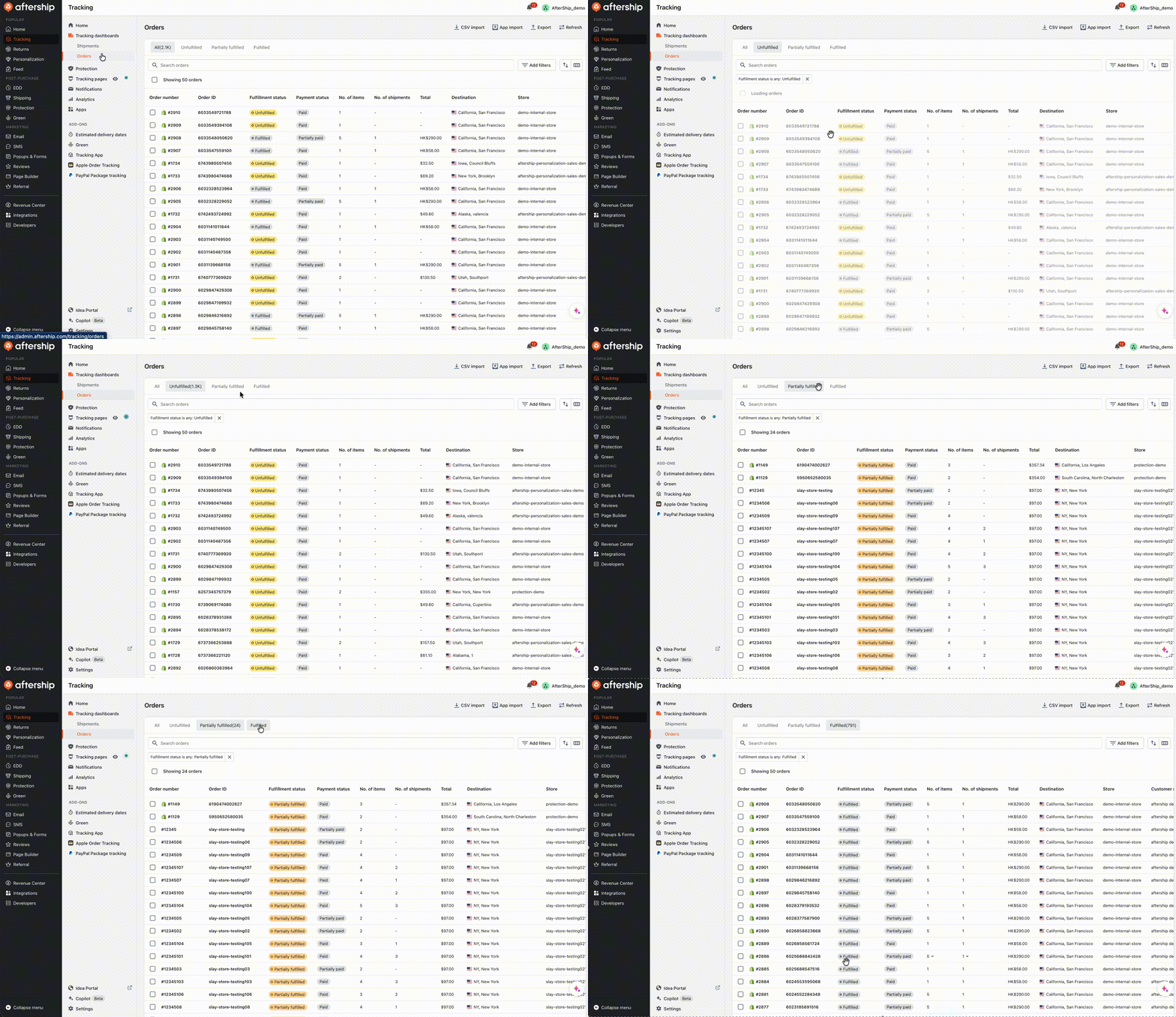
You can see that consolidation in the AfterShip admin itself, where order tracking across every carrier runs from a single dashboard - part of one AfterShip platform that adds Returns, Shipping, and Warranty as connected modules.
The takeaway is simple. A tracking-only tool can match AfterShip on the narrow job of showing a package's location, but it hits a wall the moment your operation needs returns, exchanges, warranty, or delivery estimates to work together. If your brand is scaling toward that complexity, the platform you can grow into is worth more than the point solution you will outgrow.
The 2026 Verdict for Scaling DTC Brands
For a North America DTC brand scaling from startup to serious volume, AfterShip is the lowest total-cost choice and the highest ceiling for a brand-defining customer experience. The evidence points one way once you score on total cost rather than sticker price.
The verdict splits cleanly by stage. Below roughly 200 orders a month, a budget tool or native Shopify notifications can hold you over. But in the 1,000 to 50,000 orders-per-month range, where WISMO volume, returns, and carrier complexity all compound at once, AfterShip's connected platform pays for itself in deflected tickets and reclaimed team hours. The alternatives stay viable at the edges: Redo Order Tracking (formerly Malomo) and Track by Loop (formerly Wonderment) for marketing-led brands still finding their feet, and Narvar for enterprise buyers who want a heavy professional-services engagement.
Switching is less disruptive than the renewal anxiety suggests. AfterShip publishes a Day-0 migration playbook, and most brands run a 4-to-6-week parallel install before cutting over, so your current tool keeps working until the new one is proven. If you are locked into a competitor's annual contract, start the parallel run 4 to 6 weeks ahead of your renewal date, backed by AfterShip's security and compliance posture for procurement review.
If your brand is in that scaling window and serious about post-purchase as a retention lever, AfterShip Tracking is the place to start the evaluation.
Proactive shipment tracking that delights your customers, reduces WISMO tickets, and optimizes your delivery performance.
Book a demoAfterShip Alternatives FAQ
Quick answers to the questions DTC teams ask most when weighing AfterShip alternatives.
Is AfterShip the best choice for a Shopify store?
For most scaling Shopify brands, yes. AfterShip is Built for Shopify certified, installs in one click, and connects Tracking, Returns, Shipping, and Warranty on a single stack. Smaller stores under 200 orders a month may not need that depth yet, but brands growing into real WISMO and returns volume get the lowest total cost here.
What is the best cheap AfterShip alternative?
If budget is the only constraint and you are under 200 orders a month, a low-cost Shopify starter like ParcelWILL (formerly ParcelPanel) or even native Shopify notifications can bridge the gap. They are temporary solutions, though. Once WISMO tickets and returns start eating real team hours, the cheaper tool quietly costs more than the platform it replaced.
Does AfterShip work well with WooCommerce?
Yes. AfterShip supports WooCommerce alongside 30+ other commerce platforms, so the tracking pages, notifications, and returns workflows that Shopify brands rely on are available to WooCommerce stores too. If you are weighing a replatform later, that cross-platform support means your post-purchase stack does not have to be rebuilt.