
Top AfterShip Alternatives for Shopify Tracking in 2026


Your Tracking App Choice in 2026: Point Solution vs. Growth Platform
You know you need a dedicated tracking app, but choosing one feels like a long-term commitment. Let's map the landscape so you can make the right choice for the brand you're building.
Here is the pain that brought you here. Somewhere between 50 and 1,000 orders a month, Shopify's native email notifications stop being enough, and your support desk starts filling with WISMO (where is my order) tickets. Vendors commonly cite WISMO at 30 to 50 percent of all support contacts. Yet Gorgias, one of the vendors quoting that range, puts the average closer to 18 percent in its own first-party data.
Even at 18 percent, WISMO is the single most frequent question your team answers, and every ticket is a customer who is anxious instead of delighted. The carrier's default tracking page is a dead end, for them and for you.
So you start comparing AfterShip alternatives for Shopify, and almost every guide hands you a feature checklist. That is the wrong lens. The question that matters is not which app has the cleanest tracking page this quarter, but whether the tool can still serve you at three times your current volume.
A point solution fixes WISMO and stops there. A post-purchase platform connects tracking to returns, shipping, and analytics on one account, so a new problem becomes a setting you switch on, not a vendor you re-evaluate. This is not about buying the most expensive tool: at 50 orders a month with no plans to grow, a simple tracker is a perfectly rational buy, and this guide says so out loud. The argument here is for ambitious brands, not every brand.
Picture eighteen months out: more orders, an international lane or two, and a returns process email threads can no longer hold. A tracking-only app cannot follow you there, so you pay twice, once to set it up and again to replace it. That is the whole decision, and the rest of this guide holds all four options to that single standard.
At a Glance: The Best AfterShip Alternatives for Shopify
If you only have time to skim, start here. The four names that survive most 2026 shortlists are AfterShip, ParcelWILL, Wonderment, and Route, each earning its place for a specific kind of Shopify brand.
| Tool | Best For | Pricing Model | Key Limitation |
|---|---|---|---|
| AfterShip | Brands with serious growth ambitions that want one post-purchase platform | Tiered SaaS; free entry, paid tiers scale by shipment volume; bundle discount across the suite | Entry-level paid plans cost more than the simplest trackers |
| ParcelWILL (formerly ParcelPanel) | Ultimate simplicity at a low order count | Freemium with low-cost paid tiers | Tracking is a separate app from CWILL's returns, reviews, and loyalty apps, not one unified platform |
| Wonderment | Klaviyo-centric marketing teams | Subscription priced by shipment volume (now Track by Loop) | Returns and shipping are separate products; carrier coverage limited to a few English-speaking markets |
| Route | Brands prioritizing package protection | Consumer-funded protection bundled with order tracking | Consumer-facing Route branding can dilute your own brand experience |
Read the "Best For" column closely; it carries the honest version of this comparison. ParcelWILL, Wonderment, and Route are strong answers to narrow questions; AfterShip is the answer when your question is bigger than tracking. The sections below break down each, saying plainly where a simpler, cheaper tool is the smarter buy.
For Ultimate Simplicity: ParcelWILL (formerly ParcelPanel)
If your needs are simple and your order count is low, the most lightweight option here is the rebranded ParcelPanel, now ParcelWILL by CWILL. It does one job, a slightly better tracking experience than Shopify's native emails, and does not pretend to be more.
Do not read "simple" as "unserious." ParcelWILL is Built for Shopify and holds a 4.9-star rating across more than 2,300 Shopify reviews, so it does the one job well.
What it covers well:
- A branded tracking page that beats the default carrier page.
- Wide carrier detection, with more than 1,400 carriers covered.
- A Klaviyo connection to push shipment notifications through your existing email flows.
The key limitation is structural. CWILL does sell returns, reviews, and loyalty, but as separate Shopify apps, not one unified platform with a shared account and dataset. Adding returns later means stitching together another app, and the tracking app has no shipping label engine and no unified analytics beneath it. The day you outgrow a stitched-together set of apps, you are evaluating a real platform anyway.
On branding, set expectations correctly: a custom tracking-page domain is a paid-tier feature almost everywhere, AfterShip included (Premium and above), so do not treat it as a free differentiator.
For a sub-100-orders-a-month store with no growth plans, ParcelWILL is a rational, low-effort pick. For anyone planning to scale, it is a starting point you will outgrow.
For Klaviyo-Centric Marketing Teams: Wonderment
Wonderment was built for marketers, not operations teams, and that focus is its advantage. If your post-purchase strategy lives inside Klaviyo, it plugs shipment events straight into the flows your marketing team already runs.
That is a genuine strength. Delivery milestones become triggers: a "shipped" event launches one flow, a "delayed" event another, with your existing Klaviyo segments handling targeting. For a team that measures everything in email and SMS revenue, it is a clean fit.
Where it gets thinner is operations. Wonderment supports far fewer carriers than AfterShip, with coverage limited to a few English-speaking markets: the US, Canada, the UK, and Australia. Ship into Europe, Latin America, or Asia and that ceiling shows up fast.
What Wonderment is good at:
- Deep Klaviyo integration for notification flows.
- A branded tracking page tuned for marketing teams.
- Shipment-status events piped into the tools you already use.
Where the platform stops short:
- Returns sit in a separate product (Loop Returns) with its own subscription, not one unified account with tracking.
- No native shipping or label engine.
- Carrier coverage limited to a few English-speaking markets.
There is a corporate footnote worth knowing. Wonderment was acquired by Loop and now appears on the Shopify App Store as Track by Loop, where it holds a 4.5-star rating across 74 reviews. Loop's flagship is Loop Returns, so returns exist in the family, but as a separate product with its own subscription, reinforcing the split above. For more, we keep a deeper dive on Wonderment, and because marketing-focused trackers cluster together, it helps to see the category compared directly to Malomo.
Wonderment is the right call when marketing owns the post-purchase experience. It is the wrong call when operations need carrier depth and returns under one roof.
For Package Protection as a Priority: Route
Route takes a different angle. Alongside tracking, it adds a consumer-facing package protection offer at checkout, turning shipping issues into a small revenue line instead of a support cost.
The economics: Route's protection is consumer-funded at about 2.5 percent of cart value with a small minimum, so shoppers pay for coverage while Route handles claims, underwritten by SEG Insurance. For brands with fragile or high-value goods and frequent damage or porch-theft claims, that model has real appeal.
Two caveats matter for the brand sizes here. On the Shopify App Store, Route holds a 3.3-star rating across 337 reviews, the lowest of the four. And according to a 2026 third-party review, Route has reportedly introduced a minimum order volume, declining stores that ship fewer than 1,000 orders a month, which would likely put it out of reach for the smaller end of this audience.
What Route brings:
- Package protection that customers fund at checkout.
- Order tracking across more than 600 carriers.
- A claims process that offloads lost-and-damaged headaches.
The trade-off is brand experience. Route is a consumer brand with its own app and identity, so its branding can sit in front of your customer at the exact moment you want them thinking about you. Its operational controls are also shallower than a dedicated tracking platform's.
One scoping note for fairness: AfterShip offers its own Protection product, so this is not protection versus none. Read Route as a tracking option with a protection hook, judged on tracking depth and brand control.
Route earns its slot for brands that want package protection as a headline feature. If owning the post-purchase brand experience matters more, the consumer-facing model works against you.
Why Ambitious Shopify Brands Choose AfterShip Tracking
This is about what happens after tracking stops being your only problem. Cross roughly 1,000 orders a month and the cracks move: returns pile into a spreadsheet, an international lane needs its own carrier logic, and you start asking questions a tracking page cannot answer. That is when a point solution becomes a ceiling. AfterShip provides tracking, returns, and shipping in one platform, so the next problem is a module you switch on, not a vendor you re-evaluate.
That single-account design is the difference. AfterShip Returns runs on the same delivery data as your tracking notifications, in one account, so adding returns is enabling a feature, not starting a fresh software search. The suite extends the same way across Shipping, AI estimated delivery dates, Email and SMS, Warranty, and Protection, with a 25 percent first-year discount on two or more products.
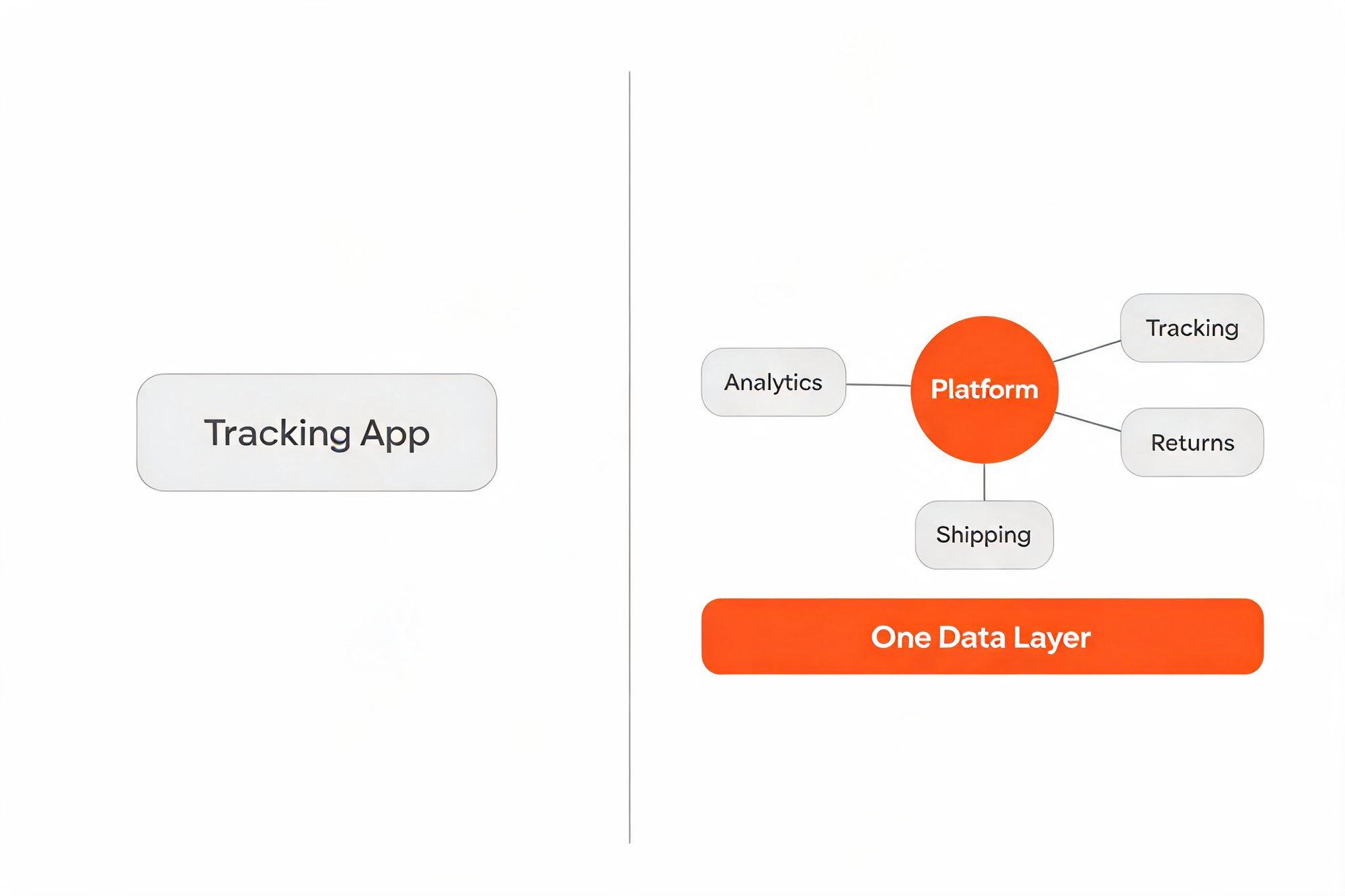
This is not a small-vendor story. AfterShip's platform is built for growing Shopify brands, and more than 20,000 paying businesses run on it, including Samsung, Gymshark, and Mejuri. The results show where it counts: StackCommerce cut WISMO tickets 71 percent year over year while reaching 99 percent shipment visibility and a 90 percent on-time rate; MyDeal saw a 25 percent drop in WISMO and a 25 percent cut in transit time.
“AfterShip's shipment tracking is pretty amazing stuff. And I think the 71% drop in WISMO tickets is due to us providing that tracking visibility to our customers.”
Deryck Lim, Sr. Operations Manager
Read their story →The brands you recognize did not pick a tracker. They picked a platform they would not outgrow.
Beyond Tracking: A Unified Post-Purchase Experience
A great post-purchase experience is not just accurate data. It is how that data looks to your customer.
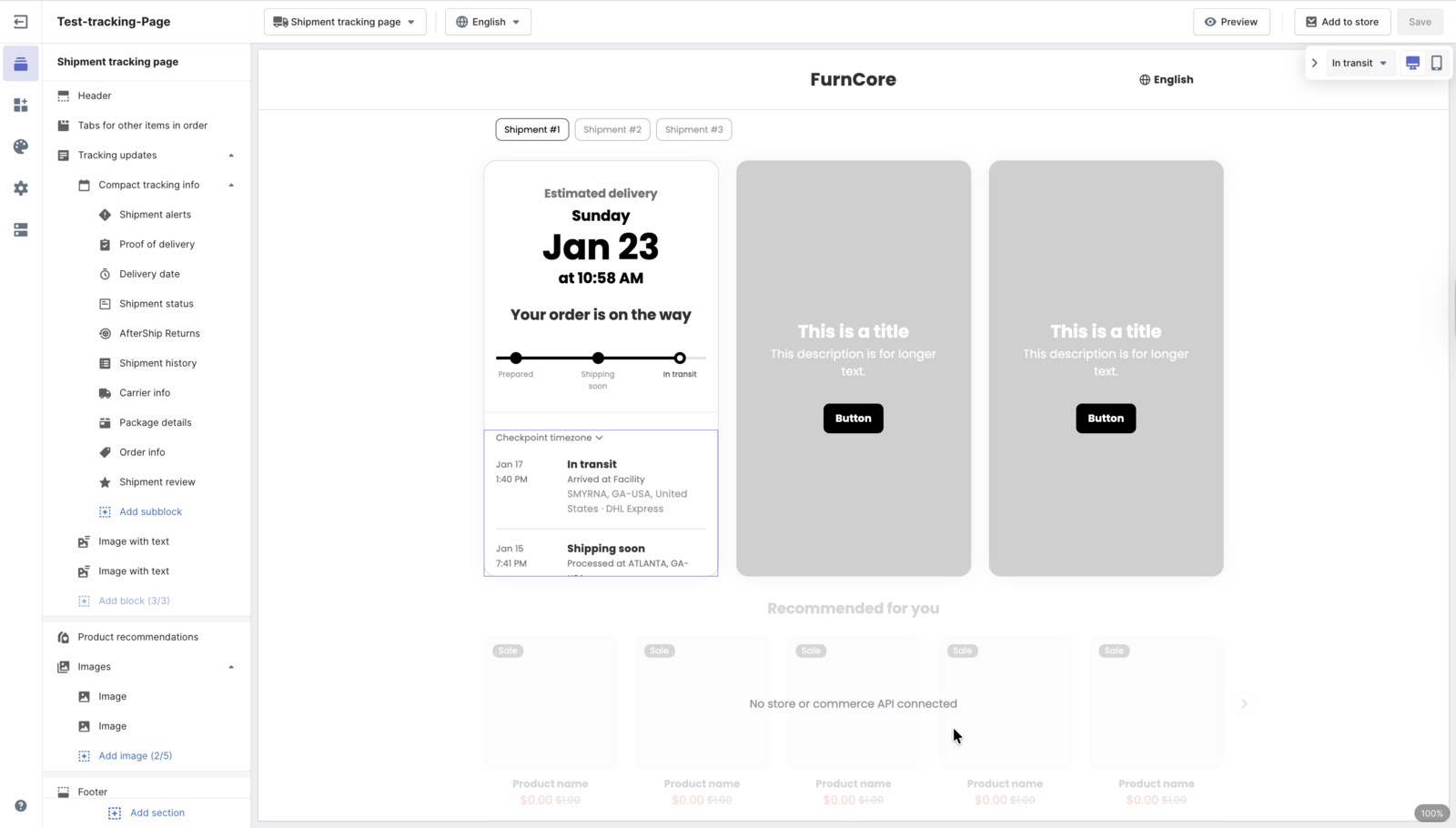
AfterShip's branded tracking page is fully customizable, with pre-designed templates plus your logo, colors, and product recommendations, and a direct handoff into the AfterShip Returns portal. Because the app is fully integrated with Shopify, the page pulls live order data without custom development. And since the tracking page is one of the most-visited screens in the post-purchase window, those product recommendations are a real revenue surface, not decoration.
Notifications are where 2026 separates the platforms from the point tools. AfterShip pushes shipment updates across Email, SMS, WhatsApp, Facebook Messenger, and Apple Wallet. Compare that with the alternatives: ParcelWILL covers Email and SMS, Wonderment routes its updates through Klaviyo, and Route relies on its own consumer app.
Many large retailers still lean on email-only updates, the exact gap a multi-channel platform closes. Meet customers where they already are, and fewer ever open a WISMO ticket.
Reliability and Scalability You Won't Outgrow
Scale punishes thin infrastructure; the two numbers that matter are carrier coverage and uptime.
AfterShip integrates with more than 1,300 carriers globally.
That network keeps growing, and it is backed by a public 99.9 percent monthly uptime SLA, with AfterShip refunding 10 percent of the affected period if it misses, the kind of commitment you rarely get from a point-solution tracker. As you grow into new lanes, you can also add multi-carrier shipping logic on the same platform rather than bolting on yet another vendor.
Now the honest part. AfterShip's Shopify install footprint has softened, to around 15,600 installs, down about 10 percent year over year, and it is not alone: counts have eased across several established post-purchase apps. Read that against the rest of the picture: more than 1,200 Tracking reviews and more than 1,260 Returns reviews, both Built for Shopify, and a 20,000-plus customer base across the suite. You pay more than the simplest tools today to stand on infrastructure that still fits at 50,000 orders a month, where an outage or a missing carrier is not an inconvenience but lost sales and a wave of tickets, the point at which an uptime SLA and deep carrier coverage become the reason you chose the platform.
From Data to Dollars: Turning Insights into Growth
Tracking data is only worth what you do with it. AfterShip Intelligence and AI-powered estimated delivery dates turn shipment signals into decisions you can sell against.
AfterShip's AI EDD predicts delivery dates with up to 95 percent accuracy, trained on 4.4 billion shipments, with full coverage across 101 major carriers and partial coverage on another 150-plus. In practice it covers at least 80 percent of a typical merchant's deliveries, versus the under-40 percent most carrier estimates manage.
That is a different class of capability from the rules-based or historical estimates typical of point-solution trackers. An accurate delivery date on the product page lifts conversion; an accurate one after checkout heads off the anxious WISMO ticket before it starts. Data becomes dollars on both ends of the sale.
The Verdict: Which Shopify Tracking App Is Right for You in 2026?
Here is the call, stated plainly.
- ParcelWILL if you want ultimate simplicity at a low order count and nothing more.
- Wonderment if your marketing team lives in Klaviyo and owns the post-purchase experience.
- Route if consumer-funded package protection is the headline feature you need.
- AfterShip if you plan to be a significantly larger brand in two years than you are today.
The honest nuance: two of these alternatives can handle returns too, but as a separate product you bolt on. ParcelWILL through a separate CWILL app, Wonderment through Loop's separate returns product. Route centers on package protection and tracking. AfterShip runs tracking and returns from one account and one dataset. That is the point-solution-versus-platform argument in a sentence, and why starting on AfterShip spares you the migration you would otherwise face when you scale.
Proactive shipment tracking that delights your customers, reduces WISMO tickets, and improves your delivery performance.
Book a demoFrequently Asked Questions
A few specifics that come up most often when Shopify brands weigh AfterShip alternatives for Shopify.
How much does AfterShip cost for a small store?
AfterShip Tracking uses shipment-volume pricing. On the Shopify App Store there is a permanent Free plan (50 shipments a month), then Essentials at $11/month (100 shipments), Pro at $119/month (2,000 shipments), and Premium at $239/month (2,000 shipments, adding AI recommendations, advanced analytics, and a custom domain). Annual billing takes roughly 17 to 18 percent off. A store doing a few hundred to about 2,000 orders a month is usually on Pro. Pricing changes often, so confirm current pricing on aftership.com/pricing/tracking before committing.
Can I automate shipping notifications with AfterShip?
Yes. AfterShip sends shipment notifications automatically across Email, SMS, WhatsApp, Facebook Messenger, and Apple Wallet, triggered by carrier shipment events, so customers get proactive updates without your team lifting a finger.
Does AfterShip support a custom domain on my plan?
Yes, on the higher tiers. The branded tracking page can run on your own custom domain on Premium ($239/month) and Enterprise; the Free, Essentials, and Pro plans offer logo and color customization on an AfterShip-hosted URL.